Hey traders, Ezekiel here! Let’s jump straight in with a quick market update—what’s unfolding right now, why it matters, and how to handle it with a pro trader’s perspective.
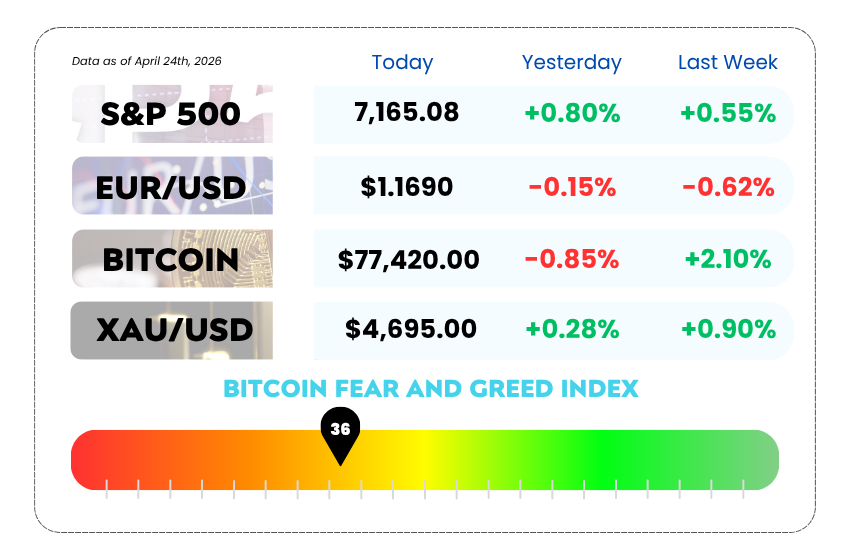
- Today's market mayhem. S&P 500, EUR/USD, Bitcoin, and XAU/USD today
- Microsoft dropped 4% because one company's earnings spooked the entire software sector
- EUR/USD is stuck under 1.1700 while the dollar feeds on fear and better data
- Your entries keep fighting the trend because you're skipping one critical step, we fix that in our video
WEEKLY MARKET MAYHEM🔥
For this week's market mayhem, here’s what we got for you today:

Microsoft Dropped 4%, But This Was Really About the Entire Software Sector Having a Panic Attack 💻
Microsoft closed lower on Thursday, falling about 4% to $415.75, with an intraday low of $411.51. That kind of selling pressure is not subtle. But here's the thing, this was not some Microsoft-specific disaster. The real culprit was a broader software-sector wobble after ServiceNow's earnings reaction spooked investors across the board.
And the funny part? ServiceNow's numbers were not even that bad.
ServiceNow actually raised its annual subscription revenue outlook, reporting $3.77 billion in revenue and roughly $0.97 in adjusted EPS, both roughly in line to slightly above expectations. But investors zeroed in on one thing: margin pressure. The company guided to a full-year non-GAAP subscription gross margin of 81.5%, weaker than what the market wanted, and flagged that its recent Armis acquisition would create headwinds for subscription gross margin, operating margin, and free cash flow margin in 2026.
That was enough to send ServiceNow cratering nearly 16%, making it the worst performer in the S&P 500 that day 💀
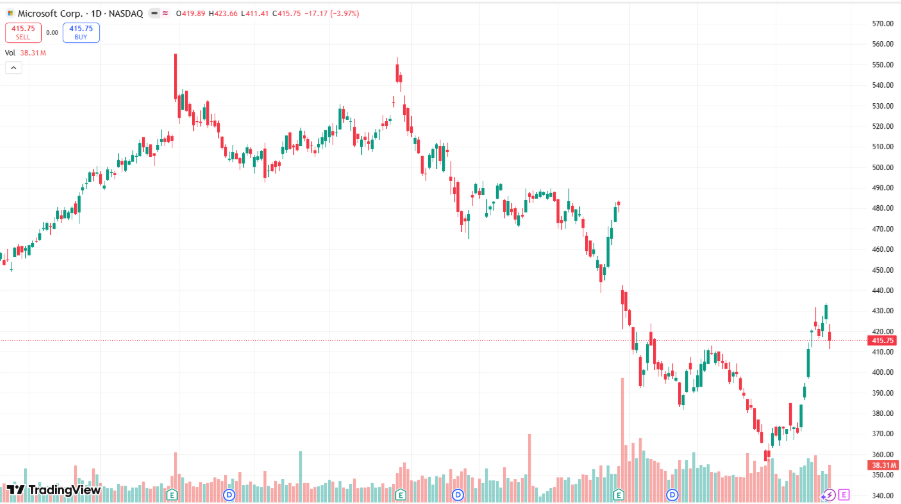
MSFT/USD Daily Chart as of April 24, 2026 (Source: TradingView)
And then the contagion spread. Salesforce, Workday, Adobe, and Intuit all got dragged into the mess. Microsoft got caught in the same risk-off rotation because, even though it's much broader than a typical SaaS name, it still sits in the same neighborhood when investors start rethinking software multiples, AI monetization, and pricing power.
Here's what's really going on beneath the surface 🧠
The software space has been carrying a LOT of hope. Investors want AI to create new revenue streams without wrecking margins. They want growth to stay healthy without signs of pricing pressure. They want software companies to look both innovative and efficient at the same time. That is a lot to ask.
So when ServiceNow delivered a quarter that was basically solid but not thrilling, the market punished it like it had shown up late to a final exam with the right notes but the wrong attitude. The impact of the Iran conflict on large Middle East deals added another layer of caution on top.
Microsoft also came into this session with its own baggage 🎒 The company is reportedly rolling out its first voluntary employee buyout program as it deals with concerns around cloud growth, big AI spending, and modest uptake for some newer AI offerings like 365 Copilot. The stock had already fallen nearly 24% between January and March, its worst quarterly performance since 2008.
So while ServiceNow was the day's trigger, Microsoft entered with investors already feeling more sensitive than usual. When sentiment is fragile, it doesn't take much to turn mild concern into a broad selloff.
🤔 Asia Forex Mentor Insights
This was a classic sympathy selloff. Microsoft got hit because investors used ServiceNow's results as a signal for the broader software group. The tricky part is that ServiceNow's quarter was not actually bad in the traditional sense. Revenue and earnings were okay, but investors zeroed in on margin pressure and deal friction, which fed the current market fear that AI may not be a clean win for every software name right away.
For traders, if software names keep selling off on “good but not great” results, that usually means expectations are still too high and sentiment is still fragile. Watch how the group reacts to the next few earnings reports, because the pattern will tell you whether this is a one-day flush or the start of a bigger re-rating.
EUR/USD Is Stuck Under 1.1700, And The Dollar Is Getting All The Help It Needs 😬
EUR/USD is hovering around 1.1690, and the bigger issue is that the pair still cannot reclaim 1.1700 in a convincing way. This is happening as the dollar keeps drawing support from safe-haven demand tied to the US-Iran conflict, while softer eurozone data is making the euro's side of the trade look heavier by the day.
The dollar has been climbing as doubts grew over the ceasefire and over how long disruptions around the Strait of Hormuz could last. When you combine that with the U.S. military intercepting Iranian-flagged oil tankers in Asian waters and Iran tightening its grip around Hormuz, the market's anxiety is basically writing the dollar a blank check 💰
That matters for EUR/USD because the euro tends to struggle when markets turn defensive, especially when Europe is more vulnerable to energy shocks. The market is not just buying dollars because the U.S. looks strong. It's buying dollars because everything else feels uncomfortable.

The dollar also had help from U.S. economic data that looked solid enough to reinforce the move. The U.S. Composite PMI rose to 52.0 in April from 50.3 in March, with manufacturing at 54.0 and services also improving. Weekly initial jobless claims came in around 215,000, still pointing to a labor market holding up fairly well.
So the dollar had two things working in its favor at once: safe-haven demand AND decent domestic data. That is not a fun combo for EUR/USD bulls trying to force a recovery.
On the euro side, the data was ugly 🇪🇺📉
The eurozone flash composite PMI fell to 48.6 in April from 50.7 in March, dropping below the 50 line that separates expansion from contraction. Services was the main weak spot, with higher costs linked to geopolitical instability and energy pressure hammering demand.
Germany looked even worse. Germany's flash composite PMI dropped to 48.3 from 51.9, marking the first contraction in nearly a year, with services taking the hardest hit.
That makes the euro's problem crystal clear. It's not only fighting a firmer dollar, it's also carrying fresh evidence that the region's growth pulse is fading again. And here's where it gets really uncomfortable for Europe: the Iran war and related disruption fears have pushed up costs sharply, and Germany's recession risk has jumped as the energy shock lifts uncertainty and weakens sentiment 🛢️
Basically, the euro needs clean economic support, while the dollar only needs market anxiety. That is not a fair fight, but forex rarely is.
🤔 Asia Forex Mentor Insights
This is one of those moves where macro tone is overpowering chart noise. EUR/USD is not just reacting to one data print. It's being pulled lower by a combination of safe-haven dollar demand, stronger U.S. PMI data, and weak eurozone growth signals, all while energy-related fears keep hanging over Europe.
That makes rallies harder to trust unless the underlying mood shifts. For traders, the key is to watch whether the pair can reclaim 1.1700 and hold it with improving risk sentiment. If not, the pressure stays tilted against the euro. Right now, this looks less like a clean bounce setup and more like a market still leaning toward dollar strength.
MEMES OF THE DAY
Stop Loss hit… then to the moon

Volatility is a different breed of monster