Learn To Trade Forex • Best Forex Trading Course • AsiaForexMentor

The 10 Best Forex Brokers in 2026

Written by

Ezekiel Chew

Updated on

January 2, 2026

i

The 10 Best Forex Brokers in 2026

Overall Trust Index

Written by:

Last updated on:

January 2, 2026

The best forex brokers share three things: tight spreads, fast execution, and regulation that actually protects you when something goes wrong. Most traders do not check all three before opening an account. That mistake costs more than any bad trade ever will.

ABOUT THIS GUIDE

We evaluated 30+ forex brokers against six criteria: regulation, spreads, platform quality, account accessibility, execution speed, and support quality. This guide ranks the 10 best forex brokers available to global traders as of July 2026, with clear notes on regulation and leverage for each entity.


QUICK ANSWER

The 10 best forex brokers in 2026 are Pepperstone, IC Markets, AvaTrade, XM, FP Markets, OANDA, Interactive Brokers, XTB, Plus500, and Saxo Bank. Pepperstone earns the top spot for most global traders. For US-based traders, OANDA is the right call, it is CFTC-registered and an NFA member, the mandatory baseline for any broker legally serving US retail clients.

How to Choose the Best Forex Broker

The broker is your infrastructure. Get this wrong, and you pay a hidden tax on every single trade you take, before the market even moves against you.

Four factors separate a genuinely good broker from an expensive one.

Regulation Comes First

A regulated broker holds client funds in segregated accounts and submits to regular audits by an independent authority. The most trusted regulators globally are:

  • ASIC (Australian Securities and Investments Commission)
  • FCA (UK Financial Conduct Authority)
  • CySEC (Cyprus Securities and Exchange Commission)
  • CFTC and NFA (United States — mandatory for US retail traders)
  • MAS (Monetary Authority of Singapore)


Every broker on this list holds at least one Tier-1 license. Some also operate separate offshore entities that offer higher leverage. When that applies, I flag it clearly so you know exactly which entity you are opening an account with.

Spreads and Total Cost Per Trade

Your broker earns on every position you open. A “0.0 pip spread” account still charges a commission, typically $3 to $7 per lot per side. Total all-in cost matters far more than the headline spread number alone.

For a standard 1-lot EUR/USD round trip, here is what the cost difference looks like in practice:

  • Low-cost broker (0.0 pips raw + $3.50 commission): $7 total
  • Average broker (1.2 pip spread, no commission): $12 total
  • High-cost broker (1.8 pip spread): $18 total


At 200 trades per month, the gap between a low-cost and a high-cost broker can exceed $2,200. That is real money before any market risk is considered.

Platform and Execution Quality

MetaTrader 4 and MetaTrader 5 are the industry standards for a reason. MT4 is simpler and widely supported. MT5 adds more order types, more timeframes, and stronger backtesting capabilities. cTrader is the preferred alternative for many algorithmic traders. TradingView integration is increasingly offered by leading brokers as a third option.

Execution speed matters most for scalpers and day traders. A 50ms average execution time is acceptable for swing traders and irrelevant for position traders. For scalpers, anything above 100ms is a measurable liability.

Account Types and Accessibility

Most reputable brokers offer at least two account tiers:

  • Standard account: Wider spreads, no per-trade commission. Suits beginners and low-frequency traders.
  • Raw or ECN account: Near-zero spreads plus a fixed commission per lot. Suits active and high-volume traders.


If you cannot hold positions with overnight interest charges due to religious requirements, confirm that Islamic swap-free accounts are available in your region. Most brokers on this list offer them.

10 Best Forex Brokers Compared at a Glance
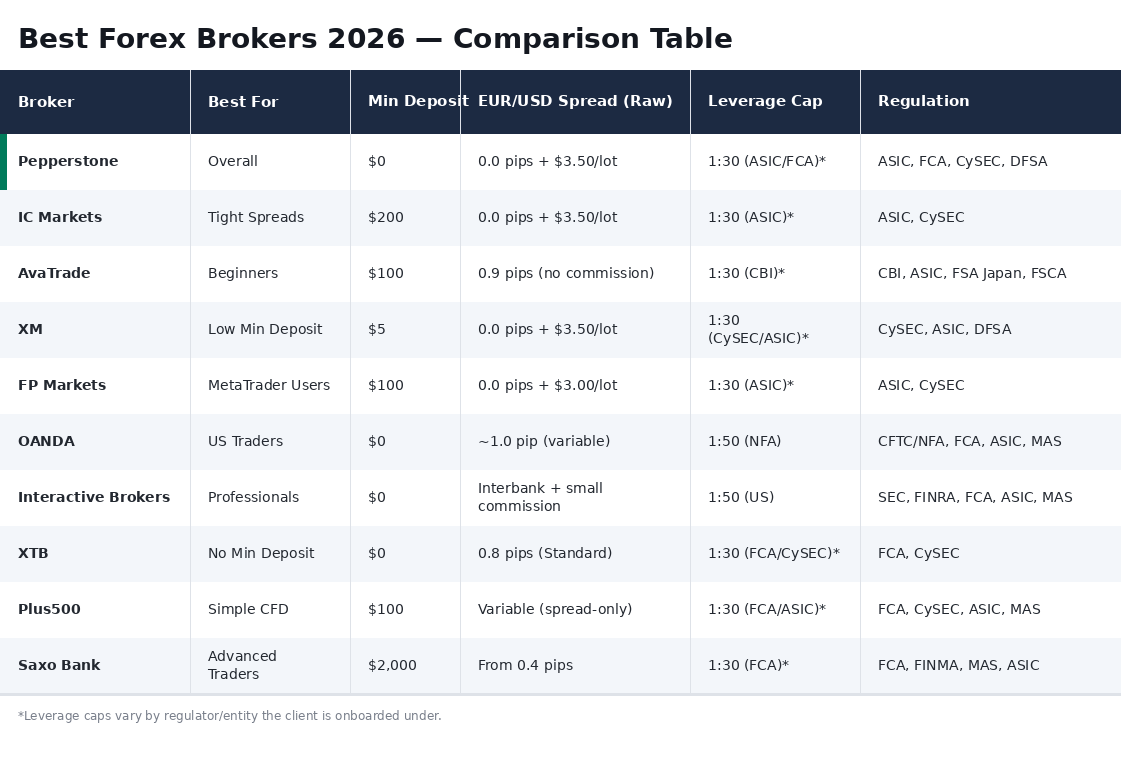
Leverage caps shown apply to retail accounts under Tier-1 regulated entities. Some brokers offer higher leverage through separate offshore entities, those carry different, less stringent regulatory protections. Always confirm which entity you are registering with.*

If you want to understand how to read the market before you settle on which broker to use, the Asia Forex Mentor free webinar lays out the complete trading framework. The broker is the vehicle. The system you trade with is what actually drives results.

#1. Pepperstone (Best Overall Forex Broker)
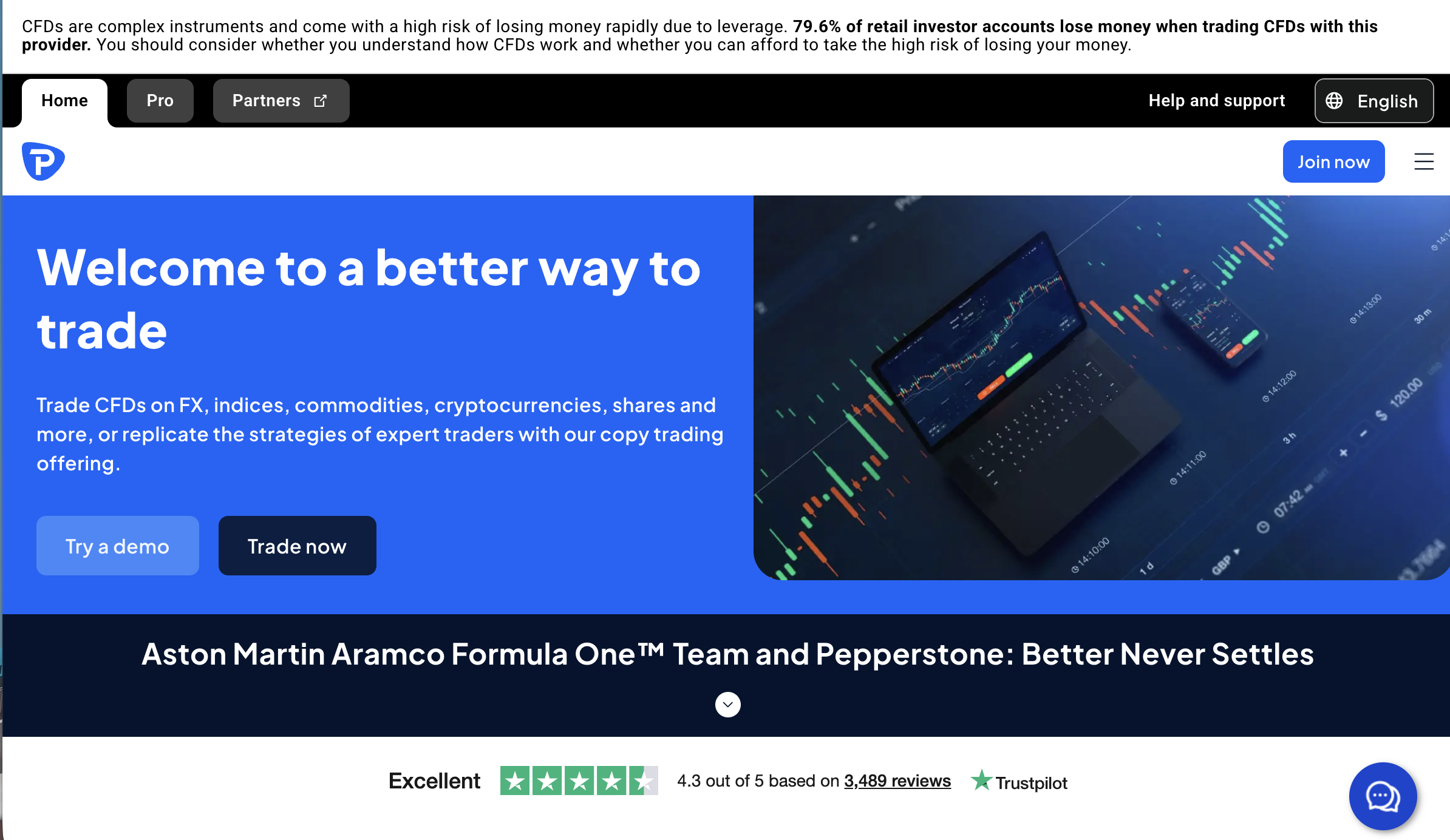
Pepperstone was founded in Melbourne in 2010 and holds active licenses from ASIC, the FCA, CySEC, the DFSA in Dubai, and the Capital Markets Authority of Kenya. That regulatory footprint spans Asia-Pacific, Europe, the Middle East, and Africa. For global traders, this is meaningful multi-jurisdictional protection.

Why Pepperstone stands out

  • No minimum deposit requirement on any account type
  • Razor account: EUR/USD spreads from 0.0 pips with a $3.50 per lot commission
  • Standard account: from 1.0 pip with no per-trade commission
  • Four platforms: MT4, MT5, cTrader, and TradingView
  • Average execution speed under 30ms on most servers
  • Smart Trader Tools suite included at no cost: one-click trading, market sentiment indicators, and currency correlation matrices


The platform coverage is particularly strong. Whether you run automated expert advisors on MT4, prefer cTrader for its depth of market data, or use TradingView for charting — Pepperstone supports all three under one account.

Who Pepperstone suits: Active traders, scalpers, and algorithmic traders who need institutional-grade execution with broad regulatory protection. It is the clearest default choice for most global retail traders who want low spreads without sacrificing regulation.

Best to Know: Customer support operates 24 hours, five days per week, not seven. Weekend traders cannot reach live support on Saturday or Sunday. Factor this in if you regularly trade economic events that break over weekends.

#2 IC Markets (Best for Tight Spreads)
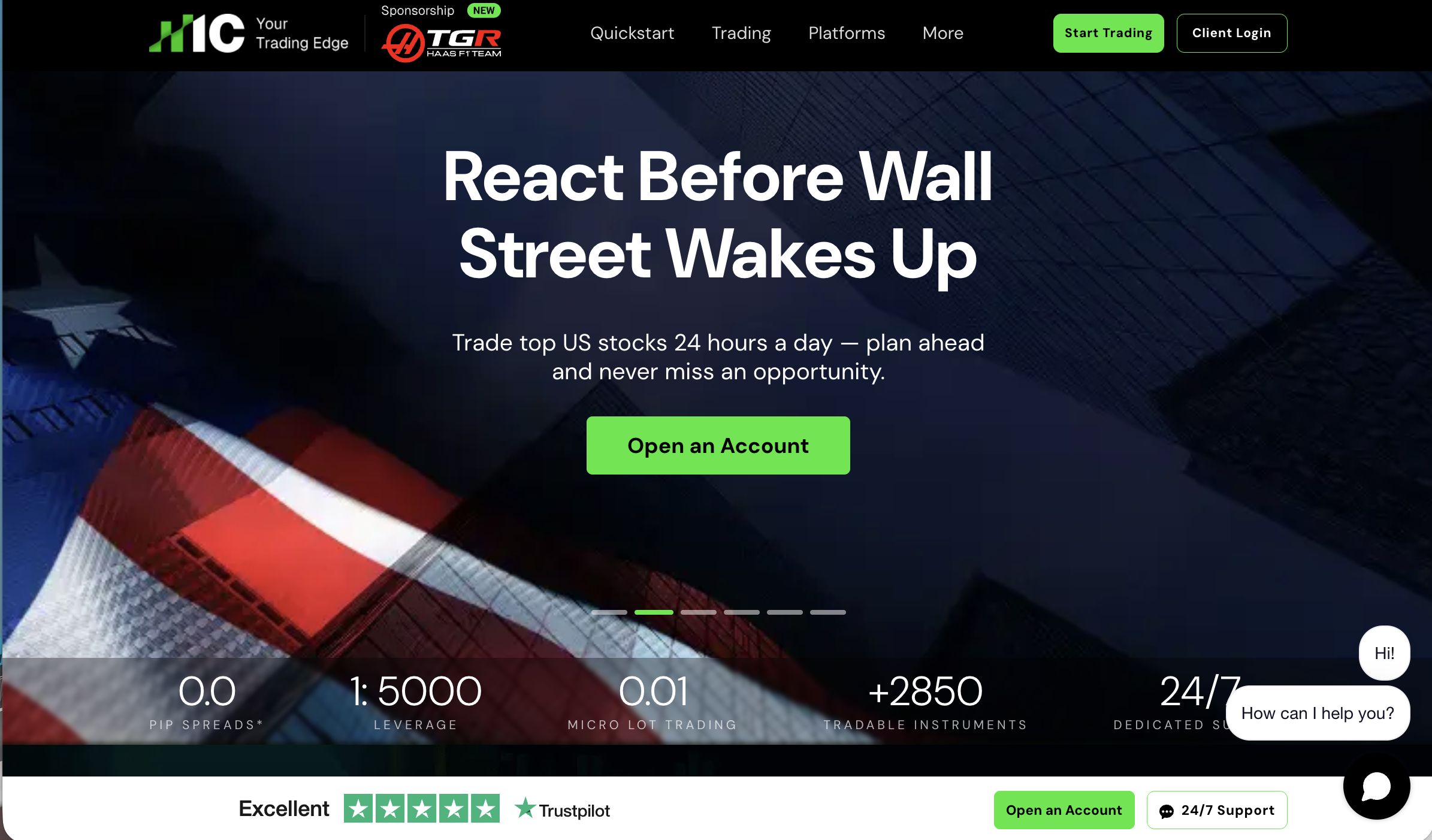
IC Markets is based in Sydney and regulated by ASIC and CySEC. It serves over 180,000 active clients globally and has earned its reputation specifically on raw spread pricing and fast execution infrastructure.

Why IC Markets stands out

  • Raw account EUR/USD spreads averaging 0.0 to 0.1 pips with $3.50 per lot commission
  • MT4, MT5, and cTrader all supported
  • Server infrastructure co-located in Equinix NY4 and LD4 data centers (same as major liquidity providers)
  • $200 minimum deposit
  • No restrictions on scalping, hedging, or algorithmic trading strategies


The Equinix co-location matters for active traders. Routing orders through data centers in the same physical locations as liquidity providers keeps latency low for strategies where execution timing is a direct input to profitability. This is infrastructure that most retail brokers cannot match.

Who IC Markets suits: High-frequency traders, scalpers, and algorithmic system traders where execution quality directly affects whether a strategy works or breaks even.

Best to Know: Educational content is minimal. IC Markets is where you trade a proven strategy, not where you develop one. Build and test your system first, then bring it to IC Markets when it is ready for live deployment.

#3 AvaTrade (Best for Beginners)
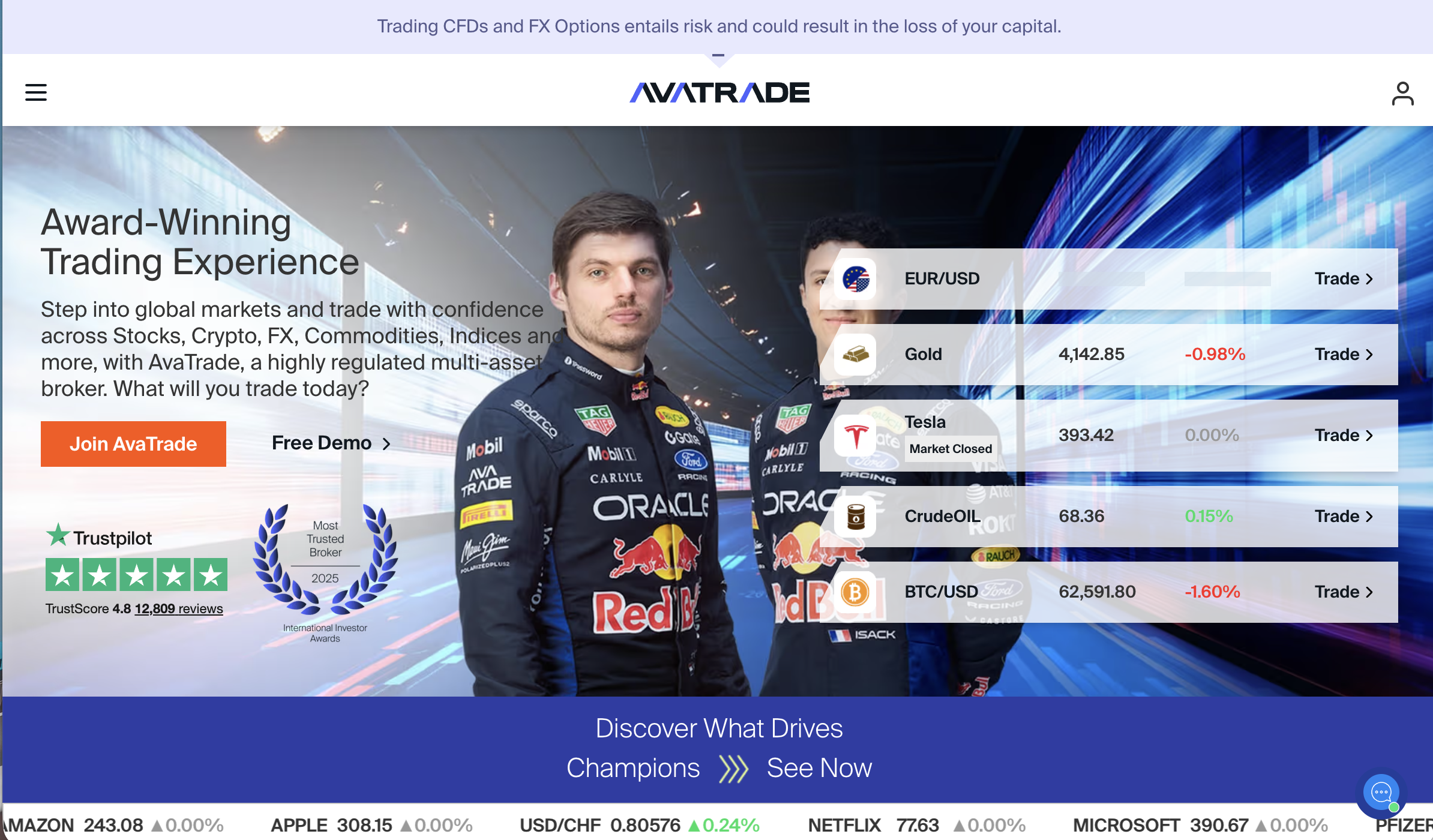
AvaTrade was founded in Dublin in 2006 and holds regulatory licenses across five continents, including the Central Bank of Ireland, ASIC, the FSA in Japan, and the FSCA in South Africa. Few retail brokers carry that level of multi-regional regulatory coverage.

Why AvaTrade stands out

  • $100 minimum deposit
  • EUR/USD spreads from 0.9 pips with no per-trade commission on standard accounts
  • Six platform options: MT4, MT5, WebTrader, AvaOptions, AvaTradeGo, and DupliTrade
  • Comprehensive free educational library covering trading basics through technical analysis
  • Islamic swap-free accounts available in eligible regions


AvaOptions is worth specific attention. It is one of the very few retail platforms that lets you trade forex options alongside standard spot forex. For traders who want to hedge positions or structure defined-risk trades, this is a genuine differentiator that most competing brokers simply do not offer.

Who AvaTrade suits: Beginners who want structured education and platform guidance, and intermediate traders who want multi-asset access (forex, equities, commodities, crypto, and options) under a single well-regulated account.

Best to Know: Standard account spreads run wider than ECN brokers. For active traders placing 100 or more trades per month, the cost difference relative to a raw spread broker like Pepperstone or IC Markets compounds meaningfully over time. AvaTrade rewards simplicity and convenience rather than the lowest possible transaction cost.

#4 XM (Best for Low Minimum Deposit)
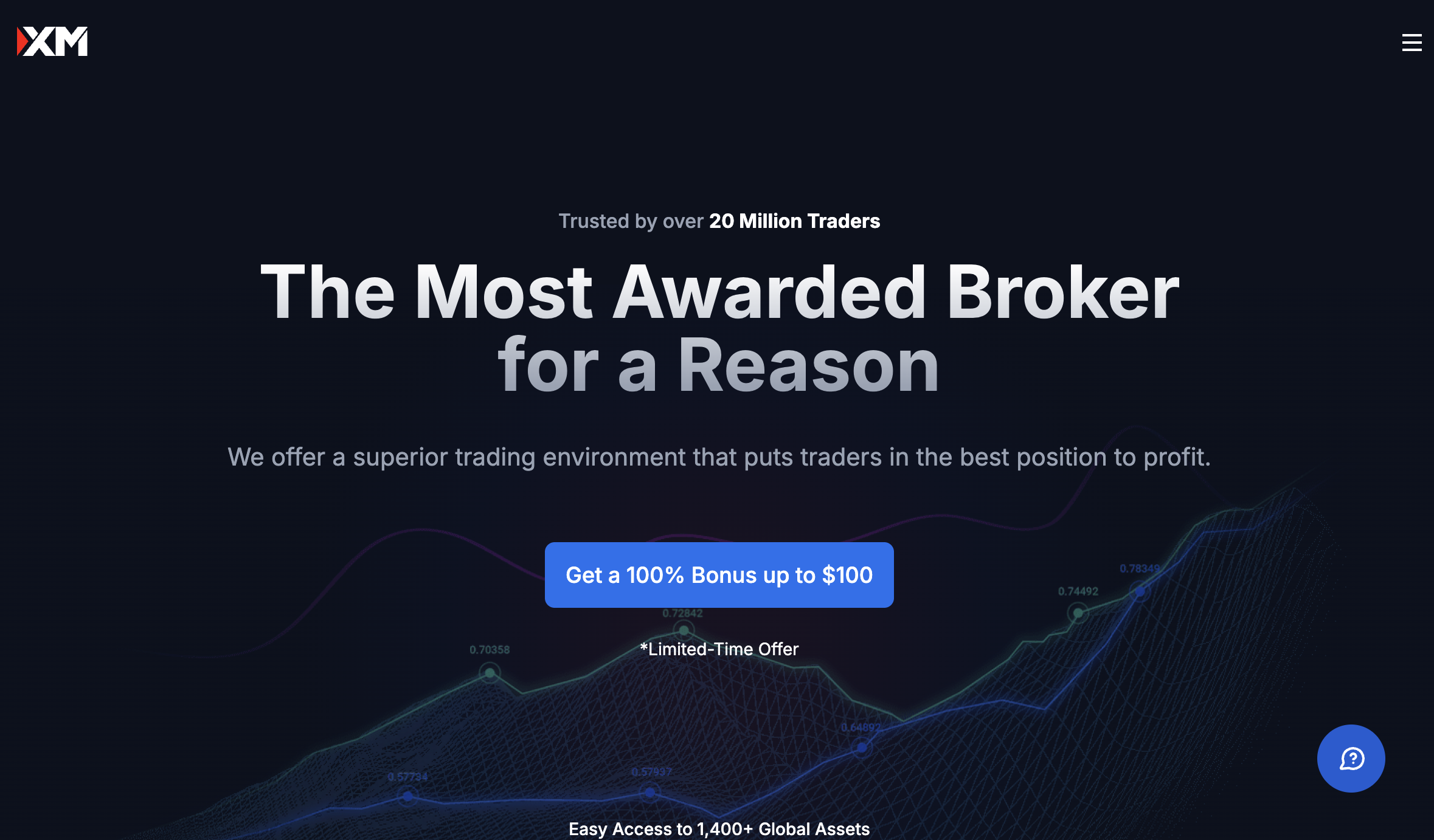
XM serves traders across 196 countries and holds licenses from CySEC, ASIC, and the DFSA. With a $5 minimum deposit on Micro and Standard accounts, it offers one of the lowest barriers to entry among regulated global brokers.

Why XM stands out

  • $5 minimum deposit on entry-level accounts
  • Zero account: spreads from 0.0 pips with a $6 per lot commission
  • Micro lot trading (0.01 lot) available across all account types
  • 1,400 plus instruments covering forex, indices, commodities, equities, and crypto
  • MT4 and MT5 both fully supported


Micro lot trading is a real structural benefit for new traders. Trading 0.01 lots on a small live account gives genuine market exposure with proportionally small risk. It is a better development path than staying on demo indefinitely, and a better risk management tool than jumping straight to standard lot sizes.

Who XM suits: New traders in emerging markets who need low barriers to entry, and intermediate traders who want wide asset class coverage under a single regulated account.

Best to Know: Standard account spreads from 1.0 pip are average, not best-in-class. Serious traders with larger accounts should compare XM's Zero account total cost against IC Markets and Pepperstone before committing long-term.

#5 FP Markets (Best MetaTrader Broker)

FP Markets is an Australian broker regulated by ASIC and CySEC. It consistently ranks among the best choices for MetaTrader users who want competitive raw spreads and professional platform options beyond the MT standard.

Why FP Markets stands out:

  • Raw account: EUR/USD from 0.0 pips with a $3.00 per lot commission (slightly cheaper than most competitors)
  • $100 minimum deposit
  • MT4, MT5, cTrader, and Iress all supported under one account
  • DMA (Direct Market Access) pricing available on Iress accounts
  • ASIC regulation with client funds held in segregated accounts


The Iress platform is the standout differentiator. It is a professional trading environment more commonly used by institutional desks than retail brokers. Access to DMA equity markets alongside forex under one account is rare at the retail level and valuable for traders who trade across multiple asset classes on a single platform.

Who FP Markets suits: Serious traders in Asia-Pacific who want ASIC regulatory protection, competitive spreads, and professional-grade platform options including DMA access.

Best to Know: Iress accounts carry a platform fee and higher account requirements. The MT4 and MT5 accounts are excellent value. The Iress tier is only worth the premium if DMA access is specifically part of your trading plan.

Knowing which broker to use is only one piece of the puzzle. If you want to understand the exact method I use to identify high-probability setups before the trade, the Asia Forex Mentor free webinar walks through it from the ground up.

#6 OANDA (Best for US Traders)
OANDA has operated since 1996. It is registered with the CFTC and is a member of the NFA, the two credentials that are mandatory for any forex broker legally serving US retail traders. It is also regulated by the FCA, ASIC, the MAS in Singapore, and CIRO in Canada

Why OANDA stands out

  • No minimum deposit requirement
  • Regulated by CFTC and NFA (US), FCA (UK), ASIC (Australia), MAS (Singapore), and CIRO in Canada
  • Three platforms: OANDA Trade, MT4, and TradingView
  • Historical spread data published openly on their website for transparency
  • Elite Trader program: rebates for high-volume traders
  • 70 plus currency pairs available


For US traders, OANDA is consistently one of the strongest available regulated options. Leverage in the US is capped at 1:50 for major pairs and 1:20 for minors under NFA rules. This is not OANDA's decision, it is the regulatory framework every CFTC-registered broker must follow. The upside is a highly regulated, transparent trading environment where client fund protections are clearly defined by law.

Who OANDA suits: US-based traders who require CFTC and NFA compliance, and global traders who want multi-regulatory protection from a broker with nearly 30 years of operating history.

Best to Know: Standard account spreads are variable and can widen significantly during low-liquidity sessions. US-based traders do not have access to the ultra-tight raw spreads available through non-US broker entities. This is a regulatory constraint, not a broker choice.

#7 Interactive Brokers (Best for Professional Traders)
Interactive Brokers is built for serious traders. It holds simultaneous regulatory registrations from the SEC, FINRA, CFTC, FCA, ASIC, and MAS, making it one of the most broadly regulated retail-accessible brokers in the world.

Why Interactive Brokers stands out

  • Interbank pricing with small commissions: the lowest effective cost per trade for high-volume traders
  • Access to 150 plus markets across 33 countries from a single unified account
  • IBKR Trader Workstation (TWS): one of the most powerful platforms available to any retail client
  • IBKR Pro: interbank-level pricing for active high-volume traders
  • IBKR Lite: commission-free forex trading for smaller accounts
  •  Regulated simultaneously by SEC, FINRA, CFTC, FCA, ASIC, and MAS


For large accounts, the combination of regulatory breadth, interbank pricing, and genuine multi-market access is difficult to match at any price point. Interactive Brokers passes through interbank forex quotes with minimal markup. High-volume traders consistently find it the lowest net cost option in the retail space.

Who Interactive Brokers suits: Professional traders, fund managers, and experienced self-directed investors who need best execution and broad market access across asset classes. This is not a beginner's broker.

Best to Know: The Trader Workstation platform is complex and has a real learning curve. New traders find it overwhelming. Interactive Brokers is a tool for traders who already have a tested, repeatable process and know exactly what they need from their infrastructure.

#8 XTB (Best With No Minimum Deposit)
XTB is a Polish broker founded in 2002, regulated by the FCA and CySEC, and listed on the Warsaw Stock Exchange. Its public listing adds a level of financial transparency that most privately held retail brokers cannot match.

Why XTB stands out:

  • No minimum deposit on Standard or Pro accounts
  • xStation 5: a proprietary platform with fast execution, a clean interface, and built-in analytical tools
  • MT4 supported alongside xStation 5
  • Over 100 integrated video trading courses for beginners and intermediate traders
  • Standard account: EUR/USD from 0.8 pips with no per-trade commission
  • Pro account: from 0.0 pips plus $3.50 per lot commission


xStation 5 is a genuine competitor to MT4 for discretionary traders. It includes a built-in economic calendar, market sentiment indicators, trading calculators, and real-time instrument statistics embedded directly in the platform. For traders who prefer a clean, modern interface over the older MT4 architecture, xStation is worth testing seriously.

Who XTB suits: Traders who want no minimum deposit and a professional-quality proprietary platform. Strong choice for EU and UK-based traders. Also well suited for traders who want educational content integrated directly into their trading environment.

Best to Know: The Pro account with raw spreads is not available in all regions. Traders outside the EU and UK may be limited to Standard account pricing, which narrows the cost advantage for high-frequency traders in other markets.

#9 Plus500 (Best for Simple CFD Trading)
Plus500 is listed on the London Stock Exchange and regulated by the FCA, CySEC, ASIC, MAS, and the FMA of New Zealand. The combination of public listing and multi-jurisdictional regulation makes it one of the most accountable retail brokers available to global traders.

Why Plus500 stands out:

  • Spread-only pricing: no commissions, no complex fee tiers to navigate
  • Clean WebTrader and mobile app with no MetaTrader complexity
  • 2,800 plus instruments: forex, indices, shares, ETFs, commodities, and crypto
  • Guaranteed stop-loss orders available (a premium applies)
  • Regulated across five major global jurisdictions


Plus500's appeal is deliberate simplicity. One platform. One retail account type. Transparent spread-based pricing with no hidden commission layers. If you want to trade forex without configuring MetaTrader, managing expert advisors, or navigating multi-tier account structures, Plus500 delivers a clean, well-regulated experience.

Who Plus500 suits: Casual and beginner traders who want a simple, regulated CFD platform with minimal setup. Also strong for mobile-first traders who primarily manage positions from a smartphone.

Best to Know: There is no MT4, MT5, or cTrader support. Plus500 is a closed ecosystem. If you run automated strategies, use third-party indicators, or want to run expert advisors, this broker will not serve those needs. It is purpose-built for manual, discretionary trading on its own platform.

#10 Saxo Bank (Best for Advanced and High-Net-Worth Traders)
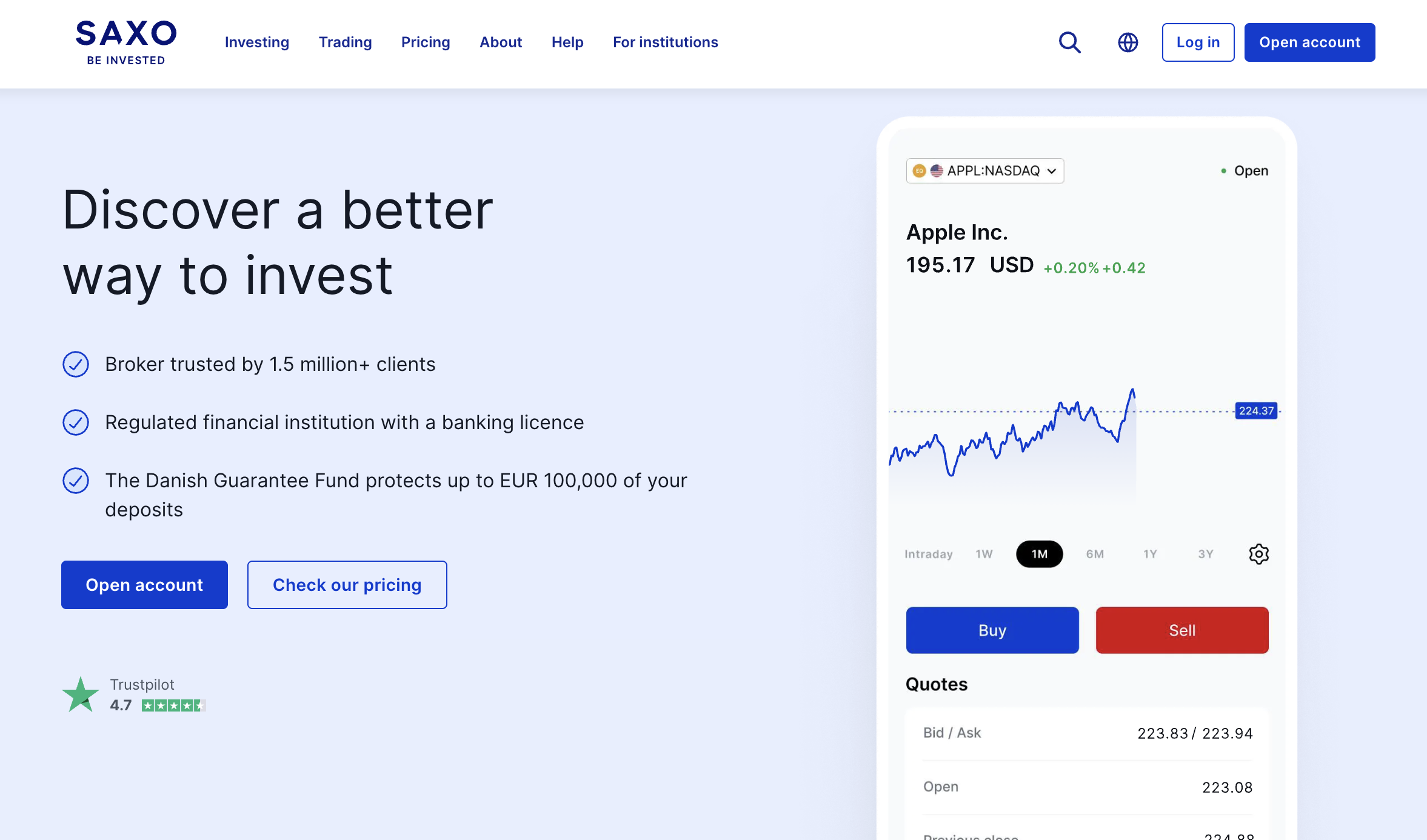
Saxo Bank was founded in Copenhagen in 1992 and has operated through multiple market cycles since then. It is regulated by the FCA, FINMA in Switzerland, the MAS, and ASIC. The client base it targets is sophisticated traders and wealth management clients, not the retail beginner market.

Why Saxo Bank stands out

  • EUR/USD spreads from 0.4 pips: among the tightest available in a non-ECN broker model
  • SaxoTraderGO and SaxoTraderPRO: professional-grade platforms with deep market analytics
  • 40,000 plus instruments: forex, stocks, bonds, options, futures, ETFs, and crypto
  • Three account tiers: Classic (from $2,000), Platinum (from $200,000), and VIP
  • Regulated by FCA, FINMA, MAS, and ASIC simultaneously


SaxoTraderPRO is a fully professional trading environment comparable to platforms used by institutional desks. The access to bonds and options alongside forex is a genuine differentiator for portfolio-level traders who want all asset classes under one roof and one regulatory framework.

Who Saxo Bank suits: High-net-worth traders and professionals who want a premium multi-asset trading environment and are prepared for the higher account minimums the Classic tier requires.

Best to Know: The $2,000 minimum for a Classic account makes Saxo Bank inaccessible for most beginner and intermediate retail traders. The Platinum and VIP tiers assume very substantial capital. This is not the right starting point for most people reading this article.

How We Ranked These Brokers

I have been trading forex for over 20 years. One pattern stands out across the thousands of students I have worked with through Asia Forex Mentor: traders fail not because their analysis was wrong, but because their broker infrastructure was working against them.

Poor execution costs you on every entry. Wide spreads compress every profit. Weak regulation puts your capital at risk beyond any control you have over your trading decisions.

Every broker on this list was ranked across six criteria:

  1. Regulation — Tier-1 licensing is the minimum standard, not an optional feature
  2. Total cost per trade — Both the headline spread and the actual all-in cost per lot
  3. Platform quality — Execution speed, platform stability, and analytical tools available
  4. Account accessibility — Minimum deposit, account types, regions served
  5. Customer support — Response time and channel availability across time zones
  6. Track record — Years in operation and any history of client fund incidents


No broker on this list has faced credible allegations of client fund misappropriation or been sanctioned by a major regulator for fraud. That should be baseline in any industry. In retail forex, it is not always guaranteed with lesser-known names.

Asia Forex Mentor has trained over 100,000 students across 50+ countries. The most common question isn't about strategy, it's about which broker to open with. This list reflects the brokers we'd genuinely recommend to any serious trader building a long-term career.

The broker is infrastructure. The system is what generates results. Learn the framework in our free webinar, then choose the broker that fits how you plan to trade.

Also Read: 10 Best Cent Account Forex Brokers for 2026

Conclusion

The best forex broker in 2026 depends on your trading style, location, and cost requirements.

Pepperstone leads for most global traders who want tight spreads, multi-platform support, and real regulatory protection. IC Markets is the specialist pick for scalpers and algorithmic traders who need the lowest possible latency and spreads. AvaTrade is the clearest choice for beginners who need educational support alongside their trading account. OANDA is the right call for US traders who require CFTC and NFA compliance. Saxo Bank is the premium option for traders managing significant capital across multiple asset classes.

Pick based on what your trading style actually requires. Open a demo account first, every broker on this list offers one at no cost and no commitment. Learning to read the market like a story takes time and the right foundation. Make sure the infrastructure you trade on supports that process, not fights against it.

Frequently Asked Questions

What is the best forex broker in 2026?

Pepperstone is the best overall forex broker in 2026 for global traders. It combines ASIC and FCA regulation, raw account spreads from 0.0 pips, no minimum deposit requirement, and full support for MT4, MT5, cTrader, and TradingView. For US-based traders, OANDA is the top regulated choice, it is CFTC-registered and holds active NFA membership, the mandatory credentials for any broker legally serving US retail forex clients.

Which forex broker has the lowest spreads?

IC Markets and Pepperstone both offer among the tightest spreads available to retail traders, with EUR/USD raw account averages between 0.0 and 0.1 pips plus a $3.50 per lot commission. The all-in round-trip cost on either broker is approximately $7 per standard lot. This is substantially cheaper than a standard-account broker charging 1.2 to 1.5 pip spreads with no commission, which translates to $12 to $15 per lot round trip.

Are forex brokers safe?

Regulated forex brokers holding Tier-1 licenses from ASIC, the FCA, CySEC, the CFTC and NFA, or the MAS are required to segregate client funds from company funds, maintain minimum capital requirements, and submit to regular independent audits. To verify a broker's license, go directly to the regulator's official public database and search the broker's published registration number. Never rely solely on a broker's own claims about its regulatory status.

What leverage do forex brokers offer in 2026?

Leverage caps are set by the regulatory jurisdiction, not by the broker. Retail traders under ASIC, FCA, or CySEC-regulated entities are capped at 1:30 on major currency pairs. US traders under CFTC and NFA rules are capped at 1:50 on majors and 1:20 on minors. Some brokers operate separate offshore entities registered in Bahamas, Belize, or Vanuatu offering leverage up to 1:500 or higher. These are legally separate entities with different and significantly less stringent regulatory protections. Always confirm which legal entity you are opening an account with before making any deposit.

Which forex broker is best for beginners in 2026?

AvaTrade is the strongest starting point for most beginners. It has a $100 minimum deposit, comprehensive free educational content, multiple platform options, and regulation across five continents. XM is a solid alternative for traders who want to start with less than $100, its $5 minimum deposit is among the lowest available from any Tier-1 regulated broker. Regardless of which broker you choose, start on a demo account and move to live trading only when you can replicate consistent decision-making across at least 20 trades.

Can US traders access international forex brokers?

US traders are legally required to use brokers registered with the CFTC and holding active NFA membership. International brokers without CFTC registration cannot legally solicit or accept US retail clients. OANDA and Interactive Brokers are the strongest regulated options for US-based forex traders. You can verify any broker's CFTC registration status directly through the NFA BASIC database at nfa.futures.org before opening an account or depositing funds.

How do I verify that a forex broker is legitimate?

Check for a current license from a Tier-1 regulator: ASIC, the FCA, CySEC, the CFTC and NFA, or the MAS. Take the broker's published license number and verify it directly on the regulator's official public database, not through the broker's own website. Confirm that client funds are held in segregated accounts separate from the broker's operating funds. Look for membership in an investor compensation scheme where applicable. Brokers with 10 or more years of clean operating history and no major regulatory sanctions represent a meaningfully lower counterparty risk than newer or obscure names.

About Ezekiel Chew​

Ezekiel Chew, founder and head of training at Asia Forex Mentor, is a renowned forex expert, frequently invited to speak at major industry events. Known for his deep market insights, Ezekiel is one of the top traders committed to supporting the trading community. Making six figures per trade, he also trains traders working in banks, fund management, and prop trading firms.

Market Structure Trading Strategy That Actually Works

Market structure trading stops working the moment traders ignore location and timing. Clean analysis on the wrong side of a level produces the same outcome every time. The move starts without you, and the chart tells you exactly why, after the fact. ABOUT THIS GUIDE This guide covers three approaches

Read More

How to Stop FOMO Trading Before It Wrecks Your Account

Learning how to stop FOMO trading matters more than any strategy, because FOMO wrecks more trading accounts than bad entries, weak setups, or poor timing ever will. Most traders try to beat FOMO with willpower. They promise to stay calm. They tell themselves they will wait for the next clean

Read More

Elliott Wave Trading Explained the Right Way

Hey, what’s up guys? It’s Ezekiel Chew here. So if you ever wanted to actually understand where the market is in a cycle right now, not just about following candles, not just about reacting to breakouts, but to know whether or not are you in an impulse or are you

Read More

How to Recover From a Trading Losing Streak

Most traders get how to recover from a trading losing streak completely backward. They try to win it all back at once, and that one move turns a rough patch into a blown account. Real recovery works the other way around. The trader who comes back trades smaller, not bigger,

Read More

Turtle Soup Trading Strategy: The 3 Step Framework

Hey, what’s up guys? It’s Ezekiel Chew here. Let me hit you with this. If you are trading breakouts, you are probably the liquidity. Most traders think that they are catching momentum in the market when they see a breakout. When they see price push above the high, they buy.

Read More

5 Stop Loss Mistakes That Are Costing You Money

Stop loss in trading is the one tool every trader has access to, and almost every trader uses incorrectly. The concept sounds simple. Place a stop loss to limit potential losses if the trade goes wrong. But the execution is where most traders destroy their accounts. They place stops at

Read More

AFM Trading Summit Live

Date: Coming Soon

Join us at the AFM Trading Summit Live and learn from top industry experts through live trading sessions, market insights, and actionable strategies.

The 10 Best Forex Brokers in 2026

4.0
Overall Trust Index

Written by:

Updated:

January 2, 2026
The best forex brokers share three things: tight spreads, fast execution, and regulation that actually protects you when something goes wrong. Most traders do not check all three before opening an account. That mistake costs more than any bad trade ever will.

ABOUT THIS GUIDE

We evaluated 30+ forex brokers against six criteria: regulation, spreads, platform quality, account accessibility, execution speed, and support quality. This guide ranks the 10 best forex brokers available to global traders as of July 2026, with clear notes on regulation and leverage for each entity.
 

QUICK ANSWER

The 10 best forex brokers in 2026 are Pepperstone, IC Markets, AvaTrade, XM, FP Markets, OANDA, Interactive Brokers, XTB, Plus500, and Saxo Bank. Pepperstone earns the top spot for most global traders. For US-based traders, OANDA is the right call, it is CFTC-registered and an NFA member, the mandatory baseline for any broker legally serving US retail clients.

How to Choose the Best Forex Broker

The broker is your infrastructure. Get this wrong, and you pay a hidden tax on every single trade you take, before the market even moves against you. Four factors separate a genuinely good broker from an expensive one.

Regulation Comes First

A regulated broker holds client funds in segregated accounts and submits to regular audits by an independent authority. The most trusted regulators globally are:
  • ASIC (Australian Securities and Investments Commission)
  • FCA (UK Financial Conduct Authority)
  • CySEC (Cyprus Securities and Exchange Commission)
  • CFTC and NFA (United States — mandatory for US retail traders)
  • MAS (Monetary Authority of Singapore)
  Every broker on this list holds at least one Tier-1 license. Some also operate separate offshore entities that offer higher leverage. When that applies, I flag it clearly so you know exactly which entity you are opening an account with.

Spreads and Total Cost Per Trade

Your broker earns on every position you open. A "0.0 pip spread" account still charges a commission, typically $3 to $7 per lot per side. Total all-in cost matters far more than the headline spread number alone. For a standard 1-lot EUR/USD round trip, here is what the cost difference looks like in practice:
  • Low-cost broker (0.0 pips raw + $3.50 commission): $7 total
  • Average broker (1.2 pip spread, no commission): $12 total
  • High-cost broker (1.8 pip spread): $18 total
  At 200 trades per month, the gap between a low-cost and a high-cost broker can exceed $2,200. That is real money before any market risk is considered.

Platform and Execution Quality

MetaTrader 4 and MetaTrader 5 are the industry standards for a reason. MT4 is simpler and widely supported. MT5 adds more order types, more timeframes, and stronger backtesting capabilities. cTrader is the preferred alternative for many algorithmic traders. TradingView integration is increasingly offered by leading brokers as a third option. Execution speed matters most for scalpers and day traders. A 50ms average execution time is acceptable for swing traders and irrelevant for position traders. For scalpers, anything above 100ms is a measurable liability.

Account Types and Accessibility

Most reputable brokers offer at least two account tiers:
  • Standard account: Wider spreads, no per-trade commission. Suits beginners and low-frequency traders.
  • Raw or ECN account: Near-zero spreads plus a fixed commission per lot. Suits active and high-volume traders.
  If you cannot hold positions with overnight interest charges due to religious requirements, confirm that Islamic swap-free accounts are available in your region. Most brokers on this list offer them.

10 Best Forex Brokers Compared at a Glance

Leverage caps shown apply to retail accounts under Tier-1 regulated entities. Some brokers offer higher leverage through separate offshore entities, those carry different, less stringent regulatory protections. Always confirm which entity you are registering with.* If you want to understand how to read the market before you settle on which broker to use, the Asia Forex Mentor free webinar lays out the complete trading framework. The broker is the vehicle. The system you trade with is what actually drives results.

#1. Pepperstone (Best Overall Forex Broker)

Pepperstone was founded in Melbourne in 2010 and holds active licenses from ASIC, the FCA, CySEC, the DFSA in Dubai, and the Capital Markets Authority of Kenya. That regulatory footprint spans Asia-Pacific, Europe, the Middle East, and Africa. For global traders, this is meaningful multi-jurisdictional protection.

Why Pepperstone stands out

  • No minimum deposit requirement on any account type
  • Razor account: EUR/USD spreads from 0.0 pips with a $3.50 per lot commission
  • Standard account: from 1.0 pip with no per-trade commission
  • Four platforms: MT4, MT5, cTrader, and TradingView
  • Average execution speed under 30ms on most servers
  • Smart Trader Tools suite included at no cost: one-click trading, market sentiment indicators, and currency correlation matrices
  The platform coverage is particularly strong. Whether you run automated expert advisors on MT4, prefer cTrader for its depth of market data, or use TradingView for charting — Pepperstone supports all three under one account. Who Pepperstone suits: Active traders, scalpers, and algorithmic traders who need institutional-grade execution with broad regulatory protection. It is the clearest default choice for most global retail traders who want low spreads without sacrificing regulation. Best to Know: Customer support operates 24 hours, five days per week, not seven. Weekend traders cannot reach live support on Saturday or Sunday. Factor this in if you regularly trade economic events that break over weekends.

#2 IC Markets (Best for Tight Spreads)

IC Markets is based in Sydney and regulated by ASIC and CySEC. It serves over 180,000 active clients globally and has earned its reputation specifically on raw spread pricing and fast execution infrastructure.

Why IC Markets stands out

  • Raw account EUR/USD spreads averaging 0.0 to 0.1 pips with $3.50 per lot commission
  • MT4, MT5, and cTrader all supported
  • Server infrastructure co-located in Equinix NY4 and LD4 data centers (same as major liquidity providers)
  • $200 minimum deposit
  • No restrictions on scalping, hedging, or algorithmic trading strategies
  The Equinix co-location matters for active traders. Routing orders through data centers in the same physical locations as liquidity providers keeps latency low for strategies where execution timing is a direct input to profitability. This is infrastructure that most retail brokers cannot match. Who IC Markets suits: High-frequency traders, scalpers, and algorithmic system traders where execution quality directly affects whether a strategy works or breaks even. Best to Know: Educational content is minimal. IC Markets is where you trade a proven strategy, not where you develop one. Build and test your system first, then bring it to IC Markets when it is ready for live deployment.

#3 AvaTrade (Best for Beginners)

AvaTrade was founded in Dublin in 2006 and holds regulatory licenses across five continents, including the Central Bank of Ireland, ASIC, the FSA in Japan, and the FSCA in South Africa. Few retail brokers carry that level of multi-regional regulatory coverage.

Why AvaTrade stands out

  • $100 minimum deposit
  • EUR/USD spreads from 0.9 pips with no per-trade commission on standard accounts
  • Six platform options: MT4, MT5, WebTrader, AvaOptions, AvaTradeGo, and DupliTrade
  • Comprehensive free educational library covering trading basics through technical analysis
  • Islamic swap-free accounts available in eligible regions
  AvaOptions is worth specific attention. It is one of the very few retail platforms that lets you trade forex options alongside standard spot forex. For traders who want to hedge positions or structure defined-risk trades, this is a genuine differentiator that most competing brokers simply do not offer. Who AvaTrade suits: Beginners who want structured education and platform guidance, and intermediate traders who want multi-asset access (forex, equities, commodities, crypto, and options) under a single well-regulated account. Best to Know: Standard account spreads run wider than ECN brokers. For active traders placing 100 or more trades per month, the cost difference relative to a raw spread broker like Pepperstone or IC Markets compounds meaningfully over time. AvaTrade rewards simplicity and convenience rather than the lowest possible transaction cost.

#4 XM (Best for Low Minimum Deposit)

XM serves traders across 196 countries and holds licenses from CySEC, ASIC, and the DFSA. With a $5 minimum deposit on Micro and Standard accounts, it offers one of the lowest barriers to entry among regulated global brokers.

Why XM stands out

  • $5 minimum deposit on entry-level accounts
  • Zero account: spreads from 0.0 pips with a $6 per lot commission
  • Micro lot trading (0.01 lot) available across all account types
  • 1,400 plus instruments covering forex, indices, commodities, equities, and crypto
  • MT4 and MT5 both fully supported
  Micro lot trading is a real structural benefit for new traders. Trading 0.01 lots on a small live account gives genuine market exposure with proportionally small risk. It is a better development path than staying on demo indefinitely, and a better risk management tool than jumping straight to standard lot sizes. Who XM suits: New traders in emerging markets who need low barriers to entry, and intermediate traders who want wide asset class coverage under a single regulated account. Best to Know: Standard account spreads from 1.0 pip are average, not best-in-class. Serious traders with larger accounts should compare XM's Zero account total cost against IC Markets and Pepperstone before committing long-term.

#5 FP Markets (Best MetaTrader Broker)

FP Markets is an Australian broker regulated by ASIC and CySEC. It consistently ranks among the best choices for MetaTrader users who want competitive raw spreads and professional platform options beyond the MT standard.

Why FP Markets stands out:

  • Raw account: EUR/USD from 0.0 pips with a $3.00 per lot commission (slightly cheaper than most competitors)
  • $100 minimum deposit
  • MT4, MT5, cTrader, and Iress all supported under one account
  • DMA (Direct Market Access) pricing available on Iress accounts
  • ASIC regulation with client funds held in segregated accounts
  The Iress platform is the standout differentiator. It is a professional trading environment more commonly used by institutional desks than retail brokers. Access to DMA equity markets alongside forex under one account is rare at the retail level and valuable for traders who trade across multiple asset classes on a single platform. Who FP Markets suits: Serious traders in Asia-Pacific who want ASIC regulatory protection, competitive spreads, and professional-grade platform options including DMA access. Best to Know: Iress accounts carry a platform fee and higher account requirements. The MT4 and MT5 accounts are excellent value. The Iress tier is only worth the premium if DMA access is specifically part of your trading plan. Knowing which broker to use is only one piece of the puzzle. If you want to understand the exact method I use to identify high-probability setups before the trade, the Asia Forex Mentor free webinar walks through it from the ground up.

#6 OANDA (Best for US Traders)

OANDA has operated since 1996. It is registered with the CFTC and is a member of the NFA, the two credentials that are mandatory for any forex broker legally serving US retail traders. It is also regulated by the FCA, ASIC, the MAS in Singapore, and CIRO in Canada

Why OANDA stands out

  • No minimum deposit requirement
  • Regulated by CFTC and NFA (US), FCA (UK), ASIC (Australia), MAS (Singapore), and CIRO in Canada
  • Three platforms: OANDA Trade, MT4, and TradingView
  • Historical spread data published openly on their website for transparency
  • Elite Trader program: rebates for high-volume traders
  • 70 plus currency pairs available
  For US traders, OANDA is consistently one of the strongest available regulated options. Leverage in the US is capped at 1:50 for major pairs and 1:20 for minors under NFA rules. This is not OANDA's decision, it is the regulatory framework every CFTC-registered broker must follow. The upside is a highly regulated, transparent trading environment where client fund protections are clearly defined by law. Who OANDA suits: US-based traders who require CFTC and NFA compliance, and global traders who want multi-regulatory protection from a broker with nearly 30 years of operating history. Best to Know: Standard account spreads are variable and can widen significantly during low-liquidity sessions. US-based traders do not have access to the ultra-tight raw spreads available through non-US broker entities. This is a regulatory constraint, not a broker choice.

#7 Interactive Brokers (Best for Professional Traders)

Interactive Brokers is built for serious traders. It holds simultaneous regulatory registrations from the SEC, FINRA, CFTC, FCA, ASIC, and MAS, making it one of the most broadly regulated retail-accessible brokers in the world.

Why Interactive Brokers stands out

  • Interbank pricing with small commissions: the lowest effective cost per trade for high-volume traders
  • Access to 150 plus markets across 33 countries from a single unified account
  • IBKR Trader Workstation (TWS): one of the most powerful platforms available to any retail client
  • IBKR Pro: interbank-level pricing for active high-volume traders
  • IBKR Lite: commission-free forex trading for smaller accounts
  •  Regulated simultaneously by SEC, FINRA, CFTC, FCA, ASIC, and MAS
  For large accounts, the combination of regulatory breadth, interbank pricing, and genuine multi-market access is difficult to match at any price point. Interactive Brokers passes through interbank forex quotes with minimal markup. High-volume traders consistently find it the lowest net cost option in the retail space. Who Interactive Brokers suits: Professional traders, fund managers, and experienced self-directed investors who need best execution and broad market access across asset classes. This is not a beginner's broker. Best to Know: The Trader Workstation platform is complex and has a real learning curve. New traders find it overwhelming. Interactive Brokers is a tool for traders who already have a tested, repeatable process and know exactly what they need from their infrastructure.

#8 XTB (Best With No Minimum Deposit)

XTB is a Polish broker founded in 2002, regulated by the FCA and CySEC, and listed on the Warsaw Stock Exchange. Its public listing adds a level of financial transparency that most privately held retail brokers cannot match.

Why XTB stands out:

  • No minimum deposit on Standard or Pro accounts
  • xStation 5: a proprietary platform with fast execution, a clean interface, and built-in analytical tools
  • MT4 supported alongside xStation 5
  • Over 100 integrated video trading courses for beginners and intermediate traders
  • Standard account: EUR/USD from 0.8 pips with no per-trade commission
  • Pro account: from 0.0 pips plus $3.50 per lot commission
  xStation 5 is a genuine competitor to MT4 for discretionary traders. It includes a built-in economic calendar, market sentiment indicators, trading calculators, and real-time instrument statistics embedded directly in the platform. For traders who prefer a clean, modern interface over the older MT4 architecture, xStation is worth testing seriously. Who XTB suits: Traders who want no minimum deposit and a professional-quality proprietary platform. Strong choice for EU and UK-based traders. Also well suited for traders who want educational content integrated directly into their trading environment. Best to Know: The Pro account with raw spreads is not available in all regions. Traders outside the EU and UK may be limited to Standard account pricing, which narrows the cost advantage for high-frequency traders in other markets.

#9 Plus500 (Best for Simple CFD Trading)

Plus500 is listed on the London Stock Exchange and regulated by the FCA, CySEC, ASIC, MAS, and the FMA of New Zealand. The combination of public listing and multi-jurisdictional regulation makes it one of the most accountable retail brokers available to global traders.

Why Plus500 stands out:

  • Spread-only pricing: no commissions, no complex fee tiers to navigate
  • Clean WebTrader and mobile app with no MetaTrader complexity
  • 2,800 plus instruments: forex, indices, shares, ETFs, commodities, and crypto
  • Guaranteed stop-loss orders available (a premium applies)
  • Regulated across five major global jurisdictions
  Plus500's appeal is deliberate simplicity. One platform. One retail account type. Transparent spread-based pricing with no hidden commission layers. If you want to trade forex without configuring MetaTrader, managing expert advisors, or navigating multi-tier account structures, Plus500 delivers a clean, well-regulated experience. Who Plus500 suits: Casual and beginner traders who want a simple, regulated CFD platform with minimal setup. Also strong for mobile-first traders who primarily manage positions from a smartphone. Best to Know: There is no MT4, MT5, or cTrader support. Plus500 is a closed ecosystem. If you run automated strategies, use third-party indicators, or want to run expert advisors, this broker will not serve those needs. It is purpose-built for manual, discretionary trading on its own platform.

#10 Saxo Bank (Best for Advanced and High-Net-Worth Traders)

Saxo Bank was founded in Copenhagen in 1992 and has operated through multiple market cycles since then. It is regulated by the FCA, FINMA in Switzerland, the MAS, and ASIC. The client base it targets is sophisticated traders and wealth management clients, not the retail beginner market.

Why Saxo Bank stands out

  • EUR/USD spreads from 0.4 pips: among the tightest available in a non-ECN broker model
  • SaxoTraderGO and SaxoTraderPRO: professional-grade platforms with deep market analytics
  • 40,000 plus instruments: forex, stocks, bonds, options, futures, ETFs, and crypto
  • Three account tiers: Classic (from $2,000), Platinum (from $200,000), and VIP
  • Regulated by FCA, FINMA, MAS, and ASIC simultaneously
  SaxoTraderPRO is a fully professional trading environment comparable to platforms used by institutional desks. The access to bonds and options alongside forex is a genuine differentiator for portfolio-level traders who want all asset classes under one roof and one regulatory framework. Who Saxo Bank suits: High-net-worth traders and professionals who want a premium multi-asset trading environment and are prepared for the higher account minimums the Classic tier requires. Best to Know: The $2,000 minimum for a Classic account makes Saxo Bank inaccessible for most beginner and intermediate retail traders. The Platinum and VIP tiers assume very substantial capital. This is not the right starting point for most people reading this article.

How We Ranked These Brokers

I have been trading forex for over 20 years. One pattern stands out across the thousands of students I have worked with through Asia Forex Mentor: traders fail not because their analysis was wrong, but because their broker infrastructure was working against them. Poor execution costs you on every entry. Wide spreads compress every profit. Weak regulation puts your capital at risk beyond any control you have over your trading decisions. Every broker on this list was ranked across six criteria:
  1. Regulation — Tier-1 licensing is the minimum standard, not an optional feature
  2. Total cost per trade — Both the headline spread and the actual all-in cost per lot
  3. Platform quality — Execution speed, platform stability, and analytical tools available
  4. Account accessibility — Minimum deposit, account types, regions served
  5. Customer support — Response time and channel availability across time zones
  6. Track record — Years in operation and any history of client fund incidents
  No broker on this list has faced credible allegations of client fund misappropriation or been sanctioned by a major regulator for fraud. That should be baseline in any industry. In retail forex, it is not always guaranteed with lesser-known names. Asia Forex Mentor has trained over 100,000 students across 50+ countries. The most common question isn't about strategy, it's about which broker to open with. This list reflects the brokers we'd genuinely recommend to any serious trader building a long-term career. The broker is infrastructure. The system is what generates results. Learn the framework in our free webinar, then choose the broker that fits how you plan to trade.

Also Read: 10 Best Cent Account Forex Brokers for 2026

Conclusion

The best forex broker in 2026 depends on your trading style, location, and cost requirements. Pepperstone leads for most global traders who want tight spreads, multi-platform support, and real regulatory protection. IC Markets is the specialist pick for scalpers and algorithmic traders who need the lowest possible latency and spreads. AvaTrade is the clearest choice for beginners who need educational support alongside their trading account. OANDA is the right call for US traders who require CFTC and NFA compliance. Saxo Bank is the premium option for traders managing significant capital across multiple asset classes. Pick based on what your trading style actually requires. Open a demo account first, every broker on this list offers one at no cost and no commitment. Learning to read the market like a story takes time and the right foundation. Make sure the infrastructure you trade on supports that process, not fights against it.

Frequently Asked Questions

What is the best forex broker in 2026?

Pepperstone is the best overall forex broker in 2026 for global traders. It combines ASIC and FCA regulation, raw account spreads from 0.0 pips, no minimum deposit requirement, and full support for MT4, MT5, cTrader, and TradingView. For US-based traders, OANDA is the top regulated choice, it is CFTC-registered and holds active NFA membership, the mandatory credentials for any broker legally serving US retail forex clients.

Which forex broker has the lowest spreads?

IC Markets and Pepperstone both offer among the tightest spreads available to retail traders, with EUR/USD raw account averages between 0.0 and 0.1 pips plus a $3.50 per lot commission. The all-in round-trip cost on either broker is approximately $7 per standard lot. This is substantially cheaper than a standard-account broker charging 1.2 to 1.5 pip spreads with no commission, which translates to $12 to $15 per lot round trip.

Are forex brokers safe?

Regulated forex brokers holding Tier-1 licenses from ASIC, the FCA, CySEC, the CFTC and NFA, or the MAS are required to segregate client funds from company funds, maintain minimum capital requirements, and submit to regular independent audits. To verify a broker's license, go directly to the regulator's official public database and search the broker's published registration number. Never rely solely on a broker's own claims about its regulatory status.

What leverage do forex brokers offer in 2026?

Leverage caps are set by the regulatory jurisdiction, not by the broker. Retail traders under ASIC, FCA, or CySEC-regulated entities are capped at 1:30 on major currency pairs. US traders under CFTC and NFA rules are capped at 1:50 on majors and 1:20 on minors. Some brokers operate separate offshore entities registered in Bahamas, Belize, or Vanuatu offering leverage up to 1:500 or higher. These are legally separate entities with different and significantly less stringent regulatory protections. Always confirm which legal entity you are opening an account with before making any deposit.

Which forex broker is best for beginners in 2026?

AvaTrade is the strongest starting point for most beginners. It has a $100 minimum deposit, comprehensive free educational content, multiple platform options, and regulation across five continents. XM is a solid alternative for traders who want to start with less than $100, its $5 minimum deposit is among the lowest available from any Tier-1 regulated broker. Regardless of which broker you choose, start on a demo account and move to live trading only when you can replicate consistent decision-making across at least 20 trades.

Can US traders access international forex brokers?

US traders are legally required to use brokers registered with the CFTC and holding active NFA membership. International brokers without CFTC registration cannot legally solicit or accept US retail clients. OANDA and Interactive Brokers are the strongest regulated options for US-based forex traders. You can verify any broker's CFTC registration status directly through the NFA BASIC database at nfa.futures.org before opening an account or depositing funds.

How do I verify that a forex broker is legitimate?

Check for a current license from a Tier-1 regulator: ASIC, the FCA, CySEC, the CFTC and NFA, or the MAS. Take the broker's published license number and verify it directly on the regulator's official public database, not through the broker's own website. Confirm that client funds are held in segregated accounts separate from the broker's operating funds. Look for membership in an investor compensation scheme where applicable. Brokers with 10 or more years of clean operating history and no major regulatory sanctions represent a meaningfully lower counterparty risk than newer or obscure names.
ezekiel chew asiaforexmentor

About Ezekiel Chew

Ezekiel Chew, founder and head of training at Asia Forex Mentor, is a renowned forex expert, frequently invited to speak at major industry events. Known for his deep market insights, Ezekiel is one of the top traders committed to supporting the trading community. Making six figures per trade, he also trains traders working in banks, fund management, and prop trading firms.

RELATED ARTICLES

The 10 Best Forex Brokers in 2026

4.0
Overall Trust Index

Written by:

Updated:

January 2, 2026
The best forex brokers share three things: tight spreads, fast execution, and regulation that actually protects you when something goes wrong. Most traders do not check all three before opening an account. That mistake costs more than any bad trade ever will.

ABOUT THIS GUIDE

We evaluated 30+ forex brokers against six criteria: regulation, spreads, platform quality, account accessibility, execution speed, and support quality. This guide ranks the 10 best forex brokers available to global traders as of July 2026, with clear notes on regulation and leverage for each entity.
 

QUICK ANSWER

The 10 best forex brokers in 2026 are Pepperstone, IC Markets, AvaTrade, XM, FP Markets, OANDA, Interactive Brokers, XTB, Plus500, and Saxo Bank. Pepperstone earns the top spot for most global traders. For US-based traders, OANDA is the right call, it is CFTC-registered and an NFA member, the mandatory baseline for any broker legally serving US retail clients.

How to Choose the Best Forex Broker

The broker is your infrastructure. Get this wrong, and you pay a hidden tax on every single trade you take, before the market even moves against you. Four factors separate a genuinely good broker from an expensive one.

Regulation Comes First

A regulated broker holds client funds in segregated accounts and submits to regular audits by an independent authority. The most trusted regulators globally are:
  • ASIC (Australian Securities and Investments Commission)
  • FCA (UK Financial Conduct Authority)
  • CySEC (Cyprus Securities and Exchange Commission)
  • CFTC and NFA (United States — mandatory for US retail traders)
  • MAS (Monetary Authority of Singapore)
  Every broker on this list holds at least one Tier-1 license. Some also operate separate offshore entities that offer higher leverage. When that applies, I flag it clearly so you know exactly which entity you are opening an account with.

Spreads and Total Cost Per Trade

Your broker earns on every position you open. A "0.0 pip spread" account still charges a commission, typically $3 to $7 per lot per side. Total all-in cost matters far more than the headline spread number alone. For a standard 1-lot EUR/USD round trip, here is what the cost difference looks like in practice:
  • Low-cost broker (0.0 pips raw + $3.50 commission): $7 total
  • Average broker (1.2 pip spread, no commission): $12 total
  • High-cost broker (1.8 pip spread): $18 total
  At 200 trades per month, the gap between a low-cost and a high-cost broker can exceed $2,200. That is real money before any market risk is considered.

Platform and Execution Quality

MetaTrader 4 and MetaTrader 5 are the industry standards for a reason. MT4 is simpler and widely supported. MT5 adds more order types, more timeframes, and stronger backtesting capabilities. cTrader is the preferred alternative for many algorithmic traders. TradingView integration is increasingly offered by leading brokers as a third option. Execution speed matters most for scalpers and day traders. A 50ms average execution time is acceptable for swing traders and irrelevant for position traders. For scalpers, anything above 100ms is a measurable liability.

Account Types and Accessibility

Most reputable brokers offer at least two account tiers:
  • Standard account: Wider spreads, no per-trade commission. Suits beginners and low-frequency traders.
  • Raw or ECN account: Near-zero spreads plus a fixed commission per lot. Suits active and high-volume traders.
  If you cannot hold positions with overnight interest charges due to religious requirements, confirm that Islamic swap-free accounts are available in your region. Most brokers on this list offer them.

10 Best Forex Brokers Compared at a Glance

Leverage caps shown apply to retail accounts under Tier-1 regulated entities. Some brokers offer higher leverage through separate offshore entities, those carry different, less stringent regulatory protections. Always confirm which entity you are registering with.* If you want to understand how to read the market before you settle on which broker to use, the Asia Forex Mentor free webinar lays out the complete trading framework. The broker is the vehicle. The system you trade with is what actually drives results.

#1. Pepperstone (Best Overall Forex Broker)

Pepperstone was founded in Melbourne in 2010 and holds active licenses from ASIC, the FCA, CySEC, the DFSA in Dubai, and the Capital Markets Authority of Kenya. That regulatory footprint spans Asia-Pacific, Europe, the Middle East, and Africa. For global traders, this is meaningful multi-jurisdictional protection.

Why Pepperstone stands out

  • No minimum deposit requirement on any account type
  • Razor account: EUR/USD spreads from 0.0 pips with a $3.50 per lot commission
  • Standard account: from 1.0 pip with no per-trade commission
  • Four platforms: MT4, MT5, cTrader, and TradingView
  • Average execution speed under 30ms on most servers
  • Smart Trader Tools suite included at no cost: one-click trading, market sentiment indicators, and currency correlation matrices
  The platform coverage is particularly strong. Whether you run automated expert advisors on MT4, prefer cTrader for its depth of market data, or use TradingView for charting — Pepperstone supports all three under one account. Who Pepperstone suits: Active traders, scalpers, and algorithmic traders who need institutional-grade execution with broad regulatory protection. It is the clearest default choice for most global retail traders who want low spreads without sacrificing regulation. Best to Know: Customer support operates 24 hours, five days per week, not seven. Weekend traders cannot reach live support on Saturday or Sunday. Factor this in if you regularly trade economic events that break over weekends.

#2 IC Markets (Best for Tight Spreads)

IC Markets is based in Sydney and regulated by ASIC and CySEC. It serves over 180,000 active clients globally and has earned its reputation specifically on raw spread pricing and fast execution infrastructure.

Why IC Markets stands out

  • Raw account EUR/USD spreads averaging 0.0 to 0.1 pips with $3.50 per lot commission
  • MT4, MT5, and cTrader all supported
  • Server infrastructure co-located in Equinix NY4 and LD4 data centers (same as major liquidity providers)
  • $200 minimum deposit
  • No restrictions on scalping, hedging, or algorithmic trading strategies
  The Equinix co-location matters for active traders. Routing orders through data centers in the same physical locations as liquidity providers keeps latency low for strategies where execution timing is a direct input to profitability. This is infrastructure that most retail brokers cannot match. Who IC Markets suits: High-frequency traders, scalpers, and algorithmic system traders where execution quality directly affects whether a strategy works or breaks even. Best to Know: Educational content is minimal. IC Markets is where you trade a proven strategy, not where you develop one. Build and test your system first, then bring it to IC Markets when it is ready for live deployment.

#3 AvaTrade (Best for Beginners)

AvaTrade was founded in Dublin in 2006 and holds regulatory licenses across five continents, including the Central Bank of Ireland, ASIC, the FSA in Japan, and the FSCA in South Africa. Few retail brokers carry that level of multi-regional regulatory coverage.

Why AvaTrade stands out

  • $100 minimum deposit
  • EUR/USD spreads from 0.9 pips with no per-trade commission on standard accounts
  • Six platform options: MT4, MT5, WebTrader, AvaOptions, AvaTradeGo, and DupliTrade
  • Comprehensive free educational library covering trading basics through technical analysis
  • Islamic swap-free accounts available in eligible regions
  AvaOptions is worth specific attention. It is one of the very few retail platforms that lets you trade forex options alongside standard spot forex. For traders who want to hedge positions or structure defined-risk trades, this is a genuine differentiator that most competing brokers simply do not offer. Who AvaTrade suits: Beginners who want structured education and platform guidance, and intermediate traders who want multi-asset access (forex, equities, commodities, crypto, and options) under a single well-regulated account. Best to Know: Standard account spreads run wider than ECN brokers. For active traders placing 100 or more trades per month, the cost difference relative to a raw spread broker like Pepperstone or IC Markets compounds meaningfully over time. AvaTrade rewards simplicity and convenience rather than the lowest possible transaction cost.

#4 XM (Best for Low Minimum Deposit)

XM serves traders across 196 countries and holds licenses from CySEC, ASIC, and the DFSA. With a $5 minimum deposit on Micro and Standard accounts, it offers one of the lowest barriers to entry among regulated global brokers.

Why XM stands out

  • $5 minimum deposit on entry-level accounts
  • Zero account: spreads from 0.0 pips with a $6 per lot commission
  • Micro lot trading (0.01 lot) available across all account types
  • 1,400 plus instruments covering forex, indices, commodities, equities, and crypto
  • MT4 and MT5 both fully supported
  Micro lot trading is a real structural benefit for new traders. Trading 0.01 lots on a small live account gives genuine market exposure with proportionally small risk. It is a better development path than staying on demo indefinitely, and a better risk management tool than jumping straight to standard lot sizes. Who XM suits: New traders in emerging markets who need low barriers to entry, and intermediate traders who want wide asset class coverage under a single regulated account. Best to Know: Standard account spreads from 1.0 pip are average, not best-in-class. Serious traders with larger accounts should compare XM's Zero account total cost against IC Markets and Pepperstone before committing long-term.

#5 FP Markets (Best MetaTrader Broker)

FP Markets is an Australian broker regulated by ASIC and CySEC. It consistently ranks among the best choices for MetaTrader users who want competitive raw spreads and professional platform options beyond the MT standard.

Why FP Markets stands out:

  • Raw account: EUR/USD from 0.0 pips with a $3.00 per lot commission (slightly cheaper than most competitors)
  • $100 minimum deposit
  • MT4, MT5, cTrader, and Iress all supported under one account
  • DMA (Direct Market Access) pricing available on Iress accounts
  • ASIC regulation with client funds held in segregated accounts
  The Iress platform is the standout differentiator. It is a professional trading environment more commonly used by institutional desks than retail brokers. Access to DMA equity markets alongside forex under one account is rare at the retail level and valuable for traders who trade across multiple asset classes on a single platform. Who FP Markets suits: Serious traders in Asia-Pacific who want ASIC regulatory protection, competitive spreads, and professional-grade platform options including DMA access. Best to Know: Iress accounts carry a platform fee and higher account requirements. The MT4 and MT5 accounts are excellent value. The Iress tier is only worth the premium if DMA access is specifically part of your trading plan. Knowing which broker to use is only one piece of the puzzle. If you want to understand the exact method I use to identify high-probability setups before the trade, the Asia Forex Mentor free webinar walks through it from the ground up.

#6 OANDA (Best for US Traders)

OANDA has operated since 1996. It is registered with the CFTC and is a member of the NFA, the two credentials that are mandatory for any forex broker legally serving US retail traders. It is also regulated by the FCA, ASIC, the MAS in Singapore, and CIRO in Canada

Why OANDA stands out

  • No minimum deposit requirement
  • Regulated by CFTC and NFA (US), FCA (UK), ASIC (Australia), MAS (Singapore), and CIRO in Canada
  • Three platforms: OANDA Trade, MT4, and TradingView
  • Historical spread data published openly on their website for transparency
  • Elite Trader program: rebates for high-volume traders
  • 70 plus currency pairs available
  For US traders, OANDA is consistently one of the strongest available regulated options. Leverage in the US is capped at 1:50 for major pairs and 1:20 for minors under NFA rules. This is not OANDA's decision, it is the regulatory framework every CFTC-registered broker must follow. The upside is a highly regulated, transparent trading environment where client fund protections are clearly defined by law. Who OANDA suits: US-based traders who require CFTC and NFA compliance, and global traders who want multi-regulatory protection from a broker with nearly 30 years of operating history. Best to Know: Standard account spreads are variable and can widen significantly during low-liquidity sessions. US-based traders do not have access to the ultra-tight raw spreads available through non-US broker entities. This is a regulatory constraint, not a broker choice.

#7 Interactive Brokers (Best for Professional Traders)

Interactive Brokers is built for serious traders. It holds simultaneous regulatory registrations from the SEC, FINRA, CFTC, FCA, ASIC, and MAS, making it one of the most broadly regulated retail-accessible brokers in the world.

Why Interactive Brokers stands out

  • Interbank pricing with small commissions: the lowest effective cost per trade for high-volume traders
  • Access to 150 plus markets across 33 countries from a single unified account
  • IBKR Trader Workstation (TWS): one of the most powerful platforms available to any retail client
  • IBKR Pro: interbank-level pricing for active high-volume traders
  • IBKR Lite: commission-free forex trading for smaller accounts
  •  Regulated simultaneously by SEC, FINRA, CFTC, FCA, ASIC, and MAS
  For large accounts, the combination of regulatory breadth, interbank pricing, and genuine multi-market access is difficult to match at any price point. Interactive Brokers passes through interbank forex quotes with minimal markup. High-volume traders consistently find it the lowest net cost option in the retail space. Who Interactive Brokers suits: Professional traders, fund managers, and experienced self-directed investors who need best execution and broad market access across asset classes. This is not a beginner's broker. Best to Know: The Trader Workstation platform is complex and has a real learning curve. New traders find it overwhelming. Interactive Brokers is a tool for traders who already have a tested, repeatable process and know exactly what they need from their infrastructure.

#8 XTB (Best With No Minimum Deposit)

XTB is a Polish broker founded in 2002, regulated by the FCA and CySEC, and listed on the Warsaw Stock Exchange. Its public listing adds a level of financial transparency that most privately held retail brokers cannot match.

Why XTB stands out:

  • No minimum deposit on Standard or Pro accounts
  • xStation 5: a proprietary platform with fast execution, a clean interface, and built-in analytical tools
  • MT4 supported alongside xStation 5
  • Over 100 integrated video trading courses for beginners and intermediate traders
  • Standard account: EUR/USD from 0.8 pips with no per-trade commission
  • Pro account: from 0.0 pips plus $3.50 per lot commission
  xStation 5 is a genuine competitor to MT4 for discretionary traders. It includes a built-in economic calendar, market sentiment indicators, trading calculators, and real-time instrument statistics embedded directly in the platform. For traders who prefer a clean, modern interface over the older MT4 architecture, xStation is worth testing seriously. Who XTB suits: Traders who want no minimum deposit and a professional-quality proprietary platform. Strong choice for EU and UK-based traders. Also well suited for traders who want educational content integrated directly into their trading environment. Best to Know: The Pro account with raw spreads is not available in all regions. Traders outside the EU and UK may be limited to Standard account pricing, which narrows the cost advantage for high-frequency traders in other markets.

#9 Plus500 (Best for Simple CFD Trading)

Plus500 is listed on the London Stock Exchange and regulated by the FCA, CySEC, ASIC, MAS, and the FMA of New Zealand. The combination of public listing and multi-jurisdictional regulation makes it one of the most accountable retail brokers available to global traders.

Why Plus500 stands out:

  • Spread-only pricing: no commissions, no complex fee tiers to navigate
  • Clean WebTrader and mobile app with no MetaTrader complexity
  • 2,800 plus instruments: forex, indices, shares, ETFs, commodities, and crypto
  • Guaranteed stop-loss orders available (a premium applies)
  • Regulated across five major global jurisdictions
  Plus500's appeal is deliberate simplicity. One platform. One retail account type. Transparent spread-based pricing with no hidden commission layers. If you want to trade forex without configuring MetaTrader, managing expert advisors, or navigating multi-tier account structures, Plus500 delivers a clean, well-regulated experience. Who Plus500 suits: Casual and beginner traders who want a simple, regulated CFD platform with minimal setup. Also strong for mobile-first traders who primarily manage positions from a smartphone. Best to Know: There is no MT4, MT5, or cTrader support. Plus500 is a closed ecosystem. If you run automated strategies, use third-party indicators, or want to run expert advisors, this broker will not serve those needs. It is purpose-built for manual, discretionary trading on its own platform.

#10 Saxo Bank (Best for Advanced and High-Net-Worth Traders)

Saxo Bank was founded in Copenhagen in 1992 and has operated through multiple market cycles since then. It is regulated by the FCA, FINMA in Switzerland, the MAS, and ASIC. The client base it targets is sophisticated traders and wealth management clients, not the retail beginner market.

Why Saxo Bank stands out

  • EUR/USD spreads from 0.4 pips: among the tightest available in a non-ECN broker model
  • SaxoTraderGO and SaxoTraderPRO: professional-grade platforms with deep market analytics
  • 40,000 plus instruments: forex, stocks, bonds, options, futures, ETFs, and crypto
  • Three account tiers: Classic (from $2,000), Platinum (from $200,000), and VIP
  • Regulated by FCA, FINMA, MAS, and ASIC simultaneously
  SaxoTraderPRO is a fully professional trading environment comparable to platforms used by institutional desks. The access to bonds and options alongside forex is a genuine differentiator for portfolio-level traders who want all asset classes under one roof and one regulatory framework. Who Saxo Bank suits: High-net-worth traders and professionals who want a premium multi-asset trading environment and are prepared for the higher account minimums the Classic tier requires. Best to Know: The $2,000 minimum for a Classic account makes Saxo Bank inaccessible for most beginner and intermediate retail traders. The Platinum and VIP tiers assume very substantial capital. This is not the right starting point for most people reading this article.

How We Ranked These Brokers

I have been trading forex for over 20 years. One pattern stands out across the thousands of students I have worked with through Asia Forex Mentor: traders fail not because their analysis was wrong, but because their broker infrastructure was working against them. Poor execution costs you on every entry. Wide spreads compress every profit. Weak regulation puts your capital at risk beyond any control you have over your trading decisions. Every broker on this list was ranked across six criteria:
  1. Regulation — Tier-1 licensing is the minimum standard, not an optional feature
  2. Total cost per trade — Both the headline spread and the actual all-in cost per lot
  3. Platform quality — Execution speed, platform stability, and analytical tools available
  4. Account accessibility — Minimum deposit, account types, regions served
  5. Customer support — Response time and channel availability across time zones
  6. Track record — Years in operation and any history of client fund incidents
  No broker on this list has faced credible allegations of client fund misappropriation or been sanctioned by a major regulator for fraud. That should be baseline in any industry. In retail forex, it is not always guaranteed with lesser-known names. Asia Forex Mentor has trained over 100,000 students across 50+ countries. The most common question isn't about strategy, it's about which broker to open with. This list reflects the brokers we'd genuinely recommend to any serious trader building a long-term career. The broker is infrastructure. The system is what generates results. Learn the framework in our free webinar, then choose the broker that fits how you plan to trade.

Also Read: 10 Best Cent Account Forex Brokers for 2026

Conclusion

The best forex broker in 2026 depends on your trading style, location, and cost requirements. Pepperstone leads for most global traders who want tight spreads, multi-platform support, and real regulatory protection. IC Markets is the specialist pick for scalpers and algorithmic traders who need the lowest possible latency and spreads. AvaTrade is the clearest choice for beginners who need educational support alongside their trading account. OANDA is the right call for US traders who require CFTC and NFA compliance. Saxo Bank is the premium option for traders managing significant capital across multiple asset classes. Pick based on what your trading style actually requires. Open a demo account first, every broker on this list offers one at no cost and no commitment. Learning to read the market like a story takes time and the right foundation. Make sure the infrastructure you trade on supports that process, not fights against it.

Frequently Asked Questions

What is the best forex broker in 2026?

Pepperstone is the best overall forex broker in 2026 for global traders. It combines ASIC and FCA regulation, raw account spreads from 0.0 pips, no minimum deposit requirement, and full support for MT4, MT5, cTrader, and TradingView. For US-based traders, OANDA is the top regulated choice, it is CFTC-registered and holds active NFA membership, the mandatory credentials for any broker legally serving US retail forex clients.

Which forex broker has the lowest spreads?

IC Markets and Pepperstone both offer among the tightest spreads available to retail traders, with EUR/USD raw account averages between 0.0 and 0.1 pips plus a $3.50 per lot commission. The all-in round-trip cost on either broker is approximately $7 per standard lot. This is substantially cheaper than a standard-account broker charging 1.2 to 1.5 pip spreads with no commission, which translates to $12 to $15 per lot round trip.

Are forex brokers safe?

Regulated forex brokers holding Tier-1 licenses from ASIC, the FCA, CySEC, the CFTC and NFA, or the MAS are required to segregate client funds from company funds, maintain minimum capital requirements, and submit to regular independent audits. To verify a broker's license, go directly to the regulator's official public database and search the broker's published registration number. Never rely solely on a broker's own claims about its regulatory status.

What leverage do forex brokers offer in 2026?

Leverage caps are set by the regulatory jurisdiction, not by the broker. Retail traders under ASIC, FCA, or CySEC-regulated entities are capped at 1:30 on major currency pairs. US traders under CFTC and NFA rules are capped at 1:50 on majors and 1:20 on minors. Some brokers operate separate offshore entities registered in Bahamas, Belize, or Vanuatu offering leverage up to 1:500 or higher. These are legally separate entities with different and significantly less stringent regulatory protections. Always confirm which legal entity you are opening an account with before making any deposit.

Which forex broker is best for beginners in 2026?

AvaTrade is the strongest starting point for most beginners. It has a $100 minimum deposit, comprehensive free educational content, multiple platform options, and regulation across five continents. XM is a solid alternative for traders who want to start with less than $100, its $5 minimum deposit is among the lowest available from any Tier-1 regulated broker. Regardless of which broker you choose, start on a demo account and move to live trading only when you can replicate consistent decision-making across at least 20 trades.

Can US traders access international forex brokers?

US traders are legally required to use brokers registered with the CFTC and holding active NFA membership. International brokers without CFTC registration cannot legally solicit or accept US retail clients. OANDA and Interactive Brokers are the strongest regulated options for US-based forex traders. You can verify any broker's CFTC registration status directly through the NFA BASIC database at nfa.futures.org before opening an account or depositing funds.

How do I verify that a forex broker is legitimate?

Check for a current license from a Tier-1 regulator: ASIC, the FCA, CySEC, the CFTC and NFA, or the MAS. Take the broker's published license number and verify it directly on the regulator's official public database, not through the broker's own website. Confirm that client funds are held in segregated accounts separate from the broker's operating funds. Look for membership in an investor compensation scheme where applicable. Brokers with 10 or more years of clean operating history and no major regulatory sanctions represent a meaningfully lower counterparty risk than newer or obscure names.
ezekiel chew asiaforexmentor

About Ezekiel Chew

Ezekiel Chew, founder and head of training at Asia Forex Mentor, is a renowned forex expert, frequently invited to speak at major industry events. Known for his deep market insights, Ezekiel is one of the top traders committed to supporting the trading community. Making six figures per trade, he also trains traders working in banks, fund management, and prop trading firms.

RELATED ARTICLES

Join the Live Event
Get Your Free Ticket Now

I consent to receiving emails and/or text message reminders for this event.

REGISTER FOR THE MASTERCLASS!