Learn To Trade Forex • Best Forex Trading Course • AsiaForexMentor

- Best Forex BrokersRaw spreads, ECN execution and regulation — tested on live accounts.Best Stock BrokersCommissions, market access and platform depth, compared.Best Prop FirmsFunding rules, drawdown limits and real payout records.Best Crypto BrokersFees, custody and coin coverage across the major exchanges.AFM Top Pick
Every other site ranks ten brokers. We rank one — and show you exactly why.
See the #1 pick → - Articles
- Awards
- Newsletter
 Singapore
 Malaysia
 Indonesia
 Philippines
 Thailand
 Vietnam
 Cambodia
 Myanmar
 Brunei
 China
China Japan
Japan South Korea
 Taiwan
 India
India Australia
  New Zealand
 United Kingdom
 Switzerland
 Italy
Italy Spain
Spain UAE
UAE United States
 Mexico
 Argentina
 South Africa
 IC Markets
 Axon Markets
 Pepperstone
 AvaTrade
 XM
XM Plus500
 RoboForex
 TMGM
TMGM Exness
 JustMarkets
 Orbex
Orbex Interactive Brokers
 Saxo
Saxo Tiger Brokers
 Binance
 Coinbase
 Gemini Exchange
 Kraken
 iFunds
 IC Funded
 The 5%ers
 TopStep
 IQ Option
 Pocket Option
 RaceOption
 IQCent
Noventra Exchange Review 2026
Despite its polished interface, high leverage, and commission-free trading, Noventra Exchange carries significant operational risks that outweigh its advantages. Its lack of Tier-1 regulation, proprietary internal trading terminal, and numerous withdrawal complaints make it unsafe for serious investors. To protect your capital and ensure compliance, trade only with brokers regulated by strict authorities like FCA, ASIC, or CySEC, which offer trusted services and transparent pricing.
Risk warning: your capital is at risk. Forex and CFDs carry the potential for gains, but statistically only 11–25% of traders profit while 74–89% lose their investment. AFM earns a commission if you open an account through our links — it never changes how we score a broker.
- This review was written by the Asia Forex Mentor team and has been reformatted into our current layout. The analysis below is our earlier work on Noventra Exchange, presented more clearly.
- It has not been re-verified against Noventra Exchange’s current published terms. Spreads, fees, leverage caps and account rules change, and so does the legal entity that serves a given country.
- Treat every figure here as a starting point for your own checks rather than a live quote.
- Before depositing, confirm the details on Noventra Exchange’s own site — above all, which company your client agreement names. That determines your regulator, your protections and who you can complain to.
- This review is not scored. Our re-verified reviews carry an AFM Trust Score; this one has not been through that process.
Reformatted September 2026. The details in this review have not been independently re-verified since it was written, so check Noventra Exchange’s own site before acting on anything here. Spotted something out of date? Tell us.

Ezekiel has traded foreign exchange for over two decades and built the One Core Program, the trading curriculum Asia Forex Mentor teaches to retail and institutional traders across Asia. He sets the scoring criteria these broker reviews are graded against.
On this page
- Noventra Exchange Review
- What Is a Noventra Exchange?
- Is Noventra Exchange Regulated and Safe?
- What Can You Trade with Noventra Exchange?
- Noventra Exchange Spreads, Fees, and Hidden Costs
- Real Trader Feedback & Noventra Exchange Reviews
- Trading Platforms and Technical Tools
- Noventra Exchange Account Types and Leverage
- Account Types Offered
- Customer Support Quality: Is It Reliable?
- Noventra Exchange vs. Regulated Competitors
- Final Verdict: Is Noventra Exchange Safe or a Scam?
- FAQs
- Verdict
Noventra Exchange Review
Choosing the right trading platform is crucial for success in financial markets. Noventra Exchange stands out on paper with a sleek, user-friendly interface designed to make registration and order placement fast and simple for beginners. Its streamlined onboarding process allows traders to access global digital markets within minutes without dealing with complicated technical steps.
However, this review delves beneath the appealing surface to assess the actual operations of Noventra Exchange. Despite heavy advertising positioning it as a top-tier broker and digital asset exchange, the company lacks essential regulatory compliance and transparency. Unlike reputable brokers that implement strict safety measures to protect client funds, trading here involves significant risks that every investor should carefully consider before depositing.
What Is a Noventra Exchange?
Noventra Exchange markets itself as a modern digital trading platform aimed at retail traders seeking quick access to global financial markets. The platform boasts ultra-fast execution speeds, deep liquidity pools, and clean, responsive charting tools that attract crypto enthusiasts and active day traders alike. Its browser-based terminal lets users manage orders across multiple asset classes from one screen without installing complex software, enhancing trading efficiency. Despite these attractive front-end features, Noventra Exchange operates within a closed internal system rather than as a genuine external brokerage. Instead of directing customer trades to institutional liquidity providers, all order execution happens internally. This setup gives the company full control over execution prices and client account balances, creating a clear conflict of interest and raising serious concerns about transparency and trust.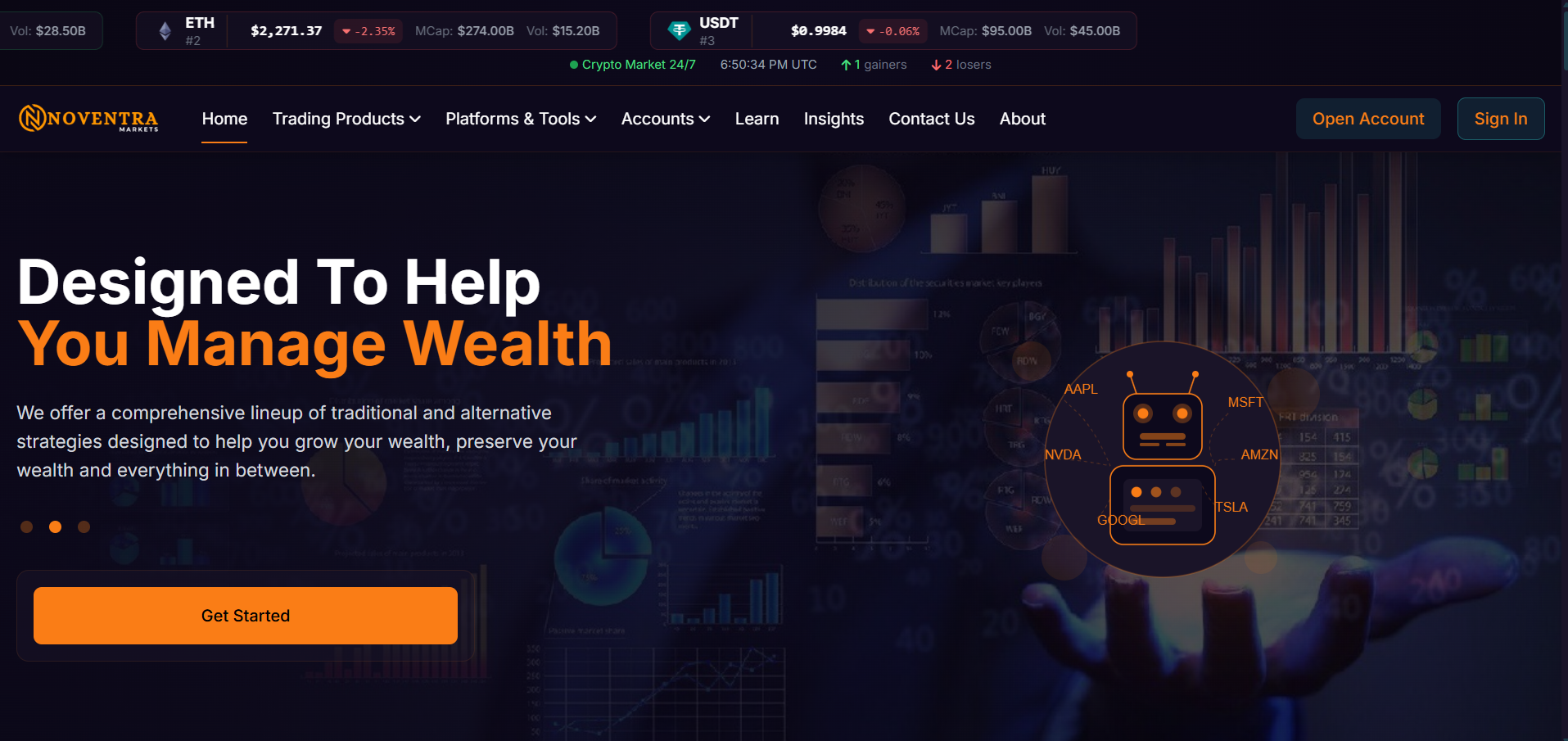
Is Noventra Exchange Regulated and Safe?
At first glance, the platform seems secure by using HTTPS encryption, modern client portal security, and listing corporate addresses. These elements provide a sense of technical safety when registering accounts or submitting personal identification. However, web security does not equal legal financial authorization or regulatory oversight. Noventra Exchange lacks valid licenses from respected regulatory bodies such as the UK’s Financial Conduct Authority (FCA), Australia’s ASIC, or the Cyprus Securities and Exchange Commission (CySEC). In fact, ASIC has officially included Noventra on its Investor Alert List as an unlicensed entity. Without regulatory supervision, traders miss critical protections like segregated client accounts, negative balance protection, and compensation schemes, leaving investments vulnerable if the company freezes withdrawals or ceases operations.
What Can You Trade with Noventra Exchange?
Noventra Exchange provides access to over 200 derivative instruments, enabling users to build diverse multi-asset portfolios on a single platform:
- Forex Currency Pairs: Major, minor, and exotic pairs including EUR/USD, GBP/JPY, and USD/CAD for broad market exposure.
- Precious Metals & Energies: Gold (XAU/USD), Silver (XAG/USD), WTI Crude Oil, and Natural Gas to capitalize on commodity price movements.
- Global Stock Indices: CFDs on major international indices like US30, NAS100, and GER40 to support index trading strategies.
- Cryptocurrency Pairs: Over 100 high-volatility crypto CFDs available 24/7 for leveraged speculation, catering to growing digital asset interest.
- Individual Share CFDs: CFDs on leading US and European equities to expand diversification options.
Note: All instruments on Noventra Exchange are traded as Contracts for Difference (CFDs), meaning traders speculate on price movements without owning the underlying shares or tokens. Since the platform uses an internal price feed without independent verification, pricing transparency can be compromised.
Real Trader Feedback & Noventra Exchange Reviews
Trader feedback highlights a contrast between smooth initial account setup and difficulties with withdrawals:
- Positive Early Experience: New users praise fast onboarding, quick approvals, and responsive community managers offering personalized advice and support.
- Withdrawal Problems: Ratings decline sharply when traders request payouts. Many report delayed withdrawals, unhelpful support, and sudden demands for extra “tax” or “activation” deposits before processing, raising serious doubts about platform integrity.

Trading Platforms and Technical Tools
Noventra Exchange offers a proprietary browser-based web terminal with clean chart layouts, built-in drawing tools, and standard technical indicators. It runs smoothly on desktop and mobile browsers without requiring heavy software installations, making it convenient for quick market monitoring and trade scaling. However, Noventra Exchange does not support industry-standard platforms like MetaTrader 4 (MT4), MetaTrader 5 (MT5), or cTrader. Using proprietary, closed-source code without independent market connections means trade execution speeds and price quotes can be manipulated internally, exposing traders to unchecked slippage and operational risks.
Noventra Exchange Account Types and Leverage
Though they offer various account tiers, all are deceptive and structured to cause client losses. They provide unrealistically high leverage, which is extremely risky and unsuitable for beginners despite marketing claims. Their account options are tactics to extract larger deposits rather than support traders. Genuine brokers provide leverage responsibly and promote safe trading. Noventra Exchange does not.
Account Types Offered
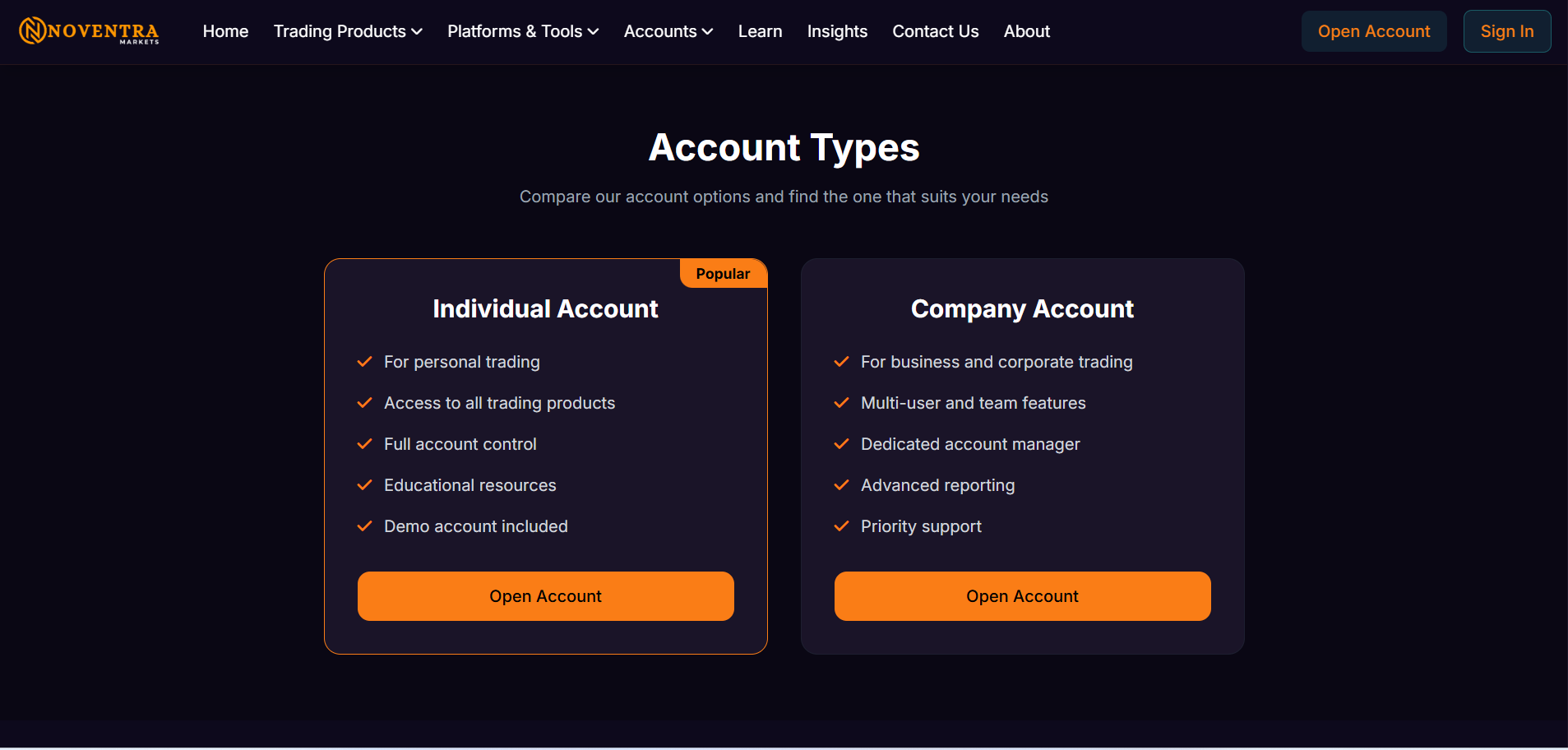
Noventra Exchange provides two main structures depending on who holds ownership of the account:
1. Individual Account
An Individual Account is registered under a single person’s legal name and is intended for retail traders managing personal capital.
- Ownership: Owned and operated strictly by one individual.
- Verification (KYC): Requires standard personal identification, such as a government-issued ID (Passport or Driver’s License) and proof of address (utility bill or bank statement).
- Funding & Withdrawals: All deposits and cash-outs must originate from and return to a personal bank account or wallet matching the registered individual’s legal name.
- Best For: Everyday retail day traders and crypto investors trading personal funds.
2. Company (Corporate) Account
A Company Account is registered under a legally incorporated business entity (such as an LLC, Corporation, or Partnership).
- Ownership: Owned by the business entity. Trading authority is assigned to designated representatives or corporate officers.
- Verification (KYB): Requires business documentation, including the Certificate of Incorporation, Articles of Association, proof of business address, and KYC documents for all directors and major shareholders (>25% ownership).
- Funding & Withdrawals: Financial transactions must go through a corporate bank account or business crypto wallet held under the exact legal company name.
- Best For: Proprietary trading firms, investment companies, and businesses seeking institutional exposure or corporate asset hedging.
Customer Support Quality: Is It Reliable?
Noventra Exchange provides multiple support channels including live chat, email tickets, and direct messaging. Support is prompt and courteous during registration and deposits, creating a welcoming atmosphere. However, support quality declines sharply when handling disputes or withdrawal requests. Agents often become evasive, provide automated replies, or demand additional deposits for “account verification,” undermining user confidence.
Noventra Exchange vs. Regulated Competitors
Noventra Exchange vs. AvaTrade Noventra offers easy registration but lacks regulatory safeguards. AvaTrade holds multiple global licenses, providing negative balance protection, segregated accounts, and transparent pricing. Noventra Exchange vs. RoboForex Noventra relies on an unverified internal system, while RoboForex offers verified execution, regulatory oversight, and automated instant withdrawals. Noventra Exchange vs. Exness Noventra’s manual withdrawal reviews cause delays, whereas Exness provides deep institutional liquidity, full fee transparency, and automated instant payouts.
Final Verdict: Is Noventra Exchange Safe or a Scam?
Despite its polished interface, high leverage, and commission-free trading, Noventra Exchange carries significant operational risks that outweigh its advantages. Its lack of Tier-1 regulation, proprietary internal trading terminal, and numerous withdrawal complaints make it unsafe for serious investors. To protect your capital and ensure compliance, trade only with brokers regulated by strict authorities like FCA, ASIC, or CySEC, which offer trusted services and transparent pricing. Also Read: AvaTrade Review 2024- Expert Trader Insights
Noventra Exchange Review FAQs
How long does a withdrawal take on Noventra Exchange?
Though Noventra claims withdrawals take 24 to 48 hours, users often report delays lasting weeks or blocked payouts due to extra clearance fees, impacting your confidence and finances.
Is Noventra Exchange a regulated forex broker?
No. Noventra Exchange lacks valid Tier-1 licenses from regulators like FCA or ASIC, leaving client funds unprotected by compensation schemes and increasing operational risks.
Can I use automated EAs or trading bots on Noventra Exchange?
No. Since Noventra Exchange uses a proprietary web terminal instead of standard MetaTrader or cTrader platforms, it does not support custom Expert Advisors or automated trading bots, limiting automation options. OPEN AN ACCOUNT NOW WITH NOVENTRA EXCHANGE AND GET YOURS BONUS
The verdict on Noventra Exchange
Despite its polished interface, high leverage, and commission-free trading, Noventra Exchange carries significant operational risks that outweigh its advantages. Its lack of Tier-1 regulation, proprietary internal trading terminal, and numerous withdrawal complaints make it unsafe for serious investors. To protect your capital and ensure compliance, trade only with brokers regulated by strict authorities like FCA, ASIC, or CySEC, which offer trusted services and transparent pricing.