

Learn To Trade Forex • Best Forex Trading Course • AsiaForexMentor

Nvidia’s Blowout Quarter Powers Chip Rally, But Breadth Is Narrowing

Written by:

Ezekiel Chew

Last updated on:

September 6, 2026

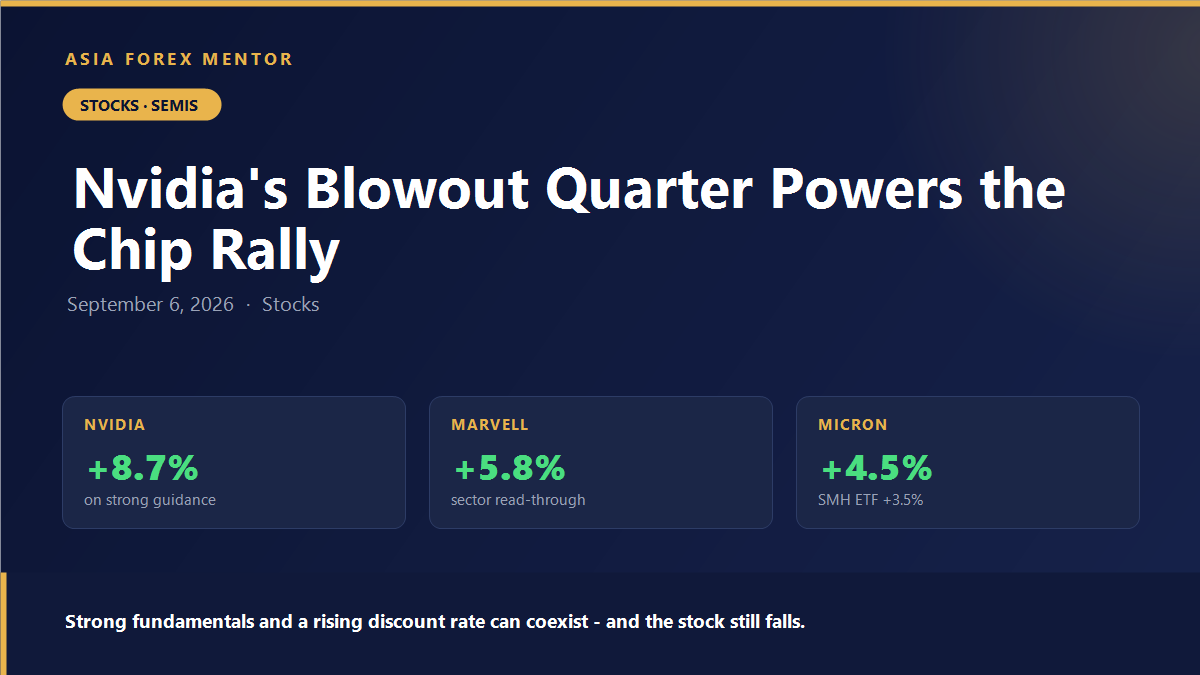
Nvidia up 8.7% with Marvell up 5.8% and Micron up 4.5% on the chip rally

Nvidia delivered the quarter the bulls needed, the chip complex rallied hard on it, and the market is now facing an uncomfortable question: what happens to the S&P 500 if this one theme stops working?

Nvidia shares jumped 8.7% after beating analyst expectations and guiding to strong revenue growth, with projections putting fiscal 2028 revenue growth near 70% — well above what analysts had modelled. The read-through hit the entire semiconductor complex: Marvell Technology gained 5.8%, Micron added 4.5%, and the VanEck Semiconductor ETF rose 3.5%. The Nasdaq Composite climbed 1.57% to 26,541.35 on the strength of the results.

Then, a week later, the jobs report arrived and the Nasdaq gave much of it back, closing at 26,506.99 on 4 September as rate hike odds jumped to 58%.

That sequence is the story of this market in miniature.

The Numbers Behind the Guidance

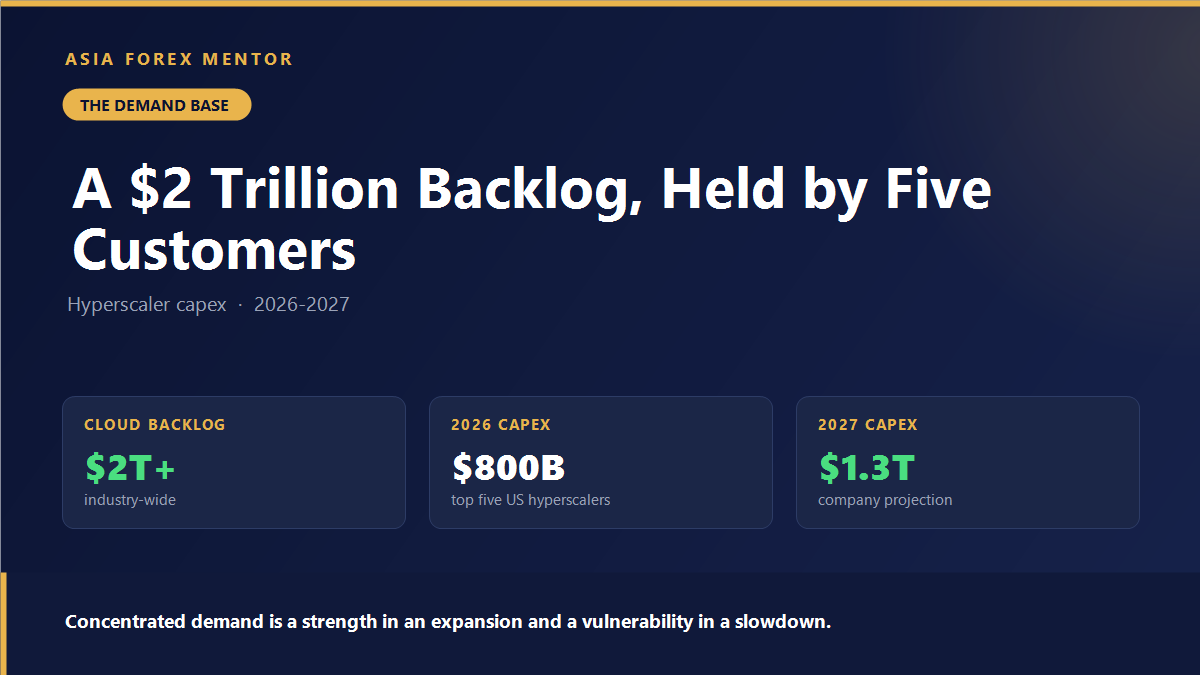
Nvidia’s case rests on demand it says is already contracted rather than forecast. The company points to a cloud computing industry backlog exceeding $2 trillion, and expects capital expenditure from the top five US hyperscalers to rise from roughly $800 billion in 2026 to $1.3 trillion in 2027.

If that capex path holds, the revenue guidance is conservative. Hyperscaler capital expenditure is the most direct input into Nvidia’s order book, and a $500 billion year-on-year increase across five customers is an enormous tailwind.

The risk sits in the same sentence. Five customers. Hyperscaler capex is a budget decision, not a contractual obligation, and budgets get revised when financing costs rise or when the return on the previous year’s spending disappoints. A demand base that concentrated is a strength in an expansion and a vulnerability in a slowdown.

Half the Market’s Earnings Growth Comes From One Theme

This is the number that should shape how traders think about index exposure right now.

Consensus expects the S&P 500 to deliver 11% revenue growth and 23% earnings growth in 2026 — the fastest on both measures in several years. AI-infrastructure beneficiaries are expected to account for roughly half of that earnings growth.

An investor holding an S&P 500 index fund believes they own 500 companies. On the earnings growth that justifies the index’s current multiple, they substantially own one theme.

That is why analysts have flagged narrowing market breadth alongside a sharp increase in momentum as cautionary signals. Both describe the same condition: fewer names carrying more of the load.
Cloud backlog above 2 trillion dollars with hyperscaler capex rising from 800 billion to 1.3 trillion

The Valuation Math

The index entered 2026 with a forward P/E near 22, a level exceeded only during the dot-com bubble and the COVID-19 period. Strategists expect the multiple to hold around 21 times, with any benefit from lower Treasury yields offset by slowing growth, geopolitical uncertainty, and — explicitly — investor scepticism about the durability of AI-related profits.

Read that carefully. The consensus forecast already assumes the market will not pay a higher multiple for AI earnings. Analysts are modelling growth they do not fully trust.

That scepticism is rational. The question is not whether AI infrastructure spending is real — the capex figures are real and being spent. It is whether the companies spending $1.3 trillion in 2027 will earn an adequate return on it, because that determines whether they spend similarly in 2028.

September Has a History Here

Two additional cautions are worth noting. September has historically been a weak month for this stock specifically, and analysts describe the month as a test of whether the latest earnings beat marks the start of another growth phase or the peak of an extraordinary AI cycle.

Seasonality is a weak signal on its own. But combined with a coin-flip Fed meeting on 15–16 September and a market whose earnings growth is half-dependent on one theme, it argues for caution rather than conviction.

How the Rate Story Connects

Long-duration growth stocks are the most sensitive assets on the board to the discount rate, because more of their value sits in distant cash flows. That is precisely why the Nasdaq gave back its Nvidia-driven gains when payrolls beat and yields rose.

With the two-year Treasury yield at its highest since January 2025 and roughly 58% odds of a September hike, AI infrastructure names face a genuine headwind that has nothing to do with their order books. Strong fundamentals and a rising discount rate can coexist, and when they do, the stock falls anyway.

Practical Takeaways

Know what you actually own. If you hold an S&P 500 or Nasdaq index product, quantify your AI-infrastructure exposure. It is likely larger than the sector weightings suggest once you account for earnings contribution.

Separate the business from the stock. Nvidia can execute perfectly and still fall on a hawkish CPI print. Confusing a rate-driven drawdown with a thesis break is one of the most common ways traders exit good positions at bad prices.

Watch hyperscaler capex guidance, not chip earnings. Nvidia’s results are a lagging indicator of a decision five customers made months earlier. The forward signal is in their capital expenditure guidance.

Narrow breadth cuts both ways. Concentration amplifies gains on the way up and losses on the way down. It is not a reason to avoid the theme — it is a reason to size it deliberately.

For traders building exposure to this theme, our stock trading guides and market analysis cover position sizing and risk management in concentrated markets.

The Bottom Line

Nvidia’s quarter was strong and the backlog behind it is real. But a market trading near 21 times forward earnings, drawing half its earnings growth from one theme, with narrowing breadth and a coin-flip rate decision days away, is a market where being right about the business is not the same as being right about the stock.

Figures cited are as of 4 September 2026. Market data moves quickly; verify current levels before trading. This article is general information, not personal financial advice.

About Ezekiel Chew​

Ezekiel Chew, founder and head of training at Asia Forex Mentor, is a renowned forex expert, frequently invited to speak at major industry events. Known for his deep market insights, Ezekiel is one of the top traders committed to supporting the trading community. Making six figures per trade, he also trains traders working in banks, fund management, and prop trading firms.

Nvidia’s Blowout Quarter Powers Chip Rally, But Breadth Is Narrowing

Written by:

Updated:

September 6, 2026
Nvidia up 8.7% with Marvell up 5.8% and Micron up 4.5% on the chip rally Nvidia delivered the quarter the bulls needed, the chip complex rallied hard on it, and the market is now facing an uncomfortable question: what happens to the S&P 500 if this one theme stops working? Nvidia shares jumped 8.7% after beating analyst expectations and guiding to strong revenue growth, with projections putting fiscal 2028 revenue growth near 70% — well above what analysts had modelled. The read-through hit the entire semiconductor complex: Marvell Technology gained 5.8%, Micron added 4.5%, and the VanEck Semiconductor ETF rose 3.5%. The Nasdaq Composite climbed 1.57% to 26,541.35 on the strength of the results. Then, a week later, the jobs report arrived and the Nasdaq gave much of it back, closing at 26,506.99 on 4 September as rate hike odds jumped to 58%. That sequence is the story of this market in miniature.

The Numbers Behind the Guidance

Nvidia's case rests on demand it says is already contracted rather than forecast. The company points to a cloud computing industry backlog exceeding $2 trillion, and expects capital expenditure from the top five US hyperscalers to rise from roughly $800 billion in 2026 to $1.3 trillion in 2027. If that capex path holds, the revenue guidance is conservative. Hyperscaler capital expenditure is the most direct input into Nvidia's order book, and a $500 billion year-on-year increase across five customers is an enormous tailwind. The risk sits in the same sentence. Five customers. Hyperscaler capex is a budget decision, not a contractual obligation, and budgets get revised when financing costs rise or when the return on the previous year's spending disappoints. A demand base that concentrated is a strength in an expansion and a vulnerability in a slowdown.

Half the Market's Earnings Growth Comes From One Theme

This is the number that should shape how traders think about index exposure right now. Consensus expects the S&P 500 to deliver 11% revenue growth and 23% earnings growth in 2026 — the fastest on both measures in several years. AI-infrastructure beneficiaries are expected to account for roughly half of that earnings growth. An investor holding an S&P 500 index fund believes they own 500 companies. On the earnings growth that justifies the index's current multiple, they substantially own one theme. That is why analysts have flagged narrowing market breadth alongside a sharp increase in momentum as cautionary signals. Both describe the same condition: fewer names carrying more of the load. Cloud backlog above 2 trillion dollars with hyperscaler capex rising from 800 billion to 1.3 trillion

The Valuation Math

The index entered 2026 with a forward P/E near 22, a level exceeded only during the dot-com bubble and the COVID-19 period. Strategists expect the multiple to hold around 21 times, with any benefit from lower Treasury yields offset by slowing growth, geopolitical uncertainty, and — explicitly — investor scepticism about the durability of AI-related profits. Read that carefully. The consensus forecast already assumes the market will not pay a higher multiple for AI earnings. Analysts are modelling growth they do not fully trust. That scepticism is rational. The question is not whether AI infrastructure spending is real — the capex figures are real and being spent. It is whether the companies spending $1.3 trillion in 2027 will earn an adequate return on it, because that determines whether they spend similarly in 2028.

September Has a History Here

Two additional cautions are worth noting. September has historically been a weak month for this stock specifically, and analysts describe the month as a test of whether the latest earnings beat marks the start of another growth phase or the peak of an extraordinary AI cycle. Seasonality is a weak signal on its own. But combined with a coin-flip Fed meeting on 15–16 September and a market whose earnings growth is half-dependent on one theme, it argues for caution rather than conviction.

How the Rate Story Connects

Long-duration growth stocks are the most sensitive assets on the board to the discount rate, because more of their value sits in distant cash flows. That is precisely why the Nasdaq gave back its Nvidia-driven gains when payrolls beat and yields rose. With the two-year Treasury yield at its highest since January 2025 and roughly 58% odds of a September hike, AI infrastructure names face a genuine headwind that has nothing to do with their order books. Strong fundamentals and a rising discount rate can coexist, and when they do, the stock falls anyway.

Practical Takeaways

Know what you actually own. If you hold an S&P 500 or Nasdaq index product, quantify your AI-infrastructure exposure. It is likely larger than the sector weightings suggest once you account for earnings contribution. Separate the business from the stock. Nvidia can execute perfectly and still fall on a hawkish CPI print. Confusing a rate-driven drawdown with a thesis break is one of the most common ways traders exit good positions at bad prices. Watch hyperscaler capex guidance, not chip earnings. Nvidia's results are a lagging indicator of a decision five customers made months earlier. The forward signal is in their capital expenditure guidance. Narrow breadth cuts both ways. Concentration amplifies gains on the way up and losses on the way down. It is not a reason to avoid the theme — it is a reason to size it deliberately. For traders building exposure to this theme, our stock trading guides and market analysis cover position sizing and risk management in concentrated markets.

The Bottom Line

Nvidia's quarter was strong and the backlog behind it is real. But a market trading near 21 times forward earnings, drawing half its earnings growth from one theme, with narrowing breadth and a coin-flip rate decision days away, is a market where being right about the business is not the same as being right about the stock. Figures cited are as of 4 September 2026. Market data moves quickly; verify current levels before trading. This article is general information, not personal financial advice.

ezekiel chew asiaforexmentor

About Ezekiel Chew

Ezekiel Chew, founder and head of training at Asia Forex Mentor, is a renowned forex expert, frequently invited to speak at major industry events. Known for his deep market insights, Ezekiel is one of the top traders committed to supporting the trading community. Making six figures per trade, he also trains traders working in banks, fund management, and prop trading firms.

RELATED ARTICLES

Join the Live Event
Get Your Free Ticket Now

I consent to receiving emails and/or text message reminders for this event.

REGISTER FOR THE MASTERCLASS!