
The yen just delivered its sharpest move in a month, and it happened for a reason that should interest every currency trader: for the first time in years, the Bank of Japan and the Ministry of Finance appear to be pulling in the same direction.
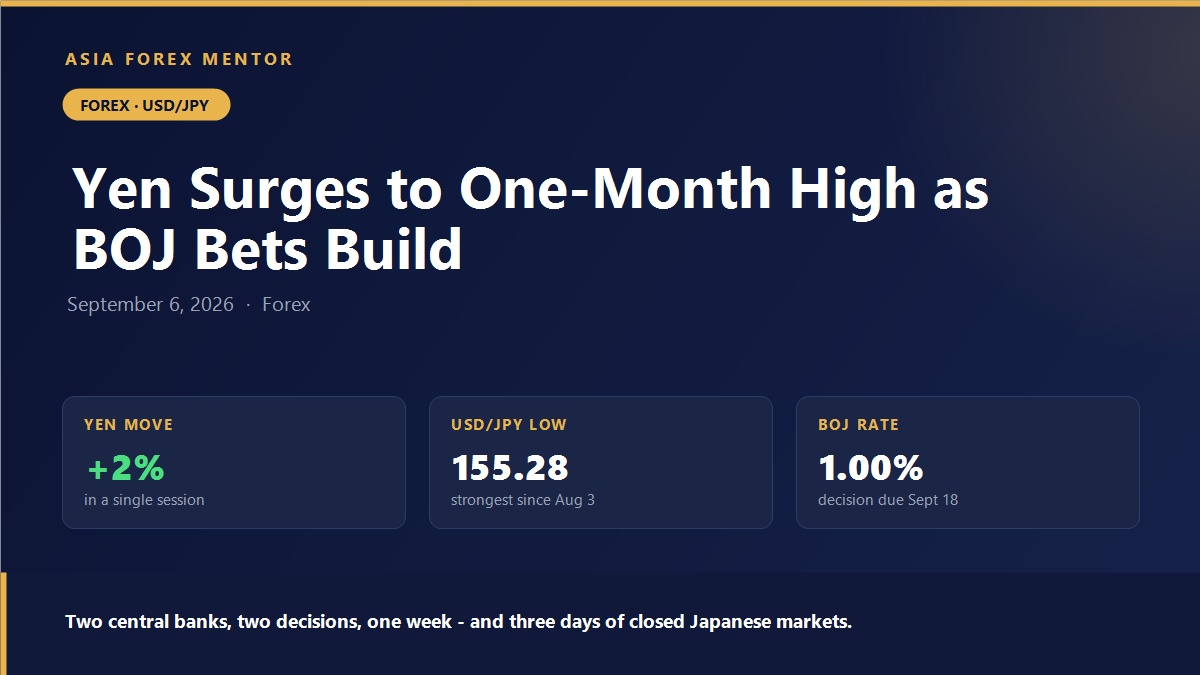
On Thursday 3 September the yen jumped more than 2% against the US dollar, touching 155.28 per dollar at one point — its strongest level since 3 August. The move came as traders weighed the prospect of further Japanese intervention against rapidly rising expectations for a Bank of Japan rate hike.
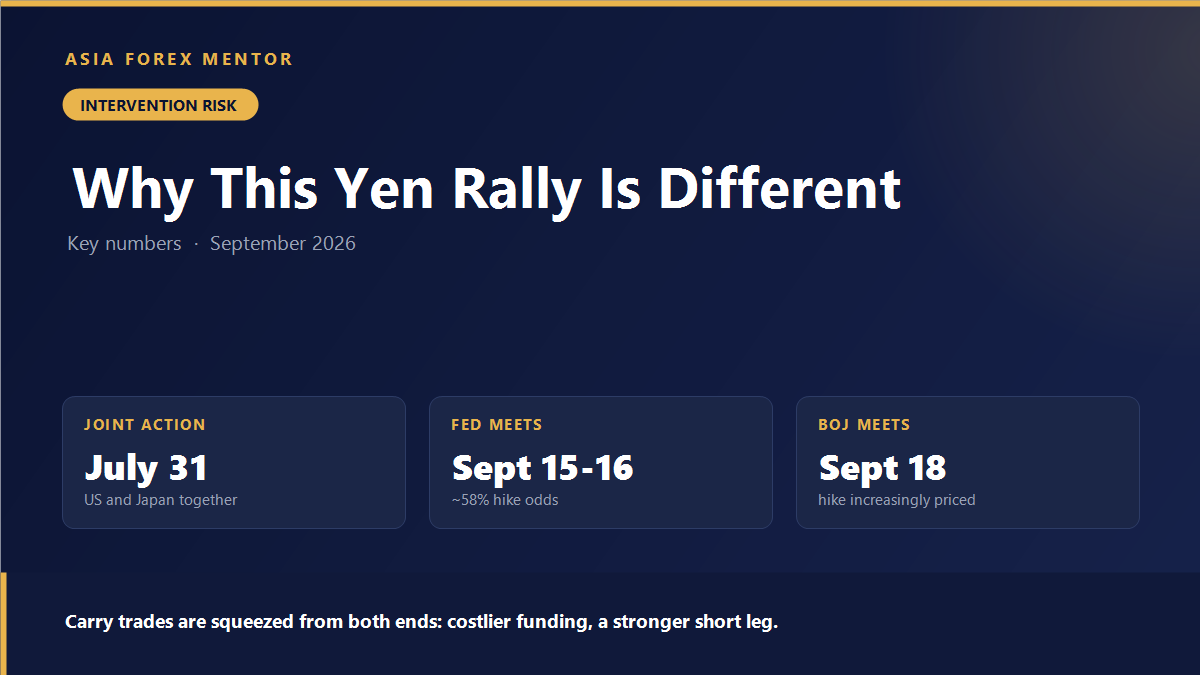
Both forces are now converging on a single date: 18 September.
What Changed at the Bank of Japan
The BOJ held its policy rate at 1% at its 31 July meeting — the highest in three decades, after raising from 0.75% — while warning that core inflation was running above its 2% target. At the time, the market read the hold as a pause.
That reading is no longer safe. BOJ board member Hajime Takata said this week that the central bank should raise rates “nimbly” in response to rising inflation, and suggested the BOJ could move faster or in larger increments than the roughly semiannual pace it has settled into. Coming from a sitting board member weeks before a decision, that is not idle commentary — it is guidance.
Markets are now pricing a hike at the 18 September meeting with increasing conviction.
The Intervention Overhang
Running alongside the rate story is something rarer and, for short-term traders, considerably more dangerous.
On 31 July, the United States and Japan staged a joint intervention to support the yen. Coordinated intervention between the two countries is unusual — Japan has more often acted alone, and typically without Washington’s public blessing. A joint operation signals that both governments regarded yen weakness as a shared problem, which meaningfully raises the credibility of any future action.
That credibility is the whole point. Intervention works less through the size of the flows than through the fear of the next one. Every trader running a short-yen carry position now has to price the possibility that the MOF steps in again.
There is a specific window worth marking. Traders are watching for possible intervention around the thin liquidity of Japan’s “Silver Week” holidays, which close markets for three consecutive days immediately after the BOJ meeting. Thin markets amplify the impact of intervention flows — which is exactly why authorities have historically favoured them.
Why the Carry Trade Is the Real Story
The yen has spent years as the world’s funding currency. Borrow at near-zero in Japan, buy something yielding more elsewhere, collect the difference. It works beautifully until the funding currency appreciates.
A BOJ that is hiking, backed by a treasury willing to intervene, attacks that trade from both ends: the cost of the funding leg rises, and the currency you are short strengthens. That is why yen rallies tend to be violent rather than orderly — they are not accumulation, they are unwinding.
Consensus forecasts still put USD/JPY in a 156–162 range for September, with Q4 projections around 160. But those ranges were built before this week’s repricing, and a forecast range is a poor guide during a positioning unwind.
The Complication: The Fed Is Hiking Too
Here is what makes this pair genuinely difficult rather than simply bullish-yen.
The same week that BOJ hike bets firmed, US non-farm payrolls came in at 162,000 against a 53,000 forecast, pushing the implied odds of a Federal Reserve hike on 16 September to around 58%. The FOMC meets two days before the BOJ.
So USD/JPY faces two central bank decisions in the same week, both leaning hawkish, in opposite directions for the pair. The rate differential — the single biggest driver of USD/JPY over the past three years — may barely move even if both banks hike. What moves instead is volatility.
Practical Notes for Traders
Intervention risk is not a stop-loss problem, it is a gap problem. Historical intervention has moved USD/JPY several figures in minutes. A stop does not guarantee your exit price; it guarantees an order. Size positions on the assumption that your fill could be materially worse than your level.
Watch the holiday calendar, not just the economic one. The three-day Japanese market closure after the BOJ decision is a structural liquidity event. Carrying size through it is a different risk than carrying it through a normal weekend.
Two decisions in one week compounds, it does not average. Traders often net two opposing catalysts down to “no change.” In practice you get both moves, sequentially, with a whipsaw between them.
Check what your broker does during intervention. Not every broker handles a several-figure gap the same way. Spreads, slippage policy and margin treatment vary considerably — our forex broker reviews break down execution conditions broker by broker.
What to Watch Next
The sequence is tight: US CPI on 11 September, the FOMC on 15–16 September, and the Bank of Japan on 18 September, followed immediately by three days of closed Japanese markets.
That is four catalysts inside eight sessions in a pair that has already moved 2% in a day. Whatever your directional view, this is a period that rewards smaller positions and wider stops rather than conviction.
Figures cited are as of 4 September 2026. Market data moves quickly; verify current levels before trading. This article is general information, not personal financial advice.