Hey traders, Ezekiel here! Time to break down the market quickly—what’s happening now, why you should pay attention, and how to trade it with confidence.
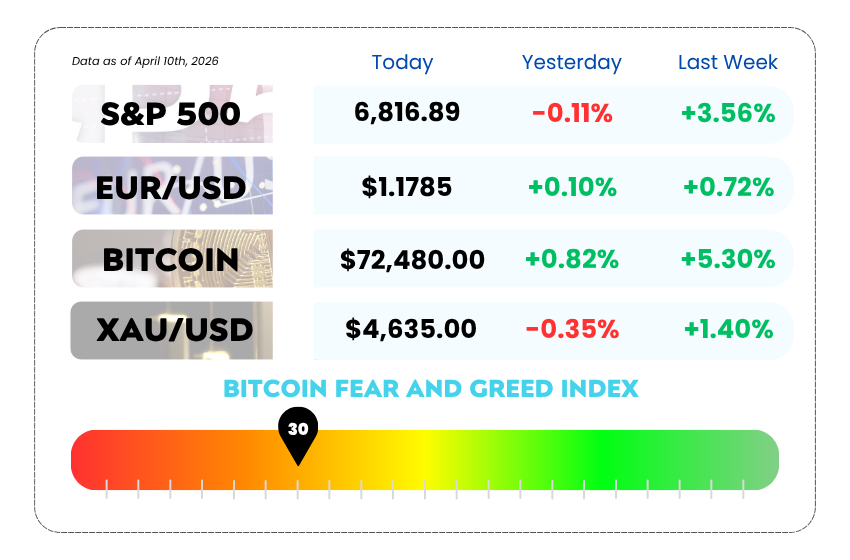
- Today's market mayhem. S&P 500, EUR/USD, Bitcoin, and XAU/USD today
- EUR/USD is holding above 1.1800 as markets lean into calm instead of chaos
- Microsoft just popped 4% as AI fears flip into AI demand and Azure roars back
- Most traders misuse Fibonacci Extensions, we show you the right framework in our video
WEEKLY MARKET MAYHEM🔥
For this week's market mayhem, here’s what we got for you today:

The S&P 500 Just Had Its Best Week Since November, And A Fragile Ceasefire Is The Only Reason Why 📈
The S&P 500 slipped slightly on Friday, closing down 0.11% at 6,816.89, but nobody really cared because the weekly scoreboard tells the real story: the index just gained 3.6%, its best week since last November 🚀
The Nasdaq did even better, surging 4.7% on the week, carried by semiconductor heavyweights like Nvidia and Broadcom that continue to power the AI trade. The Dow added 3%. Nineteen S&P 500 stocks hit new 52-week highs in a single session, including names like SanDisk, Corning, and GE Vernova.
So what sparked this rally? Two words: ceasefire hopes.
The fragile two-week ceasefire between the U.S. and Iran has been enough to shift the market's mood from “prepare for the worst” to “maybe things will be okay” 🤞 And when fear fades even a little, risk assets go on a shopping spree.
But here's the uncomfortable truth: this entire rally is built on geopolitical hope, not economic certainty. The ceasefire is fragile. Tensions around the Strait of Hormuz are not resolved. Oil is still elevated. And if negotiations break down next week, this entire rally could unwind just as fast as it appeared.
Friday's slight dip was a reminder of exactly that. Trump doubled down on his aggressive posture toward Iran, and the market flinched just enough to end the day in the red, even as the weekly gains remained massive.
The semiconductor trade is also getting extremely crowded. When chip stocks are carrying the entire market, that creates concentration risk. If sentiment toward AI spending shifts even slightly, the names holding up the indexes could become the names dragging them down.
🤔 Asia Forex Mentor Insights
This was a relief rally, not a fundamentals rally. The S&P gained 3.6% in one week almost entirely because traders believe the ceasefire will hold. That makes the market extremely sensitive to any headline that suggests otherwise. For traders, the risk/reward here is tricky. Chasing this rally after a 3.6% weekly gain means buying into crowded optimism with binary headline risk.
The smarter play is to wait for either a confirmed continuation with improving geopolitical conditions, or a pullback that offers a better entry. Right now, the market is priced for peace, and if peace doesn't deliver, the correction could be sharp and fast.
Wall Street's Biggest Names Are Quietly Going On-Chain, And The Numbers Are Getting Ridiculous 🏦
Here's something that happened this week that didn't get nearly enough attention.
Six of the world's largest financial institutions just joined Pyth Network to distribute proprietary institutional data on-chain. We're talking Euronext, Fidelity, Tradeweb, OTC Markets Group, SGX FX, and EDI 🏛️ These are not crypto-native startups. These are the companies that power traditional financial markets.
Through the new Pyth Data Marketplace, they're now pushing spot FX pricing, precious metals data, crude swaps, OTC pricing, fixed income data, corporate actions, and reference data directly on-chain. In plain English, the same data that powers Wall Street trading desks is now flowing into DeFi infrastructure.

Meanwhile, Europe's largest asset manager Amundi (managing €2.3 trillion in assets) teamed up with Spiko to launch a tokenized mutual fund on Ethereum and Stellar, powered by Chainlink. The Spiko Amundi Overnight Swap Fund hit $400 million in AUM in just three weeks, making it the fastest-growing tokenized fund ever launched. That's not a pilot program. That's institutional capital flooding into on-chain infrastructure at speed.
And there's more 🔥 Jump Crypto's Firedancer launched a $1 million bug bounty audit competition for its Solana validator client, running from April 9 to May 9. Firedancer is one of the most anticipated pieces of Solana infrastructure, and offering a million-dollar bounty signals that they're serious about getting it production-ready.
Oh, and the U.S. Treasury's OCCIP launched a cybersecurity information-sharing initiative specifically for digital asset firms, extending the same threat intelligence traditionally reserved for banks to eligible crypto companies at no cost. The government is literally treating crypto firms like banks now, and that's a bigger deal than it sounds.
This is the tokenization wave people have been talking about for years, except it's not “coming” anymore. It's here. When Fidelity, Euronext, and a €2.3 trillion asset manager are all building on-chain in the same week, the narrative has shifted from “will institutions adopt crypto?” to “how fast are they doing it?”
🤔 Asia Forex Mentor Insights
For crypto traders, the institutional infrastructure story is the most important long-term signal happening right now, even though it doesn't move prices the way a Bitcoin breakout does. When the world's largest financial data providers start pushing feeds on-chain, it creates the plumbing for real institutional trading in DeFi.
The Amundi fund hitting $400M in three weeks proves that tokenized assets are no longer experimental. For positioning, this strengthens the bull case for infrastructure tokens like LINK and PYTH, and it reinforces the idea that this crypto cycle is being driven by institutional adoption, not retail speculation.
The short-term price action in Bitcoin around $72,000 may not reflect this yet, but the structural foundation underneath the market is getting stronger by the week.
MEMES OF THE DAY 🤣
Your ego is the most expensive thing you own.

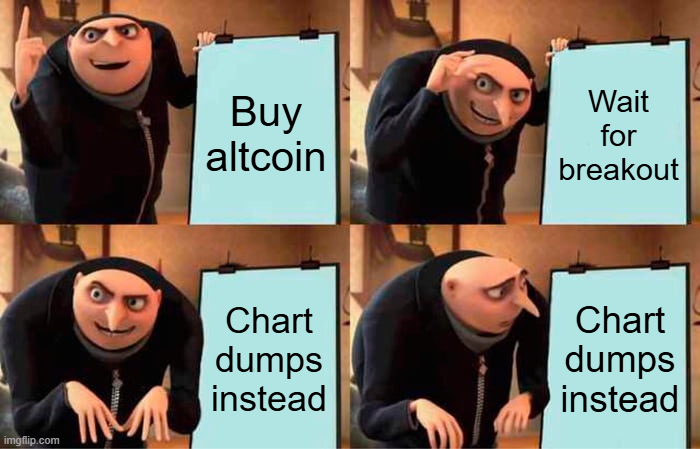
Chart dumps instead