Learn To Trade Forex • Best Forex Trading Course • AsiaForexMentor

The 25 Best Stock Brokers in India in 2025: Expert Rankings

Written by

Ezekiel Chew

Updated on

January 21, 2025

i

The 25 Best Stock Brokers in India in 2025: Expert Rankings

Overall Trust Index

Written by:

Last updated on:

January 21, 2025

Choosing the right stock and share broker in India is crucial for optimizing your investments and navigating the dynamic Indian stock market. The year 2025 brings a rapidly evolving trading landscape, with advanced trading platforms, tailored investment services, and competitive brokerage charges. Selecting a broker requires evaluating factors like low brokerage fees, real-time market data, and access to comprehensive research reports. Whether you're a new investor or a seasoned trader, finding the best fit can significantly impact your financial outcomes.

This guide leverages expert insights to rank the best stock brokers in India, factoring in offerings like mutual funds, portfolio management services, and discount brokerage services. From full-service brokers like HDFC Securities and ICICI Direct to innovative online trading platforms, this list is designed to support informed decisions. Prioritizing features such as seamless trading experiences, user-friendly platforms, and personalized investment solutions, we aim to help investors align their choice with their investment goals and trading needs.


Criteria for Ranking Stock Brokers


Ranking the best stock brokers in India involves evaluating several key factors crucial for retail and experienced investors. Transparency in brokerage charges, including low brokerage fees and affordability in equity delivery trades, is paramount. User-friendly trading platforms with advanced charting tools, real-time market data, and seamless functionality for options trading also weigh heavily in the rankings.

Additionally, stock brokers in India are judged on their investment services, such as portfolio management, mutual funds, and advisory services tailored to investment goals. Trustworthy full-service brokers, like HDFC Securities, ICICI Direct, and Kotak Securities, excel in offering comprehensive research reports and educational resources. The quality of customer support, SEBI compliance, and features like integrated demat accounts and banking services further enhance the overall experience for both new investors and seasoned traders.


The 25 Best Stock Brokers in India in 2025

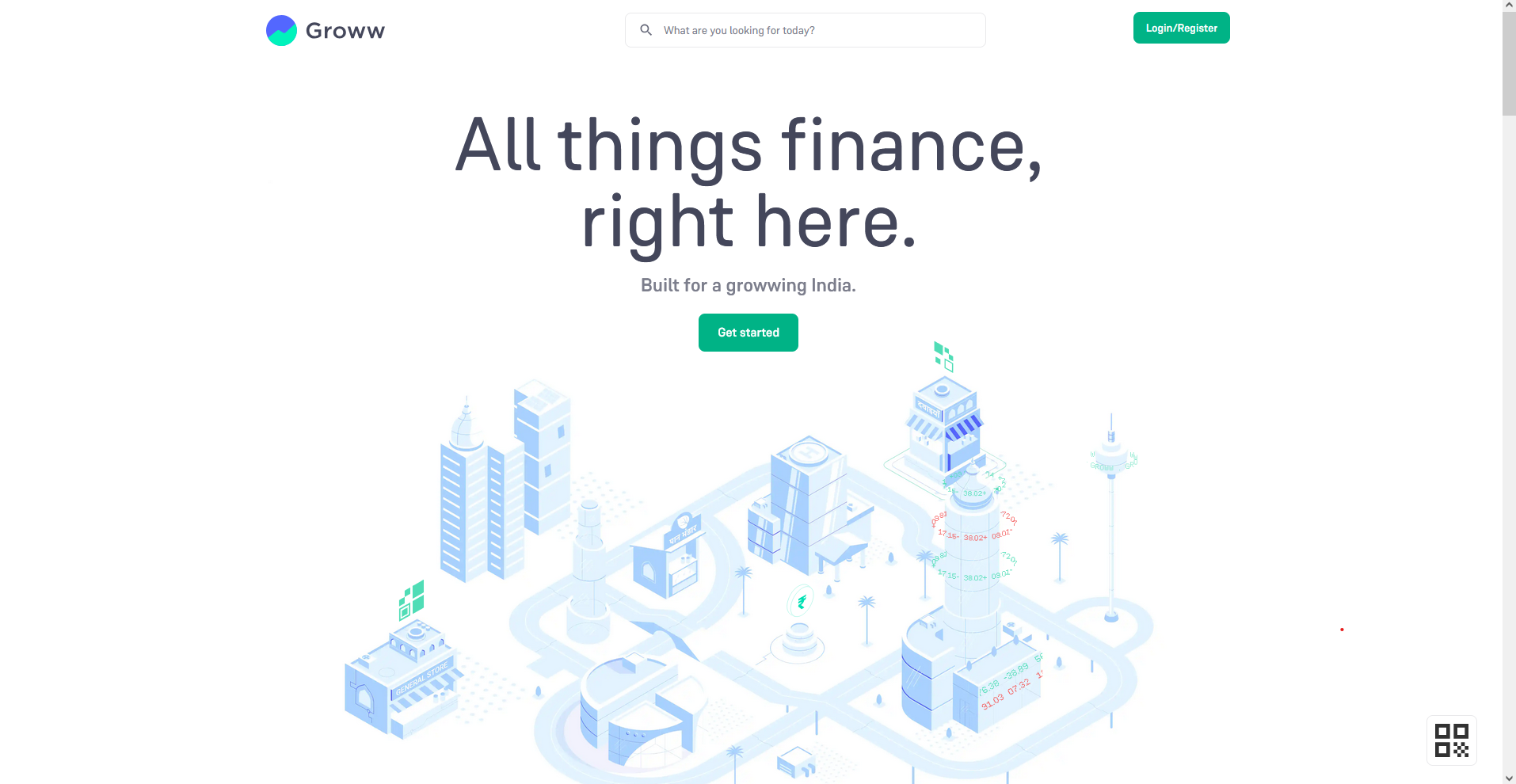
#1. Groww

What is Groww?

Groww is an Indian online investment platform that enables users to invest in stocks, mutual funds, IPOs, and digital gold. Founded in 2016 by former Flipkart employees Lalit Keshre, Harsh Jain, Ishan Bansal, and Neeraj Singh, Groww aims to make investing simple, accessible, and transparent. The platform offers a user-friendly interface and a seamless, paperless account setup process.

Advantages and Disadvantages of Groww

  Advantages
  Disadvantage
  • Low fees

  • User-friendly interface

  • Diverse investment options

  • Paperless account setup

  • Limited customer support

  • No commodity trading

  • No currency trading

  • No research reports

Groww Commissions and Fees

Groww follows a fixed brokerage model, charging a lower of Rs 20 or 0.05% per executed trade for equity delivery, intraday, and F&O trades. The platform offers free mutual fund services with no charges for investing or redemption. Additionally, there are no account opening fees or annual maintenance charges, making it cost-effective for investors.

OPEN AN ACCOUNT NOW WITH GROWW AND GET YOUR WELCOME BONUS


#2. Zerodha
What is Zerodha?

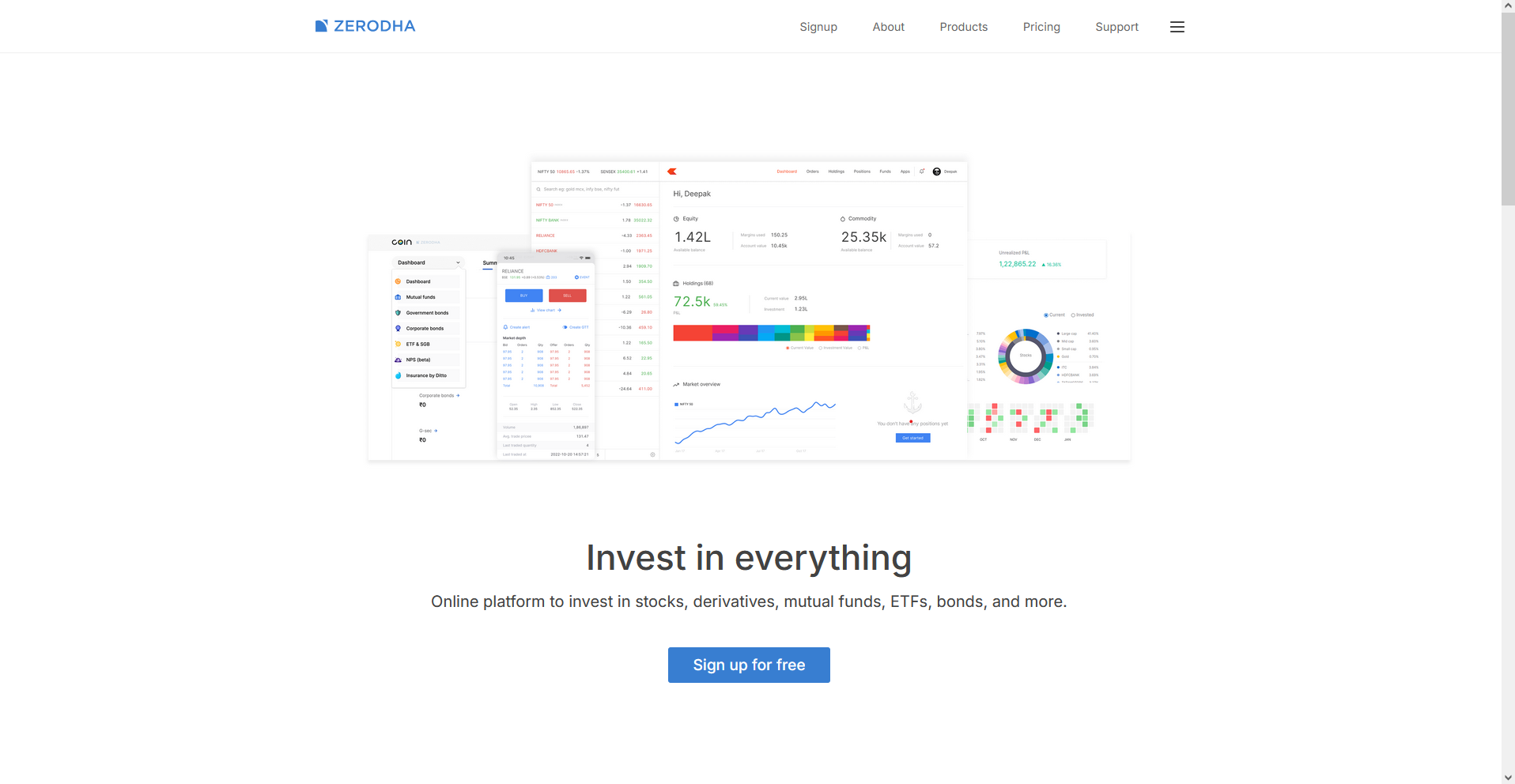
Zerodha, founded in 2010 by Nithin Kamath, is India's largest discount brokerage firm, offering a range of financial services including equity, commodity, and currency trading. It has revolutionized the Indian broking industry with its low-cost trading platforms and innovative technology solutions, attracting a substantial retail client base.

Advantages and Disadvantages of Zerodha

  Advantages
  Disadvantage
  • Low fees

  • User-friendly platforms

  • Comprehensive research tools

  • Diverse product offerings

  • Slow account opening

  • Limited to Indian market

  • No investor protection

  • No negative balance protection

Zerodha Commissions and Fees

Zerodha employs a flat fee structure, charging ₹20 per executed order for intraday and F&O trades, regardless of trade size, while equity delivery trades are free. This transparent pricing model has been instrumental in attracting a large number of retail investors. However, it's important to note that Zerodha does not provide investor protection or negative balance protection, which are considerations for potential clients.

OPEN AN ACCOUNT NOW WITH ZERODHA AND GET YOUR WELCOME BONUS


#3. Angel One
What is Angel One?

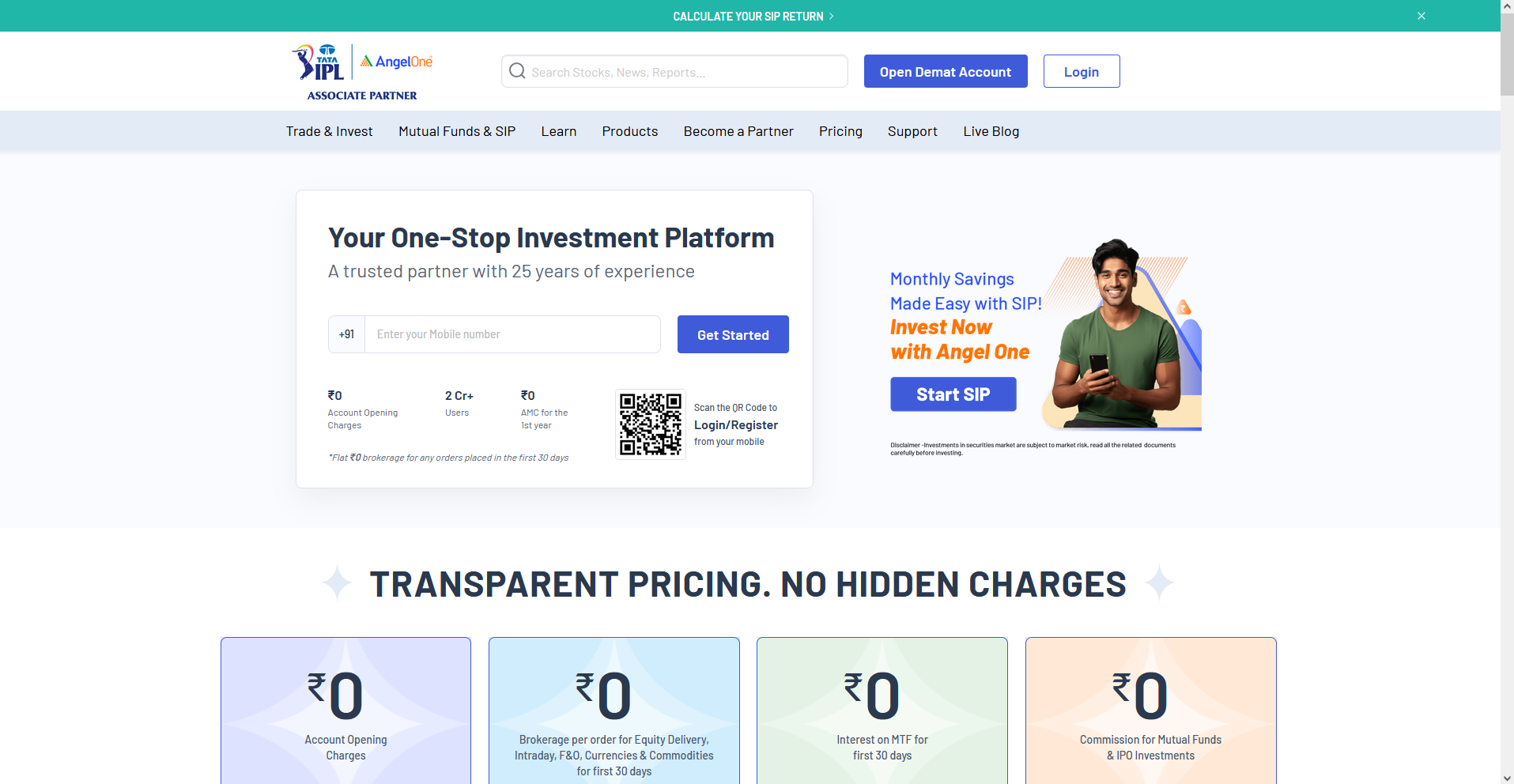
Angel One, formerly known as Angel Broking Limited, is a prominent Indian stockbroking firm established in 1996. It offers a comprehensive suite of financial services, including broking and advisory services, margin funding, loans against shares, and financial product distribution. Operating through both online and digital platforms, Angel One caters to a diverse clientele across India.

Advantages and Disadvantages of Angel One

  Advantages
  Disadvantage
  • User-friendly platform

  • Comprehensive services

  • Competitive pricing

  • Extensive research tools

  • Account maintenance fees

  • Limited international presence

  • No 3-in-1 account

  • Broker-assisted trade fees

Angel One Commissions and Fees

Angel One employs a flat brokerage fee structure, charging a flat INR 20 per executed order or 0.25%, whichever is lower, for all stocks, futures, options, commodities, and currencies, regardless of order size. Notably, there is no account opening fee and no withdrawal fee. However, a monthly account maintenance fee of INR 20 applies. Additionally, while debit card fund transfers are permitted with a nominal fee, credit card deposits are not supported.


OPEN AN ACCOUNT NOW WITH ANGEL ONE AND GET YOUR WELCOME BONUS

#4. Upstox
What is Upstox?


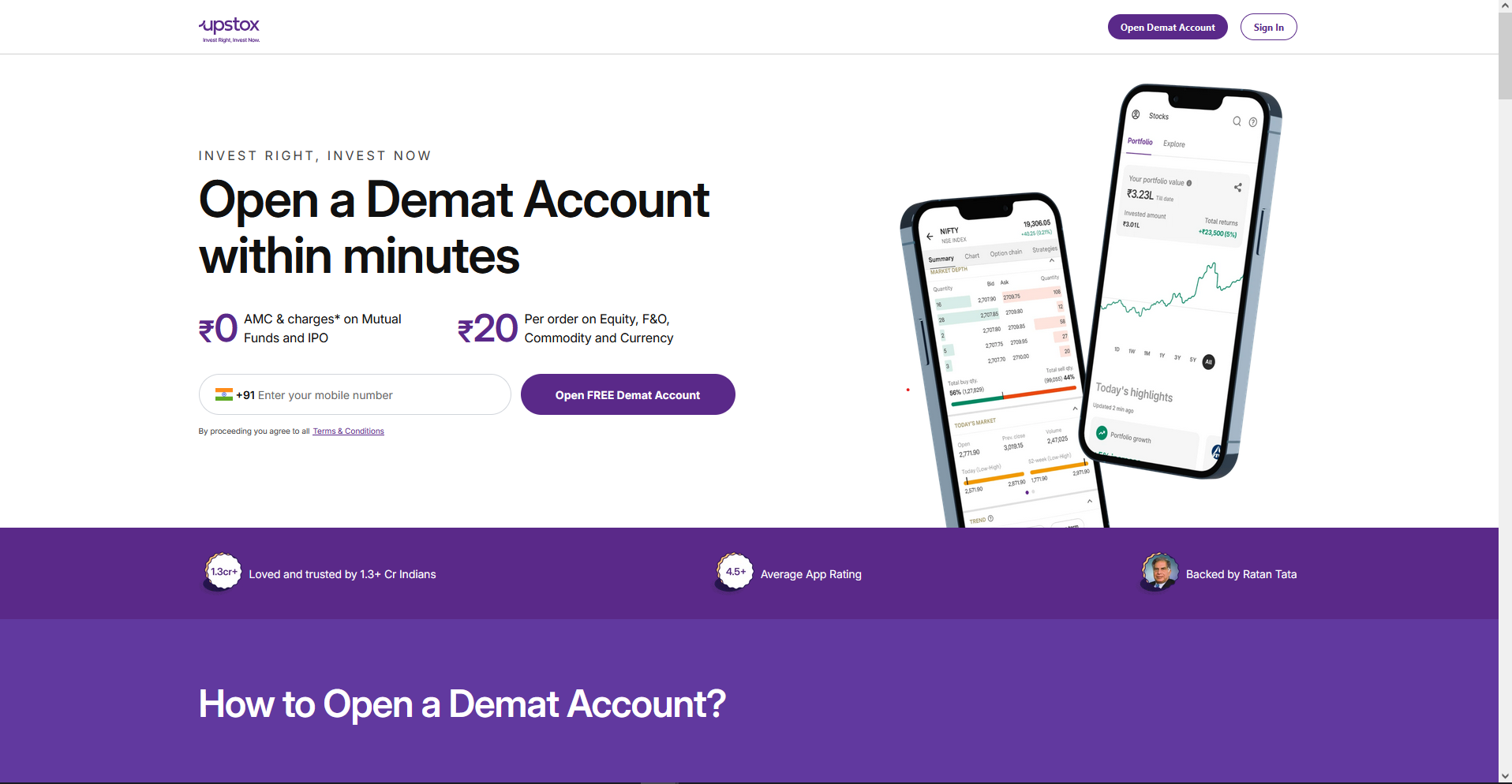
Upstox is a leading Indian discount brokerage firm that offers online services for trading in equities, commodities, currencies, mutual funds, and initial public offerings (IPOs). Founded in 2009 by Ravi Kumar, Raghu Kumar, and Shrini Viswanath, the company aims to make investing simple, affordable, and accessible. With a user-friendly platform and competitive pricing, Upstox has become one of India's fastest-growing brokerage firms.

Advantages and Disadvantages of Upstox

  Advantages
  Disadvantage
  • Low brokerage

  • User-friendly platform

  • Diverse investment options

  • Transparent pricing

  • Limited research tools

  • No branch support

  • Additional charges

  • Occasional technical issues

Upstox Commissions and Fees

Upstox employs a flat-fee brokerage structure, charging up to ₹20 per executed order across various segments, including equity delivery, intraday, futures, options, commodities, and currencies. Notably, there is zero brokerage on mutual funds and IPO investments. This transparent pricing model ensures that traders and investors can manage their costs effectively, regardless of trade size.


OPEN AN ACCOUNT NOW WITH UPSTOX AND GET YOUR WELCOME BONUS

#5. ICICI Direct

What is ICICI Direct?


ICICI Direct is the online trading and investment platform of ICICI Securities, a subsidiary of ICICI Bank. It offers a 3-in-1 account integrating banking, trading, and demat services, providing a seamless experience for retail investors. Through ICICI Direct, users can invest in equities, derivatives, mutual funds, and other financial products.


Advantages and Disadvantages of ICICI Direct

  Advantages
  Disadvantage
  • Comprehensive services

  • Strong brand reputation

  • Extensive research support

  • Wide product range

  • High brokerage fees

  • Minimum brokerage clause

  • No commodity trading

  • Average mobile app

ICICI Direct Commissions and Fees


ICICI Direct's brokerage charges vary based on the chosen plan. For example, under the I-Secure Plan, equity delivery trades incur a brokerage fee of 0.55% of the transaction value. In contrast, the Neo Plan offers zero brokerage on equity futures and a flat fee of Rs 20 per order for intraday and options trading. Additional charges, such as annual maintenance fees and transaction charges, may apply depending on the services utilized.

OPEN AN ACCOUNT NOW WITH ICICI DIRECT AND GET YOUR WELCOME BONUS

Rank Name Description
6 Motilal Oswal Financial Services Motilal Oswal offers a range of financial services, including retail broking, institutional broking, and wealth management. It is renowned for its research-driven approach and customer-centric services. The firm has a strong pan-India presence. Founded in 1987, it provides trading in equities, derivatives, commodities, currencies, mutual funds, and IPOs. With advanced trading platforms like MO Trader and MO Investor, it caters to both beginners and experienced traders. The company emphasizes value investing through its research reports and advisory services. It also offers portfolio management services (PMS) and structured products for high-net-worth individuals. Motilal Oswal has received numerous awards for its brokerage and research excellence. 
7 SBI Securities SBI Securities is a subsidiary of the State Bank of India, offering a range of investment services. It provides trading in equities, derivatives, and mutual funds. The firm leverages SBI’s extensive network to reach investors across the country. As a full-service broker, it integrates banking, demat, and trading accounts for seamless operations. Users benefit from research reports, market analysis, and educational resources. SBI Securities offers mobile apps and web platforms for easy access. It charges competitive brokerage fees and provides options for both online and offline support through SBI branches. Ideal for conservative investors seeking reliability and trust backed by India's largest bank. 
8 Dhan (Moneylicious Securities) Dhan is a technology-driven stock broking platform offering zero brokerage on equity delivery trades. It focuses on providing a seamless trading experience with advanced tools. The platform caters to both beginners and experienced traders. Launched in 2021, Dhan provides trading in stocks, futures, options, commodities, and currencies. Its features include advanced charting, API integrations, and custom strategies. The app is user-friendly with fast execution speeds. Dhan also offers investor education through blogs and webinars. With no account opening fees and low margins, it's popular among active traders. The company emphasizes innovation in trading technology. 
9 5paisa Capital Ltd. 5paisa is a discount brokerage firm offering low-cost trading services. It provides a range of financial products including equities, mutual funds, and insurance. The platform is known for its user-friendly mobile app and competitive pricing. Part of IIFL Group, 5paisa charges a flat ₹20 per order across segments. It offers research tools, robo-advisory, and margin funding. Users can invest in IPOs, bonds, and ETFs. The broker provides educational content for new investors. With SEBI registration, it ensures secure transactions. 5paisa has grown rapidly due to its cost-effectiveness and digital-first approach. 
10 Sharekhan Sharekhan is one of India’s leading full-service brokerage firms, offering a comprehensive suite of investment products. It provides services in equities, commodities, and portfolio management. The firm is known for its strong research and customer service. Established in 2000, Sharekhan offers trading platforms like TradeTiger and Sharekhan App. It provides in-depth market research, stock recommendations, and advisory services. Sharekhan also deals in mutual funds, IPOs, and bonds. With a network of branches, it supports both online and offline trading. Competitive brokerage plans and educational initiatives make it suitable for all investor types.
11 Edelweiss Broking Ltd. Edelweiss Broking is part of the Edelweiss Group, offering a range of financial services including brokerage, wealth management, and investment banking. It caters to a diverse client base with personalized investment solutions. The firm emphasizes innovation and customer-centricity. It provides trading in equities, derivatives, currencies, and commodities. Platforms like Edelweiss Mobile Trader offer advanced features. Edelweiss offers research reports, PMS, and alternative investments. With competitive fees and strong risk management, it's favored by HNIs and institutions. The company has a global presence and focuses on sustainable wealth creation.
12 IIFL Securities IIFL Securities is a leading brokerage firm offering services in equity, commodity, and currency trading. It provides research-backed investment advice and a robust trading platform. The firm serves a wide range of clients, including retail and institutional investors. Part of the India Infoline Group, IIFL offers apps like IIFL Markets for seamless trading. It includes advisory, PMS, and mutual funds. Known for low brokerage and high leverage, it supports IPOs and bonds. IIFL emphasizes technology and customer support with 24/7 assistance. 
13 Geojit Financial Services Geojit is a prominent financial services company offering a range of investment solutions, including equities, mutual funds, and portfolio management. It has a strong presence in South India and the Middle East. The firm is known for its research capabilities and customer service. Founded in 1987, Geojit provides platforms like Selfie for trading. It offers advisory, insurance, and gold investments. With the BNP Paribas partnership, it ensures global standards. Geojit focuses on investor education through seminars. Competitive fees and reliable support make it popular.
14 Anand Rathi Anand Rathi is a full-service financial services firm offering a wide array of investment and advisory services. It caters to individuals, corporations, and institutions with customized solutions. The firm emphasizes a client-centric approach and robust research. It provides trading in equities, derivatives, commodities, and currencies. Platforms include Trade Mobi and ARMS. Anand Rathi offers wealth management, IPOs, and mutual funds. Known for ethical practices and innovation, it has a pan-India presence. 
15 SAS Online SAS Online is a discount brokerage firm offering low-cost trading services in equities, commodities, and currencies. It provides a robust trading platform with advanced features. The firm focuses on technology-driven solutions for active traders. With flat ₹9 per order or ₹999 monthly plans, it's cost-effective. SAS offers API access and algorithmic trading. Founded in 1995, it emphasizes transparency and speed. No hidden charges and quick support.
16 Trade Smart Online Trade Smart Online is a discount brokerage firm offering competitive pricing and advanced trading platforms. It provides services in equities, commodities, and derivatives. The firm emphasizes transparency and customer support. With plans like ₹15 per order, it's affordable. Platforms include NEST and mobile apps. Trade Smart offers margin funding and research tools. Suitable for frequent traders.
17 ProStocks ProStocks is a discount brokerage firm offering zero brokerage on equity delivery trades. It provides a range of trading services with a focus on cost efficiency. The platform is known for its simplicity and customer-friendly approach. Flat ₹15 for intraday and F&O. Offers unlimited monthly plans. ProStocks includes API and algo trading. No AMC fees. 
18 Paytm Money Paytm Money is a digital-first discount broker focusing on mobile-based investing. It provides low-cost investing in stocks, F&O, mutual funds, and NPS. Backed by the Paytm ecosystem, it attracts young, tech-savvy investors. Minimal charges and high transparency are its key features. Offers direct mutual funds with zero commission. User-friendly app with alerts and insights. 
19 m.Stock by Mirae Asset m.Stock offers zero brokerage across all segments with a one-time fee model. It’s a bold, disruptive entry by Mirae Asset into broking. The platform supports stocks, ETFs, mutual funds, and SIPs. Its interface and pricing appeal to active traders. Backed by global expertise, it provides research and tools.
20 FYERS Securities FYERS (Focus Your Energy & Reform the Self) is a discount broker tailored for traders. It offers charting tools, zero brokerage on delivery, and flat Rs. 20 per trade. FYERS Web is known for advanced features and intuitive design. They focus heavily on user education and tools. Includes thematic investing and APIs.
21 Ventura Securities Ventura is a full-service broker offering stockbroking and portfolio management services. They operate both online and offline across India. Their “Ventura Wealth” app offers access to stocks, mutual funds, and IPOs. They are popular among traditional investors preferring advisory support. Competitive plans and research. 
22 Religare Broking Ltd. Religare offers a broad suite of financial services, including equity, commodity, and wealth management. They have a strong retail network across India. Their terminal-based software is favored by active traders. They are rebranding after past regulatory challenges. Focuses on comprehensive solutions. 
23 SMC Global SMC Global is a diversified financial services company offering trading, research, and wealth services. It has a vast network of branches and franchisees. They also provide insurance and investment banking solutions. SMC is preferred by HNIs and retail investors alike. 
24 MasterTrust MasterTrust has been serving investors for over 35 years. They offer both discount and full-service brokerage services. Known for regional dominance in North India. They provide equity, commodity, mutual funds, and insurance. Emphasizes experience and reliability. 
25 Choice Broking Choice Broking is part of the Choice Group and offers a wide range of financial products. Their Investica platform supports mutual fund investments. They offer personalized services and research reports. Their mobile app “Jiffy” has gained traction recently. 

How to Choose the Best Stock Broker for Your Needs


Choosing the best stock brokers in India involves aligning your broker selection with your investment goals, trading style, and budget. First, assess whether you're a new investor or a seasoned trader, as this determines the importance of features like educational resources or advanced tools. Look for online trading platforms that offer user-friendly interfaces and seamless trading experiences, especially if you're starting. Prioritize brokers with low brokerage fees, such as discount brokers, to maximize returns while keeping costs manageable.

Consider the range of investment options available, including mutual funds, equity delivery trades, and commodity trading, to match your financial planning needs. Evaluate additional features like real-time market data, advanced charting tools, and comprehensive research reports offered by full-service brokers like HDFC Securities or ICICI Direct, which cater to those seeking wealth management and portfolio management services. Review the broker's trading platforms for personalized investment solutions, strong customer support, and integration with banking services like those of Kotak Mahindra Bank or Axis Bank. Always check brokerage charges, annual maintenance costs, and the availability of a demat account for a well-rounded investment experience.


Also Read: The Best Crypto Brokers in India in 2025: Prime Options


Conclusion


Making an informed decision is essential when choosing among the best stock brokers in India. A suitable broker not only offers low brokerage fees but also provides robust trading platforms, advanced charting tools, and personalised investment solutions for experienced traders and new investors alike. A thorough analysis of the stock brokers in India, focusing on their investment options, brokerage charges, and customer support, ensures that your investment goals are met with the right blend of services.

Among the top stock brokers, HDFC Securities stands out with its seamless trading experience, comprehensive research reports, and user-friendly platform. We encourage you to explore the detailed features of this leading broker or any other stock brokers aligned with your financial planning needs. Start your journey with a trading account today to access advanced tools, valuable insights, and real-time market data to make smarter investment decisions.


FAQ


What factors should I consider when choosing a stockbroker in India?


When selecting a stockbroker in India, evaluate brokerage fees, as lower costs can enhance returns on equity delivery and intraday trades. Assess the user-friendliness of trading platforms, including mobile apps and web interfaces for seamless order execution. Check for comprehensive services like mutual fund investments, IPO access, and research tools such as charting and market analysis. Ensure regulatory compliance with SEBI for security. Consider customer support availability, educational resources for beginners, and integration with banking for efficient fund transfers. Prioritize brokers offering diverse investment options to align with your goals, whether short-term trading or long-term wealth building.


How do discount brokers differ from full-service brokers?


Discount brokers focus on low-cost trading with basic platforms, charging flat fees per order, ideal for cost-conscious active traders who prefer self-directed decisions. They typically lack advisory services but offer essential tools for equities, derivatives, and commodities. Full-service brokers provide comprehensive support, including personalized advice, research reports, and portfolio management, at higher fees. They suit beginners or those needing guidance on investment strategies. Both types must be SEBI-registered, but your choice depends on whether you value affordability and independence or expert insights and additional services for informed decision-making in the stock market.


What is a demat account and why is it necessary?


A demat account electronically holds securities like shares, bonds, and mutual funds, eliminating physical certificates for safer, faster transactions. It's essential for trading on Indian exchanges as it facilitates seamless buying, selling, and transferring of assets. Linked to a trading account, it ensures compliance with SEBI regulations. Opening one involves KYC verification, and maintenance fees may apply annually. Benefits include easy portfolio tracking, dividend crediting, and corporate action handling. Without it, participating in the stock market is impossible, making it a foundational requirement for investors aiming to build wealth through equities and other instruments.


How can beginners start investing in the Indian stock market?


Beginners should educate themselves on market basics, including stocks, indices like Sensex and Nifty, and risk management. Open a trading and demat account with a SEBI-registered broker after completing KYC. Start with small investments in blue-chip stocks or mutual funds to minimize risks. Use educational resources like webinars and tutorials to understand technical analysis and fundamental evaluation. Set clear investment goals, diversify your portfolio, and monitor market trends via real-time data. Practice with virtual trading tools before committing real funds, and consult financial advisors if needed to avoid common pitfalls in volatile markets.


What are brokerage fees and how do they impact investments?


Brokerage fees are charges levied by brokers for executing trades, typically as a percentage of transaction value or flat rates per order. They affect returns by reducing profits, especially in frequent trading scenarios like intraday or options. Lower fees benefit high-volume traders, while higher ones may include added services like research. Additional costs include transaction charges, STT, and GST. To minimize impact, compare fee structures and opt for plans matching your trading frequency. Understanding these helps in budgeting and maximizing net gains, ensuring cost efficiency aligns with your overall investment strategy in the dynamic market.


Why is SEBI regulation important for stock brokers?


SEBI regulation ensures transparency, fairness, and investor protection in the Indian securities market by enforcing rules on broker operations, fee disclosures, and grievance redressal. It mandates registration, periodic audits, and compliance with ethical standards to prevent malpractices like insider trading or fund misuse. Regulated brokers offer secure platforms, segregated client funds, and risk disclosure statements. This builds trust, especially for retail investors, reducing fraud risks. Choosing a SEBI-registered entity safeguards your investments, provides access to dispute resolution mechanisms, and promotes a stable environment for trading equities, derivatives, and other financial instruments.


What investment options are available through stock brokers?


Stock brokers offer diverse options like equities for ownership in companies, derivatives including futures and options for hedging or speculation, and commodities for trading goods like gold or oil. Mutual funds allow pooled investments in diversified portfolios, while IPOs enable buying new shares. Bonds and ETFs provide fixed-income or index-tracking alternatives. Currency trading involves forex pairs. These cater to various risk appetites and goals, from long-term growth to short-term gains. Brokers facilitate access via integrated platforms, helping investors build balanced portfolios aligned with financial objectives in the Indian market.


How does a trading platform enhance the investment experience?


A trading platform provides real-time market data, advanced charting tools, and quick order placement for efficient decision-making. It supports multiple devices like mobiles and desktops, enabling anytime access. Features include watchlists, alerts, and technical indicators for analysis. Seamless integration with demat accounts streamlines transactions, reducing errors. Educational modules and simulators aid learning. Robust security like two-factor authentication protects users. Overall, it empowers investors to monitor portfolios, execute strategies, and respond to market volatility, improving outcomes whether for day trading or long-term holdings in stocks and other assets.


What role do research reports play in stock investing?


Research reports offer in-depth analysis of companies, sectors, and market trends, including financial metrics, growth projections, and risk assessments. They help investors make informed decisions by highlighting buy/sell recommendations based on fundamental and technical data. Covering earnings forecasts, valuation models, and economic indicators, these reports reduce uncertainty in volatile markets. They are crucial for identifying opportunities in equities, mutual funds, or IPOs. Regular updates keep investors abreast of changes, aiding portfolio adjustments. Utilizing them fosters disciplined investing, potentially enhancing returns while mitigating losses through evidence-based strategies.


How can I manage risks in stock market trading?


Risk management involves diversifying across asset classes like stocks, bonds, and mutual funds to spread exposure. Set stop-loss orders to limit losses on trades. Conduct thorough research using fundamental and technical analysis before investing. Allocate only surplus funds, adhering to a budget. Stay informed on market news and economic events that could impact prices. Use hedging tools like options for protection. Regularly review and rebalance your portfolio. Emotional discipline, avoiding greed or panic, is key. Long-term perspectives often yield better results than short-term speculation in the unpredictable Indian market.


What is the difference between equity delivery and intraday trading?


Equity delivery involves buying shares for long-term holding, settling on T+1 basis with full payment, ideal for investors seeking dividends and growth. No leverage, lower risks. Intraday trading means buying and selling within the same day, capitalizing on price fluctuations without holding overnight. It uses margin for higher exposure but carries risks like market volatility leading to losses. Delivery suits conservative strategies, while intraday demands quick decisions and monitoring. Both incur brokerage fees, but intraday may have lower charges. Understanding your risk tolerance helps choose the right approach.


Why should investors diversify their portfolios?


Diversification spreads investments across various assets like stocks, bonds, mutual funds, and commodities to reduce risk from any single underperformer. It balances potential losses with gains, stabilizing returns amid market fluctuations. By including different sectors and geographies, it mitigates sector-specific downturns. This strategy enhances long-term wealth creation while protecting capital. Tools like ETFs simplify diversification. Regular assessment ensures alignment with goals. In India's growing economy, it guards against volatility from events like policy changes or global cues, promoting sustainable growth without over-reliance on one investment type.


How do mutual funds work through stock brokers?


Mutual funds pool money from investors to buy a diversified portfolio of stocks, bonds, or other securities, managed by professionals. Brokers facilitate investments via platforms, allowing SIPs for regular contributions or lump sums. They provide options in equity, debt, or hybrid funds based on risk profiles. NAV determines unit prices daily. Benefits include expert management, liquidity, and tax advantages. Brokers offer research to select suitable schemes. This democratizes access to markets for small investors, aiming for steady returns with lower individual stock risks in the Indian investment landscape.


What are IPOs and how can I invest in them?


IPOs are initial public offerings where companies issue shares to the public for the first time to raise capital. They provide opportunities to buy into growing firms at potentially attractive prices. To invest, apply through brokers via ASBA, blocking funds in your bank account. Research prospectuses for company details, risks, and valuations. Allotment is lottery-based if oversubscribed. Post-listing, shares trade on exchanges. Benefits include potential capital gains, but risks involve market debut volatility. Suitable for informed investors seeking early entry into promising businesses in India's expanding economy.


How important is customer support in choosing a broker?


Customer support is vital for resolving queries on account setup, transactions, or technical issues promptly, ensuring uninterrupted trading. Reliable channels like chat, phone, or email build confidence, especially during market hours. For beginners, guidance on platform usage or investment basics is invaluable. Quick grievance redressal complies with SEBI norms, protecting interests. Evaluate response times and availability, including weekends. Strong support minimizes downtime losses and enhances user experience, making it a key factor for both novice and experienced traders navigating complex market scenarios effectively.


What are the tax implications of stock market investments?


Gains from stocks held over a year qualify as long-term capital gains, taxed at 12.5% above Rs 1.25 lakh exemption. Short-term gains (under a year) are taxed at 20%. Dividends are taxable in investors' hands. STT is levied on transactions. Deductions under sections like 80C for ELSS mutual funds offer relief. Losses can offset gains, carried forward if needed. Accurate reporting via ITR forms is mandatory. Understanding these helps in tax planning, maximizing post-tax returns while complying with laws in India's investment ecosystem.


How can educational resources from brokers help investors?


Educational resources like articles, videos, webinars, and courses teach market fundamentals, trading strategies, and risk management. They demystify concepts such as technical analysis, chart patterns, and economic indicators. For beginners, they build foundational knowledge; for experts, advanced insights refine skills. Interactive tools like simulators allow practice without real losses. Staying updated on regulations and trends fosters informed decisions. These free or low-cost materials empower self-reliance, reducing dependency on advice and potentially improving investment outcomes in the volatile stock market environment.


What is margin trading, and when should I use it?


Margin trading allows borrowing funds from brokers to buy more securities than your capital permits, amplifying potential returns through leverage. It's useful for short-term opportunities in intraday or futures trading. However, it increases risks, as losses can exceed initial investment, triggering margin calls. Suitable for experienced traders with high risk tolerance and market knowledge. Assess interest charges on borrowed amounts. In India, SEBI regulates margins to prevent excessive speculation. Use judiciously, with stop-losses, to avoid financial strain in fluctuating markets.


How do real-time market data tools benefit traders?


Real-time market data provides instant price updates, volume, and news feeds, enabling quick reactions to changes. Tools like tickers, heatmaps, and alerts help identify trends and entry/exit points. They support technical analysis with live charts and indicators. For day traders, this minimizes slippage; for investors, it aids timely decisions. Integration with platforms ensures accuracy. In fast-paced Indian markets, access to such data levels the playing field against institutions, enhancing strategy execution and potential profitability while reducing information asymmetry.


What should I know about portfolio management services?


Portfolio management services involve professionals handling your investments to achieve specific goals, using customized strategies in stocks, bonds, and funds. They offer discretionary or non-discretionary options, with the former allowing managers full control. Benefits include expert analysis, diversification, and regular reviews. Fees are performance-based or fixed. Suitable for high-net-worth individuals lacking time for self-management. In India, SEBI oversees these for transparency. Evaluate track records and risk alignments before opting, as they aim for optimized returns but don't guarantee profits in uncertain markets.


About Ezekiel Chew​

Ezekiel Chew, founder and head of training at Asia Forex Mentor, is a renowned forex expert, frequently invited to speak at major industry events. Known for his deep market insights, Ezekiel is one of the top traders committed to supporting the trading community. Making six figures per trade, he also trains traders working in banks, fund management, and prop trading firms.

Best Forex Trading Courses and Formations In New Zealand - AFM

Best Forex Trading Courses and Formations In New Zealand

Finding a quality forex trading course in New Zealand can make the difference between profitable trading and costly mistakes. Whether you’re new to currency markets or looking to sharpen your strategy, the right training program provides structured learning, risk management techniques, and proven methods to trade forex, stocks, and crypto

Read More
Best Forex Trading Courses and Formations in Australia - AFM

Best Forex Trading Courses and Formations in Australia

Finding a quality forex trading course in Australia can make the difference between losing money and building a sustainable trading income. Whether you’re starting fresh or looking to refine your strategies, learning professional trading methodologies with experienced mentors helps you avoid common mistakes that cost most retail traders their capital.

Read More
Best Forex Trading Courses and Formations In Hong Kong - AFM

Best Forex Trading Courses and Formations in Hong Kong

Finding a quality forex trading course in Hong Kong can transform your financial future, giving you the skills to trade profitably in one of the world’s leading financial hubs. Whether you’re a complete beginner or an experienced trader looking to refine your strategy, choosing the right program makes all the

Read More

Forex Trade Update After a 950% Crazy Growth Month

  What if one forex trade could change the way anyone sees the foreign exchange market? Many retail traders open a forex trading account with big expectations, yet face early setbacks. The constant movement of currency prices in the major currency pairs, like EUR USD or the Japanese yen, creates

Read More

Crypto Tax Cut in Japan Could Spark a New Trading Wave

Crypto traders in Japan just got a fresh reason to review their portfolios and call their accountant. Regulators are now exploring a major change in how crypto is treated, and that could transform trading. The shift could affect everyone holding digital coins in the country, especially those watching for clearer

Read More

What Just Sent Gold Prices Racing Again?

Gold price jumped strongly before the government shutdown, and even though it ended, the rally is not fading yet today. Analysts say strong investment demand mixed with steady uncertainty could keep pushing gold higher for the next several months ahead. Gold reached record levels this year, climbing to $4,360 on

Read More

The 25 Best Stock Brokers in India in 2025: Expert Rankings

4.0
Overall Trust Index

Written by:

Updated:

January 21, 2025
Choosing the right stock and share broker in India is crucial for optimizing your investments and navigating the dynamic Indian stock market. The year 2025 brings a rapidly evolving trading landscape, with advanced trading platforms, tailored investment services, and competitive brokerage charges. Selecting a broker requires evaluating factors like low brokerage fees, real-time market data, and access to comprehensive research reports. Whether you're a new investor or a seasoned trader, finding the best fit can significantly impact your financial outcomes. This guide leverages expert insights to rank the best stock brokers in India, factoring in offerings like mutual funds, portfolio management services, and discount brokerage services. From full-service brokers like HDFC Securities and ICICI Direct to innovative online trading platforms, this list is designed to support informed decisions. Prioritizing features such as seamless trading experiences, user-friendly platforms, and personalized investment solutions, we aim to help investors align their choice with their investment goals and trading needs.  

Criteria for Ranking Stock Brokers

  Ranking the best stock brokers in India involves evaluating several key factors crucial for retail and experienced investors. Transparency in brokerage charges, including low brokerage fees and affordability in equity delivery trades, is paramount. User-friendly trading platforms with advanced charting tools, real-time market data, and seamless functionality for options trading also weigh heavily in the rankings. Additionally, stock brokers in India are judged on their investment services, such as portfolio management, mutual funds, and advisory services tailored to investment goals. Trustworthy full-service brokers, like HDFC Securities, ICICI Direct, and Kotak Securities, excel in offering comprehensive research reports and educational resources. The quality of customer support, SEBI compliance, and features like integrated demat accounts and banking services further enhance the overall experience for both new investors and seasoned traders.  

The 25 Best Stock Brokers in India in 2025

#1. Groww

What is Groww?

Groww is an Indian online investment platform that enables users to invest in stocks, mutual funds, IPOs, and digital gold. Founded in 2016 by former Flipkart employees Lalit Keshre, Harsh Jain, Ishan Bansal, and Neeraj Singh, Groww aims to make investing simple, accessible, and transparent. The platform offers a user-friendly interface and a seamless, paperless account setup process.

Advantages and Disadvantages of Groww

  Advantages
  Disadvantage
  • Low fees

  • User-friendly interface

  • Diverse investment options

  • Paperless account setup

  • Limited customer support

  • No commodity trading

  • No currency trading

  • No research reports

Groww Commissions and Fees

Groww follows a fixed brokerage model, charging a lower of Rs 20 or 0.05% per executed trade for equity delivery, intraday, and F&O trades. The platform offers free mutual fund services with no charges for investing or redemption. Additionally, there are no account opening fees or annual maintenance charges, making it cost-effective for investors.

OPEN AN ACCOUNT NOW WITH GROWW AND GET YOUR WELCOME BONUS


#2. Zerodha

What is Zerodha?

Zerodha, founded in 2010 by Nithin Kamath, is India's largest discount brokerage firm, offering a range of financial services including equity, commodity, and currency trading. It has revolutionized the Indian broking industry with its low-cost trading platforms and innovative technology solutions, attracting a substantial retail client base.

Advantages and Disadvantages of Zerodha

  Advantages
  Disadvantage
  • Low fees

  • User-friendly platforms

  • Comprehensive research tools

  • Diverse product offerings

  • Slow account opening

  • Limited to Indian market

  • No investor protection

  • No negative balance protection

Zerodha Commissions and Fees

Zerodha employs a flat fee structure, charging ₹20 per executed order for intraday and F&O trades, regardless of trade size, while equity delivery trades are free. This transparent pricing model has been instrumental in attracting a large number of retail investors. However, it's important to note that Zerodha does not provide investor protection or negative balance protection, which are considerations for potential clients.

OPEN AN ACCOUNT NOW WITH ZERODHA AND GET YOUR WELCOME BONUS


#3. Angel One

What is Angel One?

Angel One, formerly known as Angel Broking Limited, is a prominent Indian stockbroking firm established in 1996. It offers a comprehensive suite of financial services, including broking and advisory services, margin funding, loans against shares, and financial product distribution. Operating through both online and digital platforms, Angel One caters to a diverse clientele across India.

Advantages and Disadvantages of Angel One

  Advantages
  Disadvantage
  • User-friendly platform

  • Comprehensive services

  • Competitive pricing

  • Extensive research tools

  • Account maintenance fees

  • Limited international presence

  • No 3-in-1 account

  • Broker-assisted trade fees

Angel One Commissions and Fees

Angel One employs a flat brokerage fee structure, charging a flat INR 20 per executed order or 0.25%, whichever is lower, for all stocks, futures, options, commodities, and currencies, regardless of order size. Notably, there is no account opening fee and no withdrawal fee. However, a monthly account maintenance fee of INR 20 applies. Additionally, while debit card fund transfers are permitted with a nominal fee, credit card deposits are not supported.  

OPEN AN ACCOUNT NOW WITH ANGEL ONE AND GET YOUR WELCOME BONUS

#4. Upstox

What is Upstox?

  Upstox is a leading Indian discount brokerage firm that offers online services for trading in equities, commodities, currencies, mutual funds, and initial public offerings (IPOs). Founded in 2009 by Ravi Kumar, Raghu Kumar, and Shrini Viswanath, the company aims to make investing simple, affordable, and accessible. With a user-friendly platform and competitive pricing, Upstox has become one of India's fastest-growing brokerage firms.

Advantages and Disadvantages of Upstox

  Advantages
  Disadvantage
  • Low brokerage

  • User-friendly platform

  • Diverse investment options

  • Transparent pricing

  • Limited research tools

  • No branch support

  • Additional charges

  • Occasional technical issues

Upstox Commissions and Fees

Upstox employs a flat-fee brokerage structure, charging up to ₹20 per executed order across various segments, including equity delivery, intraday, futures, options, commodities, and currencies. Notably, there is zero brokerage on mutual funds and IPO investments. This transparent pricing model ensures that traders and investors can manage their costs effectively, regardless of trade size.  

OPEN AN ACCOUNT NOW WITH UPSTOX AND GET YOUR WELCOME BONUS

#5. ICICI Direct

What is ICICI Direct?

  ICICI Direct is the online trading and investment platform of ICICI Securities, a subsidiary of ICICI Bank. It offers a 3-in-1 account integrating banking, trading, and demat services, providing a seamless experience for retail investors. Through ICICI Direct, users can invest in equities, derivatives, mutual funds, and other financial products.  

Advantages and Disadvantages of ICICI Direct

  Advantages
  Disadvantage
  • Comprehensive services

  • Strong brand reputation

  • Extensive research support

  • Wide product range

  • High brokerage fees

  • Minimum brokerage clause

  • No commodity trading

  • Average mobile app

ICICI Direct Commissions and Fees

  ICICI Direct's brokerage charges vary based on the chosen plan. For example, under the I-Secure Plan, equity delivery trades incur a brokerage fee of 0.55% of the transaction value. In contrast, the Neo Plan offers zero brokerage on equity futures and a flat fee of Rs 20 per order for intraday and options trading. Additional charges, such as annual maintenance fees and transaction charges, may apply depending on the services utilized.

OPEN AN ACCOUNT NOW WITH ICICI DIRECT AND GET YOUR WELCOME BONUS

Rank Name Description
6 Motilal Oswal Financial Services Motilal Oswal offers a range of financial services, including retail broking, institutional broking, and wealth management. It is renowned for its research-driven approach and customer-centric services. The firm has a strong pan-India presence. Founded in 1987, it provides trading in equities, derivatives, commodities, currencies, mutual funds, and IPOs. With advanced trading platforms like MO Trader and MO Investor, it caters to both beginners and experienced traders. The company emphasizes value investing through its research reports and advisory services. It also offers portfolio management services (PMS) and structured products for high-net-worth individuals. Motilal Oswal has received numerous awards for its brokerage and research excellence. 
7 SBI Securities SBI Securities is a subsidiary of the State Bank of India, offering a range of investment services. It provides trading in equities, derivatives, and mutual funds. The firm leverages SBI’s extensive network to reach investors across the country. As a full-service broker, it integrates banking, demat, and trading accounts for seamless operations. Users benefit from research reports, market analysis, and educational resources. SBI Securities offers mobile apps and web platforms for easy access. It charges competitive brokerage fees and provides options for both online and offline support through SBI branches. Ideal for conservative investors seeking reliability and trust backed by India's largest bank. 
8 Dhan (Moneylicious Securities) Dhan is a technology-driven stock broking platform offering zero brokerage on equity delivery trades. It focuses on providing a seamless trading experience with advanced tools. The platform caters to both beginners and experienced traders. Launched in 2021, Dhan provides trading in stocks, futures, options, commodities, and currencies. Its features include advanced charting, API integrations, and custom strategies. The app is user-friendly with fast execution speeds. Dhan also offers investor education through blogs and webinars. With no account opening fees and low margins, it's popular among active traders. The company emphasizes innovation in trading technology. 
9 5paisa Capital Ltd. 5paisa is a discount brokerage firm offering low-cost trading services. It provides a range of financial products including equities, mutual funds, and insurance. The platform is known for its user-friendly mobile app and competitive pricing. Part of IIFL Group, 5paisa charges a flat ₹20 per order across segments. It offers research tools, robo-advisory, and margin funding. Users can invest in IPOs, bonds, and ETFs. The broker provides educational content for new investors. With SEBI registration, it ensures secure transactions. 5paisa has grown rapidly due to its cost-effectiveness and digital-first approach. 
10 Sharekhan Sharekhan is one of India’s leading full-service brokerage firms, offering a comprehensive suite of investment products. It provides services in equities, commodities, and portfolio management. The firm is known for its strong research and customer service. Established in 2000, Sharekhan offers trading platforms like TradeTiger and Sharekhan App. It provides in-depth market research, stock recommendations, and advisory services. Sharekhan also deals in mutual funds, IPOs, and bonds. With a network of branches, it supports both online and offline trading. Competitive brokerage plans and educational initiatives make it suitable for all investor types.
11 Edelweiss Broking Ltd. Edelweiss Broking is part of the Edelweiss Group, offering a range of financial services including brokerage, wealth management, and investment banking. It caters to a diverse client base with personalized investment solutions. The firm emphasizes innovation and customer-centricity. It provides trading in equities, derivatives, currencies, and commodities. Platforms like Edelweiss Mobile Trader offer advanced features. Edelweiss offers research reports, PMS, and alternative investments. With competitive fees and strong risk management, it's favored by HNIs and institutions. The company has a global presence and focuses on sustainable wealth creation.
12 IIFL Securities IIFL Securities is a leading brokerage firm offering services in equity, commodity, and currency trading. It provides research-backed investment advice and a robust trading platform. The firm serves a wide range of clients, including retail and institutional investors. Part of the India Infoline Group, IIFL offers apps like IIFL Markets for seamless trading. It includes advisory, PMS, and mutual funds. Known for low brokerage and high leverage, it supports IPOs and bonds. IIFL emphasizes technology and customer support with 24/7 assistance. 
13 Geojit Financial Services Geojit is a prominent financial services company offering a range of investment solutions, including equities, mutual funds, and portfolio management. It has a strong presence in South India and the Middle East. The firm is known for its research capabilities and customer service. Founded in 1987, Geojit provides platforms like Selfie for trading. It offers advisory, insurance, and gold investments. With the BNP Paribas partnership, it ensures global standards. Geojit focuses on investor education through seminars. Competitive fees and reliable support make it popular.
14 Anand Rathi Anand Rathi is a full-service financial services firm offering a wide array of investment and advisory services. It caters to individuals, corporations, and institutions with customized solutions. The firm emphasizes a client-centric approach and robust research. It provides trading in equities, derivatives, commodities, and currencies. Platforms include Trade Mobi and ARMS. Anand Rathi offers wealth management, IPOs, and mutual funds. Known for ethical practices and innovation, it has a pan-India presence. 
15 SAS Online SAS Online is a discount brokerage firm offering low-cost trading services in equities, commodities, and currencies. It provides a robust trading platform with advanced features. The firm focuses on technology-driven solutions for active traders. With flat ₹9 per order or ₹999 monthly plans, it's cost-effective. SAS offers API access and algorithmic trading. Founded in 1995, it emphasizes transparency and speed. No hidden charges and quick support.
16 Trade Smart Online Trade Smart Online is a discount brokerage firm offering competitive pricing and advanced trading platforms. It provides services in equities, commodities, and derivatives. The firm emphasizes transparency and customer support. With plans like ₹15 per order, it's affordable. Platforms include NEST and mobile apps. Trade Smart offers margin funding and research tools. Suitable for frequent traders.
17 ProStocks ProStocks is a discount brokerage firm offering zero brokerage on equity delivery trades. It provides a range of trading services with a focus on cost efficiency. The platform is known for its simplicity and customer-friendly approach. Flat ₹15 for intraday and F&O. Offers unlimited monthly plans. ProStocks includes API and algo trading. No AMC fees. 
18 Paytm Money Paytm Money is a digital-first discount broker focusing on mobile-based investing. It provides low-cost investing in stocks, F&O, mutual funds, and NPS. Backed by the Paytm ecosystem, it attracts young, tech-savvy investors. Minimal charges and high transparency are its key features. Offers direct mutual funds with zero commission. User-friendly app with alerts and insights. 
19 m.Stock by Mirae Asset m.Stock offers zero brokerage across all segments with a one-time fee model. It’s a bold, disruptive entry by Mirae Asset into broking. The platform supports stocks, ETFs, mutual funds, and SIPs. Its interface and pricing appeal to active traders. Backed by global expertise, it provides research and tools.
20 FYERS Securities FYERS (Focus Your Energy & Reform the Self) is a discount broker tailored for traders. It offers charting tools, zero brokerage on delivery, and flat Rs. 20 per trade. FYERS Web is known for advanced features and intuitive design. They focus heavily on user education and tools. Includes thematic investing and APIs.
21 Ventura Securities Ventura is a full-service broker offering stockbroking and portfolio management services. They operate both online and offline across India. Their “Ventura Wealth” app offers access to stocks, mutual funds, and IPOs. They are popular among traditional investors preferring advisory support. Competitive plans and research. 
22 Religare Broking Ltd. Religare offers a broad suite of financial services, including equity, commodity, and wealth management. They have a strong retail network across India. Their terminal-based software is favored by active traders. They are rebranding after past regulatory challenges. Focuses on comprehensive solutions. 
23 SMC Global SMC Global is a diversified financial services company offering trading, research, and wealth services. It has a vast network of branches and franchisees. They also provide insurance and investment banking solutions. SMC is preferred by HNIs and retail investors alike. 
24 MasterTrust MasterTrust has been serving investors for over 35 years. They offer both discount and full-service brokerage services. Known for regional dominance in North India. They provide equity, commodity, mutual funds, and insurance. Emphasizes experience and reliability. 
25 Choice Broking Choice Broking is part of the Choice Group and offers a wide range of financial products. Their Investica platform supports mutual fund investments. They offer personalized services and research reports. Their mobile app “Jiffy” has gained traction recently. 

How to Choose the Best Stock Broker for Your Needs

  Choosing the best stock brokers in India involves aligning your broker selection with your investment goals, trading style, and budget. First, assess whether you're a new investor or a seasoned trader, as this determines the importance of features like educational resources or advanced tools. Look for online trading platforms that offer user-friendly interfaces and seamless trading experiences, especially if you're starting. Prioritize brokers with low brokerage fees, such as discount brokers, to maximize returns while keeping costs manageable. Consider the range of investment options available, including mutual funds, equity delivery trades, and commodity trading, to match your financial planning needs. Evaluate additional features like real-time market data, advanced charting tools, and comprehensive research reports offered by full-service brokers like HDFC Securities or ICICI Direct, which cater to those seeking wealth management and portfolio management services. Review the broker's trading platforms for personalized investment solutions, strong customer support, and integration with banking services like those of Kotak Mahindra Bank or Axis Bank. Always check brokerage charges, annual maintenance costs, and the availability of a demat account for a well-rounded investment experience.   Also Read: The Best Crypto Brokers in India in 2025: Prime Options  

Conclusion

  Making an informed decision is essential when choosing among the best stock brokers in India. A suitable broker not only offers low brokerage fees but also provides robust trading platforms, advanced charting tools, and personalised investment solutions for experienced traders and new investors alike. A thorough analysis of the stock brokers in India, focusing on their investment options, brokerage charges, and customer support, ensures that your investment goals are met with the right blend of services. Among the top stock brokers, HDFC Securities stands out with its seamless trading experience, comprehensive research reports, and user-friendly platform. We encourage you to explore the detailed features of this leading broker or any other stock brokers aligned with your financial planning needs. Start your journey with a trading account today to access advanced tools, valuable insights, and real-time market data to make smarter investment decisions.  

FAQ


What factors should I consider when choosing a stockbroker in India?

  When selecting a stockbroker in India, evaluate brokerage fees, as lower costs can enhance returns on equity delivery and intraday trades. Assess the user-friendliness of trading platforms, including mobile apps and web interfaces for seamless order execution. Check for comprehensive services like mutual fund investments, IPO access, and research tools such as charting and market analysis. Ensure regulatory compliance with SEBI for security. Consider customer support availability, educational resources for beginners, and integration with banking for efficient fund transfers. Prioritize brokers offering diverse investment options to align with your goals, whether short-term trading or long-term wealth building.  

How do discount brokers differ from full-service brokers?

  Discount brokers focus on low-cost trading with basic platforms, charging flat fees per order, ideal for cost-conscious active traders who prefer self-directed decisions. They typically lack advisory services but offer essential tools for equities, derivatives, and commodities. Full-service brokers provide comprehensive support, including personalized advice, research reports, and portfolio management, at higher fees. They suit beginners or those needing guidance on investment strategies. Both types must be SEBI-registered, but your choice depends on whether you value affordability and independence or expert insights and additional services for informed decision-making in the stock market.  

What is a demat account and why is it necessary?

  A demat account electronically holds securities like shares, bonds, and mutual funds, eliminating physical certificates for safer, faster transactions. It's essential for trading on Indian exchanges as it facilitates seamless buying, selling, and transferring of assets. Linked to a trading account, it ensures compliance with SEBI regulations. Opening one involves KYC verification, and maintenance fees may apply annually. Benefits include easy portfolio tracking, dividend crediting, and corporate action handling. Without it, participating in the stock market is impossible, making it a foundational requirement for investors aiming to build wealth through equities and other instruments.  

How can beginners start investing in the Indian stock market?

  Beginners should educate themselves on market basics, including stocks, indices like Sensex and Nifty, and risk management. Open a trading and demat account with a SEBI-registered broker after completing KYC. Start with small investments in blue-chip stocks or mutual funds to minimize risks. Use educational resources like webinars and tutorials to understand technical analysis and fundamental evaluation. Set clear investment goals, diversify your portfolio, and monitor market trends via real-time data. Practice with virtual trading tools before committing real funds, and consult financial advisors if needed to avoid common pitfalls in volatile markets.  

What are brokerage fees and how do they impact investments?

  Brokerage fees are charges levied by brokers for executing trades, typically as a percentage of transaction value or flat rates per order. They affect returns by reducing profits, especially in frequent trading scenarios like intraday or options. Lower fees benefit high-volume traders, while higher ones may include added services like research. Additional costs include transaction charges, STT, and GST. To minimize impact, compare fee structures and opt for plans matching your trading frequency. Understanding these helps in budgeting and maximizing net gains, ensuring cost efficiency aligns with your overall investment strategy in the dynamic market.  

Why is SEBI regulation important for stock brokers?

  SEBI regulation ensures transparency, fairness, and investor protection in the Indian securities market by enforcing rules on broker operations, fee disclosures, and grievance redressal. It mandates registration, periodic audits, and compliance with ethical standards to prevent malpractices like insider trading or fund misuse. Regulated brokers offer secure platforms, segregated client funds, and risk disclosure statements. This builds trust, especially for retail investors, reducing fraud risks. Choosing a SEBI-registered entity safeguards your investments, provides access to dispute resolution mechanisms, and promotes a stable environment for trading equities, derivatives, and other financial instruments.  

What investment options are available through stock brokers?

  Stock brokers offer diverse options like equities for ownership in companies, derivatives including futures and options for hedging or speculation, and commodities for trading goods like gold or oil. Mutual funds allow pooled investments in diversified portfolios, while IPOs enable buying new shares. Bonds and ETFs provide fixed-income or index-tracking alternatives. Currency trading involves forex pairs. These cater to various risk appetites and goals, from long-term growth to short-term gains. Brokers facilitate access via integrated platforms, helping investors build balanced portfolios aligned with financial objectives in the Indian market.  

How does a trading platform enhance the investment experience?

  A trading platform provides real-time market data, advanced charting tools, and quick order placement for efficient decision-making. It supports multiple devices like mobiles and desktops, enabling anytime access. Features include watchlists, alerts, and technical indicators for analysis. Seamless integration with demat accounts streamlines transactions, reducing errors. Educational modules and simulators aid learning. Robust security like two-factor authentication protects users. Overall, it empowers investors to monitor portfolios, execute strategies, and respond to market volatility, improving outcomes whether for day trading or long-term holdings in stocks and other assets.  

What role do research reports play in stock investing?

  Research reports offer in-depth analysis of companies, sectors, and market trends, including financial metrics, growth projections, and risk assessments. They help investors make informed decisions by highlighting buy/sell recommendations based on fundamental and technical data. Covering earnings forecasts, valuation models, and economic indicators, these reports reduce uncertainty in volatile markets. They are crucial for identifying opportunities in equities, mutual funds, or IPOs. Regular updates keep investors abreast of changes, aiding portfolio adjustments. Utilizing them fosters disciplined investing, potentially enhancing returns while mitigating losses through evidence-based strategies.  

How can I manage risks in stock market trading?

  Risk management involves diversifying across asset classes like stocks, bonds, and mutual funds to spread exposure. Set stop-loss orders to limit losses on trades. Conduct thorough research using fundamental and technical analysis before investing. Allocate only surplus funds, adhering to a budget. Stay informed on market news and economic events that could impact prices. Use hedging tools like options for protection. Regularly review and rebalance your portfolio. Emotional discipline, avoiding greed or panic, is key. Long-term perspectives often yield better results than short-term speculation in the unpredictable Indian market.  

What is the difference between equity delivery and intraday trading?

  Equity delivery involves buying shares for long-term holding, settling on T+1 basis with full payment, ideal for investors seeking dividends and growth. No leverage, lower risks. Intraday trading means buying and selling within the same day, capitalizing on price fluctuations without holding overnight. It uses margin for higher exposure but carries risks like market volatility leading to losses. Delivery suits conservative strategies, while intraday demands quick decisions and monitoring. Both incur brokerage fees, but intraday may have lower charges. Understanding your risk tolerance helps choose the right approach.  

Why should investors diversify their portfolios?

  Diversification spreads investments across various assets like stocks, bonds, mutual funds, and commodities to reduce risk from any single underperformer. It balances potential losses with gains, stabilizing returns amid market fluctuations. By including different sectors and geographies, it mitigates sector-specific downturns. This strategy enhances long-term wealth creation while protecting capital. Tools like ETFs simplify diversification. Regular assessment ensures alignment with goals. In India's growing economy, it guards against volatility from events like policy changes or global cues, promoting sustainable growth without over-reliance on one investment type.  

How do mutual funds work through stock brokers?

  Mutual funds pool money from investors to buy a diversified portfolio of stocks, bonds, or other securities, managed by professionals. Brokers facilitate investments via platforms, allowing SIPs for regular contributions or lump sums. They provide options in equity, debt, or hybrid funds based on risk profiles. NAV determines unit prices daily. Benefits include expert management, liquidity, and tax advantages. Brokers offer research to select suitable schemes. This democratizes access to markets for small investors, aiming for steady returns with lower individual stock risks in the Indian investment landscape.  

What are IPOs and how can I invest in them?

  IPOs are initial public offerings where companies issue shares to the public for the first time to raise capital. They provide opportunities to buy into growing firms at potentially attractive prices. To invest, apply through brokers via ASBA, blocking funds in your bank account. Research prospectuses for company details, risks, and valuations. Allotment is lottery-based if oversubscribed. Post-listing, shares trade on exchanges. Benefits include potential capital gains, but risks involve market debut volatility. Suitable for informed investors seeking early entry into promising businesses in India's expanding economy.  

How important is customer support in choosing a broker?

  Customer support is vital for resolving queries on account setup, transactions, or technical issues promptly, ensuring uninterrupted trading. Reliable channels like chat, phone, or email build confidence, especially during market hours. For beginners, guidance on platform usage or investment basics is invaluable. Quick grievance redressal complies with SEBI norms, protecting interests. Evaluate response times and availability, including weekends. Strong support minimizes downtime losses and enhances user experience, making it a key factor for both novice and experienced traders navigating complex market scenarios effectively.  

What are the tax implications of stock market investments?

  Gains from stocks held over a year qualify as long-term capital gains, taxed at 12.5% above Rs 1.25 lakh exemption. Short-term gains (under a year) are taxed at 20%. Dividends are taxable in investors' hands. STT is levied on transactions. Deductions under sections like 80C for ELSS mutual funds offer relief. Losses can offset gains, carried forward if needed. Accurate reporting via ITR forms is mandatory. Understanding these helps in tax planning, maximizing post-tax returns while complying with laws in India's investment ecosystem.  

How can educational resources from brokers help investors?

  Educational resources like articles, videos, webinars, and courses teach market fundamentals, trading strategies, and risk management. They demystify concepts such as technical analysis, chart patterns, and economic indicators. For beginners, they build foundational knowledge; for experts, advanced insights refine skills. Interactive tools like simulators allow practice without real losses. Staying updated on regulations and trends fosters informed decisions. These free or low-cost materials empower self-reliance, reducing dependency on advice and potentially improving investment outcomes in the volatile stock market environment.  

What is margin trading, and when should I use it?

  Margin trading allows borrowing funds from brokers to buy more securities than your capital permits, amplifying potential returns through leverage. It's useful for short-term opportunities in intraday or futures trading. However, it increases risks, as losses can exceed initial investment, triggering margin calls. Suitable for experienced traders with high risk tolerance and market knowledge. Assess interest charges on borrowed amounts. In India, SEBI regulates margins to prevent excessive speculation. Use judiciously, with stop-losses, to avoid financial strain in fluctuating markets.  

How do real-time market data tools benefit traders?

  Real-time market data provides instant price updates, volume, and news feeds, enabling quick reactions to changes. Tools like tickers, heatmaps, and alerts help identify trends and entry/exit points. They support technical analysis with live charts and indicators. For day traders, this minimizes slippage; for investors, it aids timely decisions. Integration with platforms ensures accuracy. In fast-paced Indian markets, access to such data levels the playing field against institutions, enhancing strategy execution and potential profitability while reducing information asymmetry.  

What should I know about portfolio management services?

  Portfolio management services involve professionals handling your investments to achieve specific goals, using customized strategies in stocks, bonds, and funds. They offer discretionary or non-discretionary options, with the former allowing managers full control. Benefits include expert analysis, diversification, and regular reviews. Fees are performance-based or fixed. Suitable for high-net-worth individuals lacking time for self-management. In India, SEBI oversees these for transparency. Evaluate track records and risk alignments before opting, as they aim for optimized returns but don't guarantee profits in uncertain markets.

ezekiel chew asiaforexmentor

About Ezekiel Chew

Ezekiel Chew, founder and head of training at Asia Forex Mentor, is a renowned forex expert, frequently invited to speak at major industry events. Known for his deep market insights, Ezekiel is one of the top traders committed to supporting the trading community. Making six figures per trade, he also trains traders working in banks, fund management, and prop trading firms.

RELATED ARTICLES

I consent to receiving emails and/or text message reminders for this event.

REGISTER FOR THE MASTERCLASS!