Learn To Trade Forex • Best Forex Trading Course • AsiaForexMentor

Selfwealth Review 2026 – REAL Traders Report

Written by

Ezekiel Chew

Updated on

March 5, 2026

i

Selfwealth Review 2026 – REAL Traders Report

Overall Trust Index

Written by:

Last updated on:

March 5, 2026

Position in Rating

Overall Rating

Trading Terminals

103nd

4.5 Overall Rating


            OPEN AN ACCOUNT            

Selfwealth Review

Choosing the right broker is an important step for anyone starting or improving their investing journey, as the platform used can directly affect trading costs, market access, and overall investing experience. A good broker should offer transparent fees, reliable market access, secure asset ownership, and tools that match an investor’s goals, whether focused on long-term investing or active trading. Factors such as pricing structure, available markets, ease of use, and account security all play a role in determining if a broker is suitable. Understanding these key elements helps investors select a platform that supports better decision-making and provides confidence when managing their investments. Selfwealth is Australian owned and operated, appealing to investors who prefer a locally run broker.

Selfwealth is an online stock brokerage platform that allows investors to buy and sell shares and ETFs through a simple, low-cost trading system. The broker is known for its flat brokerage fee of $9.50 per trade, regardless of trade size, helping investors avoid percentage-based commissions and hidden charges. Selfwealth provides access to multiple markets, including ASX, U.S. exchanges (NYSE and Nasdaq), and the Hong Kong Exchange, all from one account. For international shares, Selfwealth holds the legal title, but the investor remains the beneficial owner, receiving dividends and voting rights. When you open an account, Selfwealth provides an ANZ cash account as the default bank account for funding trades, and trades are executed and settled via a partnership with ANZ and OpenMarkets. The platform focuses on transparent pricing, direct share ownership, and self-directed investing, making it suitable for investors who want a straightforward and cost-efficient way to manage their own portfolios.

In this comprehensive review of Selfwealth, the platform’s features, fees, trading conditions, regulation, and overall brokerage services are examined to help investors determine whether it is the right stock broker for their investment needs.

Asia Forex Mentor Evaluation Criteria

Selecting an appropriate broker is pivotal for trading success. Asia Forex Mentor (AFM) utilizes a comprehensive approach, evaluating more than 70 criteria to deliver unbiased, expert broker evaluations. Their analysis focuses on five key domains:

Cost Analysis: AFM delves into the broker's trading fees, with particular attention to spreads, commissions, and any additional charges. They determine the competitiveness and fairness of the broker's pricing structure, aiming to ensure traders receive good value.

Operational Performance: AFM looks into how efficiently the broker operates, including order execution speed, slippage rates, and the occurrence of requotes. This evaluation is crucial in understanding the broker's capacity to provide an uninterrupted and effective trading platform.

Financial Safety: AFM examines the broker's adherence to regulations, the safeguarding of deposits, and the overall management and protection of client assets. This aspect is essential in evaluating the trustworthiness and security offered by the broker.

Technical Assessment: AFM investigates the broker's technological infrastructure, focusing on the reliability and performance of their trading platforms. This includes the availability of custom indicators and the support for automated trading solutions.

User Interface Evaluation: AFM analyzes the broker's interface for its user-friendliness, adaptability, and educational resources. This ensures the platform can cater to traders with different levels of experience.

These dimensions are critical for a comprehensive understanding of Selfwealth's service quality. While Selfwealth demonstrates proficiency in these areas, any limitations will be clearly addressed in the review.

What is Selfwealth

Selfwealth is an online stock brokerage platform that allows investors to buy and sell shares and ETFs through a flat-fee trading model. The platform is designed for self-directed investors who want a simple and transparent way to invest in both local and international markets. Through Selfwealth, users can access thousands of investments across major exchanges, while benefiting from a fixed brokerage fee and CHESS-sponsored ownership, meaning shares are registered directly under the investor’s name rather than held by a custodian.

The company was founded in 2012, originally starting as an online investor community where individuals could discuss and share ideas about the share market. Over time, Selfwealth evolved into one of the early platforms to introduce flat-fee online investing, helping simplify trading costs for everyday investors. In 2017, the company became publicly listed on the Australian Securities Exchange, increasing transparency and supporting its expansion as a digital brokerage platform serving a growing investor base.

As the platform expanded, Selfwealth grew into a widely used online broker with more than 129,000 investors using its services. In 2025, the company entered a new phase after transitioning into private ownership under Syfe, a digital wealth management group, allowing the platform to broaden its investment ecosystem and technology capabilities. Today, Selfwealth positions itself as a low-cost investing platform focused on direct share ownership, transparent pricing, and accessible investing tools for long-term investors.

Benefits of Trading with Selfwealth
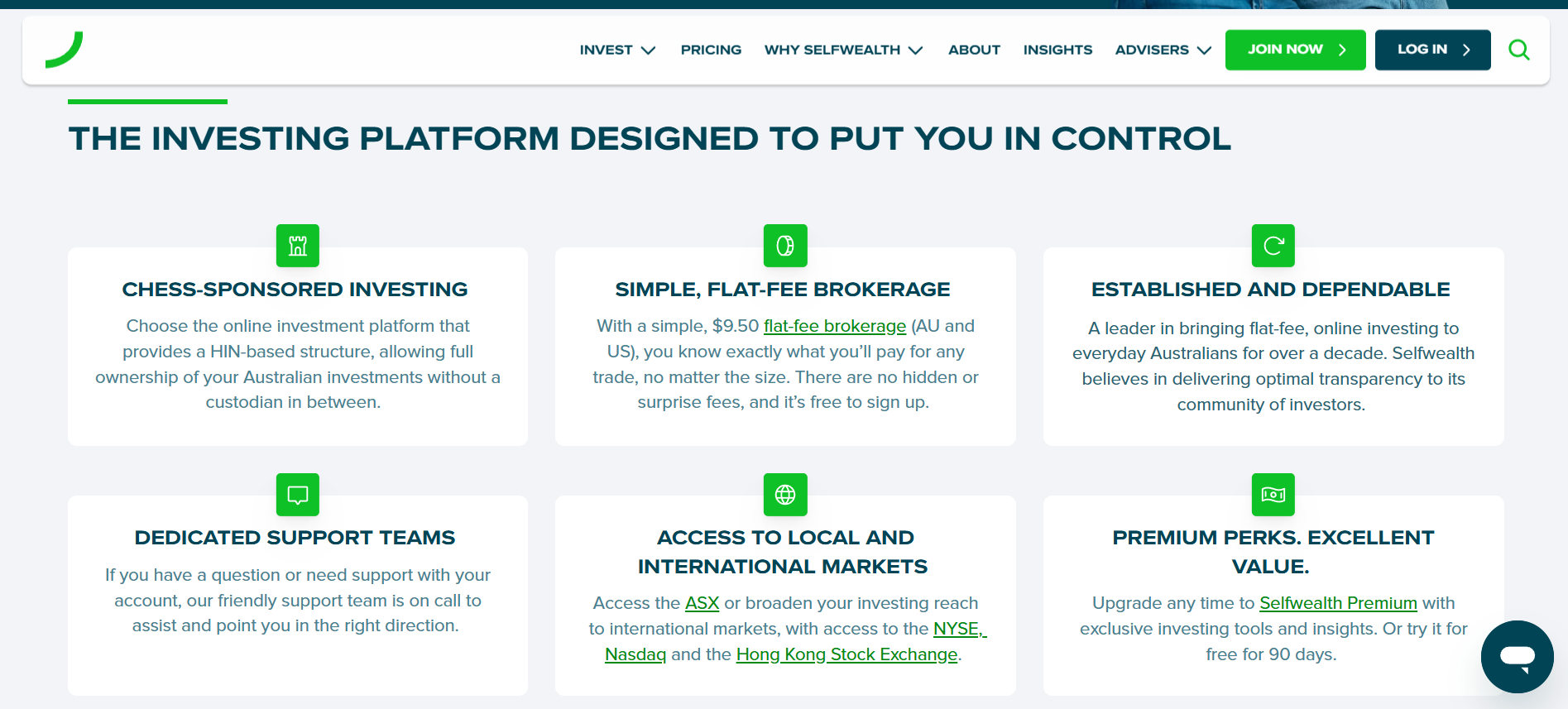
Selfwealth provides investors with a simple and transparent trading experience built around low costs and direct ownership of investments. One of its main advantages is the flat brokerage fee of $9.50 per trade, which remains the same regardless of trade size. This means investors benefit from low fees and cheaper trades compared to traditional brokers, especially for larger trades. The flat fee applies no matter the size of the trade, making it especially cost-effective for larger trades and offering significant savings over percentage-based commissions. Selfwealth's trading fees are nearly the lowest in Australia, and it is significantly cheaper than CommSec for larger trades, though it offers fewer advanced trading features. The platform also does not charge account-keeping fees, making it easier for long-term investors to manage costs while maintaining an active investment account.

Another major benefit is Selfwealth’s CHESS-sponsored structure, where shares are registered directly under the investor’s own Holder Identification Number (HIN). This ensures investors retain direct legal ownership of their shares, rather than relying on a custodial holding system used by some online brokers. Client funds are held in segregated trust accounts for asset protection, adding an extra layer of transparency and security, which is particularly important for investors focused on long-term portfolio building.

Selfwealth also offers access to multiple international markets through a single account, including the ASX, NYSE, Nasdaq, and Hong Kong Exchange. This allows investors to diversify globally without needing separate brokerage accounts. Combined with a user-friendly platform, clear fee structure, and access to global stocks and ETFs, Selfwealth is positioned as a practical option for self-directed investors seeking cost efficiency and straightforward investing tools.

Selfwealth Regulation and Safety

Selfwealth operates as a regulated online stock broker through SelfWealth Pty Ltd (ABN 52 154 324 428) and holds an Australian Financial Services Licence (AFSL No. 421789). This licence authorizes the company to provide financial services and brokerage operations under regulatory supervision, ensuring the platform follows established financial compliance standards, client protection requirements, and operational transparency rules. Regulation helps ensure that brokerage activities, client communications, and financial services are conducted according to strict legal and industry guidelines.

In terms of investor safety, Selfwealth uses a CHESS-sponsored ownership structure, meaning shares are registered directly under the investor’s own Holder Identification Number (HIN). This setup provides an additional layer of protection because client assets remain legally owned by the investor rather than being pooled under the broker’s name. As a result, investors maintain direct ownership of their securities even if the brokerage encounters operational issues.

Selfwealth also provides general financial information accompanied by standard risk disclosures, reminding users that the information shared on its platform does not consider individual financial situations. Investors are encouraged to review the relevant Product Disclosure Statements and seek professional financial or tax advice before making investment decisions. These disclosures, combined with regulatory licensing and direct share ownership, form the foundation of Selfwealth’s safety and compliance framework.

Selfwealth Pros and Cons

Pros

  • Selfwealth charges a fixed $9.50 per trade, regardless of trade size, helping investors keep costs predictable and transparent.
  • Shares are registered directly under the investor’s own HIN, providing full legal ownership instead of a custodian holding structure.
  • Investors can trade across the ASX, NYSE, Nasdaq, and Hong Kong Exchange from one account, allowing easier portfolio diversification.
  • No hidden brokerage surprises and free account setup make the platform suitable for long-term investors focused on cost control.
  • Reviews frequently highlight the platform’s ease of use and straightforward trading experience for both beginners and experienced investors.

Cons

  • Compared with some global brokers, Selfwealth focuses more on investing than active trading features or complex order types.
  • While predictable, the fixed fee can be less competitive than percentage-based or zero-commission brokers for very small trades.
  • SelfWealth’s flat fee is highly competitive for large trades but may be costlier for very small transactions compared to some other brokers.
  • SelfWealth's foreign exchange fees for international trading are higher than some competitors, resulting in high fees for currency conversion.


               OPEN YOUR ACCOUNT NOW              


Selfwealth Customer Reviews

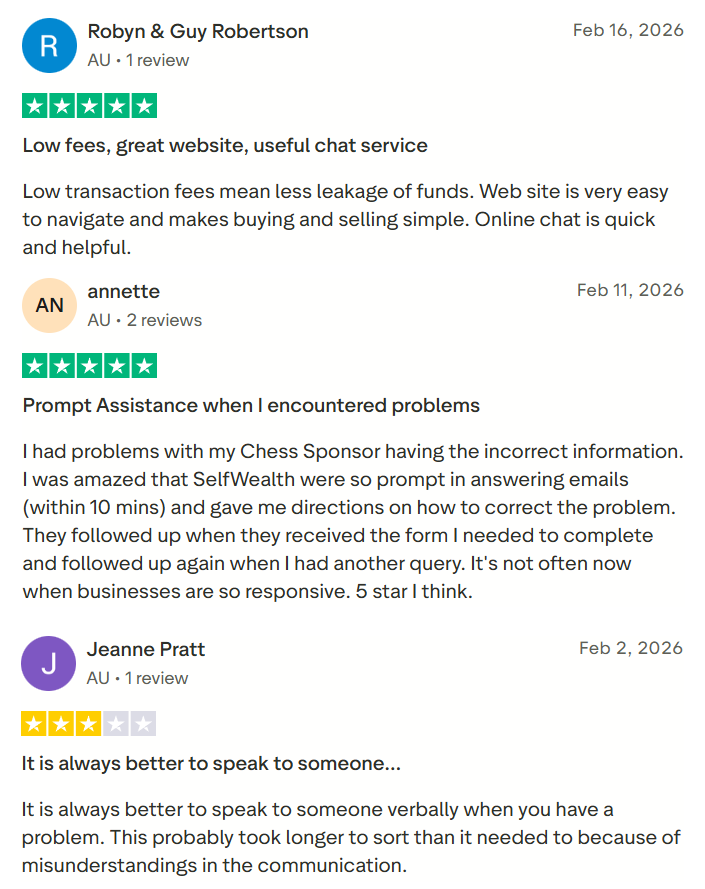
Customer feedback for Selfwealth is generally positive, with many users highlighting the platform’s simple interface, transparent pricing, and ease of trading as key strengths. Investors often mention that the flat brokerage fee structure makes costs predictable, which is especially appealing for long-term portfolio management. Reviews frequently describe the platform as straightforward to use for buying and holding shares, with clear navigation and an overall user-friendly experience suitable for both newer and experienced investors.

On the other hand, some users note areas where the platform could improve. Common concerns include limited advanced trading tools compared to larger global brokers and occasional delays related to account funding or processing times. A few reviewers also mention that customer support communication is primarily handled through online channels, which may not suit traders looking for immediate assistance. Despite these drawbacks, overall customer sentiment remains favorable, with many investors viewing Selfwealth as a reliable and cost-effective brokerage for self-directed investing.

Selfwealth Spreads, Fees, and Commissions

Selfwealth uses a flat-fee pricing model rather than spreads or percentage-based commissions, making its cost structure simple and predictable for investors. For Australian and U.S. shares, the platform charges a fixed brokerage fee of $9.50 per trade, regardless of the trade value. This means investors pay the same fee whether they trade a small parcel or a large investment amount, eliminating tiered pricing or variable commissions commonly used by traditional brokers. For Hong Kong market trades, Selfwealth applies a flat brokerage fee of HKD 88 per transaction. The platform also promotes transparent pricing with no account opening, inactivity, or account-keeping fees, helping reduce ongoing costs for long-term investors.

For international share trading, Selfwealth charges a foreign currency exchange fee of 0.6% (60c USD per $100 AUD exchanged) when converting AUD to USD. This can result in a higher effective rate depending on the AUD/USD exchange rate. Selfwealth applies this FX cost when funds are deposited or withdrawn between currencies, rather than on every trade. Additionally, certain external regulatory or exchange fees may apply, such as U.S. Securities and Exchange Commission charges or trading activity fees on sell orders, which are standard industry costs and not set by the broker itself.

Selfwealth integrates with Sharesight to provide tax reporting capabilities, making it easier for users to manage their taxes efficiently. The trading platform also allows users to set flexible order types, including market and limit orders.

Account Types
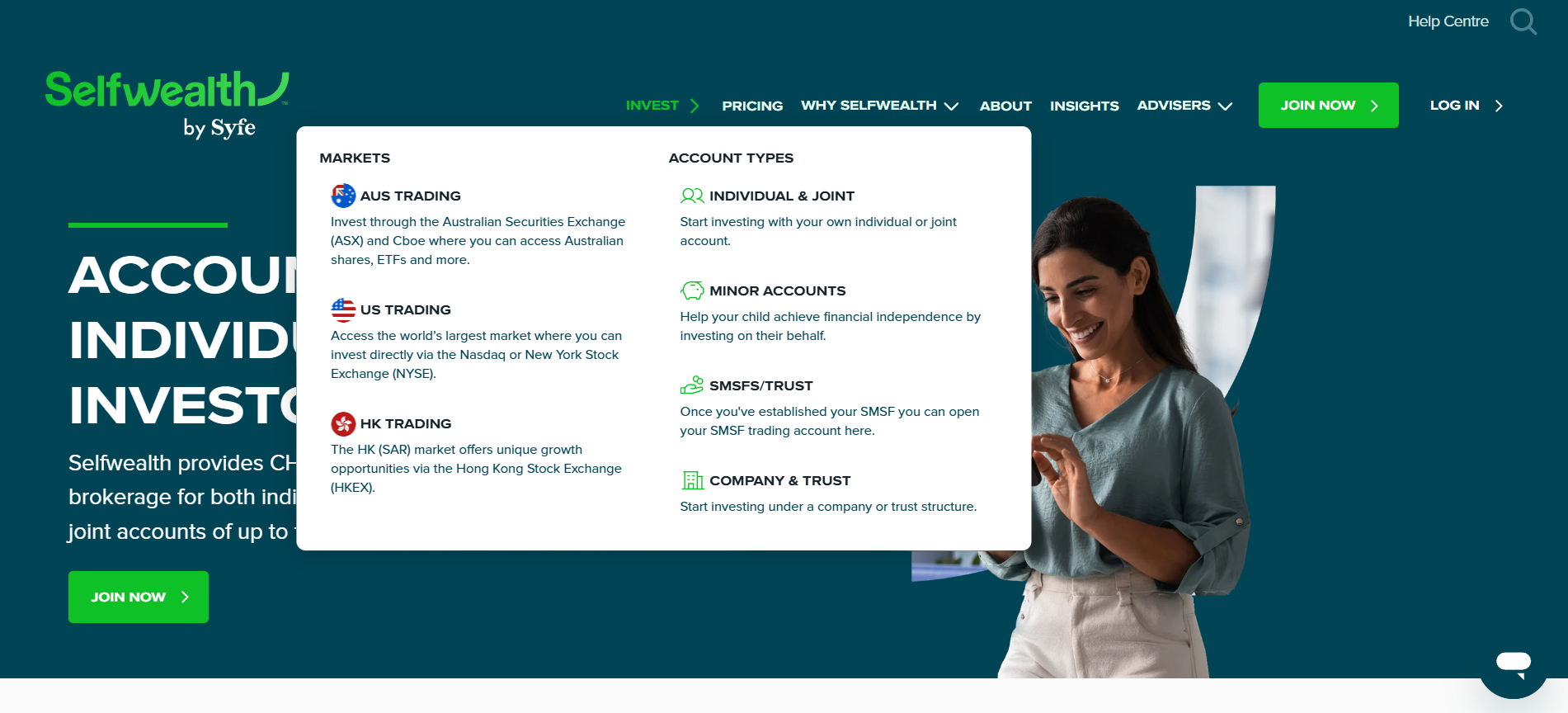
Selfwealth offers several share trading account types, including individual, joint, company, trust, SMSF, and kids accounts. Each share trading account provides access to the same trading platform and markets, but ownership and legal structures vary depending on the investor’s needs. During sign-up, users must provide proof of an Australian residential address as part of the account verification process, in line with industry-standard KYC procedures.

Individual Account

  • Designed for a single investor
  • Shares are held under the investor’s own Holder Identification Number (HIN)
  • Full control over trading and investment decisions
  • Access to local and international markets
  • Suitable for personal investing portfolios

Minor Account

  • Allows parents or guardians to invest on behalf of a child under 18
  • Operates as an informal trust where an adult acts as trustee and the child is the beneficiary
  • Shares are managed by the adult until the child reaches adulthood
  • When the child turns 18, holdings can be transferred into their own individual account
  • Uses the same flat brokerage fee ($9.50 per trade) and platform features as standard accounts
  • Designed to help children benefit from long-term compounding and learn investing early

Joint Account

  • Shared account between two individuals
  • Both account holders have ownership and trading authority
  • Investments registered under a joint HIN structure
  • Suitable for partners or shared investment management

Company Account

  • Opened under a registered company name
  • Investments owned by the company entity rather than an individual
  • Useful for corporate investing or business treasury management
  • Requires company registration details during setup

Trust Account

  • Designed for trustees managing investments on behalf of a trust
  • Commonly used for family trusts or estate planning
  • Investments held according to trust legal structure
  • Requires trustee and trust documentation

Self-Managed Super Fund (SMSF) Account

  • Built for SMSF trustees managing retirement investments, the process of setting up and managing an SMSF trading account is straight forward and user-friendly.
  • Investments held within the super fund structure
  • Supports long-term retirement portfolio management
  • Requires SMSF compliance and registration details

How to Open Your Account
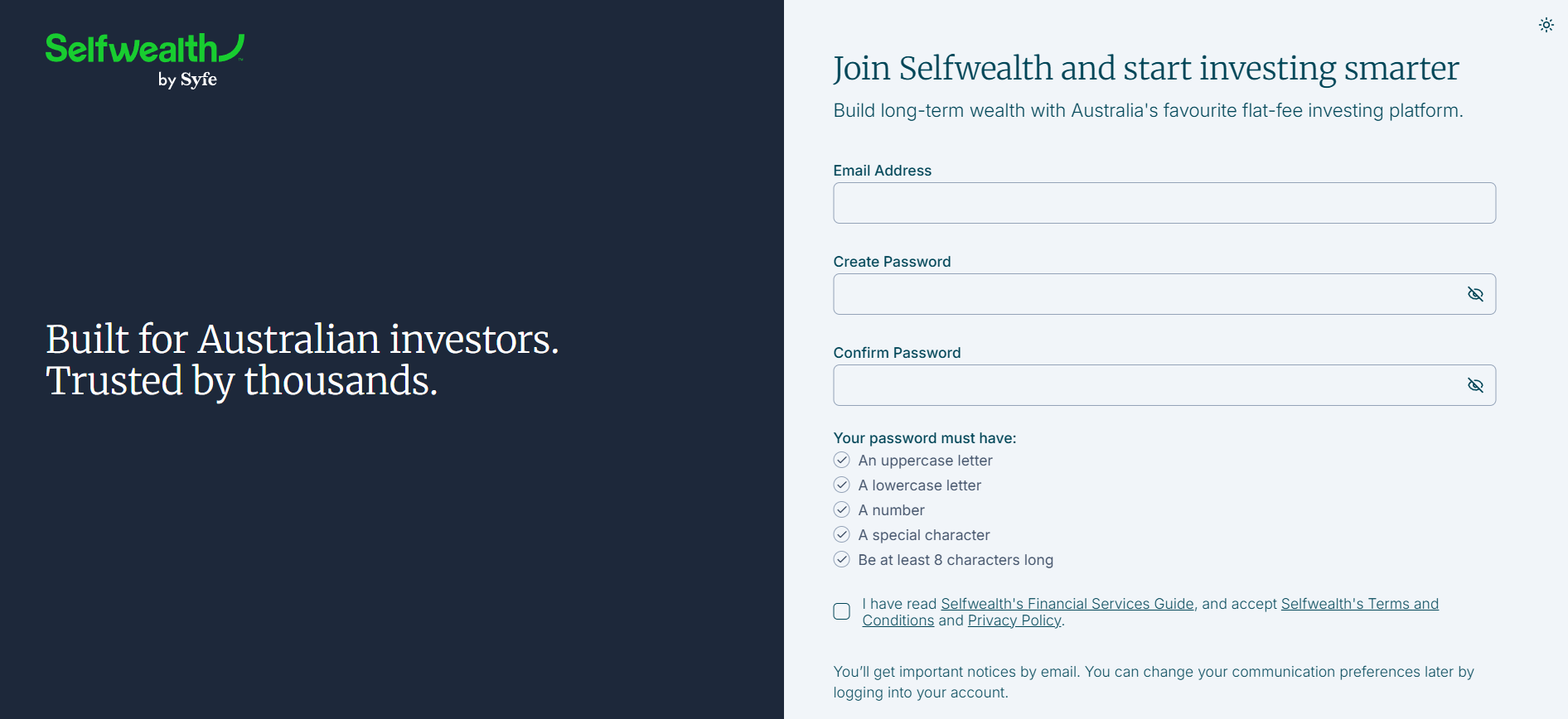
  1. Go to the Selfwealth website and click “Create Account” or “Sign Up.”
  2. Enter your email address and create a password that meets the security requirements (uppercase letter, lowercase letter, number, special character, and at least 8 characters).
  3. Accept the Financial Services Guide, Terms and Conditions, and Privacy Policy, then proceed with account creation.
  4. Verify your email address through the confirmation link sent to your inbox.
  5. Choose your account type (individual, joint, company, trust, SMSF, or kids account).
  6. Link your bank account for deposits and withdrawals.
  7. Wait for account approval, then fund your account and begin trading.


               OPEN A REAL ACCOUNT              


Selfwealth Trading Platforms

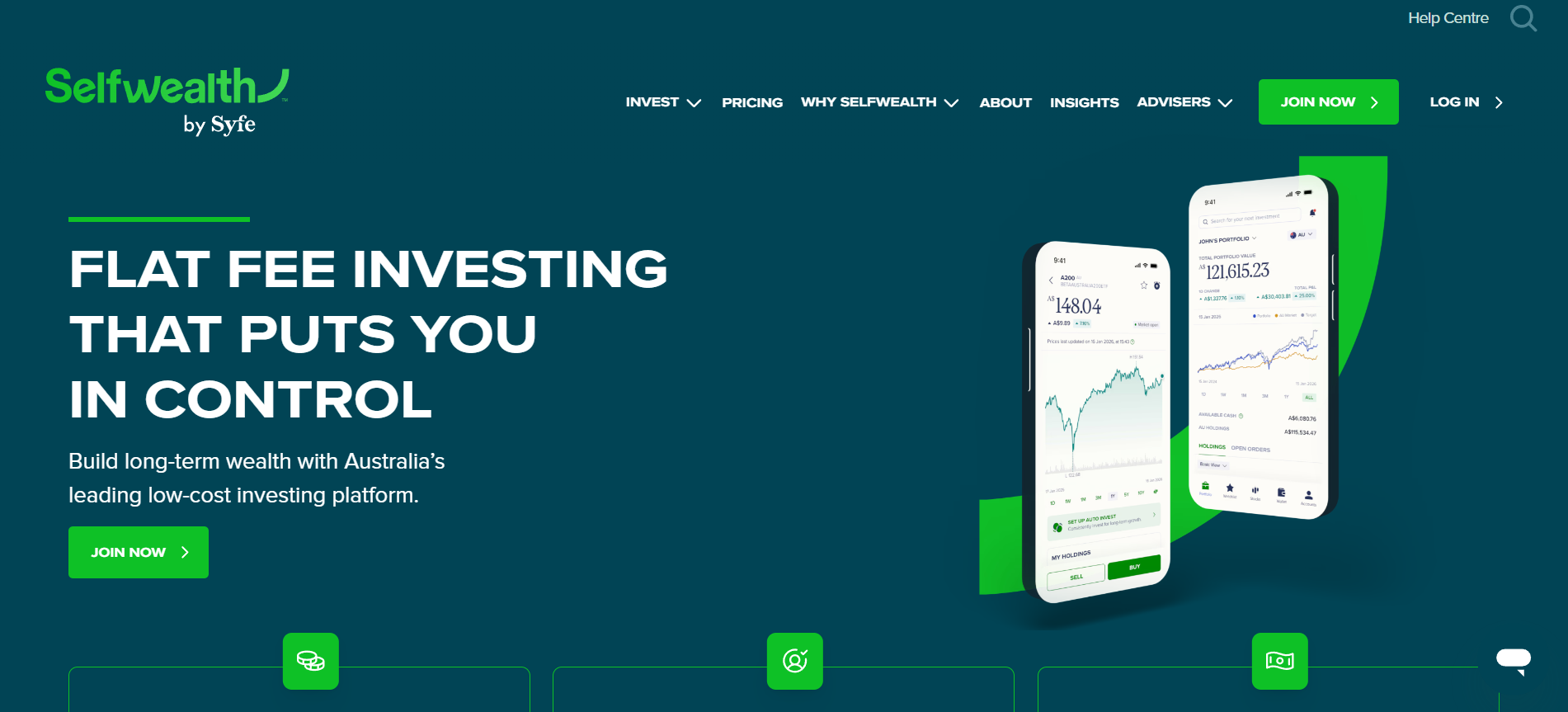
Selfwealth provides a multi-device trading experience through both a desktop platform and a mobile trading app, allowing investors to manage their portfolios anytime and anywhere. The platform is designed with simplicity in mind, focusing on an intuitive interface that helps investors research, buy, and monitor shares without complicated tools or cluttered layouts. Users can access thousands of shares and ETFs across local and international markets directly from their account dashboard.

The Selfwealth desktop platform offers a full-feature investing environment accessible through a web browser. It includes portfolio tracking tools, market insights, research data, and order management features designed for long-term investors. Traders can place buy and sell orders, view company financial information, and monitor portfolio performance using built-in analytics and diagnostic tools. Users can also view their cash balance and track portfolio performance using the dashboard and basic data and reporting tools provided by Selfwealth. The desktop version also supports stop-loss orders and provides access to research and insights to help investors make informed decisions.

Selfwealth also offers a mobile trading app available on iOS and Android devices, enabling investors to trade and manage investments on the go. The app allows users to deposit funds, track portfolios, view their cash balance, and trade shares across major markets such as the ASX, NYSE, Nasdaq, and HKEX directly from their smartphones. It is designed to keep investing simple, removing complex fee structures and unnecessary features while maintaining security through measures like two-factor authentication and protected cash accounts.

What Can You Trade on Selfwealth

Selfwealth is a share trading platform that allows users to open a share trading account and access both Australian and international trading, including US shares and US stocks. Selfwealth allows investors to trade a range of exchange-listed securities across major global markets through a single brokerage account. The platform focuses on traditional investing products rather than derivatives, giving users access to shares (stocks) and exchange-traded funds (ETFs) listed on the ASX and Cboe Australia, as well as international markets including the NYSE, Nasdaq, and Hong Kong Exchange (HKEX). This enables investors to buy shares in thousands of global companies and diversify portfolios across different regions and industries without needing multiple brokers.

When you purchase shares on international exchanges through Selfwealth, they are held under trust on your behalf by a custodian. For Australian shares, ownership records are maintained by the company's share registry, allowing you to view your holdings independently of the broker. However, Selfwealth is limited in international market access, primarily offering US and Hong Kong markets for international trading.

In addition to stocks, Selfwealth supports trading in ETFs, which provide exposure to indices, sectors, commodities, and global markets through a single investment. Investors can also access other Australian exchange-listed securities such as A-REITs (real estate investment trusts), Listed Investment Companies (LICs), and certain listed debt securities available on the ASX. Importantly, Selfwealth does not offer CFDs, forex, or leveraged derivatives, positioning the platform primarily for long-term investing and portfolio building rather than short-term speculative trading.

Selfwealth Customer Support
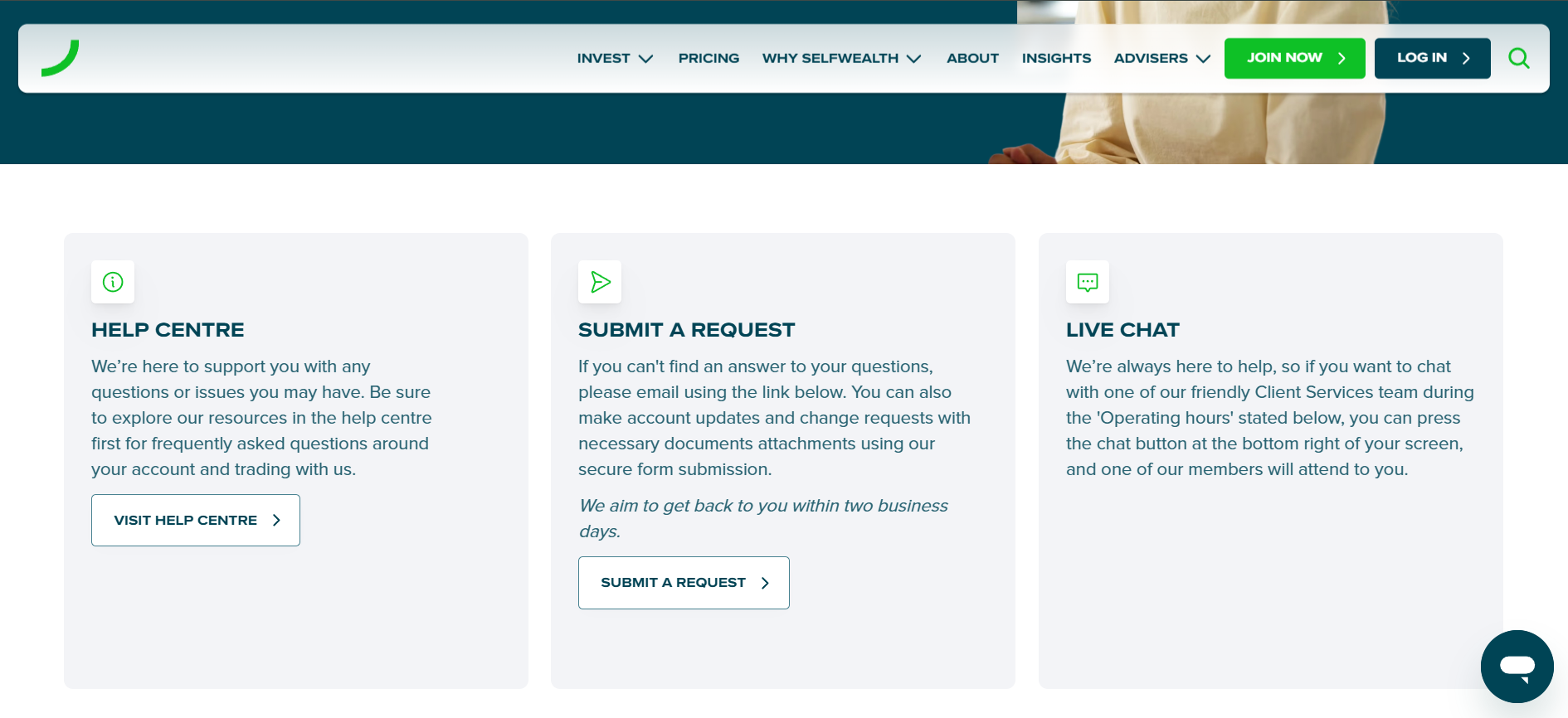
Selfwealth provides customer support through several online channels designed to help investors resolve account, trading, and technical issues efficiently. The primary support options include a Help Centre, live chat, and secure email request system, allowing users to contact the Client Services team directly from the platform. The Help Centre contains frequently asked questions and guides covering account setup, trading, deposits, and platform features, making it the first point of support for common inquiries. If further assistance is needed, users can submit a request through an online form, with responses typically provided within two business days.

Live chat support is available during operating hours, offering real-time assistance from customer service representatives. Support hours generally run Monday to Friday, 10:00 AM to 6:00 PM (Sydney time), with additional availability aligned to U.S. trading sessions. Selfwealth mainly prioritizes email and live chat communication rather than phone-based support, ensuring requests are handled through documented channels for faster follow-up. Investors may also contact the company via postal mail if required, although digital support remains the recommended method for quicker responses.

Advantages and Disadvantages of Selfwealth Customer Support

  Advantages  Disadvantages
  • Users can contact support through live chat, online request forms, and a detailed Help Centre.

  • Provides guides and FAQs covering account setup, trading, funding, and platform features, allowing users to solve common issues quickly.

  • Real-time assistance is available during business hours for faster responses to general inquiries.

  • Email and request-based support ensures issues are tracked and followed up properly.

  • Customer service operates during standard business days with additional coverage aligned with U.S. market sessions.

  • Email or ticket responses can take up to a couple of business days depending on request volume.

  • Assistance is limited to business hours rather than round-the-clock availability.

  • Immediate help may not be accessible outside scheduled support times.

Withdrawal Options and Fees

Selfwealth allows users to withdraw funds directly from their trading cash account to a nominated external bank account through the platform or mobile app. Withdrawals are processed online by submitting a transfer request, after which the funds are immediately deducted from the available balance and confirmation is sent via email. After a withdrawal request, your cash balance in the account is updated to reflect the deduction, ensuring you always see your current available funds. Investors can withdraw cash from their AUD trading account to their linked bank account, and the platform also allows currency transfers between AUD and USD balances before withdrawal when trading international shares.

In terms of fees, Selfwealth generally does not charge standard withdrawal fees, as there are no ongoing account or cash account fees associated with transferring money out of the platform. However, investors may incur foreign exchange (FX) conversion costs of about 0.60% when withdrawing funds that require currency conversion between AUD and USD. Additionally, withdrawals from share sales can only be made after the standard T+2 settlement period, meaning funds typically become available two business days after a trade settles. External bank processing times may then add another one to two business days before the money reaches the investor’s account.

Selfwealth Vs Other Brokers

#1. Selfwealth vs AvaTrade

Selfwealth is a stock brokerage platform focused on long-term investing, offering direct ownership of shares through a CHESS-sponsored structure and a flat brokerage fee model designed for investors building portfolios over time. In contrast, AvaTrade is primarily a CFD and forex broker, providing leveraged trading across forex, indices, commodities, cryptocurrencies, and CFDs with advanced trading platforms like MetaTrader. While Selfwealth emphasizes simplicity, transparency, and real share ownership, AvaTrade focuses on active trading tools, leverage, and short-term market speculation.

Verdict: Selfwealth is more suitable for investors seeking direct share ownership and predictable trading costs, while AvaTrade appeals to traders interested in leveraged CFD and forex trading. The better choice depends on whether the priority is long-term investing or active speculative trading.

#2. Selfwealth vs RoboForex
Selfwealth stands out as a traditional share investing platform, whereas RoboForex is structured as a multi-asset CFD broker offering forex, indices, commodities, and crypto trading with leverage. Selfwealth’s uniqueness lies in its flat-fee brokerage and direct ownership model, making it attractive for investors focused on stocks and ETFs across major exchanges. RoboForex, on the other hand, differentiates itself through flexible account types, automated trading compatibility, and algorithmic trading support via MetaTrader platforms. The two platforms target different audiences, with Selfwealth prioritizing investment simplicity and RoboForex catering to active traders seeking trading flexibility and higher market exposure.

Verdict: Selfwealth suits investors focused on long-term share investing and transparent pricing, while RoboForex may appeal more to traders looking for leveraged products and automated trading features. The better option depends on individual trading style and risk tolerance.

#3. SelfweaLth vs Exness
Selfwealth specializes in stock and ETF investing, offering access to global exchanges with direct share ownership and a straightforward fee structure aimed at portfolio investors. Exness, by comparison, is a forex and CFD broker known for tight spreads, flexible leverage options, and fast trade execution suited to active traders and short-term strategies. Selfwealth emphasizes ownership and long-term wealth building, while Exness focuses on trading efficiency, liquidity access, and leveraged market participation.

Verdict: Selfwealth is better aligned with investors seeking regulated share ownership and cost transparency, while Exness is designed for traders prioritizing leveraged forex and CFD trading. Each platform fits different investment objectives, making the choice dependent on whether the user prefers investing or active trading.


Also Read: AvaTrade Review 2024- Expert Trader Insights


               OPEN AN ACCOUNT WITH SELFWEALTH


Conclusion: Selfwealth Review

Selfwealth positions itself as a low-cost online stock broker built for self-directed investors who prioritize simplicity, transparency, and direct ownership of shares. Its flat-fee brokerage model, CHESS-sponsored structure, and access to major global exchanges make it particularly appealing for long-term investors focused on building diversified portfolios rather than actively trading leveraged products. The platform removes much of the complexity often associated with investing by offering predictable pricing, straightforward account management, and an easy-to-use trading environment across desktop and mobile devices.

While Selfwealth may not provide advanced trading tools, extensive international market coverage, or the lowest FX costs compared to some global competitors, it delivers strong value for investors seeking clear fees, secure asset ownership, and a buy-and-hold investing approach. Overall, Selfwealth is best suited for individuals who want a reliable and transparent share trading platform designed for long-term investing, portfolio growth, and cost-efficient access to both local and international markets.

Also Read: MarketsVox Review 2024 – Expert Trader Insights

Selfwealth: FAQs

Does Selfwealth charge account fees?

Selfwealth does not charge account opening, inactivity, or account-keeping fees. Instead, it applies a flat brokerage fee of $9.50 per trade for Australian and U.S. shares.

How long do deposits and withdrawals take?

Deposits typically take one to two business days depending on the bank. Withdrawals can be made after the T+2 settlement period, with funds usually arriving within one to two business days after processing.

Is Selfwealth good for active trading?

Selfwealth is mainly built for long-term investing rather than high-frequency or leveraged trading, as it offers fewer advanced trading tools compared to CFD-focused brokers.


OPEN AN ACCOUNT NOW WITH SELFWEALTH AND GET YOUR BONUS



Top 5 Forex Brokers Ranked by Traders in 2025

About Ezekiel Chew​

Ezekiel Chew, founder and head of training at Asia Forex Mentor, is a renowned forex expert, frequently invited to speak at major industry events. Known for his deep market insights, Ezekiel is one of the top traders committed to supporting the trading community. Making six figures per trade, he also trains traders working in banks, fund management, and prop trading firms.

Giraffe Markets Review 2026 – REAL Traders Report

            OPEN AN ACCOUNT             Giraffe Markets Review Giraffe Markets positions itself as a CFD trading broker and a brokerage firm focused on giving traders access to multiple markets from one place, including forex, indices, commodities, and crypto. As a company

Read More

Freedom24 Review 2026 – REAL Traders Report

            OPEN AN ACCOUNT             Freedom24 Review This Freedom24 review looks at what the broker offers, who it is built for, and the key facts that matter before opening an account. Freedom24 presents itself as an online broker for investing in

Read More

EverTrader Review 2026 – REAL Traders Report

            OPEN AN ACCOUNT               EverTrader Review EverTrader offers traders a streamlined way to enter the world of professional trading without the need for personal capital. Their Instant Funding program provides immediate access to funded accounts ranging from $10,000 to

Read More

Forex Trade Update After a 950% Crazy Growth Month

Imagine a single forex trade changing how you see on the foreign exchange market. Many retail traders dive into a forex trading account with high hopes but quickly encounter challenges. The constant price changes of major currency pairs, like EUR USD or the Japanese yen, create chances and challenges. As

Read More

Understanding Monad in Crypto: A New Chapter of Blockchain Innovation

As blockchain technology continues to evolve, new concepts and frameworks appear, targeting the traditional challenges of blockchain scalability, decentralization, and transaction efficiency. One such concept rising in interest in the cryptocurrency market is Monad. But what exactly is Monad as related to crypto? Let’s take a look at how Monad

Read More

FXCentrum Review 2026 – REAL Traders Report

            OPEN AN ACCOUNT             FXCentrum Review FXCentrum (FXC) is an online broker that offers 2,200 trading instruments, these includes Forex, stocks, indices, commodities, metals, cryptocurrencies, and CFDs. Traders can use the Trader platform of FXCentrum, available for both desktop and

Read More

AFM Trading Summit Live

Date: Coming Soon

Join us at the AFM Trading Summit Live and learn from top industry experts through live trading sessions, market insights, and actionable strategies.

Selfwealth Review 2026 – REAL Traders Report

4.0
Overall Trust Index

Written by:

Updated:

March 5, 2026

Position in Rating

Overall Rating

Trading Terminals

103nd

4.5 Overall Rating


            OPEN AN ACCOUNT            

Selfwealth Review

Choosing the right broker is an important step for anyone starting or improving their investing journey, as the platform used can directly affect trading costs, market access, and overall investing experience. A good broker should offer transparent fees, reliable market access, secure asset ownership, and tools that match an investor’s goals, whether focused on long-term investing or active trading. Factors such as pricing structure, available markets, ease of use, and account security all play a role in determining if a broker is suitable. Understanding these key elements helps investors select a platform that supports better decision-making and provides confidence when managing their investments. Selfwealth is Australian owned and operated, appealing to investors who prefer a locally run broker.

Selfwealth is an online stock brokerage platform that allows investors to buy and sell shares and ETFs through a simple, low-cost trading system. The broker is known for its flat brokerage fee of $9.50 per trade, regardless of trade size, helping investors avoid percentage-based commissions and hidden charges. Selfwealth provides access to multiple markets, including ASX, U.S. exchanges (NYSE and Nasdaq), and the Hong Kong Exchange, all from one account. For international shares, Selfwealth holds the legal title, but the investor remains the beneficial owner, receiving dividends and voting rights. When you open an account, Selfwealth provides an ANZ cash account as the default bank account for funding trades, and trades are executed and settled via a partnership with ANZ and OpenMarkets. The platform focuses on transparent pricing, direct share ownership, and self-directed investing, making it suitable for investors who want a straightforward and cost-efficient way to manage their own portfolios. In this comprehensive review of Selfwealth, the platform’s features, fees, trading conditions, regulation, and overall brokerage services are examined to help investors determine whether it is the right stock broker for their investment needs.

Asia Forex Mentor Evaluation Criteria

Selecting an appropriate broker is pivotal for trading success. Asia Forex Mentor (AFM) utilizes a comprehensive approach, evaluating more than 70 criteria to deliver unbiased, expert broker evaluations. Their analysis focuses on five key domains:

Cost Analysis: AFM delves into the broker's trading fees, with particular attention to spreads, commissions, and any additional charges. They determine the competitiveness and fairness of the broker's pricing structure, aiming to ensure traders receive good value.

Operational Performance: AFM looks into how efficiently the broker operates, including order execution speed, slippage rates, and the occurrence of requotes. This evaluation is crucial in understanding the broker's capacity to provide an uninterrupted and effective trading platform.

Financial Safety: AFM examines the broker's adherence to regulations, the safeguarding of deposits, and the overall management and protection of client assets. This aspect is essential in evaluating the trustworthiness and security offered by the broker.

Technical Assessment: AFM investigates the broker's technological infrastructure, focusing on the reliability and performance of their trading platforms. This includes the availability of custom indicators and the support for automated trading solutions.

User Interface Evaluation: AFM analyzes the broker's interface for its user-friendliness, adaptability, and educational resources. This ensures the platform can cater to traders with different levels of experience.

These dimensions are critical for a comprehensive understanding of Selfwealth's service quality. While Selfwealth demonstrates proficiency in these areas, any limitations will be clearly addressed in the review.

What is Selfwealth

Selfwealth is an online stock brokerage platform that allows investors to buy and sell shares and ETFs through a flat-fee trading model. The platform is designed for self-directed investors who want a simple and transparent way to invest in both local and international markets. Through Selfwealth, users can access thousands of investments across major exchanges, while benefiting from a fixed brokerage fee and CHESS-sponsored ownership, meaning shares are registered directly under the investor’s name rather than held by a custodian.

The company was founded in 2012, originally starting as an online investor community where individuals could discuss and share ideas about the share market. Over time, Selfwealth evolved into one of the early platforms to introduce flat-fee online investing, helping simplify trading costs for everyday investors. In 2017, the company became publicly listed on the Australian Securities Exchange, increasing transparency and supporting its expansion as a digital brokerage platform serving a growing investor base. As the platform expanded, Selfwealth grew into a widely used online broker with more than 129,000 investors using its services. In 2025, the company entered a new phase after transitioning into private ownership under Syfe, a digital wealth management group, allowing the platform to broaden its investment ecosystem and technology capabilities. Today, Selfwealth positions itself as a low-cost investing platform focused on direct share ownership, transparent pricing, and accessible investing tools for long-term investors.

Benefits of Trading with Selfwealth

Selfwealth provides investors with a simple and transparent trading experience built around low costs and direct ownership of investments. One of its main advantages is the flat brokerage fee of $9.50 per trade, which remains the same regardless of trade size. This means investors benefit from low fees and cheaper trades compared to traditional brokers, especially for larger trades. The flat fee applies no matter the size of the trade, making it especially cost-effective for larger trades and offering significant savings over percentage-based commissions. Selfwealth's trading fees are nearly the lowest in Australia, and it is significantly cheaper than CommSec for larger trades, though it offers fewer advanced trading features. The platform also does not charge account-keeping fees, making it easier for long-term investors to manage costs while maintaining an active investment account.

Another major benefit is Selfwealth’s CHESS-sponsored structure, where shares are registered directly under the investor’s own Holder Identification Number (HIN). This ensures investors retain direct legal ownership of their shares, rather than relying on a custodial holding system used by some online brokers. Client funds are held in segregated trust accounts for asset protection, adding an extra layer of transparency and security, which is particularly important for investors focused on long-term portfolio building. Selfwealth also offers access to multiple international markets through a single account, including the ASX, NYSE, Nasdaq, and Hong Kong Exchange. This allows investors to diversify globally without needing separate brokerage accounts. Combined with a user-friendly platform, clear fee structure, and access to global stocks and ETFs, Selfwealth is positioned as a practical option for self-directed investors seeking cost efficiency and straightforward investing tools.

Selfwealth Regulation and Safety

Selfwealth operates as a regulated online stock broker through SelfWealth Pty Ltd (ABN 52 154 324 428) and holds an Australian Financial Services Licence (AFSL No. 421789). This licence authorizes the company to provide financial services and brokerage operations under regulatory supervision, ensuring the platform follows established financial compliance standards, client protection requirements, and operational transparency rules. Regulation helps ensure that brokerage activities, client communications, and financial services are conducted according to strict legal and industry guidelines. In terms of investor safety, Selfwealth uses a CHESS-sponsored ownership structure, meaning shares are registered directly under the investor’s own Holder Identification Number (HIN). This setup provides an additional layer of protection because client assets remain legally owned by the investor rather than being pooled under the broker’s name. As a result, investors maintain direct ownership of their securities even if the brokerage encounters operational issues. Selfwealth also provides general financial information accompanied by standard risk disclosures, reminding users that the information shared on its platform does not consider individual financial situations. Investors are encouraged to review the relevant Product Disclosure Statements and seek professional financial or tax advice before making investment decisions. These disclosures, combined with regulatory licensing and direct share ownership, form the foundation of Selfwealth’s safety and compliance framework.

Selfwealth Pros and Cons

Pros

  • Selfwealth charges a fixed $9.50 per trade, regardless of trade size, helping investors keep costs predictable and transparent.
  • Shares are registered directly under the investor’s own HIN, providing full legal ownership instead of a custodian holding structure.
  • Investors can trade across the ASX, NYSE, Nasdaq, and Hong Kong Exchange from one account, allowing easier portfolio diversification.
  • No hidden brokerage surprises and free account setup make the platform suitable for long-term investors focused on cost control.
  • Reviews frequently highlight the platform’s ease of use and straightforward trading experience for both beginners and experienced investors.

Cons

  • Compared with some global brokers, Selfwealth focuses more on investing than active trading features or complex order types.
  • While predictable, the fixed fee can be less competitive than percentage-based or zero-commission brokers for very small trades.
  • SelfWealth’s flat fee is highly competitive for large trades but may be costlier for very small transactions compared to some other brokers.
  • SelfWealth's foreign exchange fees for international trading are higher than some competitors, resulting in high fees for currency conversion.


               OPEN YOUR ACCOUNT NOW              


Selfwealth Customer Reviews

Customer feedback for Selfwealth is generally positive, with many users highlighting the platform’s simple interface, transparent pricing, and ease of trading as key strengths. Investors often mention that the flat brokerage fee structure makes costs predictable, which is especially appealing for long-term portfolio management. Reviews frequently describe the platform as straightforward to use for buying and holding shares, with clear navigation and an overall user-friendly experience suitable for both newer and experienced investors.

On the other hand, some users note areas where the platform could improve. Common concerns include limited advanced trading tools compared to larger global brokers and occasional delays related to account funding or processing times. A few reviewers also mention that customer support communication is primarily handled through online channels, which may not suit traders looking for immediate assistance. Despite these drawbacks, overall customer sentiment remains favorable, with many investors viewing Selfwealth as a reliable and cost-effective brokerage for self-directed investing.

Selfwealth Spreads, Fees, and Commissions

Selfwealth uses a flat-fee pricing model rather than spreads or percentage-based commissions, making its cost structure simple and predictable for investors. For Australian and U.S. shares, the platform charges a fixed brokerage fee of $9.50 per trade, regardless of the trade value. This means investors pay the same fee whether they trade a small parcel or a large investment amount, eliminating tiered pricing or variable commissions commonly used by traditional brokers. For Hong Kong market trades, Selfwealth applies a flat brokerage fee of HKD 88 per transaction. The platform also promotes transparent pricing with no account opening, inactivity, or account-keeping fees, helping reduce ongoing costs for long-term investors. For international share trading, Selfwealth charges a foreign currency exchange fee of 0.6% (60c USD per $100 AUD exchanged) when converting AUD to USD. This can result in a higher effective rate depending on the AUD/USD exchange rate. Selfwealth applies this FX cost when funds are deposited or withdrawn between currencies, rather than on every trade. Additionally, certain external regulatory or exchange fees may apply, such as U.S. Securities and Exchange Commission charges or trading activity fees on sell orders, which are standard industry costs and not set by the broker itself. Selfwealth integrates with Sharesight to provide tax reporting capabilities, making it easier for users to manage their taxes efficiently. The trading platform also allows users to set flexible order types, including market and limit orders.

Account Types

Selfwealth offers several share trading account types, including individual, joint, company, trust, SMSF, and kids accounts. Each share trading account provides access to the same trading platform and markets, but ownership and legal structures vary depending on the investor’s needs. During sign-up, users must provide proof of an Australian residential address as part of the account verification process, in line with industry-standard KYC procedures.

Individual Account

  • Designed for a single investor
  • Shares are held under the investor’s own Holder Identification Number (HIN)
  • Full control over trading and investment decisions
  • Access to local and international markets
  • Suitable for personal investing portfolios

Minor Account

  • Allows parents or guardians to invest on behalf of a child under 18
  • Operates as an informal trust where an adult acts as trustee and the child is the beneficiary
  • Shares are managed by the adult until the child reaches adulthood
  • When the child turns 18, holdings can be transferred into their own individual account
  • Uses the same flat brokerage fee ($9.50 per trade) and platform features as standard accounts
  • Designed to help children benefit from long-term compounding and learn investing early

Joint Account

  • Shared account between two individuals
  • Both account holders have ownership and trading authority
  • Investments registered under a joint HIN structure
  • Suitable for partners or shared investment management

Company Account

  • Opened under a registered company name
  • Investments owned by the company entity rather than an individual
  • Useful for corporate investing or business treasury management
  • Requires company registration details during setup

Trust Account

  • Designed for trustees managing investments on behalf of a trust
  • Commonly used for family trusts or estate planning
  • Investments held according to trust legal structure
  • Requires trustee and trust documentation

Self-Managed Super Fund (SMSF) Account

  • Built for SMSF trustees managing retirement investments, the process of setting up and managing an SMSF trading account is straight forward and user-friendly.
  • Investments held within the super fund structure
  • Supports long-term retirement portfolio management
  • Requires SMSF compliance and registration details

How to Open Your Account

  1. Go to the Selfwealth website and click “Create Account” or “Sign Up.”
  2. Enter your email address and create a password that meets the security requirements (uppercase letter, lowercase letter, number, special character, and at least 8 characters).
  3. Accept the Financial Services Guide, Terms and Conditions, and Privacy Policy, then proceed with account creation.
  4. Verify your email address through the confirmation link sent to your inbox.
  5. Choose your account type (individual, joint, company, trust, SMSF, or kids account).
  6. Link your bank account for deposits and withdrawals.
  7. Wait for account approval, then fund your account and begin trading.
 

               OPEN A REAL ACCOUNT              


Selfwealth Trading Platforms

Selfwealth provides a multi-device trading experience through both a desktop platform and a mobile trading app, allowing investors to manage their portfolios anytime and anywhere. The platform is designed with simplicity in mind, focusing on an intuitive interface that helps investors research, buy, and monitor shares without complicated tools or cluttered layouts. Users can access thousands of shares and ETFs across local and international markets directly from their account dashboard. The Selfwealth desktop platform offers a full-feature investing environment accessible through a web browser. It includes portfolio tracking tools, market insights, research data, and order management features designed for long-term investors. Traders can place buy and sell orders, view company financial information, and monitor portfolio performance using built-in analytics and diagnostic tools. Users can also view their cash balance and track portfolio performance using the dashboard and basic data and reporting tools provided by Selfwealth. The desktop version also supports stop-loss orders and provides access to research and insights to help investors make informed decisions. Selfwealth also offers a mobile trading app available on iOS and Android devices, enabling investors to trade and manage investments on the go. The app allows users to deposit funds, track portfolios, view their cash balance, and trade shares across major markets such as the ASX, NYSE, Nasdaq, and HKEX directly from their smartphones. It is designed to keep investing simple, removing complex fee structures and unnecessary features while maintaining security through measures like two-factor authentication and protected cash accounts.

What Can You Trade on Selfwealth

Selfwealth is a share trading platform that allows users to open a share trading account and access both Australian and international trading, including US shares and US stocks. Selfwealth allows investors to trade a range of exchange-listed securities across major global markets through a single brokerage account. The platform focuses on traditional investing products rather than derivatives, giving users access to shares (stocks) and exchange-traded funds (ETFs) listed on the ASX and Cboe Australia, as well as international markets including the NYSE, Nasdaq, and Hong Kong Exchange (HKEX). This enables investors to buy shares in thousands of global companies and diversify portfolios across different regions and industries without needing multiple brokers. When you purchase shares on international exchanges through Selfwealth, they are held under trust on your behalf by a custodian. For Australian shares, ownership records are maintained by the company's share registry, allowing you to view your holdings independently of the broker. However, Selfwealth is limited in international market access, primarily offering US and Hong Kong markets for international trading. In addition to stocks, Selfwealth supports trading in ETFs, which provide exposure to indices, sectors, commodities, and global markets through a single investment. Investors can also access other Australian exchange-listed securities such as A-REITs (real estate investment trusts), Listed Investment Companies (LICs), and certain listed debt securities available on the ASX. Importantly, Selfwealth does not offer CFDs, forex, or leveraged derivatives, positioning the platform primarily for long-term investing and portfolio building rather than short-term speculative trading.

Selfwealth Customer Support

Selfwealth provides customer support through several online channels designed to help investors resolve account, trading, and technical issues efficiently. The primary support options include a Help Centre, live chat, and secure email request system, allowing users to contact the Client Services team directly from the platform. The Help Centre contains frequently asked questions and guides covering account setup, trading, deposits, and platform features, making it the first point of support for common inquiries. If further assistance is needed, users can submit a request through an online form, with responses typically provided within two business days.

Live chat support is available during operating hours, offering real-time assistance from customer service representatives. Support hours generally run Monday to Friday, 10:00 AM to 6:00 PM (Sydney time), with additional availability aligned to U.S. trading sessions. Selfwealth mainly prioritizes email and live chat communication rather than phone-based support, ensuring requests are handled through documented channels for faster follow-up. Investors may also contact the company via postal mail if required, although digital support remains the recommended method for quicker responses.

Advantages and Disadvantages of Selfwealth Customer Support

  Advantages  Disadvantages
  • Users can contact support through live chat, online request forms, and a detailed Help Centre.

  • Provides guides and FAQs covering account setup, trading, funding, and platform features, allowing users to solve common issues quickly.

  • Real-time assistance is available during business hours for faster responses to general inquiries.

  • Email and request-based support ensures issues are tracked and followed up properly.

  • Customer service operates during standard business days with additional coverage aligned with U.S. market sessions.

  • Email or ticket responses can take up to a couple of business days depending on request volume.

  • Assistance is limited to business hours rather than round-the-clock availability.

  • Immediate help may not be accessible outside scheduled support times.

Withdrawal Options and Fees

Selfwealth allows users to withdraw funds directly from their trading cash account to a nominated external bank account through the platform or mobile app. Withdrawals are processed online by submitting a transfer request, after which the funds are immediately deducted from the available balance and confirmation is sent via email. After a withdrawal request, your cash balance in the account is updated to reflect the deduction, ensuring you always see your current available funds. Investors can withdraw cash from their AUD trading account to their linked bank account, and the platform also allows currency transfers between AUD and USD balances before withdrawal when trading international shares.

In terms of fees, Selfwealth generally does not charge standard withdrawal fees, as there are no ongoing account or cash account fees associated with transferring money out of the platform. However, investors may incur foreign exchange (FX) conversion costs of about 0.60% when withdrawing funds that require currency conversion between AUD and USD. Additionally, withdrawals from share sales can only be made after the standard T+2 settlement period, meaning funds typically become available two business days after a trade settles. External bank processing times may then add another one to two business days before the money reaches the investor’s account.

Selfwealth Vs Other Brokers

#1. Selfwealth vs AvaTrade

Selfwealth is a stock brokerage platform focused on long-term investing, offering direct ownership of shares through a CHESS-sponsored structure and a flat brokerage fee model designed for investors building portfolios over time. In contrast, AvaTrade is primarily a CFD and forex broker, providing leveraged trading across forex, indices, commodities, cryptocurrencies, and CFDs with advanced trading platforms like MetaTrader. While Selfwealth emphasizes simplicity, transparency, and real share ownership, AvaTrade focuses on active trading tools, leverage, and short-term market speculation.

Verdict: Selfwealth is more suitable for investors seeking direct share ownership and predictable trading costs, while AvaTrade appeals to traders interested in leveraged CFD and forex trading. The better choice depends on whether the priority is long-term investing or active speculative trading.

#2. Selfwealth vs RoboForex

Selfwealth stands out as a traditional share investing platform, whereas RoboForex is structured as a multi-asset CFD broker offering forex, indices, commodities, and crypto trading with leverage. Selfwealth’s uniqueness lies in its flat-fee brokerage and direct ownership model, making it attractive for investors focused on stocks and ETFs across major exchanges. RoboForex, on the other hand, differentiates itself through flexible account types, automated trading compatibility, and algorithmic trading support via MetaTrader platforms. The two platforms target different audiences, with Selfwealth prioritizing investment simplicity and RoboForex catering to active traders seeking trading flexibility and higher market exposure.

Verdict: Selfwealth suits investors focused on long-term share investing and transparent pricing, while RoboForex may appeal more to traders looking for leveraged products and automated trading features. The better option depends on individual trading style and risk tolerance.

#3. SelfweaLth vs Exness

Selfwealth specializes in stock and ETF investing, offering access to global exchanges with direct share ownership and a straightforward fee structure aimed at portfolio investors. Exness, by comparison, is a forex and CFD broker known for tight spreads, flexible leverage options, and fast trade execution suited to active traders and short-term strategies. Selfwealth emphasizes ownership and long-term wealth building, while Exness focuses on trading efficiency, liquidity access, and leveraged market participation.

Verdict: Selfwealth is better aligned with investors seeking regulated share ownership and cost transparency, while Exness is designed for traders prioritizing leveraged forex and CFD trading. Each platform fits different investment objectives, making the choice dependent on whether the user prefers investing or active trading.   Also Read: AvaTrade Review 2024- Expert Trader Insights    

               OPEN AN ACCOUNT WITH SELFWEALTH


Conclusion: Selfwealth Review

Selfwealth positions itself as a low-cost online stock broker built for self-directed investors who prioritize simplicity, transparency, and direct ownership of shares. Its flat-fee brokerage model, CHESS-sponsored structure, and access to major global exchanges make it particularly appealing for long-term investors focused on building diversified portfolios rather than actively trading leveraged products. The platform removes much of the complexity often associated with investing by offering predictable pricing, straightforward account management, and an easy-to-use trading environment across desktop and mobile devices.

While Selfwealth may not provide advanced trading tools, extensive international market coverage, or the lowest FX costs compared to some global competitors, it delivers strong value for investors seeking clear fees, secure asset ownership, and a buy-and-hold investing approach. Overall, Selfwealth is best suited for individuals who want a reliable and transparent share trading platform designed for long-term investing, portfolio growth, and cost-efficient access to both local and international markets.

Also Read: MarketsVox Review 2024 - Expert Trader Insights

Selfwealth: FAQs

Does Selfwealth charge account fees?

Selfwealth does not charge account opening, inactivity, or account-keeping fees. Instead, it applies a flat brokerage fee of $9.50 per trade for Australian and U.S. shares.

How long do deposits and withdrawals take?

Deposits typically take one to two business days depending on the bank. Withdrawals can be made after the T+2 settlement period, with funds usually arriving within one to two business days after processing.

Is Selfwealth good for active trading?

Selfwealth is mainly built for long-term investing rather than high-frequency or leveraged trading, as it offers fewer advanced trading tools compared to CFD-focused brokers.  

OPEN AN ACCOUNT NOW WITH SELFWEALTH AND GET YOUR BONUS



Top 5 Forex Brokers Ranked by Traders in 2025

ezekiel chew asiaforexmentor

About Ezekiel Chew

Ezekiel Chew, founder and head of training at Asia Forex Mentor, is a renowned forex expert, frequently invited to speak at major industry events. Known for his deep market insights, Ezekiel is one of the top traders committed to supporting the trading community. Making six figures per trade, he also trains traders working in banks, fund management, and prop trading firms.

RELATED ARTICLES

Selfwealth Review 2026 – REAL Traders Report

4.0
Overall Trust Index

Written by:

Updated:

March 5, 2026

Position in Rating

Overall Rating

Trading Terminals

103nd

4.5 Overall Rating


            OPEN AN ACCOUNT            

Selfwealth Review

Choosing the right broker is an important step for anyone starting or improving their investing journey, as the platform used can directly affect trading costs, market access, and overall investing experience. A good broker should offer transparent fees, reliable market access, secure asset ownership, and tools that match an investor’s goals, whether focused on long-term investing or active trading. Factors such as pricing structure, available markets, ease of use, and account security all play a role in determining if a broker is suitable. Understanding these key elements helps investors select a platform that supports better decision-making and provides confidence when managing their investments. Selfwealth is Australian owned and operated, appealing to investors who prefer a locally run broker.

Selfwealth is an online stock brokerage platform that allows investors to buy and sell shares and ETFs through a simple, low-cost trading system. The broker is known for its flat brokerage fee of $9.50 per trade, regardless of trade size, helping investors avoid percentage-based commissions and hidden charges. Selfwealth provides access to multiple markets, including ASX, U.S. exchanges (NYSE and Nasdaq), and the Hong Kong Exchange, all from one account. For international shares, Selfwealth holds the legal title, but the investor remains the beneficial owner, receiving dividends and voting rights. When you open an account, Selfwealth provides an ANZ cash account as the default bank account for funding trades, and trades are executed and settled via a partnership with ANZ and OpenMarkets. The platform focuses on transparent pricing, direct share ownership, and self-directed investing, making it suitable for investors who want a straightforward and cost-efficient way to manage their own portfolios. In this comprehensive review of Selfwealth, the platform’s features, fees, trading conditions, regulation, and overall brokerage services are examined to help investors determine whether it is the right stock broker for their investment needs.

Asia Forex Mentor Evaluation Criteria

Selecting an appropriate broker is pivotal for trading success. Asia Forex Mentor (AFM) utilizes a comprehensive approach, evaluating more than 70 criteria to deliver unbiased, expert broker evaluations. Their analysis focuses on five key domains:

Cost Analysis: AFM delves into the broker's trading fees, with particular attention to spreads, commissions, and any additional charges. They determine the competitiveness and fairness of the broker's pricing structure, aiming to ensure traders receive good value.

Operational Performance: AFM looks into how efficiently the broker operates, including order execution speed, slippage rates, and the occurrence of requotes. This evaluation is crucial in understanding the broker's capacity to provide an uninterrupted and effective trading platform.

Financial Safety: AFM examines the broker's adherence to regulations, the safeguarding of deposits, and the overall management and protection of client assets. This aspect is essential in evaluating the trustworthiness and security offered by the broker.

Technical Assessment: AFM investigates the broker's technological infrastructure, focusing on the reliability and performance of their trading platforms. This includes the availability of custom indicators and the support for automated trading solutions.

User Interface Evaluation: AFM analyzes the broker's interface for its user-friendliness, adaptability, and educational resources. This ensures the platform can cater to traders with different levels of experience.

These dimensions are critical for a comprehensive understanding of Selfwealth's service quality. While Selfwealth demonstrates proficiency in these areas, any limitations will be clearly addressed in the review.

What is Selfwealth

Selfwealth is an online stock brokerage platform that allows investors to buy and sell shares and ETFs through a flat-fee trading model. The platform is designed for self-directed investors who want a simple and transparent way to invest in both local and international markets. Through Selfwealth, users can access thousands of investments across major exchanges, while benefiting from a fixed brokerage fee and CHESS-sponsored ownership, meaning shares are registered directly under the investor’s name rather than held by a custodian.

The company was founded in 2012, originally starting as an online investor community where individuals could discuss and share ideas about the share market. Over time, Selfwealth evolved into one of the early platforms to introduce flat-fee online investing, helping simplify trading costs for everyday investors. In 2017, the company became publicly listed on the Australian Securities Exchange, increasing transparency and supporting its expansion as a digital brokerage platform serving a growing investor base. As the platform expanded, Selfwealth grew into a widely used online broker with more than 129,000 investors using its services. In 2025, the company entered a new phase after transitioning into private ownership under Syfe, a digital wealth management group, allowing the platform to broaden its investment ecosystem and technology capabilities. Today, Selfwealth positions itself as a low-cost investing platform focused on direct share ownership, transparent pricing, and accessible investing tools for long-term investors.

Benefits of Trading with Selfwealth

Selfwealth provides investors with a simple and transparent trading experience built around low costs and direct ownership of investments. One of its main advantages is the flat brokerage fee of $9.50 per trade, which remains the same regardless of trade size. This means investors benefit from low fees and cheaper trades compared to traditional brokers, especially for larger trades. The flat fee applies no matter the size of the trade, making it especially cost-effective for larger trades and offering significant savings over percentage-based commissions. Selfwealth's trading fees are nearly the lowest in Australia, and it is significantly cheaper than CommSec for larger trades, though it offers fewer advanced trading features. The platform also does not charge account-keeping fees, making it easier for long-term investors to manage costs while maintaining an active investment account.

Another major benefit is Selfwealth’s CHESS-sponsored structure, where shares are registered directly under the investor’s own Holder Identification Number (HIN). This ensures investors retain direct legal ownership of their shares, rather than relying on a custodial holding system used by some online brokers. Client funds are held in segregated trust accounts for asset protection, adding an extra layer of transparency and security, which is particularly important for investors focused on long-term portfolio building. Selfwealth also offers access to multiple international markets through a single account, including the ASX, NYSE, Nasdaq, and Hong Kong Exchange. This allows investors to diversify globally without needing separate brokerage accounts. Combined with a user-friendly platform, clear fee structure, and access to global stocks and ETFs, Selfwealth is positioned as a practical option for self-directed investors seeking cost efficiency and straightforward investing tools.

Selfwealth Regulation and Safety

Selfwealth operates as a regulated online stock broker through SelfWealth Pty Ltd (ABN 52 154 324 428) and holds an Australian Financial Services Licence (AFSL No. 421789). This licence authorizes the company to provide financial services and brokerage operations under regulatory supervision, ensuring the platform follows established financial compliance standards, client protection requirements, and operational transparency rules. Regulation helps ensure that brokerage activities, client communications, and financial services are conducted according to strict legal and industry guidelines. In terms of investor safety, Selfwealth uses a CHESS-sponsored ownership structure, meaning shares are registered directly under the investor’s own Holder Identification Number (HIN). This setup provides an additional layer of protection because client assets remain legally owned by the investor rather than being pooled under the broker’s name. As a result, investors maintain direct ownership of their securities even if the brokerage encounters operational issues. Selfwealth also provides general financial information accompanied by standard risk disclosures, reminding users that the information shared on its platform does not consider individual financial situations. Investors are encouraged to review the relevant Product Disclosure Statements and seek professional financial or tax advice before making investment decisions. These disclosures, combined with regulatory licensing and direct share ownership, form the foundation of Selfwealth’s safety and compliance framework.

Selfwealth Pros and Cons

Pros

  • Selfwealth charges a fixed $9.50 per trade, regardless of trade size, helping investors keep costs predictable and transparent.
  • Shares are registered directly under the investor’s own HIN, providing full legal ownership instead of a custodian holding structure.
  • Investors can trade across the ASX, NYSE, Nasdaq, and Hong Kong Exchange from one account, allowing easier portfolio diversification.
  • No hidden brokerage surprises and free account setup make the platform suitable for long-term investors focused on cost control.
  • Reviews frequently highlight the platform’s ease of use and straightforward trading experience for both beginners and experienced investors.

Cons

  • Compared with some global brokers, Selfwealth focuses more on investing than active trading features or complex order types.
  • While predictable, the fixed fee can be less competitive than percentage-based or zero-commission brokers for very small trades.
  • SelfWealth’s flat fee is highly competitive for large trades but may be costlier for very small transactions compared to some other brokers.
  • SelfWealth's foreign exchange fees for international trading are higher than some competitors, resulting in high fees for currency conversion.


               OPEN YOUR ACCOUNT NOW              


Selfwealth Customer Reviews

Customer feedback for Selfwealth is generally positive, with many users highlighting the platform’s simple interface, transparent pricing, and ease of trading as key strengths. Investors often mention that the flat brokerage fee structure makes costs predictable, which is especially appealing for long-term portfolio management. Reviews frequently describe the platform as straightforward to use for buying and holding shares, with clear navigation and an overall user-friendly experience suitable for both newer and experienced investors.

On the other hand, some users note areas where the platform could improve. Common concerns include limited advanced trading tools compared to larger global brokers and occasional delays related to account funding or processing times. A few reviewers also mention that customer support communication is primarily handled through online channels, which may not suit traders looking for immediate assistance. Despite these drawbacks, overall customer sentiment remains favorable, with many investors viewing Selfwealth as a reliable and cost-effective brokerage for self-directed investing.

Selfwealth Spreads, Fees, and Commissions

Selfwealth uses a flat-fee pricing model rather than spreads or percentage-based commissions, making its cost structure simple and predictable for investors. For Australian and U.S. shares, the platform charges a fixed brokerage fee of $9.50 per trade, regardless of the trade value. This means investors pay the same fee whether they trade a small parcel or a large investment amount, eliminating tiered pricing or variable commissions commonly used by traditional brokers. For Hong Kong market trades, Selfwealth applies a flat brokerage fee of HKD 88 per transaction. The platform also promotes transparent pricing with no account opening, inactivity, or account-keeping fees, helping reduce ongoing costs for long-term investors. For international share trading, Selfwealth charges a foreign currency exchange fee of 0.6% (60c USD per $100 AUD exchanged) when converting AUD to USD. This can result in a higher effective rate depending on the AUD/USD exchange rate. Selfwealth applies this FX cost when funds are deposited or withdrawn between currencies, rather than on every trade. Additionally, certain external regulatory or exchange fees may apply, such as U.S. Securities and Exchange Commission charges or trading activity fees on sell orders, which are standard industry costs and not set by the broker itself. Selfwealth integrates with Sharesight to provide tax reporting capabilities, making it easier for users to manage their taxes efficiently. The trading platform also allows users to set flexible order types, including market and limit orders.

Account Types

Selfwealth offers several share trading account types, including individual, joint, company, trust, SMSF, and kids accounts. Each share trading account provides access to the same trading platform and markets, but ownership and legal structures vary depending on the investor’s needs. During sign-up, users must provide proof of an Australian residential address as part of the account verification process, in line with industry-standard KYC procedures.

Individual Account

  • Designed for a single investor
  • Shares are held under the investor’s own Holder Identification Number (HIN)
  • Full control over trading and investment decisions
  • Access to local and international markets
  • Suitable for personal investing portfolios

Minor Account

  • Allows parents or guardians to invest on behalf of a child under 18
  • Operates as an informal trust where an adult acts as trustee and the child is the beneficiary
  • Shares are managed by the adult until the child reaches adulthood
  • When the child turns 18, holdings can be transferred into their own individual account
  • Uses the same flat brokerage fee ($9.50 per trade) and platform features as standard accounts
  • Designed to help children benefit from long-term compounding and learn investing early

Joint Account

  • Shared account between two individuals
  • Both account holders have ownership and trading authority
  • Investments registered under a joint HIN structure
  • Suitable for partners or shared investment management

Company Account

  • Opened under a registered company name
  • Investments owned by the company entity rather than an individual
  • Useful for corporate investing or business treasury management
  • Requires company registration details during setup

Trust Account

  • Designed for trustees managing investments on behalf of a trust
  • Commonly used for family trusts or estate planning
  • Investments held according to trust legal structure
  • Requires trustee and trust documentation

Self-Managed Super Fund (SMSF) Account

  • Built for SMSF trustees managing retirement investments, the process of setting up and managing an SMSF trading account is straight forward and user-friendly.
  • Investments held within the super fund structure
  • Supports long-term retirement portfolio management
  • Requires SMSF compliance and registration details

How to Open Your Account

  1. Go to the Selfwealth website and click “Create Account” or “Sign Up.”
  2. Enter your email address and create a password that meets the security requirements (uppercase letter, lowercase letter, number, special character, and at least 8 characters).
  3. Accept the Financial Services Guide, Terms and Conditions, and Privacy Policy, then proceed with account creation.
  4. Verify your email address through the confirmation link sent to your inbox.
  5. Choose your account type (individual, joint, company, trust, SMSF, or kids account).
  6. Link your bank account for deposits and withdrawals.
  7. Wait for account approval, then fund your account and begin trading.
 

               OPEN A REAL ACCOUNT              


Selfwealth Trading Platforms

Selfwealth provides a multi-device trading experience through both a desktop platform and a mobile trading app, allowing investors to manage their portfolios anytime and anywhere. The platform is designed with simplicity in mind, focusing on an intuitive interface that helps investors research, buy, and monitor shares without complicated tools or cluttered layouts. Users can access thousands of shares and ETFs across local and international markets directly from their account dashboard. The Selfwealth desktop platform offers a full-feature investing environment accessible through a web browser. It includes portfolio tracking tools, market insights, research data, and order management features designed for long-term investors. Traders can place buy and sell orders, view company financial information, and monitor portfolio performance using built-in analytics and diagnostic tools. Users can also view their cash balance and track portfolio performance using the dashboard and basic data and reporting tools provided by Selfwealth. The desktop version also supports stop-loss orders and provides access to research and insights to help investors make informed decisions. Selfwealth also offers a mobile trading app available on iOS and Android devices, enabling investors to trade and manage investments on the go. The app allows users to deposit funds, track portfolios, view their cash balance, and trade shares across major markets such as the ASX, NYSE, Nasdaq, and HKEX directly from their smartphones. It is designed to keep investing simple, removing complex fee structures and unnecessary features while maintaining security through measures like two-factor authentication and protected cash accounts.

What Can You Trade on Selfwealth

Selfwealth is a share trading platform that allows users to open a share trading account and access both Australian and international trading, including US shares and US stocks. Selfwealth allows investors to trade a range of exchange-listed securities across major global markets through a single brokerage account. The platform focuses on traditional investing products rather than derivatives, giving users access to shares (stocks) and exchange-traded funds (ETFs) listed on the ASX and Cboe Australia, as well as international markets including the NYSE, Nasdaq, and Hong Kong Exchange (HKEX). This enables investors to buy shares in thousands of global companies and diversify portfolios across different regions and industries without needing multiple brokers. When you purchase shares on international exchanges through Selfwealth, they are held under trust on your behalf by a custodian. For Australian shares, ownership records are maintained by the company's share registry, allowing you to view your holdings independently of the broker. However, Selfwealth is limited in international market access, primarily offering US and Hong Kong markets for international trading. In addition to stocks, Selfwealth supports trading in ETFs, which provide exposure to indices, sectors, commodities, and global markets through a single investment. Investors can also access other Australian exchange-listed securities such as A-REITs (real estate investment trusts), Listed Investment Companies (LICs), and certain listed debt securities available on the ASX. Importantly, Selfwealth does not offer CFDs, forex, or leveraged derivatives, positioning the platform primarily for long-term investing and portfolio building rather than short-term speculative trading.

Selfwealth Customer Support

Selfwealth provides customer support through several online channels designed to help investors resolve account, trading, and technical issues efficiently. The primary support options include a Help Centre, live chat, and secure email request system, allowing users to contact the Client Services team directly from the platform. The Help Centre contains frequently asked questions and guides covering account setup, trading, deposits, and platform features, making it the first point of support for common inquiries. If further assistance is needed, users can submit a request through an online form, with responses typically provided within two business days.

Live chat support is available during operating hours, offering real-time assistance from customer service representatives. Support hours generally run Monday to Friday, 10:00 AM to 6:00 PM (Sydney time), with additional availability aligned to U.S. trading sessions. Selfwealth mainly prioritizes email and live chat communication rather than phone-based support, ensuring requests are handled through documented channels for faster follow-up. Investors may also contact the company via postal mail if required, although digital support remains the recommended method for quicker responses.

Advantages and Disadvantages of Selfwealth Customer Support

  Advantages  Disadvantages
  • Users can contact support through live chat, online request forms, and a detailed Help Centre.

  • Provides guides and FAQs covering account setup, trading, funding, and platform features, allowing users to solve common issues quickly.

  • Real-time assistance is available during business hours for faster responses to general inquiries.

  • Email and request-based support ensures issues are tracked and followed up properly.

  • Customer service operates during standard business days with additional coverage aligned with U.S. market sessions.

  • Email or ticket responses can take up to a couple of business days depending on request volume.

  • Assistance is limited to business hours rather than round-the-clock availability.

  • Immediate help may not be accessible outside scheduled support times.

Withdrawal Options and Fees

Selfwealth allows users to withdraw funds directly from their trading cash account to a nominated external bank account through the platform or mobile app. Withdrawals are processed online by submitting a transfer request, after which the funds are immediately deducted from the available balance and confirmation is sent via email. After a withdrawal request, your cash balance in the account is updated to reflect the deduction, ensuring you always see your current available funds. Investors can withdraw cash from their AUD trading account to their linked bank account, and the platform also allows currency transfers between AUD and USD balances before withdrawal when trading international shares.

In terms of fees, Selfwealth generally does not charge standard withdrawal fees, as there are no ongoing account or cash account fees associated with transferring money out of the platform. However, investors may incur foreign exchange (FX) conversion costs of about 0.60% when withdrawing funds that require currency conversion between AUD and USD. Additionally, withdrawals from share sales can only be made after the standard T+2 settlement period, meaning funds typically become available two business days after a trade settles. External bank processing times may then add another one to two business days before the money reaches the investor’s account.

Selfwealth Vs Other Brokers

#1. Selfwealth vs AvaTrade

Selfwealth is a stock brokerage platform focused on long-term investing, offering direct ownership of shares through a CHESS-sponsored structure and a flat brokerage fee model designed for investors building portfolios over time. In contrast, AvaTrade is primarily a CFD and forex broker, providing leveraged trading across forex, indices, commodities, cryptocurrencies, and CFDs with advanced trading platforms like MetaTrader. While Selfwealth emphasizes simplicity, transparency, and real share ownership, AvaTrade focuses on active trading tools, leverage, and short-term market speculation.

Verdict: Selfwealth is more suitable for investors seeking direct share ownership and predictable trading costs, while AvaTrade appeals to traders interested in leveraged CFD and forex trading. The better choice depends on whether the priority is long-term investing or active speculative trading.

#2. Selfwealth vs RoboForex

Selfwealth stands out as a traditional share investing platform, whereas RoboForex is structured as a multi-asset CFD broker offering forex, indices, commodities, and crypto trading with leverage. Selfwealth’s uniqueness lies in its flat-fee brokerage and direct ownership model, making it attractive for investors focused on stocks and ETFs across major exchanges. RoboForex, on the other hand, differentiates itself through flexible account types, automated trading compatibility, and algorithmic trading support via MetaTrader platforms. The two platforms target different audiences, with Selfwealth prioritizing investment simplicity and RoboForex catering to active traders seeking trading flexibility and higher market exposure.

Verdict: Selfwealth suits investors focused on long-term share investing and transparent pricing, while RoboForex may appeal more to traders looking for leveraged products and automated trading features. The better option depends on individual trading style and risk tolerance.

#3. SelfweaLth vs Exness

Selfwealth specializes in stock and ETF investing, offering access to global exchanges with direct share ownership and a straightforward fee structure aimed at portfolio investors. Exness, by comparison, is a forex and CFD broker known for tight spreads, flexible leverage options, and fast trade execution suited to active traders and short-term strategies. Selfwealth emphasizes ownership and long-term wealth building, while Exness focuses on trading efficiency, liquidity access, and leveraged market participation.

Verdict: Selfwealth is better aligned with investors seeking regulated share ownership and cost transparency, while Exness is designed for traders prioritizing leveraged forex and CFD trading. Each platform fits different investment objectives, making the choice dependent on whether the user prefers investing or active trading.   Also Read: AvaTrade Review 2024- Expert Trader Insights    

               OPEN AN ACCOUNT WITH SELFWEALTH


Conclusion: Selfwealth Review

Selfwealth positions itself as a low-cost online stock broker built for self-directed investors who prioritize simplicity, transparency, and direct ownership of shares. Its flat-fee brokerage model, CHESS-sponsored structure, and access to major global exchanges make it particularly appealing for long-term investors focused on building diversified portfolios rather than actively trading leveraged products. The platform removes much of the complexity often associated with investing by offering predictable pricing, straightforward account management, and an easy-to-use trading environment across desktop and mobile devices.

While Selfwealth may not provide advanced trading tools, extensive international market coverage, or the lowest FX costs compared to some global competitors, it delivers strong value for investors seeking clear fees, secure asset ownership, and a buy-and-hold investing approach. Overall, Selfwealth is best suited for individuals who want a reliable and transparent share trading platform designed for long-term investing, portfolio growth, and cost-efficient access to both local and international markets.

Also Read: MarketsVox Review 2024 - Expert Trader Insights

Selfwealth: FAQs

Does Selfwealth charge account fees?

Selfwealth does not charge account opening, inactivity, or account-keeping fees. Instead, it applies a flat brokerage fee of $9.50 per trade for Australian and U.S. shares.

How long do deposits and withdrawals take?

Deposits typically take one to two business days depending on the bank. Withdrawals can be made after the T+2 settlement period, with funds usually arriving within one to two business days after processing.

Is Selfwealth good for active trading?

Selfwealth is mainly built for long-term investing rather than high-frequency or leveraged trading, as it offers fewer advanced trading tools compared to CFD-focused brokers.  

OPEN AN ACCOUNT NOW WITH SELFWEALTH AND GET YOUR BONUS



Top 5 Forex Brokers Ranked by Traders in 2025

ezekiel chew asiaforexmentor

About Ezekiel Chew

Ezekiel Chew, founder and head of training at Asia Forex Mentor, is a renowned forex expert, frequently invited to speak at major industry events. Known for his deep market insights, Ezekiel is one of the top traders committed to supporting the trading community. Making six figures per trade, he also trains traders working in banks, fund management, and prop trading firms.

RELATED ARTICLES

I consent to receiving emails and/or text message reminders for this event.

REGISTER FOR THE MASTERCLASS!