Singapore
 Malaysia
 Indonesia
 Philippines
 Thailand
 Vietnam
 Cambodia
 Myanmar
 Brunei
 China
 Japan
 South Korea
 Taiwan
 India
 Australia
 New Zealand
 United Kingdom
 Switzerland
 Italy
 Spain
 UAE
 United States
 Mexico
 Argentina
 South Africa
 IC Markets
 Axon Markets
 Pepperstone
 AvaTrade
 XM
 Plus500
 RoboForex
 TMGM
 Exness
 JustMarkets
 Orbex
 Interactive Brokers
 Saxo
 Tiger Brokers
 Binance
 Coinbase
 Gemini Exchange
 Kraken
 iFunds
 IC Funded
 The 5%ers
 TopStep
 IQ Option
 Pocket Option
 RaceOption
 IQCent

Every FXCM review glosses over the CFTC fraud finding, so this one starts there.
| About This Guide |
|---|
| This guide explains what FXCM is, who regulates it, what it costs to trade there, and what happened in the 2017 CFTC case that got it banned from the US. It covers the platforms, the account types, the spreads and the fees, with every figure checked against FXCM and the regulators rather than taken from marketing. You will finish knowing whether this broker fits the way you trade, and exactly where it falls short. All data verified October 4, 2026. |
| Quick Answer |
|---|
| FXCM is a legitimate broker regulated by the FCA, ASIC, CySEC and FSCA. It was permanently banned from the US in 2017 after a CFTC finding of client deception. Its strongest use case is algorithmic trading. Beginners and cost sensitive traders will find better options. |
FXCM At A Glance
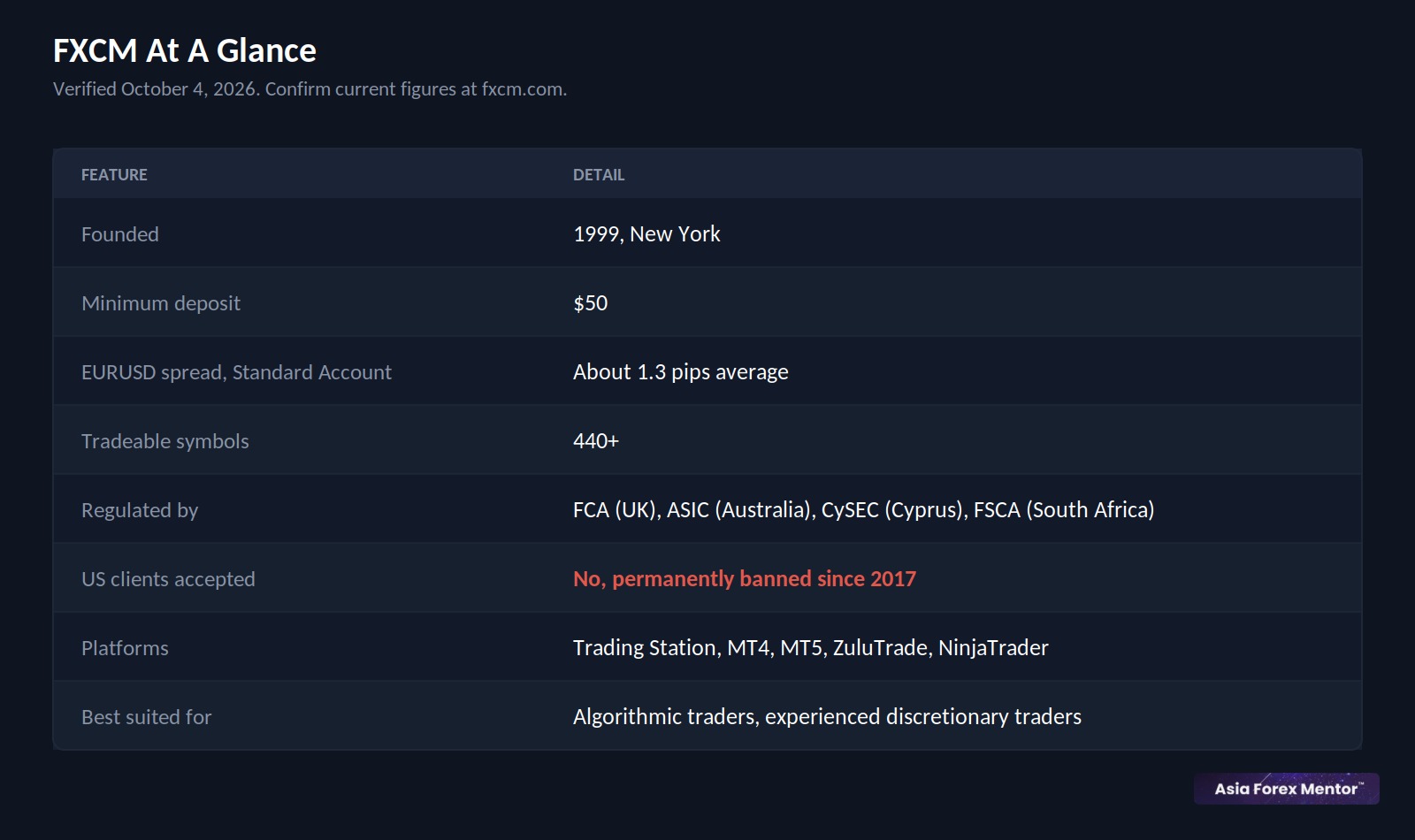
Confirm current figures at fxcm.com before depositing.
What Is FXCM?
FXCM stands for Forex Capital Markets. It was founded in New York in 1999. It is one of the oldest retail forex brokers still trading today.
The company listed on the New York Stock Exchange in 2010. After the 2017 CFTC action, which is covered in full below, FXCM left the US market. Today it runs from London, with regulated arms in the UK, Australia, Cyprus and South Africa.
FXCM offers forex, indices, commodities and crypto, over 440 symbols in total. What it is known for now is algorithmic trading. Its own Trading Station platform and its API access pull in traders who build and run automated systems.
This is not a broker trying to serve everyone. It has a narrow audience, and that is worth knowing before you open an account.
Is FXCM Regulated?
FXCM holds four separate licences.
| Regulator | Entity | Licence |
|---|---|---|
| FCA, UK | FXCM Limited | FRN 217689 |
| ASIC, Australia | FXCM Australia Pty Ltd | AFSL 309763 |
| CySEC, Cyprus | FXCM EU Ltd | 392/20 |
| FSCA, South Africa | FXCM South Africa (Pty) Ltd | FSP 46534 |
The FCA and ASIC are the two strictest regulators in retail forex. Both force a broker to keep client money in separate bank accounts, hold enough capital of its own, and get audited. These are not logos on a website. Break the rules and there are real consequences.
Leverage for retail clients is capped at 1 to 30 on major pairs. That is the regulator’s limit, not FXCM’s choice. Anything higher needs professional account status, which has strict eligibility rules.
Check any licence number yourself before you deposit. Each regulator has a free public register at fca.org.uk/register, asic.gov.au, cysec.gov.cy and fsca.co.za.
The 2017 CFTC Ban And What Really Happened
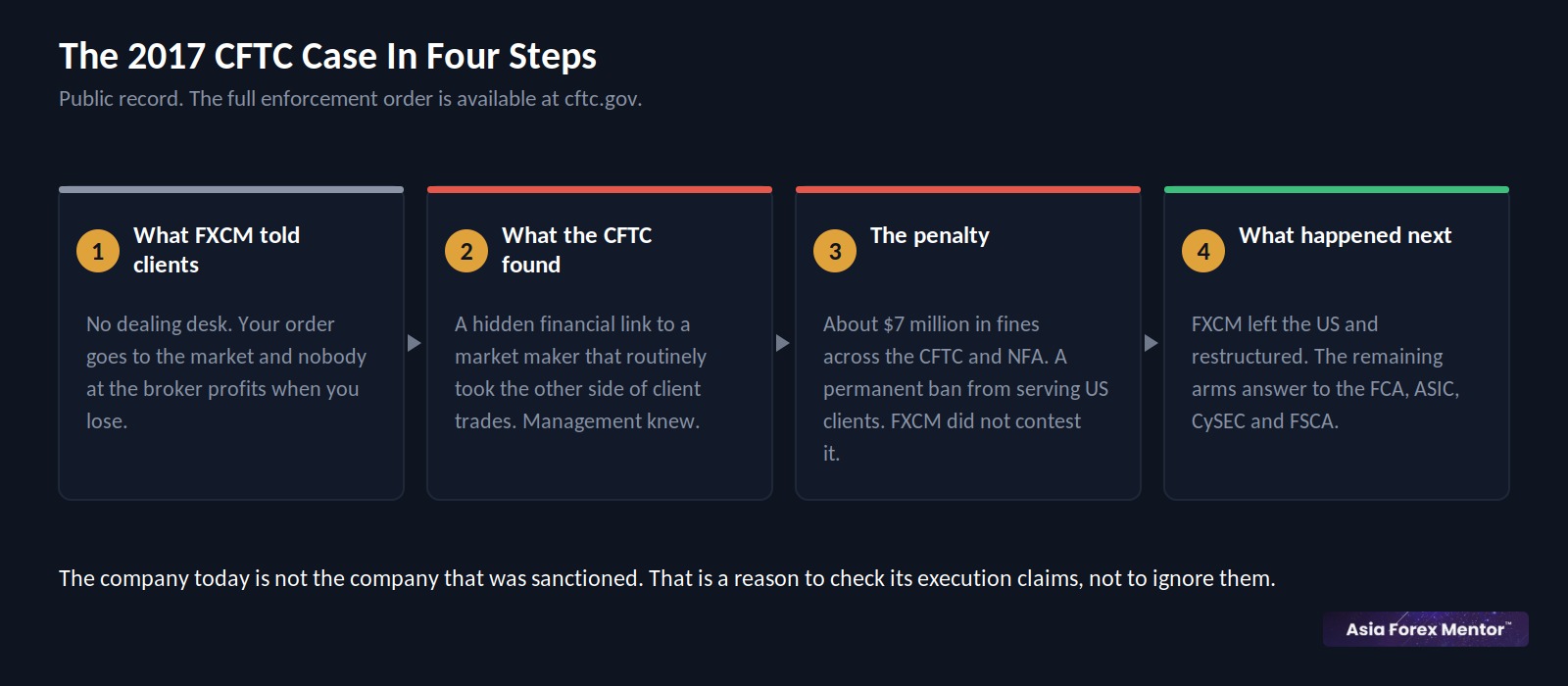
In February 2017 the CFTC and NFA brought a joint action against FXCM. It is public record. Any review that leaves it out is not telling you the whole story.
Here is the finding. FXCM told US clients it ran a “no dealing desk” model. That means your order goes to the market and nobody at the broker profits when you lose. The CFTC found that was not true.
FXCM had a hidden financial link to a market maker that routinely took the other side of client trades. Management knew. Clients were not told. The CFTC called it fraud. FXCM did not contest the findings. You can read the full order at cftc.gov.
The penalties came to roughly $7 million across both regulators. FXCM was permanently barred from the US and from serving US persons. Individual principals were barred too. The company left the market.
What changed after that: FXCM restructured its global operations and its ownership changed hands. The non US entities now answer to the FCA, ASIC, CySEC and FSCA, which audit client money and execution independently. The company today is structurally different from the one that was sanctioned.
In my view the 2017 action is not a reason to avoid FXCM forever. It is a reason to hold anything FXCM says about execution to a higher standard, and to check which entity you are signing up with before you send money. A broker that misled clients earns trust back by behaving well under tight supervision, not by rewording its marketing.
FXCM Trading Platforms
FXCM offers five platforms, which is more than most brokers at its level.
- Trading Station is FXCM’s own platform and its biggest advantage. It supports Lua strategy coding and direct REST and FIX API access. It runs on desktop, web and mobile. It is built for people who automate.
- MetaTrader 4 is the most used retail platform in the world. It is here for traders who want the standard expert advisor and indicator ecosystem.
- MetaTrader 5 adds more order types, an economic calendar and wider asset coverage than MT4.
- ZuluTrade handles copy trading. FXCM accounts connect to its signal provider network. Our ZuluTrade Review covers it in full.
- NinjaTrader is there for traders who want NinjaTrader’s charting and backtesting with FXCM doing the execution.
If you trade by hand and want clean charts and simple order entry, MT4 or MT5 is the easier choice. Trading Station only pays off if you are actually building automated strategies.
Mobile apps cover iOS and Android on Trading Station and MT4. They are fine for watching open trades and basic orders. They are not built for real analysis on a phone, which is normal across the industry.
Our Best Forex Trading Platform 2026 guide compares the leading options side by side.
Account Types And Minimum Deposit
FXCM’s minimum deposit starts at $50. That is one of the lowest entry points among brokers with this level of regulation.
There are two main retail accounts.
The Standard Account has no commission. Everything is in the spread. It suits traders who want one simple cost per trade.
The Active Trader Account has tighter raw spreads plus a commission per lot. It is built for high volume, where the tighter spread more than covers the commission.
FXCM also offers a demo account with no time limit, on both Trading Station and MT4. Many brokers cut demo access off at 30 days, so this one is unusually generous. There is also an Islamic account with no overnight swaps, replaced by an administrative fee.
One thing worth saying. A $50 minimum makes FXCM look accessible to a tiny account. It is. But trading standard lots on $50 is reckless no matter how good the broker is. Size your trades to your real capital, not to the number on the sign up page.
FXCM Spreads And Fees
| Cost item | Standard Account | Active Trader Account |
|---|---|---|
| EURUSD spread | About 1.3 pips | Tighter, plus commission |
| Commission per trade | None | From £2.00 per lot, falling to £1.70 at higher volume |
| Overnight swap | Yes | Yes |
| Inactivity fee | Up to 50 units of your account currency after 12 months of no trading | Same |
| Deposit fee | None | None |
| Withdrawal fee, card | None | None |
| Withdrawal fee, bank wire | Charged, amount not published | Charged, amount not published |
At 1.3 pips on EURUSD, FXCM sits around the industry average for spread only pricing. Raw spread brokers like Pepperstone and IC Markets quote far tighter before commission.
Here is what that gap costs. Trade 200 round turns a month on EURUSD standard lots. The difference between 1.3 pips and a tight raw spread plus commission runs to over $2,000 a year. If you trade a few times a month it barely matters. If you trade daily it matters a lot.
Spreads are reported to be tighter for clients in the UK, EU and Australia than elsewhere.
The inactivity fee matters most to swing traders who go quiet for weeks. Check the threshold before you open an account.
What FXCM Does Well
- Algorithmic trading infrastructure is the real differentiator. Lua scripting in Trading Station, REST and FIX API access and NinjaTrader support give systematic traders tools most retail brokers do not offer at any price.
- Tier 1 regulation in two jurisdictions means segregated client money, negative balance protection in the UK and EU, and a real complaints process you can use.
- Research and analysis are better than average for this tier. Daily commentary, an economic calendar and built in analytics.
- Platform choice is genuine. Five platforms serving five different kinds of trader, where most brokers offer two.
Where FXCM Falls Short
- Standard spreads are average, not competitive. Over real volume you pay more here than at a raw spread broker. That $2,000 a year gap is not marginal.
- The 2017 history needs ongoing scrutiny. FXCM’s execution claims were found fraudulent once. Test current claims against independent audits rather than taking marketing at face value. This caveat does not expire.
- Beginners are not served well. Education exists, but Trading Station is complex and structured onboarding is thin. A new trader will meet the complexity before they have the basics to handle it.
- Stock CFD range is narrow. Forex, indices, commodities and crypto are covered. Individual shares are not.
- Support is inconsistent. Trustpilot shows good experiences with individual staff alongside complaints about how long account and withdrawal issues take to resolve.
Pros And Cons
| Pros | Cons |
|---|---|
| Best in class tools for automated trading | Standard spreads are average, not competitive |
| FCA and ASIC regulation, money held separately | 2017 CFTC fraud finding on execution claims |
| $50 minimum deposit | Weak support for beginners |
| Demo account with no time limit | Very few individual share CFDs |
| Five platforms to choose from | Mixed reports on support and withdrawal times |
Who Is FXCM Best For?
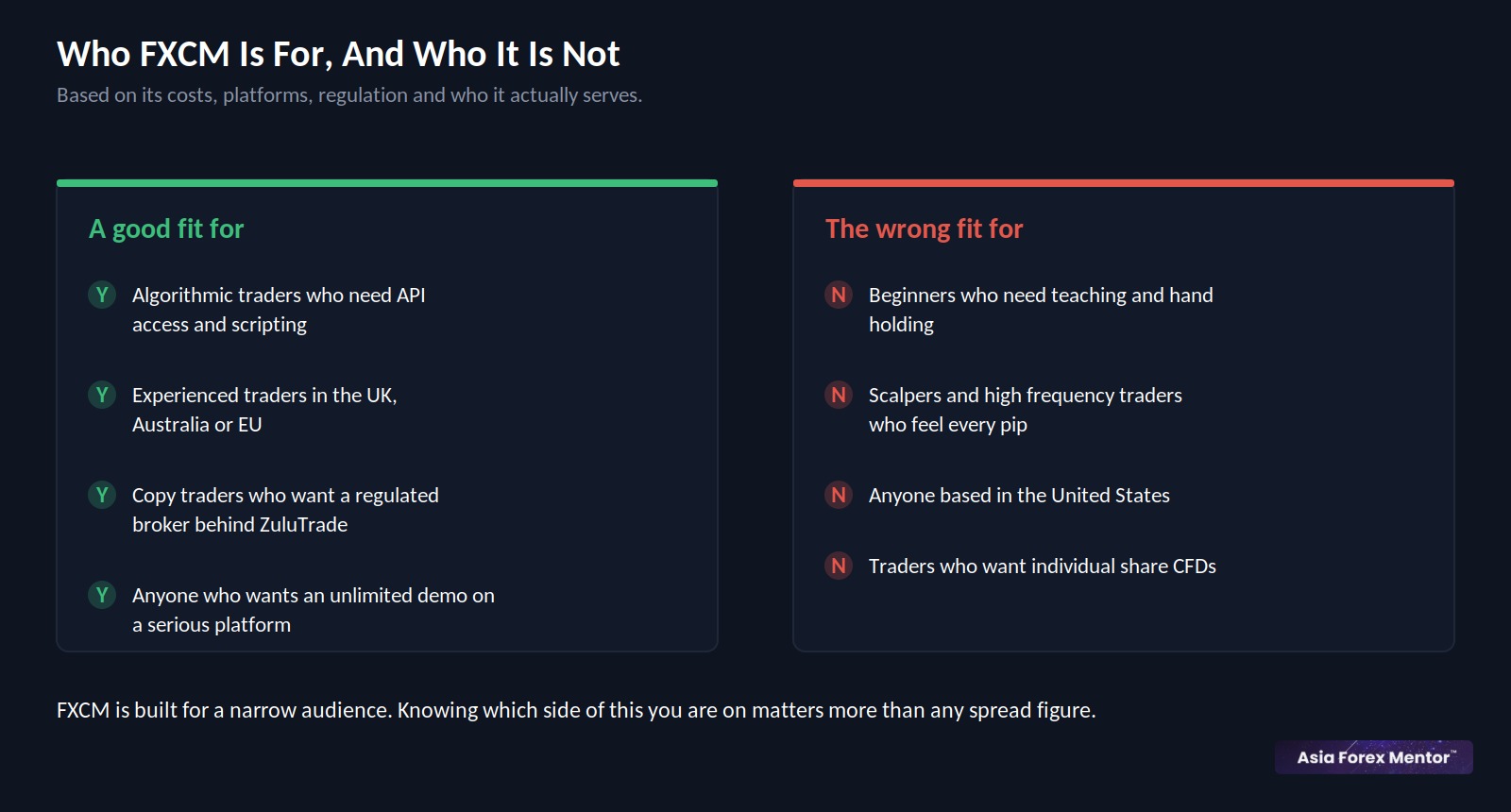
FXCM is a strong fit for algorithmic and systematic traders who need API access and scripting. It also suits experienced discretionary traders in the UK, Australia or EU who want tight regulation and will accept average spreads for it. Copy traders who want a regulated broker behind ZuluTrade fit too, as do people who want an unlimited demo on a serious platform.
It is the wrong fit for beginners who need teaching and hand holding, for scalpers and high frequency traders who feel every pip, for anyone based in the US, and for traders who want individual share CFDs.
Here is what I have seen across 20 years and more than 100,000 students. Most traders obsess over which broker to use while their actual method is still unfinished. Paying 0.2 pips instead of 1.3 matters at scale. It means nothing if your system does not find good setups. The broker does not create the edge.
Also Read: Best Forex Trading Platform 2026
Conclusion
FXCM is a real, multi regulated broker with a narrow set of genuine strengths. Its automation tools, its FCA and ASIC licences and its research make it a credible option for experienced systematic traders outside the US. The 2017 enforcement history is public record. It is not a reason to rule the broker out, but it is a standing reason to check execution claims rather than believe them.
For active discretionary traders, 1.3 pips on EURUSD is a real cost disadvantage against raw spread brokers. For beginners, the platform complexity and thin support point somewhere else.
Broker data last verified: October 4, 2026. Regulation details, spreads, fees and account terms are subject to change. Confirm current figures at fxcm.com and the relevant regulatory registers before opening an account.
Frequently Asked Questions
Is FXCM A Legitimate Broker?
Yes. FXCM is regulated by the FCA in the UK (FRN 217689), ASIC in Australia (AFSL 309763), CySEC in Cyprus (392/20) and FSCA in South Africa (FSP 46534). All four keep public registers you can search for free. FXCM was permanently banned from the US in 2017 after a CFTC fraud finding, but its non US arms operate under tight supervision. Check any licence number with the regulator before you deposit.
Why Was FXCM Banned From The United States?
In February 2017 the CFTC and NFA found that FXCM had misled US clients about how their orders were filled. FXCM said it ran a “no dealing desk” model. In fact it had a hidden financial link to a market maker that took the other side of client trades, and management knew. The fines came to around $7 million and FXCM was permanently barred from serving US persons. It did not contest the findings.
What Is The Minimum Deposit At FXCM?
It starts at $50, which is one of the lowest among brokers with this level of regulation. The minimum can change by account type, region or payment method, so confirm it at fxcm.com before opening an account.
Can US Citizens Trade With FXCM?
No. The 2017 ban is permanent and covers US persons. US based traders need a broker registered with the NFA and overseen by the CFTC.
Is FXCM Good For Beginners?
No. Trading Station is harder to learn than platforms built for new traders, and structured teaching is thin. A beginner will hit the complexity before they have the basics to deal with it. There are better first brokers.