Learn To Trade Forex • Best Forex Trading Course • AsiaForexMentor

- Best Forex BrokersRaw spreads, ECN execution and regulation — tested on live accounts.Best Stock BrokersCommissions, market access and platform depth, compared.Best Prop FirmsFunding rules, drawdown limits and real payout records.Best Crypto BrokersFees, custody and coin coverage across the major exchanges.AFM Top Pick
Every other site ranks ten brokers. We rank one — and show you exactly why.
See the #1 pick → - Articles
- Awards
- Newsletter
 Singapore
 Malaysia
 Indonesia
 Philippines
 Thailand
 Vietnam
 Cambodia
 Myanmar
 Brunei
 China
China Japan
Japan South Korea
 Taiwan
 India
India Australia
  New Zealand
 United Kingdom
 Switzerland
 Italy
Italy Spain
Spain UAE
UAE United States
 Mexico
 Argentina
 South Africa
 IC Markets
 Axon Markets
 Pepperstone
 AvaTrade
 XM
XM Plus500
 RoboForex
 TMGM
TMGM Exness
 JustMarkets
 Orbex
Orbex Interactive Brokers
 Saxo
Saxo Tiger Brokers
 Binance
 Coinbase
 Gemini Exchange
 Kraken
 iFunds
 IC Funded
 The 5%ers
 TopStep
 IQ Option
 Pocket Option
 RaceOption
 IQCent
Bamboo Review 2026
Bamboo Investment has built something genuinely useful for African investors who want access to U.S. and Nigerian stock markets without the complexity that typically comes with traditional brokerage accounts. The platform’s strengths are clear: a low minimum investment, fractional stock ownership, solid regulatory backing through the SEC Nigeria and FINRA-registered DriveWealth LLC, and a product range that goes beyond just stocks to include ETFs, Fixed Returns, and Treasury Bills.
Risk warning: your capital is at risk. Forex and CFDs carry the potential for gains, but statistically only 11–25% of traders profit while 74–89% lose their investment. AFM earns a commission if you open an account through our links — it never changes how we score a broker.
- Access to over 3,500 U.S.-listed stocks and ETFs directly from a mobile app
- Low minimum investment starting at just $20, making it accessible for beginner investors
- Offers fractional investing, allowing users to buy portions of high-priced stocks
- Accounts are protected by SIPC insurance up to $500,000 and wallet balances covered under FDIC insurance
- Regulated by the Securities and Exchange Commission of Nigeria and backed by DriveWealth LLC, a FINRA and SIPC member
- Includes a Fixed Returns product offering up to 8% annual returns for lower-risk investors
- Charges a 1.5% commission on U.S. stock trades, which can add up for frequent traders
- The platform is mobile-first, which may not suit investors who prefer a full desktop trading experience
- Customer support options are limited compared to more established global brokerages
- No access to derivatives, forex, or commodities, restricting portfolio diversification options
- This review was written by the Asia Forex Mentor team and has been reformatted into our current layout. The analysis below is our earlier work on Bamboo, presented more clearly.
- It has not been re-verified against Bamboo’s current published terms. Spreads, fees, leverage caps and account rules change, and so does the legal entity that serves a given country.
- Treat every figure here as a starting point for your own checks rather than a live quote.
- Before depositing, confirm the details on Bamboo’s own site — above all, which company your client agreement names. That determines your regulator, your protections and who you can complain to.
- The score shown is Asia Forex Mentor’s own published rating for Bamboo, carried over from this article and expressed out of 10. It reflects our earlier assessment, not a fresh re-scoring.
Reformatted September 2026. The details in this review have not been independently re-verified since it was written, so check Bamboo’s own site before acting on anything here. Spotted something out of date? Tell us.

Ezekiel has traded foreign exchange for over two decades and built the One Core Program, the trading curriculum Asia Forex Mentor teaches to retail and institutional traders across Asia. He sets the scoring criteria these broker reviews are graded against.
On this page
- Bamboo Investment Review
- What is Bamboo Investment?
- Benefits of Trading with Bamboo Investment
- Bamboo Investment Regulation and Safety
- Bamboo Investment Customer Reviews
- Bamboo Investment Spreads, Fees, and Commissions
- Account Types
- Bamboo Investment Trading Platforms
- What Can You Trade on Bamboo Investment
- Bamboo Investment Customer Support
- Withdrawal Options and Fees
- Conclusion: Bamboo Investment Review
- FAQs
- Verdict
Bamboo Investment Review
A good stock broker gives traders and investors the tools, security, and transparency they need to make informed financial decisions. The best brokers are regulated by recognized financial authorities, offer fair pricing, and provide a platform that works reliably whether you are a beginner or an experienced trader. Choosing the right brokerage can make a significant difference in your long-term investment results, which is why thorough, honest reviews matter.
Bamboo Investment is a digital stock brokerage platform built primarily for African investors who want access to both U.S. and Nigerian stock markets. It is registered and regulated by the Securities and Exchange Commission of Nigeria as a digital sub-broker, with U.S.-traded securities facilitated through DriveWealth LLC, a registered broker-dealer and member of FINRA and SIPC. Bamboo gives users the ability to buy shares and ETFs or invest in Fixed Returns with just a few taps, allowing them to fund their dollar or local currency balance almost instantly. The platform targets everyday people who want to buy stocks without needing a traditional brokerage account or prior investing experience. Bamboo uses fractional investing technology, which means users can invest as much or as little as they want, making stock market participation possible even for those with smaller amounts of capital. This makes it one of the more accessible stock brokers available to retail investors across Africa. This detailed review of Bamboo Investment takes a close look at what the platform actually offers to everyday investors and active traders alike. It covers the broker’s key features, fee structure, available investment products, and the quality of its trading platform to give readers a well-rounded picture of what to expect. The goal is to present the facts clearly so that investors can weigh the strengths and weaknesses of Bamboo Investment before committing their money.
What is Bamboo Investment?
Bamboo Investment is an online stock brokerage platform built to give African investors direct access to both the U.S. and local stock markets through a simple mobile app. It operates under Bamboo Systems Technology Limited, which is registered and regulated by the Securities and Exchange Commission of Nigeria as a digital sub-broker. The platform is designed to make stock market participation straightforward, even for people with little to no prior investing experience. The idea behind Bamboo came in 2018, when co-founders Richmond Bassey and Yanmo Omorogbe were trying to invest in the U.S. stock market from Nigeria and found the process unnecessarily slow, complicated, and expensive. That firsthand frustration became the foundation for what Bamboo is today, a platform built to remove those same barriers for millions of other African investors.
Bamboo was officially founded in 2019 and is headquartered in Lagos, Nigeria, with the mission of being the first online brokerage service to give Africans and their wealth managers direct access to U.S. and global securities. The company has been compared in ambition to building a Fidelity-equivalent platform for the African continent. Through the Bamboo platform, investors can access over 3,500 stocks listed on the U.S. stock market or their local exchanges, with the firm charging a 1.5% commission to buy and sell U.S.-listed stocks. The platform also serves corporate and institutional clients such as brokers, fund managers, and investment advisors.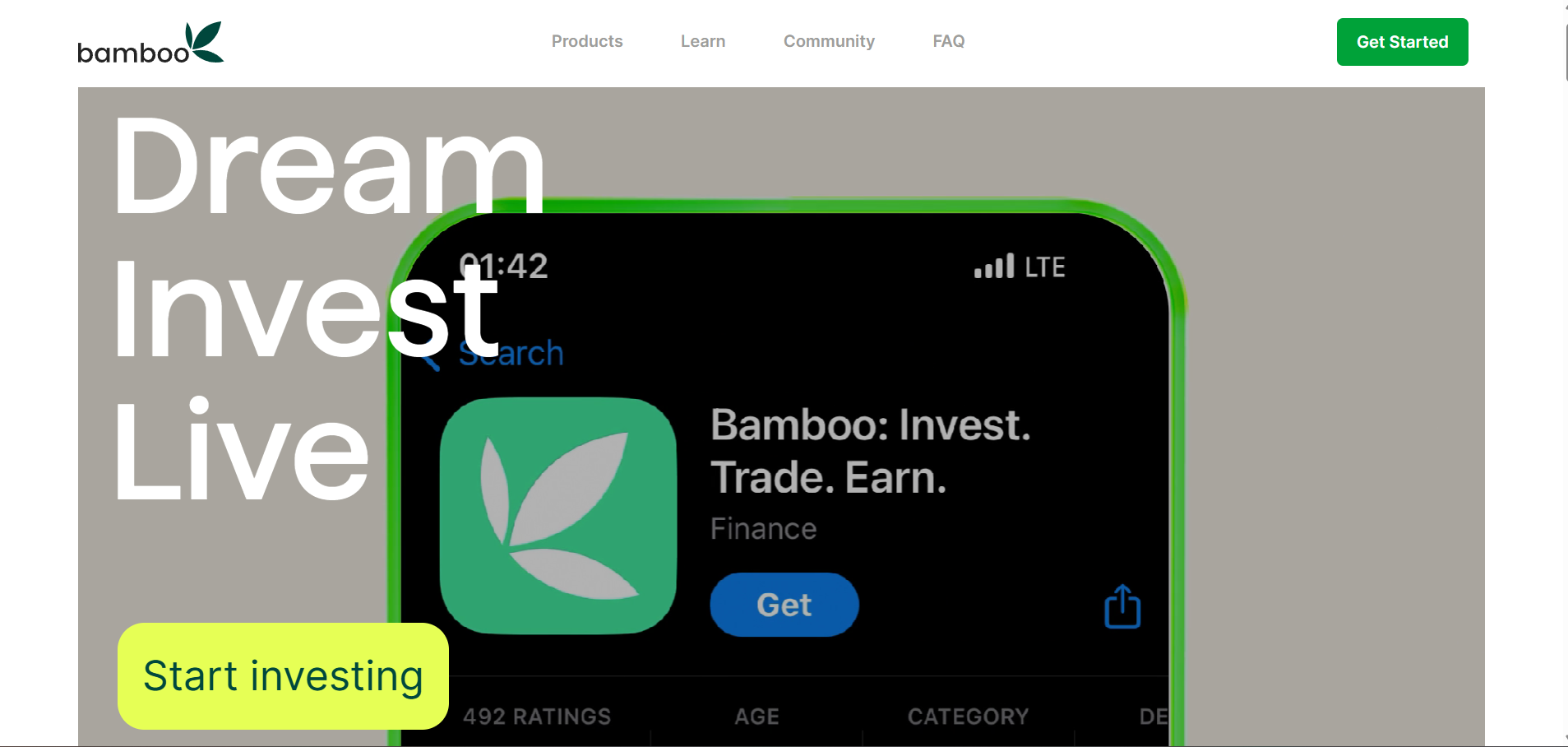
Benefits of Trading with Bamboo Investment
One of the most practical benefits of using Bamboo Investment is how easy it is to get started. Registration requires only your NIN and contact details, with zero paperwork needed, and the entire process can be completed directly from your mobile phone. This removes the usual friction that keeps many people away from stock market participation. Bamboo gives investors access to over 3,500 U.S.-listed stocks, allowing them to trade, earn dividends, and invest in global companies in real time through a mobile phone or computer. For African investors who previously had little to no access to international markets, this is a meaningful step forward.
Account security is a clear priority at Bamboo, with all accounts insured through the Securities Investor Protection Corporation (SIPC) for up to $500,000, and wallet balances covered under Federal Deposit Insurance Corporation (FDIC) insurance. This level of protection is comparable to what investors would expect from established brokerages in the U.S. Users can fund their account with as little as $20 using local currency, with the platform handling currency conversion almost instantly through its partner network. This low entry point makes Bamboo one of the more accessible stock brokers for retail investors who are just starting to build their portfolios. Fractional investing is built into the platform, meaning investors can put in as much or as little as they want into any listed U.S. stock or ETF without needing to purchase a full share. This is especially useful for investors who want exposure to high-priced stocks like Apple or Amazon without committing a large amount of capital. Bamboo also offers Fixed Returns, a fixed-income dollar-denominated investment product that delivers up to 8% annual returns, giving investors a lower-risk option to grow their money outside of direct stock trading. This product allows investors to diversify their portfolios without taking on the full volatility of the stock market. The platform provides users with real-time market data, including live stock quotes, historical price charts, and market news, so investors can make decisions based on current and accurate information. Having these tools available within the same app where trades are executed keeps the process straightforward and efficient. Bamboo also includes educational resources that cover investing basics, market analysis, and research materials, making it one of the few brokers in its space that actively works to improve financial literacy among its users. This is particularly valuable for first-time investors who need guidance before placing their first trade.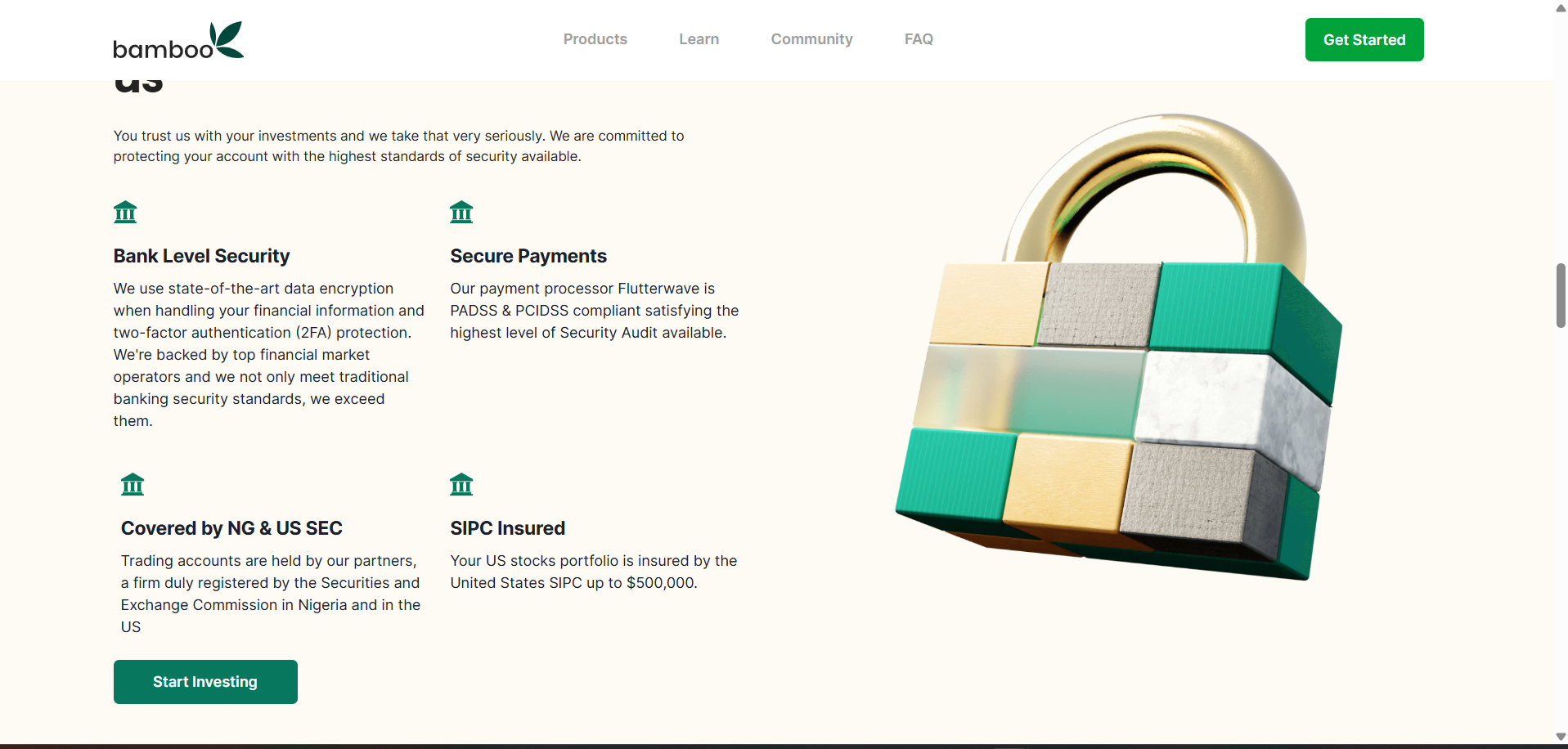
Bamboo Investment Regulation and Safety
Bamboo Investment is registered and regulated by the Securities and Exchange Commission of Nigeria as a digital sub-broker, with U.S.-traded securities provided through DriveWealth LLC, a regulated member of FINRA and SIPC. This dual-layer regulatory structure means Bamboo operates under oversight on both the Nigerian and U.S. sides of its business.
Bamboo began the formal application process for the SEC’s digital sub-broker license in 2021, which involved a thorough examination of its finances and governance procedures before the license was officially granted. This was not a simple registration but a rigorous process, which adds weight to the legitimacy of their regulatory standing. For Nigerian stock trades, securities are facilitated by Lambeth Capital, a broker-dealer registered with the Securities and Exchange Commission of Nigeria and a Trading License Holder of the Nigerian Exchange Group. This means Nigerian investors have an additional layer of local regulatory protection when trading domestic securities through the platform. All Bamboo U.S. brokerage accounts are insured by the Securities Investor Protection Corporation (SIPC) for up to $500,000, which includes a $250,000 limit for uninvested cash, while wallet balances are separately covered under FDIC insurance. These protections are standard among reputable U.S.-linked brokerages and give investors a meaningful safety net. Bamboo is also PCI DSS Certified, a security standard that applies to platforms handling card and payment data, further confirming that the broker takes data protection and financial security seriously. For investors who fund their accounts using local currency or card payments, this certification provides an added level of assurance.
Bamboo Investment Customer Reviews
Users praised Bamboo for being easy to use and seamless, highlighting that the onboarding experience and day-to-day investing functions worked well for them as first-time investors. A few reviewers also noted appreciation for the platform’s diverse product offerings, including Treasury Bills and Dollar Fixed Returns.
Some users shared that after an initial learning curve, the platform became straightforward to navigate, and that features like dollar fixed returns and Treasury Bills made it a convenient place to put spare money to work. Positive experiences like these tend to come from users who did not encounter issues with withdrawals or account access. Concern among users is withdrawal difficulties, with multiple reviewers reporting that their withdrawal requests went unaddressed for extended periods, and that they were unable to reach a live customer support representative to resolve the issue. This pattern of complaints points to a consistent gap in customer service responsiveness that has frustrated a notable number of users. Several users reported being locked out of their accounts for weeks at a time, with customer support only sending automated email replies and no actual follow-through to resolve the problem. For a stock brokerage where timely access to funds and account management is critical, this is a serious concern that potential investors should take into account.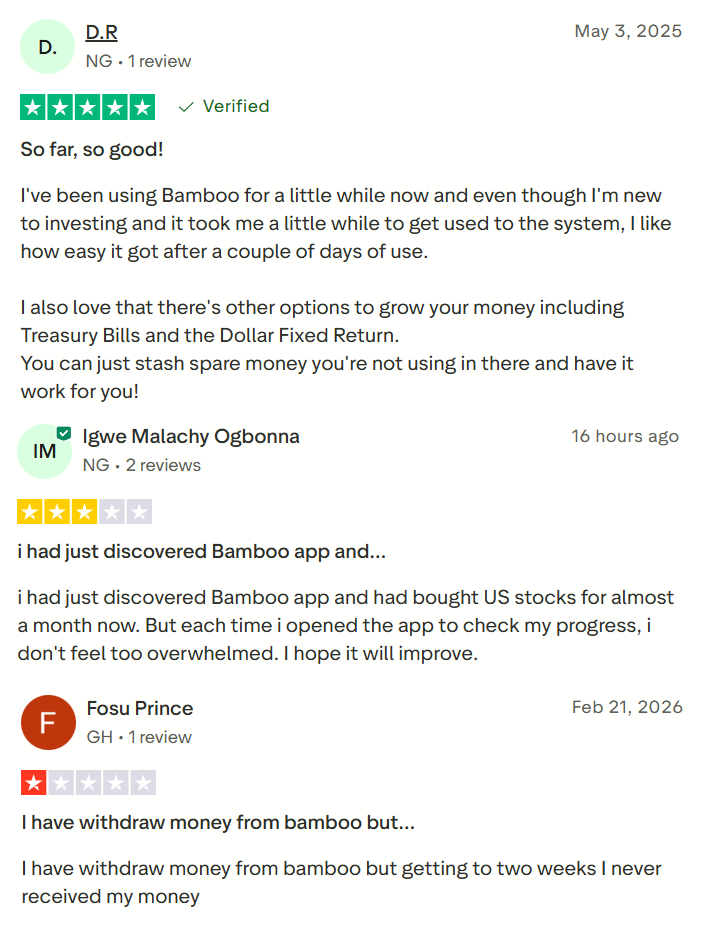
Bamboo Investment Spreads, Fees, and Commissions
Bamboo charges a 1.5% commission on every buy or sell order placed on the U.S. stock market, with a minimum charge of $1 per trade, meaning that if 1.5% of your trade value is less than $1, you will still be charged the $1 minimum regardless. This minimum commission structure was introduced to cover the execution costs of smaller trades and applies to both buy and sell orders. There are no holding fees on Bamboo, meaning investors are not charged for keeping stocks in their portfolio or leaving funds in their Bamboo wallet for extended periods. This is a reasonable benefit for long-term investors who do not trade frequently and prefer to hold positions over time. For Nigerian stock trades, Bamboo applies a 1% commission on buy and sell orders, along with a 0.5% withholding tax (WHT) on dividends, capped at N500, which applies only to dividend payments and not to profits made from selling stocks. This makes Nigerian stock trading slightly cheaper in commission terms compared to U.S. stock trades on the same platform. When it comes to deposit fees, Naira card deposits carry a charge of 1.4% capped at N2,000, while Naira bank transfers above N10,000 carry a flat fee of N150, and transfers below N10,000 carry a flat fee of N100. USD card deposits are charged at 2.9%. These deposit costs are worth factoring in, especially for investors who fund their accounts frequently. For withdrawals, Bamboo charges a flat fee of N45 for Naira bank account withdrawals and $45 for USD bank account withdrawals, with a minimum withdrawal amount of $500 for USD account transfers. The $45 flat fee on USD withdrawals can be a significant cost for investors withdrawing smaller amounts. Bamboo’s fee structure is described as transparent and clearly displayed within the app, with no hidden charges reported by the platform itself. Investors are encouraged to review the full terms and disclosures on investbamboo.com/legal before trading to have a complete picture of all applicable costs.
Account Types
U.S. Stock Market Account
- Access to over 3,500 U.S.-listed stocks, allowing users to trade and earn dividends from global companies in real time.
- Supports fractional investing, meaning users can buy portions of high-priced stocks with as little as $2.
- All accounts are SIPC-insured for up to $500,000, with wallet balances covered under FDIC insurance.
- Trades are executed through DriveWealth LLC, a registered broker-dealer and member of FINRA and SIPC
- A 1.5% commission applies on every buy or sell order, with a minimum charge of $1 per trade
Nigerian Stock Market Account
- Access to Nigerian Exchange Group (NGX) listed stocks facilitated by Lambeth Capital, a SEC Nigeria registered broker-dealer.
- Features instant trade settlements and dividend payments for retail customers.
- A 1% commission applies on buy and sell orders, lower than the rate charged for U.S. stock trades.
- A 0.5% withholding tax (WHT) applies on dividends, capped at N500.
Bamboo Fixed Returns
- Lock-in periods range from 30 days to 12 months, giving investors flexibility on duration.
- Investors can create multiple fixed-return investments simultaneously, allowing for staggered lock-in periods.
- Designed for investors who want higher yields than regular dollar savings accounts without direct stock market exposure.
- Minimum investment starts at $2, keeping the entry point low for new investors.
ETF (Exchange-Traded Fund) Account
- Provides broad market exposure through a single investment rather than picking individual stocks.
- Offers access to professionally managed funds at a lower cost compared to traditional fund management.
- Suitable for investors who want index-tracking investments without the complexity of managing multiple stock positions.
Bamboo Investment Trading Platforms
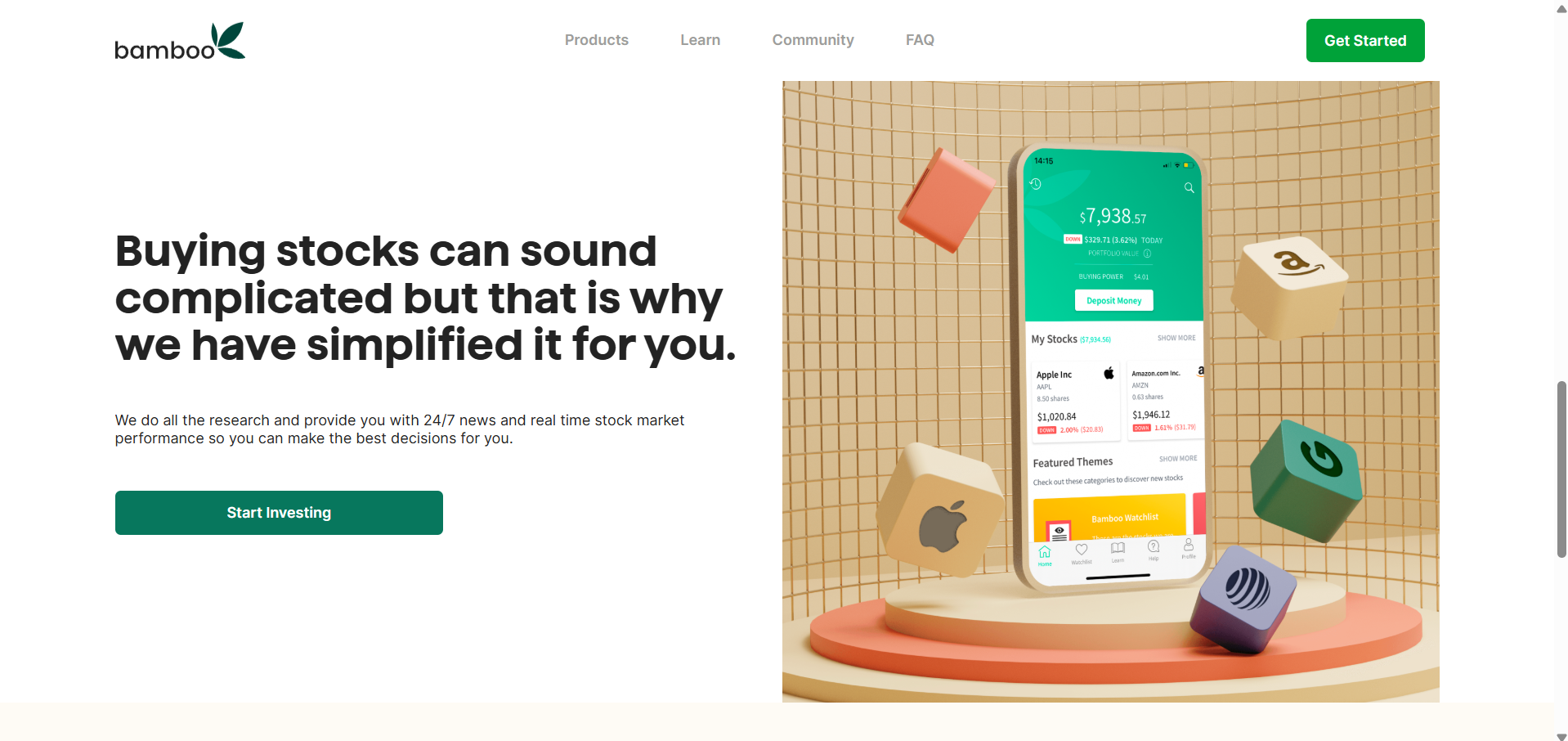
Bamboo Investment gives users access to its trading platform through both a mobile app and a web-based platform, making it available across multiple devices. With the Bamboo app, users can trade, earn dividends, and invest in global companies in real time from their mobile phone or computer. This dual-access setup means investors are not restricted to a single device when managing their portfolios. The Bamboo mobile app is available on both Android and iOS devices, allowing investors to buy and sell stocks, monitor their portfolio, and manage their account directly from their smartphone. The app is the primary platform through which most users interact with Bamboo, and it is built around simplicity to make stock trading accessible to everyday investors. Within the app, users have access to real-time stock quotes, historical price charts, and market news, giving them the data they need to make informed trading decisions without leaving the platform.The app also includes a portfolio tracking feature that allows users to monitor the performance of their investments at any time. Bamboo recently added a community feature called Live Feed, where users can talk stocks, share tips, and learn from other investors in real time, currently live in Nigeria and Ghana. This social layer adds an educational and collaborative dimension to the platform that goes beyond basic trade execution. Bamboo also offers a web-based trading platform accessible via a computer browser, giving investors the ability to trade U.S. and Nigerian stocks, manage portfolios, and access research tools from a desktop environment. The web platform mirrors the core functions of the mobile app, making it a reliable alternative for investors who prefer a larger screen.
What Can You Trade on Bamboo Investment
Bamboo Investment gives users access to a range of investment products across both U.S. and local African markets. With the Bamboo app, users can buy and sell shares, ETFs, and other holdings, funding their account with as little as $20 using their local currency and starting almost instantly. Bamboo provides real-time access to over 3,500 stocks listed on the U.S. stock market, which carries a market cap of over $31 trillion and makes up over 85% of all dollars that flow into global markets. Fractional investing technology is built into the platform, allowing investors to put in as much or as little as they want into any publicly listed U.S. company without needing to purchase a full share. This makes high-priced stocks accessible even to investors with smaller amounts of capital. Bamboo launched Nigerian stocks on its platform in May 2024, offering retail customers the ability to trade shares listed on the Nigerian Exchange Group (NGX) with instant trade settlements and dividend payments. This addition made Bamboo one of the few platforms allowing investors to hold both U.S. and Nigerian equities in a single account.
Bamboo Investment Customer Support
Customer support is one of the areas where Bamboo Investment has received the most mixed feedback from its users. Bamboo directs users to its Help Centre as the first point of contact, recommending that investors explore the knowledge base before reaching out directly, with separate Help Centres available for Nigeria and Ghana and for South Africa. While the Help Centre covers a range of common questions, it does not always resolve account-specific issues that require direct human intervention.
The primary support channel available to users is email, with the official support address being support@investbamboo.com, alongside a live chat feature accessible directly within the Bamboo app. These two channels are the main ways investors can get assistance with account issues, trading queries, or withdrawal concerns. Bamboo does not currently operate a call center, and users who prefer phone-based support will not find that option available on the platform. This has been a recurring point of frustration among users, particularly those dealing with time-sensitive issues like stuck withdrawals or account lockouts. Bamboo’s official support hours run Monday to Friday, 9:00am to 5:00pm, meaning that issues raised outside of business hours or over the weekend will not receive a response until the next working day. For active investors who may encounter problems at any time, the absence of round-the-clock support is a notable limitation. Bamboo also maintains a dedicated FAQ section on its platform, where users can find quick answers to common questions about account setup, deposits, withdrawals, and trading without needing to contact the support team directly.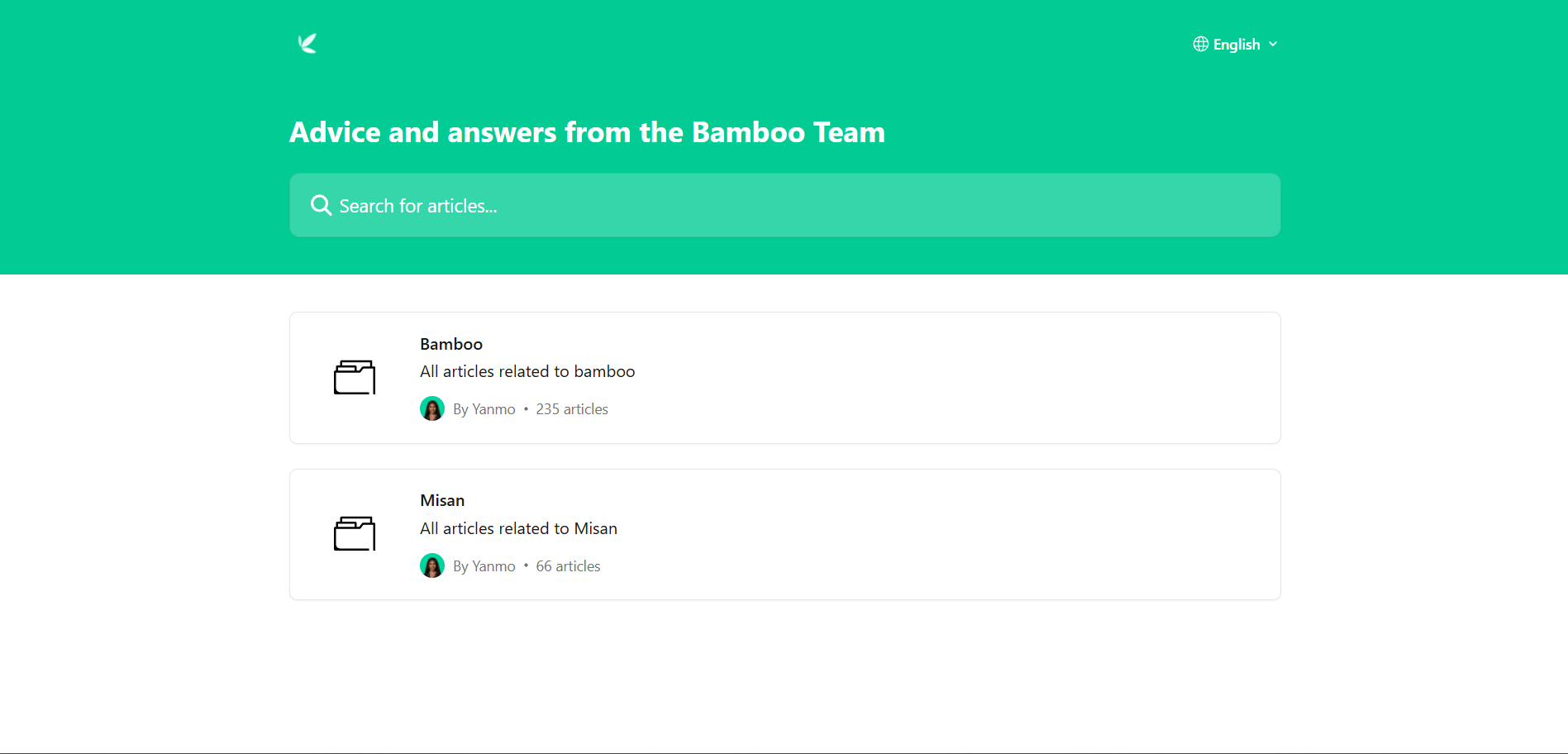
Withdrawal Options and Fees
Bamboo Investment offers withdrawal options across Naira, USD, and local currency accounts depending on the user’s country, but each method comes with its own set of fees and processing times that investors should be fully aware of before funding their account.
Withdrawals to a Naira bank account carry a flat fee of N45, with a minimum withdrawal amount of N300. This makes Naira withdrawals relatively affordable for most users, particularly those making smaller or more frequent withdrawals from their local currency wallet. Once a withdrawal request is submitted, the fiat currency withdrawn may take up to five business days to arrive in the linked bank account, depending on the processing time involved. Investors should plan around this timeline to avoid situations where they urgently need access to their funds. Withdrawals to a USD bank account carry a flat fee of $45, and the minimum withdrawal amount for USD accounts is $500. This fee structure means that for smaller USD balances, the $45 flat charge represents a significant portion of the amount being withdrawn. For users who deposited via USD wire transfer, there is an additional 30-day holding period before those specific funds can be withdrawn, meaning investors cannot immediately pull out wire-transferred deposits even after they reflect in the account. This holding period is worth noting for anyone planning short-term trades funded by wire transfer. There is currently no maximum withdrawal amount on Bamboo, meaning investors can withdraw their full balance without hitting an upper cap, while the minimum withdrawal to a Naira account is N300 and GHS 5 for Cedi accounts. The only binding lower limit for international transfers remains the $500 minimum for USD account withdrawals.
Conclusion: Bamboo Investment Review
Bamboo Investment has built something genuinely useful for African investors who want access to U.S. and Nigerian stock markets without the complexity that typically comes with traditional brokerage accounts. The platform’s strengths are clear: a low minimum investment, fractional stock ownership, solid regulatory backing through the SEC Nigeria and FINRA-registered DriveWealth LLC, and a product range that goes beyond just stocks to include ETFs, Fixed Returns, and Treasury Bills.
That said, the platform is not without its shortcomings. The 1.5% commission on U.S. stock trades, combined with deposit and withdrawal fees, makes it a relatively costly option for frequent traders. More importantly, the customer support concerns reflected across multiple user reviews are difficult to overlook, particularly the reports of delayed withdrawals, unresponsive support teams, and account access issues that went unresolved for weeks at a time. However, investors who prioritize fast withdrawals, responsive customer service, and low trading costs may find the platform’s current limitations frustrating. Bamboo shows real promise as a stock brokerage for African retail investors, but it still has meaningful ground to cover before it can be considered a fully reliable option for all types of investors.
Bamboo Review FAQs
Is Bamboo Investment regulated and safe to use?
Yes, Bamboo Investment is regulated by the Securities and Exchange Commission of Nigeria as a digital sub-broker, with U.S. trades executed through DriveWealth LLC, a registered member of FINRA and SIPC. All U.S. brokerage accounts are insured by SIPC for up to $500,000, and wallet balances are separately covered under FDIC insurance, making it a formally regulated and insured platform for stock investing.
How much money do I need to start investing on Bamboo?
Bamboo Investment has one of the lowest entry points among stock brokers available to African investors, with a minimum deposit of just $1 for Nigerian users and $10 for Ghanaian users. The platform also supports fractional investing, meaning you can buy portions of high-priced stocks like Apple or Tesla without needing to purchase a full share.
What fees does Bamboo Investment charge?
Bamboo charges a 1.5% commission on U.S. stock trades with a minimum of $1 per trade, and a 1% commission on Nigerian stock trades. Withdrawals to a Naira bank account carry a flat fee of N45, while USD bank account withdrawals carry a flat fee of $45 with a minimum withdrawal amount of $500. OPEN AN ACCOUNT NOW WITH BAMBOO INVESTMENT AND GET YOUR BONUS
The verdict on Bamboo
Bamboo Investment has built something genuinely useful for African investors who want access to U.S. and Nigerian stock markets without the complexity that typically comes with traditional brokerage accounts. The platform’s strengths are clear: a low minimum investment, fractional stock ownership, solid regulatory backing through the SEC Nigeria and FINRA-registered DriveWealth LLC, and a product range that goes beyond just stocks to include ETFs, Fixed Returns, and Treasury Bills.
More stock brokers we’ve reviewed

Get Ezekiel Chew’s 5 Day Email Course on “How to be in the Top 10% league of Forex Traders”
100% Free – Delivered to your inbox
Subscribe to the most popular Forex Trading blog online, join thousands of readers
