
Learn To Trade Forex • Best Forex Trading Course • AsiaForexMentor

Economic Time Bomb Incoming Tariffs Threaten US Growth

Written by

Ezekiel Chew

Updated on

June 4, 2025

i
Its a default text

Economic Time Bomb Incoming Tariffs Threaten US Growth

Written by:

Last updated on:

June 4, 2025

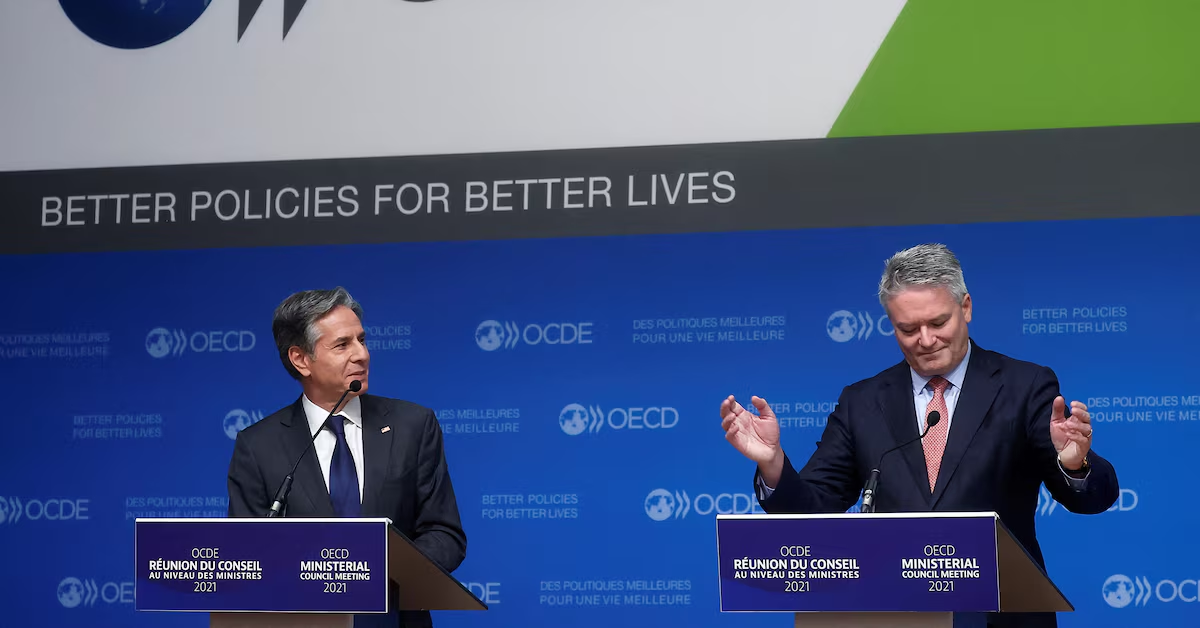
A stark warning has just been issued from one of the world's leading economic organizations, painting a concerning picture for the U.S. economy. The Organization for Economic Cooperation and Development (OECD) recently put out a forecast suggesting that the imposition of the highest U.S. tariffs seen since the 1930s isn't just a political talking point; it's set to ignite inflation and significantly slow down the nation's economic engine.

The OECD predicts that U.S. economic growth will slump to just 1.6% this year, a sharp drop from 2.8% in 2024. This isn't just a minor blip; it's a direct consequence, they say, of the uncertainty stemming from ongoing trade policies. Adding to this gloomy outlook, factors like a significant decline in immigration and substantial cuts to the federal workforce are also expected to put the brakes on growth. Globally, the picture isn't much brighter, with the OECD forecasting a decline in global gross domestic product growth to 2.9% this year from 3.3% in 2024.

According to OECD Chief Economist Álvaro Pereira, risks to the global economy have “risen significantly.” He emphasized that reaching agreements to ease trade tensions and reduce tariffs and other trade barriers would be absolutely crucial to revive growth and investment, thereby avoiding rising prices. This, he stressed, stands out as the most important policy priority right now.

These concerns aren't confined to the OECD's ivory towers. Several economists from both the private and public sectors have, in recent months, pointed to the uncertain impact of policy changes under President Donald Trump as a major threat to economic growth and employment. They've particularly singled out the tariffs as a significant risk to price stability.

Just recently, Federal Reserve Governor Lisa Cook aligned with these concerns, stating that heightened uncertainty poses risks to both price stability and unemployment. She attributed this directly to the impact of trade policy, predicting an economic slowdown this year. Cook pointed to alarming trends, noting that manufacturing output had already declined, orders for heavy trucks had plunged, and firms were reporting a drop in their capital expenditure plans for 2025 – all largely due to trade policy. She also observed that overall uncertainty has increased, and both household and business sentiment have taken a hit.

Atlanta Fed President Raphael Bostic echoed this sentiment, suggesting that a “great deal of uncertainty” makes forecasting the economy with confidence quite difficult. He highlighted trade policy as a “wild card,” stating that how things ultimately unfold on this front would heavily depend on the final shape of tariff policy and how businesses and consumers react to the additional costs and persistent uncertainty. Bostic also noted that planned changes to fiscal, regulatory, and immigration policies further cloud the economic outlook. Given these forecasting challenges, he believes that “patience” is the best approach for monetary policy, mirroring recent comments from Fed Chair Jerome Powell. He indicated that since the economy generally remains healthy, the Fed has room to wait and observe how this heightened uncertainty affects employment and prices, implying no immediate hurry to adjust their policy stance.

Despite this cautious stance from some Fed officials, the OECD has a clearer view of future price pressures. They predict that annual inflation will climb to 3.9% by the end of the year and alarmingly persist above the Fed’s 2% target into 2026. This acceleration in inflation creates a difficult dilemma for the Fed. According to the OECD, the central bank will likely not cut borrowing costs this year despite the slowing economic growth, directly confronting this inflationary surge. They foresee policymakers potentially reducing the federal funds rate by about 1 percentage point next year, likely settling into a range between 3.25% and 3.5%, but only if inflation expectations remain firmly anchored. The message is clear: the path ahead is fraught with the potential for rising prices and slower growth, demanding careful navigation from policymakers.
About Ezekiel Chew​

Ezekiel Chew, founder and head of training at Asia Forex Mentor, is a renowned forex expert, frequently invited to speak at major industry events. Known for his deep market insights, Ezekiel is one of the top traders committed to supporting the trading community. Making six figures per trade, he also trains traders working in banks, fund management, and prop trading firms.

What Just Sent Gold Prices Racing Again?

Gold price jumped strongly before the government shutdown, and even though it ended, the rally is not fading yet today. Analysts say strong investment demand mixed with steady uncertainty could keep pushing gold higher for the next several months ahead. Gold reached record levels this year, climbing to $4,360 on

Read More

Bitcoin Slow Recovery: What’s Holding the Market Back?

Bitcoin slow recovery is trying to climb out of a 330 billion slump as big buyers quietly pull back from the market now. After October’s sharp swings, the price moved up then stopped near 100,000, showing a recovery still lacking real strength today. ETF buyers and corporate treasuries stepped away

Read More

AI’s Rise Puts Finance on Alert

The Federal Reserve is balancing innovation and risk as artificial intelligence moves deeper into the global financial system today. At the Singapore FinTech Festival , a senior Fed official said banking’s fast use of AI needs clear rules to stay stable. Regulators must balance new technology with safety, making sure

Read More

The Quiet Warning Markets Aren’t Listening To

The Reserve Bank of Australia (RBA) has cautioned that markets may be underestimating geopolitical and macroeconomic risks as signs of fragmentation emerge in the global financial system. At a conference in Queensland, RBA Assistant Governor Brad Jones pointed to diverging trends in how central banks manage their reserves, noting that

Read More

Bitunix Review 2025 – REAL Traders Report

            OPEN AN ACCOUNT             Bitunix Review The world of crypto trading changes fast. Every trade can make a difference, and not every crypto exchange is built the same. Some are new and bold, while others quietly focus on building trust

Read More

Markets Slip as Tech Weakness Shakes Risk Sentiment

After a wild week for tech, the U.S. stock market looks like it’s still nursing a headache. Futures for the Dow, S&P 500, and Nasdaq edged lower Thursday night, signaling a quiet start after a heavy sell-off. Source: YahooFinance The Dow Jones futures lingered under the flatline, while S&P 500

Read More

Economic Time Bomb Incoming Tariffs Threaten US Growth

4.0
Overall Trust Index

Written by:

Updated:

June 4, 2025

A stark warning has just been issued from one of the world's leading economic organizations, painting a concerning picture for the U.S. economy. The Organization for Economic Cooperation and Development (OECD) recently put out a forecast suggesting that the imposition of the highest U.S. tariffs seen since the 1930s isn't just a political talking point; it's set to ignite inflation and significantly slow down the nation's economic engine.

The OECD predicts that U.S. economic growth will slump to just 1.6% this year, a sharp drop from 2.8% in 2024. This isn't just a minor blip; it's a direct consequence, they say, of the uncertainty stemming from ongoing trade policies. Adding to this gloomy outlook, factors like a significant decline in immigration and substantial cuts to the federal workforce are also expected to put the brakes on growth. Globally, the picture isn't much brighter, with the OECD forecasting a decline in global gross domestic product growth to 2.9% this year from 3.3% in 2024.

According to OECD Chief Economist Álvaro Pereira, risks to the global economy have "risen significantly." He emphasized that reaching agreements to ease trade tensions and reduce tariffs and other trade barriers would be absolutely crucial to revive growth and investment, thereby avoiding rising prices. This, he stressed, stands out as the most important policy priority right now.

These concerns aren't confined to the OECD's ivory towers. Several economists from both the private and public sectors have, in recent months, pointed to the uncertain impact of policy changes under President Donald Trump as a major threat to economic growth and employment. They've particularly singled out the tariffs as a significant risk to price stability.

Just recently, Federal Reserve Governor Lisa Cook aligned with these concerns, stating that heightened uncertainty poses risks to both price stability and unemployment. She attributed this directly to the impact of trade policy, predicting an economic slowdown this year. Cook pointed to alarming trends, noting that manufacturing output had already declined, orders for heavy trucks had plunged, and firms were reporting a drop in their capital expenditure plans for 2025 – all largely due to trade policy. She also observed that overall uncertainty has increased, and both household and business sentiment have taken a hit.

Atlanta Fed President Raphael Bostic echoed this sentiment, suggesting that a "great deal of uncertainty" makes forecasting the economy with confidence quite difficult. He highlighted trade policy as a "wild card," stating that how things ultimately unfold on this front would heavily depend on the final shape of tariff policy and how businesses and consumers react to the additional costs and persistent uncertainty. Bostic also noted that planned changes to fiscal, regulatory, and immigration policies further cloud the economic outlook. Given these forecasting challenges, he believes that "patience" is the best approach for monetary policy, mirroring recent comments from Fed Chair Jerome Powell. He indicated that since the economy generally remains healthy, the Fed has room to wait and observe how this heightened uncertainty affects employment and prices, implying no immediate hurry to adjust their policy stance.

Despite this cautious stance from some Fed officials, the OECD has a clearer view of future price pressures. They predict that annual inflation will climb to 3.9% by the end of the year and alarmingly persist above the Fed’s 2% target into 2026. This acceleration in inflation creates a difficult dilemma for the Fed. According to the OECD, the central bank will likely not cut borrowing costs this year despite the slowing economic growth, directly confronting this inflationary surge. They foresee policymakers potentially reducing the federal funds rate by about 1 percentage point next year, likely settling into a range between 3.25% and 3.5%, but only if inflation expectations remain firmly anchored. The message is clear: the path ahead is fraught with the potential for rising prices and slower growth, demanding careful navigation from policymakers.
ezekiel chew asiaforexmentor

About Ezekiel Chew

Ezekiel Chew, founder and head of training at Asia Forex Mentor, is a renowned forex expert, frequently invited to speak at major industry events. Known for his deep market insights, Ezekiel is one of the top traders committed to supporting the trading community. Making six figures per trade, he also trains traders working in banks, fund management, and prop trading firms.

RELATED ARTICLES

I consent to receiving emails and/or text message reminders for this event.

REGISTER FOR THE MASTERCLASS!