Learn To Trade Forex • Best Forex Trading Course • AsiaForexMentor

 English
 简体中文
简体中文 繁體中文
繁體中文 日本語
日本語 한국어
한국어 Bahasa Melayu
 Bahasa Indonesia
 Filipino
 ไทย
ไทย Tiếng Việt
 हिन्दी
 العربية
 Italiano
 Português
 Русский
 Español
 Français
- Best Forex BrokersRaw spreads, ECN execution and regulation — tested on live accounts.Best Stock BrokersCommissions, market access and platform depth, compared.Best Prop FirmsFunding rules, drawdown limits and real payout records.Best Crypto BrokersFees, custody and coin coverage across the major exchanges.AFM Top Pick
Every other site ranks ten brokers. We rank one — and show you exactly why.
See the #1 pick → - Articles
- Awards
- Events
- Newsletter
 Singapore
 Cambodia
 Myanmar
 Brunei
 Australia
  New Zealand
 Switzerland
 UAE
UAE United States
 Mexico
 Argentina
 South Africa
 IC Markets
 Pepperstone
 AvaTrade
 XM
XM Plus500
 RoboForex
 TMGM
TMGM Exness
 JustMarkets
 Orbex
Orbex Interactive Brokers
 Saxo
Saxo Tiger Brokers
 Binance
 Coinbase
 Gemini Exchange
 Kraken
 iFunds
 IC Funded
 The 5%ers
 TopStep
 IQ Option
 Pocket Option
 RaceOption
 IQCent
Edward Jones Review 2026
Edward Jones is best described as a traditional stock broker built for people who want to invest with help from a real financial advisor, not a fast, self-directed trading app. If your goal is long-term investing in stocks and other standard assets, its Select Account supports common choices like stocks, bonds, CDs, mutual funds, ETFs, and annuities. The biggest trade-off is how trading works day to day.
Risk warning: your capital is at risk. Forex and CFDs carry the potential for gains, but statistically only 11–25% of traders profit while 74–89% lose their investment. AFM earns a commission if you open an account through our links — it never changes how we score a broker.
- Financial advisor support
- Stock access in a brokerage account
- Strong investor protection disclosure
- Good account visibility: Online Access and the mobile app let you view accounts and key information securely.
- Clear fee documentation: Edward Jones publishes a brokerage fee schedule and related disclosures in one place.
- Commissions on stock trades
- Not a “free trading” setup
- Advisor-led experience
- Protection has limits
- Some fees can change
- This review was written by the Asia Forex Mentor team and has been reformatted into our current layout. The analysis below is our earlier work on Edward Jones, presented more clearly.
- It has not been re-verified against Edward Jones’s current published terms. Spreads, fees, leverage caps and account rules change, and so does the legal entity that serves a given country.
- Treat every figure here as a starting point for your own checks rather than a live quote.
- Before depositing, confirm the details on Edward Jones’s own site — above all, which company your client agreement names. That determines your regulator, your protections and who you can complain to.
- The score shown is Asia Forex Mentor’s own published rating for Edward Jones, carried over from this article and expressed out of 10. It reflects our earlier assessment, not a fresh re-scoring.
Reformatted September 2026. The details in this review have not been independently re-verified since it was written, so check Edward Jones’s own site before acting on anything here. Spotted something out of date? Tell us.

Ezekiel has traded foreign exchange for over two decades and built the One Core Program, the trading curriculum Asia Forex Mentor teaches to retail and institutional traders across Asia. He sets the scoring criteria these broker reviews are graded against.
On this page
- Edward Jones Review
- What is Edward Jones?
- Benefits of Trading with Edward Jones
- Edward Jones Regulation and Safety
- Edward Jones Customer Reviews
- Account Types
- Edward Jones Trading Platforms
- What Can You Trade on Edward Jones
- Edward Jones Customer Support
- Withdrawal Options and Fees
- Conclusion: Edward Jones Review
- FAQs
- Verdict
Edward Jones Review
Edward Jones is a stock broker for investors who want to buy and sell stocks through a traditional brokerage account, often with help from a local financial advisor. In this Edward Jones review 2026, this introduction sets the expectation for what you can do as a stock investor, how the service is structured, and what costs you may face. A key point for stock trading is pricing. Edward Jones discloses an equity commission schedule, meaning stock trades can come with a commission based on the size of the trade, not a flat “free trading” model. If you prefer to monitor your positions digitally, Edward Jones also offers Online Access, where clients can view holdings, activity, and trade confirmations, plus create stock watchlists. That matters because a stock broker is not just about placing trades, it is also about how clearly you can track what you own and what you paid.
What is Edward Jones?
Edward Jones is a U.S. brokerage firm where clients can invest in stocks and other securities, often with support from a local financial advisor. The company’s U.S. services are offered through its network of registered financial advisors, and it operates for U.S. residents through that model. For stock investing, Edward Jones offers a transactional brokerage option called an Edward Jones Select Account, which can include stocks, ETFs, mutual funds, and more. This matters because it confirms Edward Jones is set up for people who want a classic stock broker experience, not just a robo-style investing app. Edward Jones is not built around “free” stock trades, since it discloses that stock transactions can involve commissions, and the cost can depend on the trade size. If you care about costs, this fee structure is one of the first things to understand before placing your first stock order. To manage your brokerage relationship online, Edward Jones also provides Online Access so you can view account details and documents and stay connected with your Edward Jones team. This is important because even with a traditional stock broker, you still need clear visibility into holdings, activity, and confirmations. 
Benefits of Trading with Edward Jones
One key benefit of Edward Jones as a stock broker is access to a real financial advisor who can help you place trades within a bigger investing plan. This is useful if you want guidance on stock selection, position sizing, and staying consistent when markets turn volatile. Another advantage is transparency around how stock trading costs work at the firm. Edward Jones clearly states that when you buy or sell stocks, you generally pay an equity commission that is based on the trade’s principal value, with specifics shown in its equity commission schedule. If you prefer to track your trades without calling in every time, Edward Jones provides Online Access and an Edward Jones app so you can securely view accounts and goals from “virtually anywhere.” That matters for trading because you want quick access to holdings, activity, and documents, even if the broker is advisor-led. Edward Jones also publishes market content that can support stock decisions, including stock market news and a daily market recap-style snapshot. This can help investors stay updated on major market moves without relying on random social media takes. Finally, Edward Jones discloses details about order execution and routing and points clients to execution statistics by security, order type, and order size. If you care about trade quality, that level of disclosure can be a practical plus when choosing a stock broker. 
Edward Jones Regulation and Safety
Edward Jones operates as a U.S. broker-dealer that is regulated by FINRA, and its broker profile is publicly available through FINRA BrokerCheck. This matters because FINRA oversight sets rules around sales practices, licensing, and how brokerage firms must treat customers. On the federal side, Edward Jones is registered with the SEC, and it is listed as a firm that is also a brokerage business. If you want an extra layer of verification, you can cross-check the firm on the SEC’s adviser database, which confirms registration details and status. For account protection, Edward Jones states it is a Member SIPC, which is designed to help protect customers if a brokerage firm fails and securities are missing. SIPC coverage is disclosed as up to $500,000 for missing securities, including $250,000 for cash awaiting reinvestment, and Edward Jones also says it buys additional protection from Underwriters at Lloyd’s for specific types of losses like theft or misplacement. Safety is also about how clearly a broker explains its rules, fees, and account terms. Edward Jones maintains a dedicated disclosures hub where clients can review account agreements and related documents tied to brokerage accounts and services.
Edward Jones Customer Reviews
When people search for Edward Jones customer reviews, they usually want to know if the brokerage experience feels reliable and worth the cost. On Trustpilot, Edward Jones shows a low TrustScore overall, with most ratings sitting in the 1-star range and a smaller share in the 5-star range. Looking specifically at 5-star Trustpilot reviews, the praise often centers on the individual financial advisor rather than the brand itself. In other words, some clients report excellent service, but they attribute it to the advisor and branch team they worked with. On the negative side, many of the lowest reviews focus on service problems like slow handling of account requests, difficulty reaching someone, or frustration during account changes. That type of feedback matters because a stock broker is not just about buying shares, it is also about how smoothly the firm handles real-life account needs. If you run into an issue, Edward Jones publishes a formal complaint handling process that starts with your advisor and can be escalated to its client relations team if the issue is not resolved. This is important because it shows there is a documented path for disputes, even if your experience depends heavily on who supports your account. 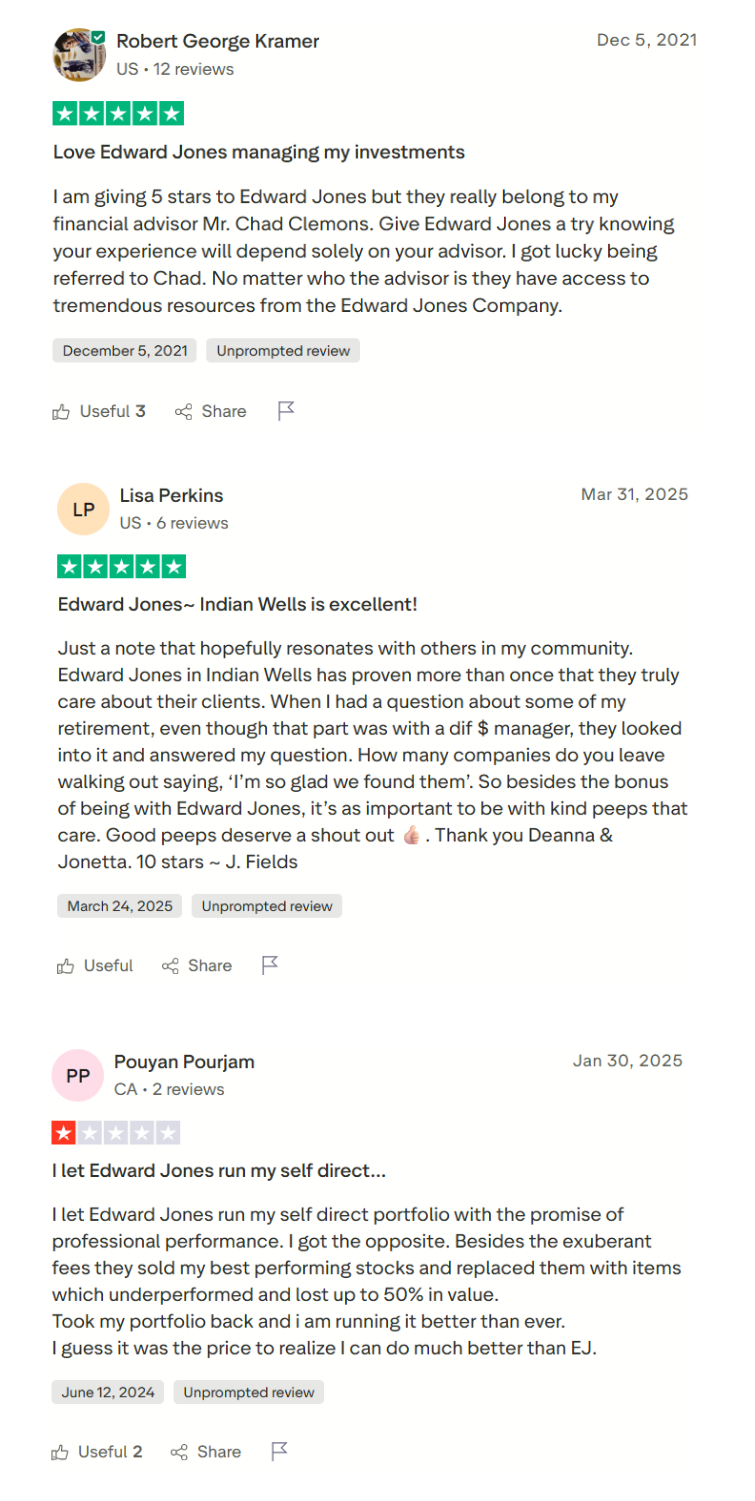
Account Types
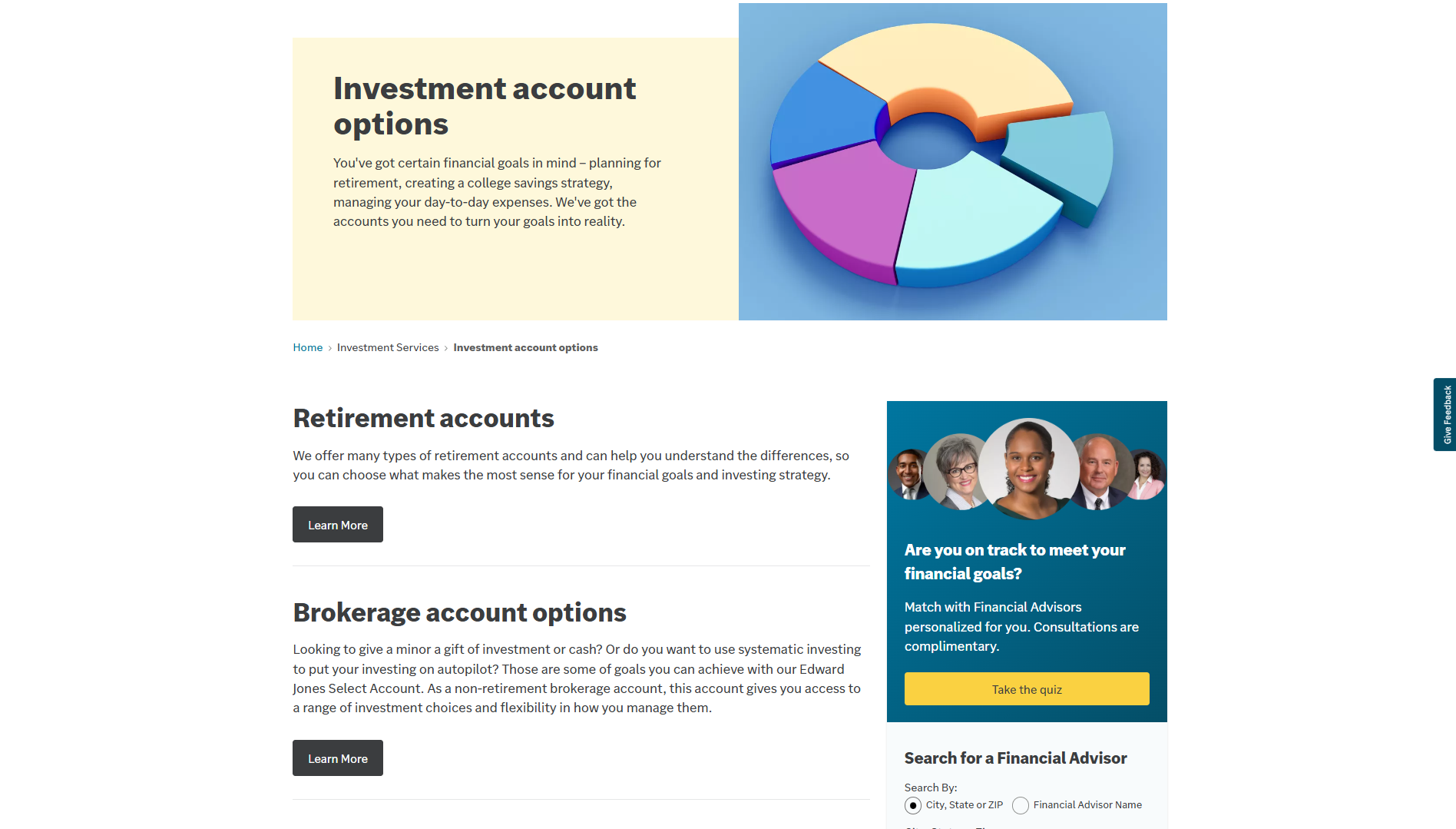
Edward Jones Select Account (Brokerage Account)
- A transactional brokerage account where you can invest in stocks, bonds, CDs, mutual funds, ETFs, and annuities, and you make the final buy or sell decision.
Edward Jones Guided Solutions Flex Account
- A client-directed account with guardrails and alerts, with a flexible mix that can include stocks, mutual funds, ETFs, plus bonds and CDs.
Edward Jones Guided Solutions Fund Account
- A client-directed account focused on mutual funds and ETFs, with built-in rebalancing and guardrails to help keep your portfolio on track.
Edward Jones Advisory Solutions UMA Models
- A professionally managed option where day-to-day decisions are handled for you, and it is positioned for investors who want potential tax efficiency and less hands-on management.
Edward Jones Advisory Solutions Fund Models
- You choose a portfolio objective, then delegate day-to-day decisions to a research team through a managed fund model approach.
Financial Advisor Managed Solutions
- You step back from daily management by delegating investment decisions and rebalancing to your financial advisor.
529 Education Savings Plans
- A tax-advantaged account type designed to help you save for future college costs.
Custodial Accounts (UGMA and UTMA)
- An account where an adult manages investments for a minor, commonly used for gifting cash or investments until the child reaches adulthood.
Retirement Accounts (Category)
- Edward Jones also supports common retirement accounts, with IRAs and 401(k)-type accounts highlighted as widely used options.
Edward Jones Trading Platforms
Edward Jones uses an advisor-led setup, so your main “platform” experience is a mix of your financial advisor plus the firm’s digital tools for tracking and account actions. If you are looking for a pure self-serve day trading terminal, this will feel different from app-first brokers. The core digital platform is Online Access, which lets you view accounts, track goals, connect outside accounts, securely message your Edward Jones team, view documents, e-sign documents, transfer funds, and pay bills online. This is built more for portfolio management and account servicing than rapid-fire trading. Edward Jones also offers the Edward Jones mobile app, which is designed for checking accounts and goals from “virtually anywhere.” It supports everyday tasks like staying updated on your financial picture while you are away from your desktop. One important limitation is that Edward Jones states you cannot place trades in Online Access. If you need a trade placed urgently and your advisor team is unavailable, the firm directs clients to call Client Relations to place an urgent trade.
What Can You Trade on Edward Jones
Edward Jones is a traditional stock broker that supports common investments used by long-term investors, not a high-speed trading app. What you can trade depends on the account you choose, but the firm clearly lists the main investment types it offers. In an Edward Jones Select Account, you can invest in stocks, bonds, CDs, mutual funds, ETFs, and annuities. This is the closest fit if you want a classic brokerage setup where you and your advisor work together, and you make the final buy or sell decision. If you use Guided Solutions, your investment menu can change based on the version of the account. The Guided Solutions Flex Account includes stocks, ETFs, and mutual funds, and it can also include individual bonds and CDs once the account reaches a stated balance threshold. The Guided Solutions Fund Account focuses on mutual funds and ETFs. This is designed for people who want guidance and monitoring, while staying inside a simpler product list than a full brokerage account. Beyond account pages, Edward Jones also highlights its wider lineup of investment products, including fixed-income investments, ETFs, and unit investment trusts (UITs). This matters because it shows the firm is built for diversified investing, not just stock picking.
Edward Jones Customer Support
Edward Jones customer support is built around your local financial advisor team, since most account help starts at the branch level. If you already have an advisor, that is usually the fastest route for help with your brokerage account, paperwork, and account requests. If you need to contact Edward Jones online, the firm provides a Contact Us form where you can choose topics like customer service, login issues, and complaints. This is useful when you want a documented message trail instead of a phone call. For Online Access help, Edward Jones lists a dedicated Online Client Support line for login issues and general platform support, with posted business hours including weekday and weekend coverage. This matters if you are locked out, your access is suspended, or you need help navigating account features. If your advisor team is unavailable and you have something time-sensitive, Edward Jones also directs clients to Client Relations for urgent account questions, including placing an urgent trade. This is an important fallback for investors who need action when markets are moving. 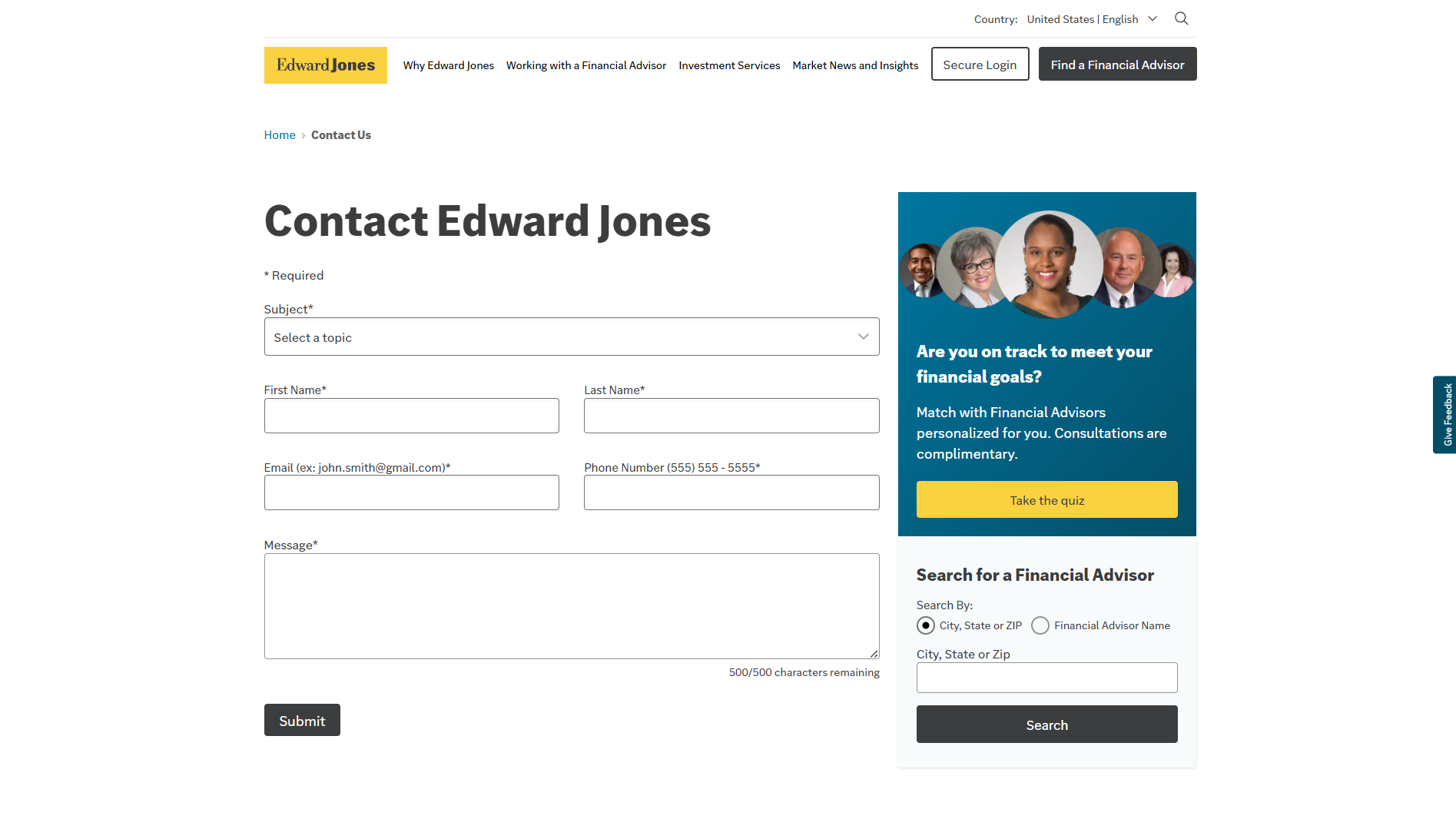
Withdrawal Options and Fees
Edward Jones gives clients a few ways to move money out, but the exact method can depend on your account type and the request you are making. The most common options are electronic transfers, wire transfers, and standard account servicing requests handled through your advisor and Online Access. A practical starting point is Online Access, which supports features like the ability to transfer funds and manage money online, with some actions also available in the mobile app. For electronic transfers, Edward Jones describes “Transfer Funds Electronically (ACH on Demand)” and notes that the transaction typically settles in about one business day, and that fees may apply. For faster movement, wire transfers are a standard option, and Edward Jones publishes pricing in its official fee schedules. The IRA fee schedule lists a domestic wire fee of $25 and an international wire fee of $100, plus related service items like an overnight delivery fee of $25. If your transfer fails or needs a special action, the same schedule shows smaller operational charges that can matter during withdrawals. Examples include a returned check fee of $25, a returned ACH payment fee of $25, and a stop payment request fee of $20, plus a same-day ACH fee of $5 when applicable. If you are moving your assets out to another brokerage, Edward Jones also discloses an account transfer fee for a full transfer in its brokerage schedule of fees. This is important because transferring out is a common “withdrawal-like” action that can affect your total cost when switching brokers.
Conclusion: Edward Jones Review
Edward Jones is best described as a traditional stock broker built for people who want to invest with help from a real financial advisor, not a fast, self-directed trading app. If your goal is long-term investing in stocks and other standard assets, its Select Account supports common choices like stocks, bonds, CDs, mutual funds, ETFs, and annuities. The biggest trade-off is how trading works day to day. Edward Jones clearly notes that you cannot place trades in Online Access, so most orders flow through your advisor team, with Client Relations as the backup option for urgent needs. From a safety standpoint, Edward Jones emphasizes account protection through SIPC coverage for missing securities, and it also describes additional coverage for specific loss events like theft or misplacement. That is a meaningful layer of protection for a brokerage relationship, but it does not protect you from normal market losses. Cost is the part you should take seriously before committing. Edward Jones discloses an equity commission schedule for stock trades, which can make small trades feel expensive compared with brokers advertising commission-free stock trading.
Edward Jones Review FAQs
Can you trade stocks with Edward Jones?
Yes. Edward Jones offers the Select Account, a brokerage account where you can invest in stocks plus other common investments like bonds, CDs, mutual funds, ETFs, and annuities. This makes Edward Jones a traditional stock broker option, not just an advisory firm.
Can you place trades online using Edward Jones Online Access?
No. Edward Jones clearly states you cannot place trades in Online Access, even though Online Access lets you do tasks like transferring funds, e-signing documents, and viewing account documents. For urgent trades, the firm directs clients to contact Client Relations.
Is Edward Jones safe and regulated, and what protection do accounts have?
Edward Jones highlights that it is a Member SIPC, with SIPC coverage up to $500,000 for missing securities, including $250,000 for cash awaiting reinvestment. It also says it buys additional protection from Underwriters at Lloyd’s, covering specific events like theft or misplacement, not market losses. OPEN AN ACCOUNT NOW WITH EDWARD JONES AND GET YOUR BONUS
The verdict on Edward Jones
Edward Jones is best described as a traditional stock broker built for people who want to invest with help from a real financial advisor, not a fast, self-directed trading app. If your goal is long-term investing in stocks and other standard assets, its Select Account supports common choices like stocks, bonds, CDs, mutual funds, ETFs, and annuities. The biggest trade-off is how trading works day to day.
More stock brokers we’ve reviewed

