Learn To Trade Forex • Best Forex Trading Course • AsiaForexMentor

Four Decimal Places Explained

Written by

Ezekiel Chew

Updated on

January 29, 2025

i

Four Decimal Places Explained

Written by:

Last updated on:

January 29, 2025


decimals
Photo Credit: toppr.com

Also Read: Forex Trading for Dummies

Contents

What Is a Decimal?

In decimal notation, the decimal point, popularly called the base ten systems, reflects mixed and fractional numbers. A decimal point distinguishes the components of the following number from the whole number. Decimal is derived from the Latin word decimals, which means “tenth.”

The following are some examples of decimal notation:

  • 03
  • 067
  • 1
  • 8
  • 0000001
  • 9979

In each of these examples, the placement of the decimal numbers tells us how big (or small) the number is. A small decimal point in an incorrect place can lead to a major error.

Back to Top

Decimal Place Value

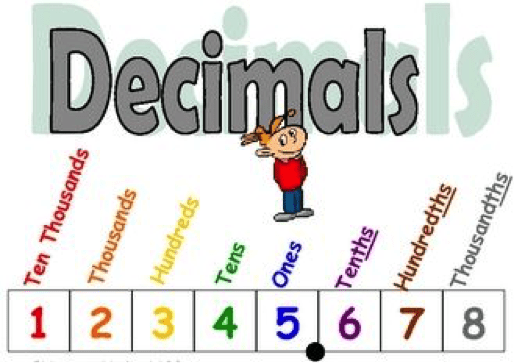
The place value of integers lower than one is referred to as the decimal place value. Place value may be apparent to you in bigger numbers, but it operates in the same manner with extremely tiny numbers.
decimals 2
Photo Credit: teachingpacks.co.uk

For example, the place value for the integer 2.34567 is as follows:

  • 2 – ones place
  • 3 – tenths place
  • 4 – hundredths place
  • 5 – thousandths place
  • 6 – ten thousandths place
  • 7 – hundred thousandths place

By shifting the decimal point towards the right, you may increase the number by a factor of 10. For instance:

  • 34567 x 10 = 23.4567
  • 4567 x 10 = 234.567
  • 567 x 10 = 2345.67

By moving the decimal point to the left, you may reduce the number by a factor of 10. For instance:

  • 34567 ÷ 10 = 0.234567
  • 234567 ÷ 10 = 0.0234567
  • 0234567 ÷ 10 = 0.00234567

Knowing how the decimal affects the magnitude of a number may make multiplication much easier to comprehend. Depending on where the decimal is placed, it can also assist you in determining if a number is very enormous or very little.

Back to Top

Four Decimal Places

The ones placing is a decimal place to the left of the decimal point. The tenths place is one decimal place to the right of the decimal place. Keep a keen eye on the numbers to see the location of decimal places.

Furthermore, what is the decimal equivalent of the tenth place? When a number has a decimal point, the number of tenths is shown by the 1st digit to the right of the decimal point.

The decimal 0.5, for example, is very much like the fraction 3/10. The number of hundredths is indicated by the 2nd digit to the right of the decimal point.

Similarly, what is the term for the decimal .00001?

  • .001 = thousandth.
  • .0001 = ten-thousandth.
  • .00001 = hundred-thousandth.
  • .000001 = millionth.

How much is 4 decimal places?

When stated in decimal notation, four decimal places means four (or less) digits to the right of the decimal point, e.g. 54.6789. In scientific work, one would often fill a number with fewer than four digits, thus 5.33 would've been rendered as 5.3300 to represent its precision level.

Back to Top

Four Decimal Place Value Explained

The decimal component of a number may be thought of as a fraction with a denominator of a multiple of ten. The whole number component of 54.3, for example, is 54, while the decimal half is 3 tenths.

Place value titles for whole numbers, such as ones, tens, and hundreds, are the same as place value identities for decimal numbers to the right of the decimal point.

These are shown below. In this lesson, we'll look at decimals with up to 4 decimal places, or integers with up to a ten-thousandths value.

Let's go through the labels of the place value fields again.

decimals 3

In a case where we have the decimal 0.78, we may write it on the place value system as shown below, indicating that 0.78 has 7 tenths and 8 hundredths.

decimals 4

In decimal, the zeros are very crucial. The place value is represented by the zeros in between decimal points as well as the digits. 0.91, 0.091, and 0.0091, for example, can not have the same value. One can see this by putting these numbers as fractions, yielding three unique fractions:
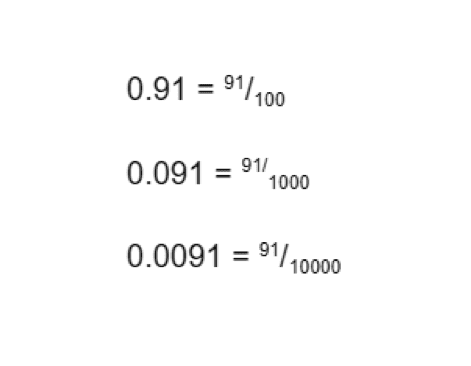
decimals 5

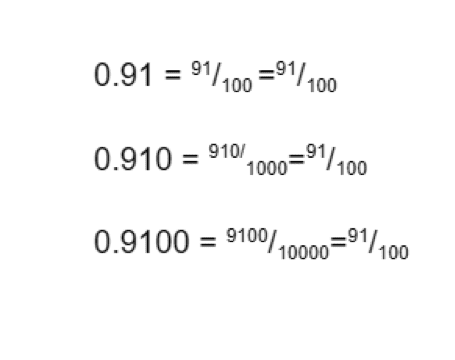
Therefore, we may put zeros to the right of a last digit in decimal and the result will remain unchanged. So, 0.91, 0.910, and 0.9100 have the same value because we can express or write them in fractions and deconstruct them, yielding:
decimals 6

Back to Top

How to Express a Decimal in Words

  • Like a whole number, consider the digits to the right from the decimal place. let's take, for instance, 0.099, one would express these digits as “ninety-nine.” We can omit any zeros just after the decimal point, and before the numeric digits when stating it as a whole number.
  • Over the last decimal digit just on right, utilize the place value description. Thousandths is the last decimal digit place value in 0.099.
  • Bring them together. In English, 0.099 is “ninety-nine thousandths.”

Back to Top

Rounding up with Decimals

The procedure for rounding decimals is identical to that for rounding entire numbers. When the digit in question is a 4, 3, 2, or 1 the digit to its left remains constant, which rounds down. If it is 5 or above, the digit to its left increases by plus 1 which rounds up.

rounding numbers
Photo Credit: numberock.com

For instance, if you round up to a decimal place or you rounded to the nearest one:

  • 8 rounds up to 5. (8 tenths rounds up to one, so 4 + 1 = 3)
  • 3 rounds down to 90 (3 tenths rounds down to zero, so 90 + 0 = 90)
  • 6 rounds up to 2 (6 tenths rounds up to one, so 1 + 1 = 2)
  • 4 rounds down to 456 (4 tenths round down to zero, so 456 + 0 = 456)

The same is applicable, whether rounding to 2 decimal places or to the nearest tenth.

  • 68 rounds up to 5.7 (the 8 hundredths round up to one tenth, so 2.6 + 0.1 = 5.7)
  • 83 rounds down to 45.8 (the 3 hundredths rounds down to zero tenths, so 45.8 + 0.0 = 45.8)
  • 38 rounds up to 4.4 (the 8 hundredths round up to one tenth, so 4.3 + 0.1 = 4.4)
  • 82 rounds down to 796.8 (the 2 hundredths round down to zero tenths, so 796.8 + 0.0 = 798.8)

When we round to three decimal places, the result is as follows:

  • 374 rounds down to 5.37 (the 4 thousandth rounds down to 0 hundredths, so 5.37 + 0.00 = 5.37)
  • 437 rounds up to 58.44 (the 7 thousandths rounds up to 1 hundredth, so 58.43 + 0.01 = 58.44)
  • 672 rounds down to 0.67 (the 2 thousandths rounds down to 0 hundredths, so 0.67 + 0.00 = 0.67)
  • 238 rounds up to 654.24 (the 8 thousandths rounds up to 1 hundredth, and 654.23 + 0.01 = 654.24).

The rounding principle holds true when you round to 4 decimal places or to the nearest thousandth, 5 decimal places, or to the nearest ten thousandths, 6 decimal places, or the nearest hundredth, below that.

Since the digits to the right of a decimal point are portions of the following number, rounding up fills in several of the gaps.

Also Read: Curve Finance: How Does It Work?

Back to Top

Fractions vs Decimals

fractions
Photo Credit: YouTube.com

Decimals are just fractions represented in a linear format. They both feature number portions as well as complete numbers. Their system differs solely in the accompanying ways:

Fractions split the numerator (main number) from the denominator (dividing number) by a fraction line.

Decimals distinguish the component from the total with a decimal point.

The figures 2/3 and 0.667 are the same number: two-thirds. The fraction illustrates that there are two parts available out of three, and the decimal figure illustrates that 667 parts are available out of 1000. They are simply various methods of expressing the same idea.

Back to Top

Conclusion

Decimal places and whole numbers are major expressions of numbers. 4 decimal places include all numbers except any number that comes after the 4th from the decimal point.

Rounding up and approximations help under decimals and fractions better.

Back to Top

FAQs

How do you count decimal places?

When a figure comes with a decimal, the 1st number to the right of the decimal shows the number of tenth. For instance, the decimal figure 0.6 has the same meaning as 6/10. The second figure to the right of the decimal is the number of hundredth, and so on.

What are two decimal places?

Rounding up a figure to the hundredth place is the same as rounding up to 2 decimal places. This is the 2nd place to the right, counting from the decimal point. A good example is 4.24334 can be rounded up to 2 decimal places as 4.24, and 0.5432 is 0.54 when rounded up to 2 decimal places.

What does 3 decimal places mean?

Approximating to the thousandths place in a decimal figure is the same as rounding up to 3 decimal places. This basically implies that figures must not have any numbers after the 4th place. 543.12345 rounded up to 3 decimal places, is 543.123.

What is a decimal place value?

The decimal point of a figure shows the place value of a decimal figure. The tenth is illustrated using the first number from the dot or decimal. The hundredth is the 2nd number to the right, which completes 2 decimal places. 0.07 can be rewritten as 7/100 in a fraction.


Back to Top


About Ezekiel Chew​

Ezekiel Chew, founder and head of training at Asia Forex Mentor, is a renowned forex expert, frequently invited to speak at major industry events. Known for his deep market insights, Ezekiel is one of the top traders committed to supporting the trading community. Making six figures per trade, he also trains traders working in banks, fund management, and prop trading firms.

Forex Trade Update After a 950% Crazy Growth Month

Imagine a single forex trade changing how you see on the foreign exchange market. Many retail traders dive into a forex trading account with high hopes but quickly encounter challenges. The constant price changes of major currency pairs, like EUR USD or the Japanese yen, create chances and challenges. As

Read More

Understanding Monad in Crypto: A New Chapter of Blockchain Innovation

As blockchain technology continues to evolve, new concepts and frameworks appear, targeting the traditional challenges of blockchain scalability, decentralization, and transaction efficiency. One such concept rising in interest in the cryptocurrency market is Monad. But what exactly is Monad as related to crypto? Let’s take a look at how Monad

Read More

FXCentrum Review 2026 – REAL Traders Report

            OPEN AN ACCOUNT             FXCentrum Review FXCentrum (FXC) is an online broker that offers 2,200 trading instruments, these includes Forex, stocks, indices, commodities, metals, cryptocurrencies, and CFDs. Traders can use the Trader platform of FXCentrum, available for both desktop and

Read More

LeoPrime Review 2026 – REAL Traders Report

            OPEN AN ACCOUNT             LeoPrime Review LeoPrime is an online forex and CFD broker regulated by the Financial Services Authority (FSA) of Seychelles. They offer several different account types, these include STP, ECN, and cent accounts, along with market execution,

Read More

EBC Financial Group Review 2026 – REAL Traders Report

            OPEN AN ACCOUNT             EBC Financial Group Review EBC Financial Group is an online trading broker offering access to over 200 global assets, including forex, U.S. stocks, indices, ETFs, cryptocurrencies, precious metals, and energies. With leverage up to 1:500 and

Read More

GFF Brokers Review 2026 – REAL Traders Report

              OPEN AN ACCOUNT             GFF Brokers Review Choosing a trustworthy broker is essential for long-term trading success. The broker must ensure transparent pricing, stable platforms, and secure fund management, minimizing risks from poor execution or system failures. While many

Read More

AFM Trading Summit Live

Date: Coming Soon

Join us at the AFM Trading Summit Live and learn from top industry experts through live trading sessions, market insights, and actionable strategies.

Four Decimal Places Explained

4.0
Overall Trust Index

Written by:

Updated:

January 29, 2025


decimals
Photo Credit: toppr.com

Also Read: Forex Trading for Dummies

Contents

What Is a Decimal?

In decimal notation, the decimal point, popularly called the base ten systems, reflects mixed and fractional numbers. A decimal point distinguishes the components of the following number from the whole number. Decimal is derived from the Latin word decimals, which means "tenth."

The following are some examples of decimal notation:

  • 03
  • 067
  • 1
  • 8
  • 0000001
  • 9979

In each of these examples, the placement of the decimal numbers tells us how big (or small) the number is. A small decimal point in an incorrect place can lead to a major error.

Back to Top

Decimal Place Value

The place value of integers lower than one is referred to as the decimal place value. Place value may be apparent to you in bigger numbers, but it operates in the same manner with extremely tiny numbers.

decimals 2
Photo Credit: teachingpacks.co.uk

For example, the place value for the integer 2.34567 is as follows:

  • 2 - ones place
  • 3 - tenths place
  • 4 - hundredths place
  • 5 - thousandths place
  • 6 - ten thousandths place
  • 7 - hundred thousandths place

By shifting the decimal point towards the right, you may increase the number by a factor of 10. For instance:

  • 34567 x 10 = 23.4567
  • 4567 x 10 = 234.567
  • 567 x 10 = 2345.67

By moving the decimal point to the left, you may reduce the number by a factor of 10. For instance:

  • 34567 ÷ 10 = 0.234567
  • 234567 ÷ 10 = 0.0234567
  • 0234567 ÷ 10 = 0.00234567

Knowing how the decimal affects the magnitude of a number may make multiplication much easier to comprehend. Depending on where the decimal is placed, it can also assist you in determining if a number is very enormous or very little.

Back to Top

Four Decimal Places

The ones placing is a decimal place to the left of the decimal point. The tenths place is one decimal place to the right of the decimal place. Keep a keen eye on the numbers to see the location of decimal places.

Furthermore, what is the decimal equivalent of the tenth place? When a number has a decimal point, the number of tenths is shown by the 1st digit to the right of the decimal point.

The decimal 0.5, for example, is very much like the fraction 3/10. The number of hundredths is indicated by the 2nd digit to the right of the decimal point.

Similarly, what is the term for the decimal .00001?

  • .001 = thousandth.
  • .0001 = ten-thousandth.
  • .00001 = hundred-thousandth.
  • .000001 = millionth.

How much is 4 decimal places?

When stated in decimal notation, four decimal places means four (or less) digits to the right of the decimal point, e.g. 54.6789. In scientific work, one would often fill a number with fewer than four digits, thus 5.33 would've been rendered as 5.3300 to represent its precision level.

Back to Top

Four Decimal Place Value Explained

The decimal component of a number may be thought of as a fraction with a denominator of a multiple of ten. The whole number component of 54.3, for example, is 54, while the decimal half is 3 tenths.

Place value titles for whole numbers, such as ones, tens, and hundreds, are the same as place value identities for decimal numbers to the right of the decimal point.

These are shown below. In this lesson, we'll look at decimals with up to 4 decimal places, or integers with up to a ten-thousandths value.

Let's go through the labels of the place value fields again.

decimals 3

In a case where we have the decimal 0.78, we may write it on the place value system as shown below, indicating that 0.78 has 7 tenths and 8 hundredths.

decimals 4

In decimal, the zeros are very crucial. The place value is represented by the zeros in between decimal points as well as the digits. 0.91, 0.091, and 0.0091, for example, can not have the same value. One can see this by putting these numbers as fractions, yielding three unique fractions:

decimals 5

Therefore, we may put zeros to the right of a last digit in decimal and the result will remain unchanged. So, 0.91, 0.910, and 0.9100 have the same value because we can express or write them in fractions and deconstruct them, yielding:

decimals 6

Back to Top

How to Express a Decimal in Words

  • Like a whole number, consider the digits to the right from the decimal place. let's take, for instance, 0.099, one would express these digits as "ninety-nine." We can omit any zeros just after the decimal point, and before the numeric digits when stating it as a whole number.
  • Over the last decimal digit just on right, utilize the place value description. Thousandths is the last decimal digit place value in 0.099.
  • Bring them together. In English, 0.099 is "ninety-nine thousandths."

Back to Top

Rounding up with Decimals

The procedure for rounding decimals is identical to that for rounding entire numbers. When the digit in question is a 4, 3, 2, or 1 the digit to its left remains constant, which rounds down. If it is 5 or above, the digit to its left increases by plus 1 which rounds up.

rounding numbers
Photo Credit: numberock.com

For instance, if you round up to a decimal place or you rounded to the nearest one:

  • 8 rounds up to 5. (8 tenths rounds up to one, so 4 + 1 = 3)
  • 3 rounds down to 90 (3 tenths rounds down to zero, so 90 + 0 = 90)
  • 6 rounds up to 2 (6 tenths rounds up to one, so 1 + 1 = 2)
  • 4 rounds down to 456 (4 tenths round down to zero, so 456 + 0 = 456)

The same is applicable, whether rounding to 2 decimal places or to the nearest tenth.

  • 68 rounds up to 5.7 (the 8 hundredths round up to one tenth, so 2.6 + 0.1 = 5.7)
  • 83 rounds down to 45.8 (the 3 hundredths rounds down to zero tenths, so 45.8 + 0.0 = 45.8)
  • 38 rounds up to 4.4 (the 8 hundredths round up to one tenth, so 4.3 + 0.1 = 4.4)
  • 82 rounds down to 796.8 (the 2 hundredths round down to zero tenths, so 796.8 + 0.0 = 798.8)

When we round to three decimal places, the result is as follows:

  • 374 rounds down to 5.37 (the 4 thousandth rounds down to 0 hundredths, so 5.37 + 0.00 = 5.37)
  • 437 rounds up to 58.44 (the 7 thousandths rounds up to 1 hundredth, so 58.43 + 0.01 = 58.44)
  • 672 rounds down to 0.67 (the 2 thousandths rounds down to 0 hundredths, so 0.67 + 0.00 = 0.67)
  • 238 rounds up to 654.24 (the 8 thousandths rounds up to 1 hundredth, and 654.23 + 0.01 = 654.24).

The rounding principle holds true when you round to 4 decimal places or to the nearest thousandth, 5 decimal places, or to the nearest ten thousandths, 6 decimal places, or the nearest hundredth, below that.

Since the digits to the right of a decimal point are portions of the following number, rounding up fills in several of the gaps.

Also Read: Curve Finance: How Does It Work?

Back to Top

Fractions vs Decimals

fractions
Photo Credit: YouTube.com

Decimals are just fractions represented in a linear format. They both feature number portions as well as complete numbers. Their system differs solely in the accompanying ways:

Fractions split the numerator (main number) from the denominator (dividing number) by a fraction line.

Decimals distinguish the component from the total with a decimal point.

The figures 2/3 and 0.667 are the same number: two-thirds. The fraction illustrates that there are two parts available out of three, and the decimal figure illustrates that 667 parts are available out of 1000. They are simply various methods of expressing the same idea.

Back to Top

Conclusion

Decimal places and whole numbers are major expressions of numbers. 4 decimal places include all numbers except any number that comes after the 4th from the decimal point.

Rounding up and approximations help under decimals and fractions better.

Back to Top

FAQs

How do you count decimal places?

When a figure comes with a decimal, the 1st number to the right of the decimal shows the number of tenth. For instance, the decimal figure 0.6 has the same meaning as 6/10. The second figure to the right of the decimal is the number of hundredth, and so on.

What are two decimal places?

Rounding up a figure to the hundredth place is the same as rounding up to 2 decimal places. This is the 2nd place to the right, counting from the decimal point. A good example is 4.24334 can be rounded up to 2 decimal places as 4.24, and 0.5432 is 0.54 when rounded up to 2 decimal places.

What does 3 decimal places mean?

Approximating to the thousandths place in a decimal figure is the same as rounding up to 3 decimal places. This basically implies that figures must not have any numbers after the 4th place. 543.12345 rounded up to 3 decimal places, is 543.123.

What is a decimal place value?

The decimal point of a figure shows the place value of a decimal figure. The tenth is illustrated using the first number from the dot or decimal. The hundredth is the 2nd number to the right, which completes 2 decimal places. 0.07 can be rewritten as 7/100 in a fraction.

Back to Top


ezekiel chew asiaforexmentor

About Ezekiel Chew

Ezekiel Chew, founder and head of training at Asia Forex Mentor, is a renowned forex expert, frequently invited to speak at major industry events. Known for his deep market insights, Ezekiel is one of the top traders committed to supporting the trading community. Making six figures per trade, he also trains traders working in banks, fund management, and prop trading firms.

RELATED ARTICLES

Four Decimal Places Explained

4.0
Overall Trust Index

Written by:

Updated:

January 29, 2025


decimals
Photo Credit: toppr.com

Also Read: Forex Trading for Dummies

Contents

What Is a Decimal?

In decimal notation, the decimal point, popularly called the base ten systems, reflects mixed and fractional numbers. A decimal point distinguishes the components of the following number from the whole number. Decimal is derived from the Latin word decimals, which means "tenth."

The following are some examples of decimal notation:

  • 03
  • 067
  • 1
  • 8
  • 0000001
  • 9979

In each of these examples, the placement of the decimal numbers tells us how big (or small) the number is. A small decimal point in an incorrect place can lead to a major error.

Back to Top

Decimal Place Value

The place value of integers lower than one is referred to as the decimal place value. Place value may be apparent to you in bigger numbers, but it operates in the same manner with extremely tiny numbers.

decimals 2
Photo Credit: teachingpacks.co.uk

For example, the place value for the integer 2.34567 is as follows:

  • 2 - ones place
  • 3 - tenths place
  • 4 - hundredths place
  • 5 - thousandths place
  • 6 - ten thousandths place
  • 7 - hundred thousandths place

By shifting the decimal point towards the right, you may increase the number by a factor of 10. For instance:

  • 34567 x 10 = 23.4567
  • 4567 x 10 = 234.567
  • 567 x 10 = 2345.67

By moving the decimal point to the left, you may reduce the number by a factor of 10. For instance:

  • 34567 ÷ 10 = 0.234567
  • 234567 ÷ 10 = 0.0234567
  • 0234567 ÷ 10 = 0.00234567

Knowing how the decimal affects the magnitude of a number may make multiplication much easier to comprehend. Depending on where the decimal is placed, it can also assist you in determining if a number is very enormous or very little.

Back to Top

Four Decimal Places

The ones placing is a decimal place to the left of the decimal point. The tenths place is one decimal place to the right of the decimal place. Keep a keen eye on the numbers to see the location of decimal places.

Furthermore, what is the decimal equivalent of the tenth place? When a number has a decimal point, the number of tenths is shown by the 1st digit to the right of the decimal point.

The decimal 0.5, for example, is very much like the fraction 3/10. The number of hundredths is indicated by the 2nd digit to the right of the decimal point.

Similarly, what is the term for the decimal .00001?

  • .001 = thousandth.
  • .0001 = ten-thousandth.
  • .00001 = hundred-thousandth.
  • .000001 = millionth.

How much is 4 decimal places?

When stated in decimal notation, four decimal places means four (or less) digits to the right of the decimal point, e.g. 54.6789. In scientific work, one would often fill a number with fewer than four digits, thus 5.33 would've been rendered as 5.3300 to represent its precision level.

Back to Top

Four Decimal Place Value Explained

The decimal component of a number may be thought of as a fraction with a denominator of a multiple of ten. The whole number component of 54.3, for example, is 54, while the decimal half is 3 tenths.

Place value titles for whole numbers, such as ones, tens, and hundreds, are the same as place value identities for decimal numbers to the right of the decimal point.

These are shown below. In this lesson, we'll look at decimals with up to 4 decimal places, or integers with up to a ten-thousandths value.

Let's go through the labels of the place value fields again.

decimals 3

In a case where we have the decimal 0.78, we may write it on the place value system as shown below, indicating that 0.78 has 7 tenths and 8 hundredths.

decimals 4

In decimal, the zeros are very crucial. The place value is represented by the zeros in between decimal points as well as the digits. 0.91, 0.091, and 0.0091, for example, can not have the same value. One can see this by putting these numbers as fractions, yielding three unique fractions:

decimals 5

Therefore, we may put zeros to the right of a last digit in decimal and the result will remain unchanged. So, 0.91, 0.910, and 0.9100 have the same value because we can express or write them in fractions and deconstruct them, yielding:

decimals 6

Back to Top

How to Express a Decimal in Words

  • Like a whole number, consider the digits to the right from the decimal place. let's take, for instance, 0.099, one would express these digits as "ninety-nine." We can omit any zeros just after the decimal point, and before the numeric digits when stating it as a whole number.
  • Over the last decimal digit just on right, utilize the place value description. Thousandths is the last decimal digit place value in 0.099.
  • Bring them together. In English, 0.099 is "ninety-nine thousandths."

Back to Top

Rounding up with Decimals

The procedure for rounding decimals is identical to that for rounding entire numbers. When the digit in question is a 4, 3, 2, or 1 the digit to its left remains constant, which rounds down. If it is 5 or above, the digit to its left increases by plus 1 which rounds up.

rounding numbers
Photo Credit: numberock.com

For instance, if you round up to a decimal place or you rounded to the nearest one:

  • 8 rounds up to 5. (8 tenths rounds up to one, so 4 + 1 = 3)
  • 3 rounds down to 90 (3 tenths rounds down to zero, so 90 + 0 = 90)
  • 6 rounds up to 2 (6 tenths rounds up to one, so 1 + 1 = 2)
  • 4 rounds down to 456 (4 tenths round down to zero, so 456 + 0 = 456)

The same is applicable, whether rounding to 2 decimal places or to the nearest tenth.

  • 68 rounds up to 5.7 (the 8 hundredths round up to one tenth, so 2.6 + 0.1 = 5.7)
  • 83 rounds down to 45.8 (the 3 hundredths rounds down to zero tenths, so 45.8 + 0.0 = 45.8)
  • 38 rounds up to 4.4 (the 8 hundredths round up to one tenth, so 4.3 + 0.1 = 4.4)
  • 82 rounds down to 796.8 (the 2 hundredths round down to zero tenths, so 796.8 + 0.0 = 798.8)

When we round to three decimal places, the result is as follows:

  • 374 rounds down to 5.37 (the 4 thousandth rounds down to 0 hundredths, so 5.37 + 0.00 = 5.37)
  • 437 rounds up to 58.44 (the 7 thousandths rounds up to 1 hundredth, so 58.43 + 0.01 = 58.44)
  • 672 rounds down to 0.67 (the 2 thousandths rounds down to 0 hundredths, so 0.67 + 0.00 = 0.67)
  • 238 rounds up to 654.24 (the 8 thousandths rounds up to 1 hundredth, and 654.23 + 0.01 = 654.24).

The rounding principle holds true when you round to 4 decimal places or to the nearest thousandth, 5 decimal places, or to the nearest ten thousandths, 6 decimal places, or the nearest hundredth, below that.

Since the digits to the right of a decimal point are portions of the following number, rounding up fills in several of the gaps.

Also Read: Curve Finance: How Does It Work?

Back to Top

Fractions vs Decimals

fractions
Photo Credit: YouTube.com

Decimals are just fractions represented in a linear format. They both feature number portions as well as complete numbers. Their system differs solely in the accompanying ways:

Fractions split the numerator (main number) from the denominator (dividing number) by a fraction line.

Decimals distinguish the component from the total with a decimal point.

The figures 2/3 and 0.667 are the same number: two-thirds. The fraction illustrates that there are two parts available out of three, and the decimal figure illustrates that 667 parts are available out of 1000. They are simply various methods of expressing the same idea.

Back to Top

Conclusion

Decimal places and whole numbers are major expressions of numbers. 4 decimal places include all numbers except any number that comes after the 4th from the decimal point.

Rounding up and approximations help under decimals and fractions better.

Back to Top

FAQs

How do you count decimal places?

When a figure comes with a decimal, the 1st number to the right of the decimal shows the number of tenth. For instance, the decimal figure 0.6 has the same meaning as 6/10. The second figure to the right of the decimal is the number of hundredth, and so on.

What are two decimal places?

Rounding up a figure to the hundredth place is the same as rounding up to 2 decimal places. This is the 2nd place to the right, counting from the decimal point. A good example is 4.24334 can be rounded up to 2 decimal places as 4.24, and 0.5432 is 0.54 when rounded up to 2 decimal places.

What does 3 decimal places mean?

Approximating to the thousandths place in a decimal figure is the same as rounding up to 3 decimal places. This basically implies that figures must not have any numbers after the 4th place. 543.12345 rounded up to 3 decimal places, is 543.123.

What is a decimal place value?

The decimal point of a figure shows the place value of a decimal figure. The tenth is illustrated using the first number from the dot or decimal. The hundredth is the 2nd number to the right, which completes 2 decimal places. 0.07 can be rewritten as 7/100 in a fraction.

Back to Top


ezekiel chew asiaforexmentor

About Ezekiel Chew

Ezekiel Chew, founder and head of training at Asia Forex Mentor, is a renowned forex expert, frequently invited to speak at major industry events. Known for his deep market insights, Ezekiel is one of the top traders committed to supporting the trading community. Making six figures per trade, he also trains traders working in banks, fund management, and prop trading firms.

RELATED ARTICLES

I consent to receiving emails and/or text message reminders for this event.

REGISTER FOR THE MASTERCLASS!