Learn To Trade Forex • Best Forex Trading Course • AsiaForexMentor

 English
 简体中文
简体中文 繁體中文
繁體中文 日本語
日本語 한국어
한국어 Bahasa Melayu
 Bahasa Indonesia
 Filipino
 ไทย
ไทย Tiếng Việt
 हिन्दी
 العربية
 Italiano
 Português
 Русский
 Español
 Français
- Best Forex BrokersRaw spreads, ECN execution and regulation — tested on live accounts.Best Stock BrokersCommissions, market access and platform depth, compared.Best Prop FirmsFunding rules, drawdown limits and real payout records.Best Crypto BrokersFees, custody and coin coverage across the major exchanges.AFM Top Pick
Every other site ranks ten brokers. We rank one — and show you exactly why.
See the #1 pick → - Articles
- Awards
- Events
- Newsletter
 Singapore
 Cambodia
 Myanmar
 Brunei
 Australia
  New Zealand
 Switzerland
 UAE
UAE United States
 Mexico
 Argentina
 South Africa
 IC Markets
 Pepperstone
 AvaTrade
 XM
XM Plus500
 RoboForex
 TMGM
TMGM Exness
 JustMarkets
 Orbex
Orbex Interactive Brokers
 Saxo
Saxo Tiger Brokers
 Binance
 Coinbase
 Gemini Exchange
 Kraken
 iFunds
 IC Funded
 The 5%ers
 TopStep
 IQ Option
 Pocket Option
 RaceOption
 IQCent
Stash Review 2026
Stash positions itself as a beginner-focused online stock broker built for investors who want a simple and structured way to start investing without needing large capital or advanced market knowledge. With features such as fractional share investing, Smart Portfolio automated investing, recurring deposits, and access to Traditional and Roth IRA retirement accounts, the platform focuses on helping users develop long-term investing habits rather than short-term trading strategies. Its subscription-based pricing model provides predictable costs, while its regulatory framework, including SEC registration, FINRA membership, and SIPC protection, adds an extra layer of credibility and investor conf
Risk warning: your capital is at risk. Forex and CFDs carry the potential for gains, but statistically only 11–25% of traders profit while 74–89% lose their investment. AFM earns a commission if you open an account through our links — it never changes how we score a broker.
- Fractional share investing, allowing small-dollar investments in stocks and ETFs
- Low entry barrier, with no large minimum deposit required
- Smart Portfolio automated investing for hands-off diversification
- Simple subscription pricing model with predictable monthly costs
- Integrated banking features, including the Stock-Back® debit card and recurring investments
- Monthly subscription fee applies regardless of account size
- Limited advanced trading tools and charting features
- No options, futures, or complex trading instruments
- Less suitable for active or short-term traders
- This review was written by the Asia Forex Mentor team and has been reformatted into our current layout. The analysis below is our earlier work on Stash, presented more clearly.
- It has not been re-verified against Stash’s current published terms. Spreads, fees, leverage caps and account rules change, and so does the legal entity that serves a given country.
- Treat every figure here as a starting point for your own checks rather than a live quote.
- Before depositing, confirm the details on Stash’s own site — above all, which company your client agreement names. That determines your regulator, your protections and who you can complain to.
- The score shown is Asia Forex Mentor’s own published rating for Stash, carried over from this article and expressed out of 10. It reflects our earlier assessment, not a fresh re-scoring.
Reformatted September 2026. The details in this review have not been independently re-verified since it was written, so check Stash’s own site before acting on anything here. Spotted something out of date? Tell us.

Ezekiel has traded foreign exchange for over two decades and built the One Core Program, the trading curriculum Asia Forex Mentor teaches to retail and institutional traders across Asia. He sets the scoring criteria these broker reviews are graded against.
On this page
- Stash Review
- What is Stash?
- Benefits of Trading with Stash
- Stash Regulation and Safety
- Stash Customer Reviews
- Stash Spreads, Fees, and Commissions
- Account Types
- Stash Trading Platforms
- What Can You Trade on Stash
- Stash Customer Support
- Withdrawal Options and Fees
- Conclusion: Stash Review
- FAQs
- Verdict
Stash Review
A good stock broker provides a secure and easy way to buy and sell stocks, ETFs, and other investments while keeping fees transparent and competitive. It should offer low account minimums, user-friendly trading platforms, and reliable customer support, making it suitable for both beginners and experienced investors. Strong brokers also provide research tools, educational resources, and retirement account options to help clients build long-term wealth. When choosing a broker, investors should look for regulated operations, clear pricing structures, and flexible account types that align with their financial goals.
Stash is an online brokerage and investing app from a registered financial services company, designed to make stock market investing easy for beginning investors and beginner investors. The company was launched in 2015, has 1.5 million active monthly users, and over 10 million downloads in the Google Play store. Stash is a subscription-based investment app focused on long-term, automated investing with fractional shares and no-commission trading. You can open an individual brokerage account with no minimum balance, invest in thousands of stocks and ETFs (including fractional shares), and choose between self-directed trading or automated Smart Portfolios—which require a minimum investment of $5 to start—helping build diversified holdings based on your goals. Stash also integrates banking features like a Stock-Back® debit card (called the Stock-Back Card) that allows users to earn stocks or ETFs as rewards when making purchases, and offers tools to set up recurring investments and personalized guidance. This in-depth review of Stash examines the platform’s core features, subscription pricing model—including Stash Growth and Stash+—available investment options, regulatory standing, and overall user experience to help potential investors determine whether it aligns with their financial goals. This comprehensive overview provides a clear understanding of how Stash works, what it costs, and who may benefit most from using the platform as part of a long-term investment strategy.
What is Stash?
Stash is an online stock broker and investing app founded in 2015 by Brandon Krieg, Ed Robinson, and David Ronick, created to make stock market investing more accessible to everyday investors. The company is a registered investment advisor (RIA) regulated by the SEC. As a brokerage platform, Stash allows users to open a taxable brokerage account, invest in fractional shares of stocks and ETFs, and build diversified portfolios without large upfront capital. Unlike traditional brokers that focus on active trading, Stash emphasizes long-term investing, automated portfolio options (Smart Portfolios), recurring investments, and retirement accounts such as Traditional and Roth IRAs. The platform operates on a monthly subscription model instead of commission-based pricing, offering predictable costs for access to its investing tools and services.
From its launch in October 2015, Stash positioned itself as a beginner-friendly stock broker, targeting individuals new to investing who want guidance and simplicity rather than complex trading platforms. The company is focused on beginning investors, providing educational resources and easy-to-use features tailored for those just starting out. Stash has 1.5 million active monthly users and manages around $4 billion in assets. It expanded quickly after launching on mobile app stores, reaching millions of users within a few years as demand for micro-investing grew. Over time, Stash added features such as the Stock-Back® debit card, educational resources, and automated investment management to strengthen its value as a full-service digital broker. Today, Stash continues to operate as a regulated brokerage platform focused on helping individuals start investing with small amounts, automate contributions, and build long-term wealth through a straightforward and structured approach.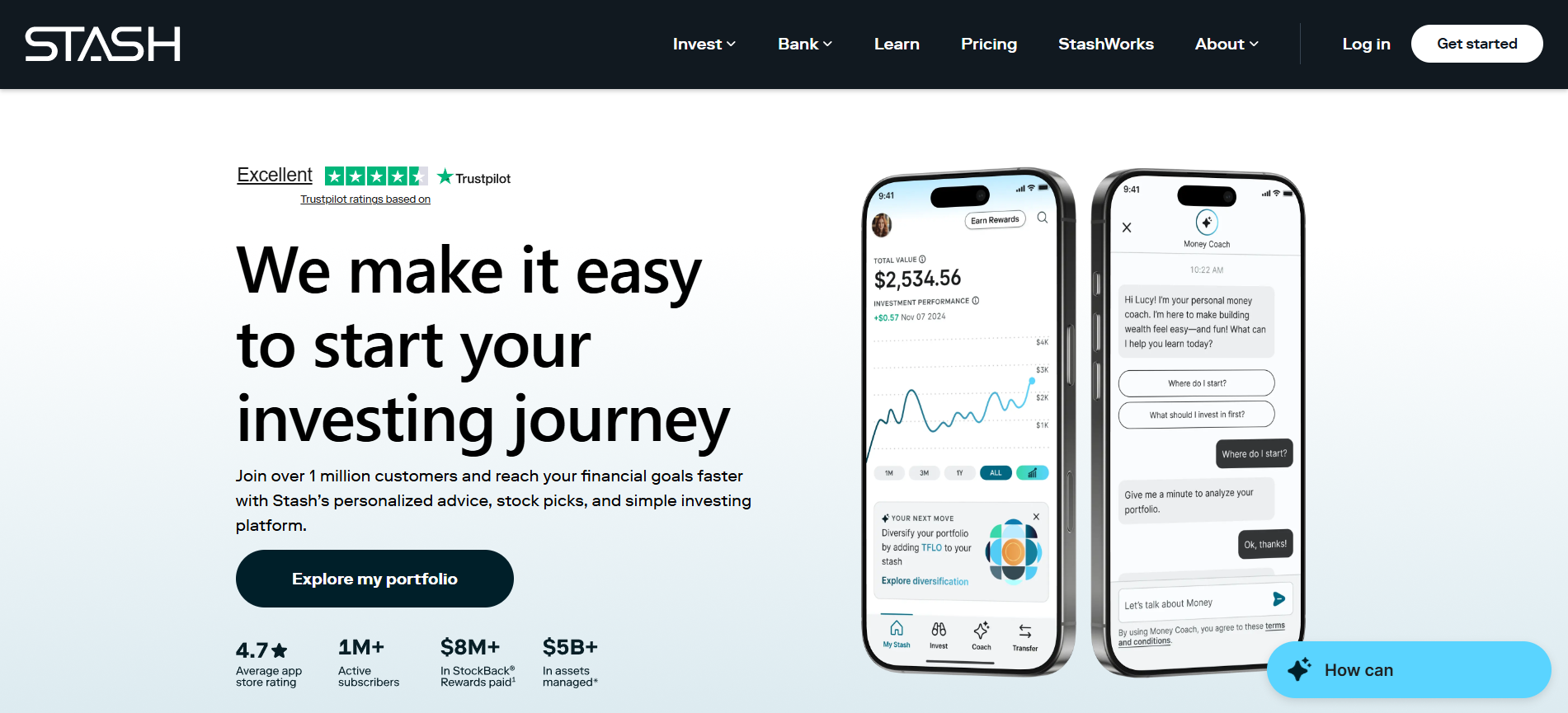
Benefits of Trading with Stash
Stash offers several advantages for individuals looking for a beginner-friendly stock broker focused on long-term investing. One of the main benefits is fractional share investing, which allows investors to buy portions of high-priced stocks and ETFs with small amounts of money. There is no large minimum deposit requirement, and users can begin investing with as little as $0.01 for manual trades or $5 for automated portfolios, making it easier for new investors to enter the stock market. Stash is especially suitable for beginning investors and beginner investors due to its low minimums and educational resources. Stash also provides Smart Portfolio automated investing, helping users build diversified portfolios based on their goals and risk tolerance. The platform supports recurring investments and Auto-Stash features, encouraging disciplined, consistent investing habits over time.
Another key benefit is its simple subscription-based pricing model, starting at $3 per month, which provides predictable costs instead of per-trade commissions. Stash combines investing with banking features, including the Stock-Back® debit card. The Stock-Back Card offers 1% back in stock for Stash+ subscribers and 0.125% for Stash Growth subscribers, rewarding eligible purchases with stock instead of cashback. Investors also gain access to retirement accounts (Traditional and Roth IRAs), personalized investment guidance, and educational resources designed to build financial knowledge. Additionally, Stash operates through SEC-registered brokerage entities and is a member of FINRA and SIPC, offering regulatory oversight and standard investor protections. These features make Stash appealing to beginners and long-term investors seeking a simple, structured stock brokerage platform.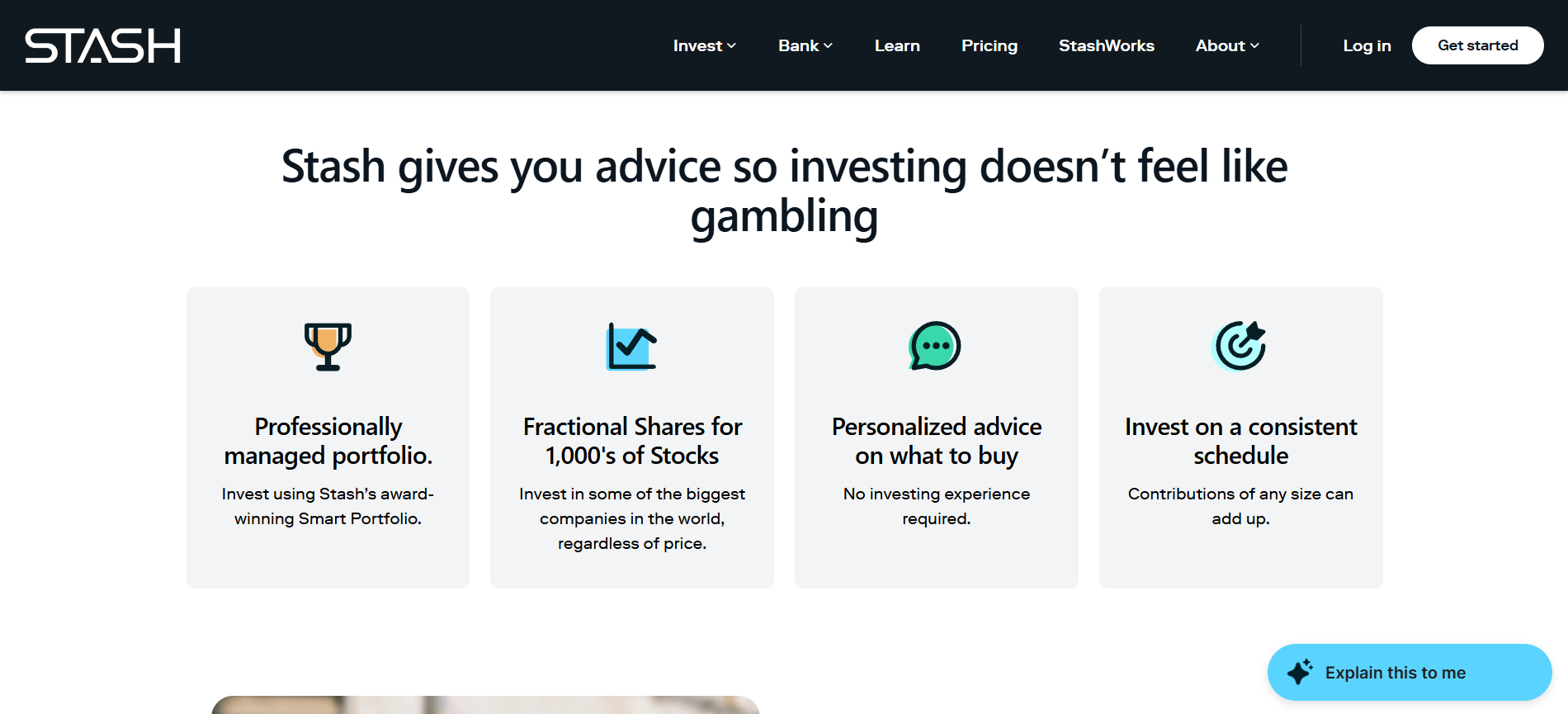
Stash Regulation and Safety
Stash operates within a regulated brokerage structure designed to provide oversight and investor protection. Stash Capital LLC is an SEC-registered broker-dealer and a member of FINRA and SIPC, and it acts as the introducing broker for Stash advisory accounts. This means it is responsible for customer-facing brokerage services while operating under U.S. securities regulations. For trade execution, clearing, and custody of client assets, Stash works with Apex Clearing Corporation, a third-party firm that is also an SEC-registered broker-dealer and member of FINRA and SIPC. Apex serves as the qualified custodian for advisory assets, which adds an additional operational layer between the platform and client funds. To keep your investments stash safe, Stash provides several layers of protection. Investments held by Stash are protected up to $500,000 by the Securities Investor Protection Corporation (SIPC). Cash deposits through Stash are insured up to $250,000 via the Apex FDIC-Insured Sweep Program. Stash also employs 256-bit bank-level encryption to safeguard your investments and personal data, and is Payment Card Industry Data Security Standard (PCI DSS) compliant, ensuring technical controls are in place to protect card data. As a member of SIPC (Securities Investor Protection Corporation), eligible accounts are protected up to standard SIPC limits in the event of broker-dealer failure. However, it is important to understand that SIPC coverage does not protect against losses due to market fluctuations or declines in investment value. Investors can review regulatory background and registration details for Apex Clearing through FINRA BrokerCheck, which provides public access to broker-dealer records and compliance history. This regulatory framework supports transparency and compliance, offering investors a structured and supervised brokerage environment.
Stash Customer Reviews
Many users praise Stash for its easy-to-use interface and simplicity, especially for beginners and first-time investors who appreciate being able to start with small amounts and learn as they go. Users highlight features like fractional share investing, automated saving tools, recurring investments, and the ability to set up retirement or custodial accounts as helpful for building consistent investing habits. The app’s design and educational resources also get positive mentions from investors who feel empowered to understand and manage their money more confidently.
However, some reviews also mention frustration with customer service experiences, including difficulties with account closure, billing issues, or slow resolution of support requests. A number of investors report challenges when trying to cancel subscriptions or withdraw funds, and mention long hold times or limited responsiveness from support teams. These mixed experiences show that while many find Stash useful for getting started with investing, others feel less satisfied with account management and service interactions.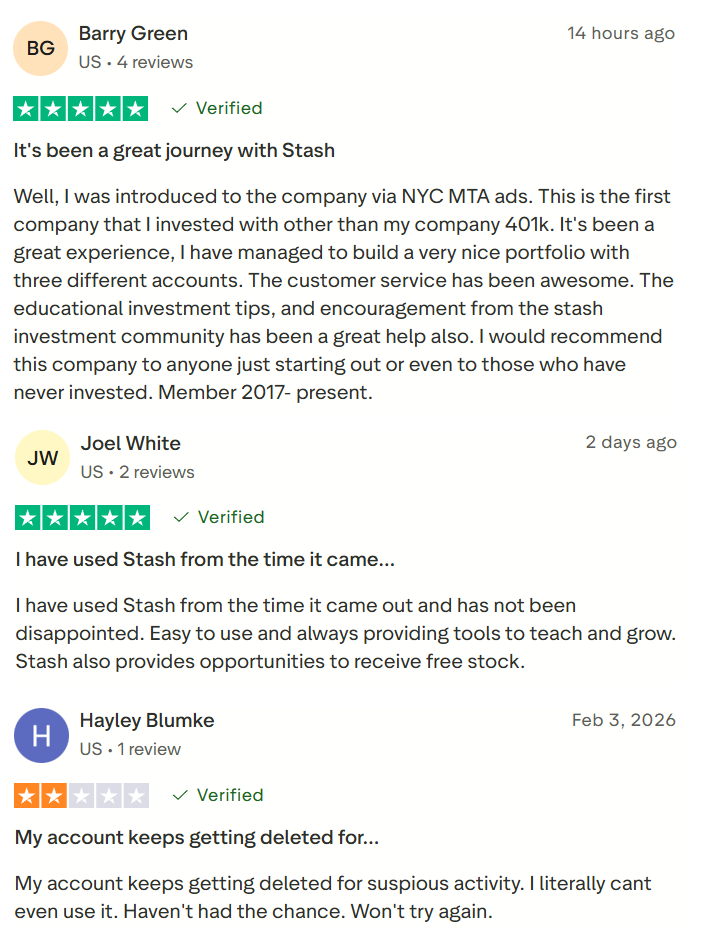
Stash Spreads, Fees, and Commissions
Stash uses a subscription-based pricing structure instead of traditional commission or spread-based trading fees, making its stash cost model simple and predictable for long-term investors. Rather than charging per trade, users pay a fixed monthly subscription fee, with two plan options: Stash Growth ($3 per month) and Stash+ ($12 per month). Both plans include access to a personal brokerage account, retirement accounts, and investing tools. Stash offers commission-free trading on stocks and ETFs, allowing investors to buy and sell securities without paying individual transaction fees. The platform does not apply traditional trading spreads like forex or CFD brokers because it focuses on stock market investing. However, trades are typically executed during scheduled trading windows, which means execution prices may slightly differ from quoted prices depending on market movement at the time of processing. In addition to the subscription cost, investors should consider standard ETF expense ratios, which are charged by fund providers rather than Stash itself. Stash’s Smart Portfolios have an average expense ratio of 0.06% to 0.08%. These fees vary depending on the ETF selected and are common across all brokerage platforms. Certain optional services or account-related actions, such as special transfers or administrative requests, may also involve additional charges. For example, Stash charges a $75 fee for transferring assets to another brokerage firm. Stash’s pricing model is designed for simplicity and accessibility, appealing to investors who prefer clear monthly costs and commission-free investing rather than complex fee structures tied to frequent trading activity.
Account Types
Individual Brokerage Account
- Taxable investment account
- Buy and sell stocks and ETFs, including fractional shares
- Use as a personal portfolio to customize your investments in stocks and ETFs
- No minimum deposit requirement
- No contribution limits
- Flexible withdrawals at any time
- Option for self-directed investing or automated portfolios
- Commission-free stock and ETF trades (subscription required)
Retirement Accounts (Traditional IRA and Roth IRA)
- Designed for long-term retirement savings
- Invest in stocks and ETFs
- Traditional IRA offers tax-deferred growth
- Roth IRA offers tax-free qualified withdrawals
- Annual contribution limits apply based on IRS rules
- Early withdrawal penalties may apply
- Supports automated or self-directed investing
Custodial Account (for Minors)
- Managed by an adult for a minor
- Invest in stocks and ETFs, including fractional shares
- Long-term savings for a child’s future
- Assets legally belong to the minor
- Transfers to the child at legal adulthood
- Available under higher-tier subscription plan
How to Open Your Account
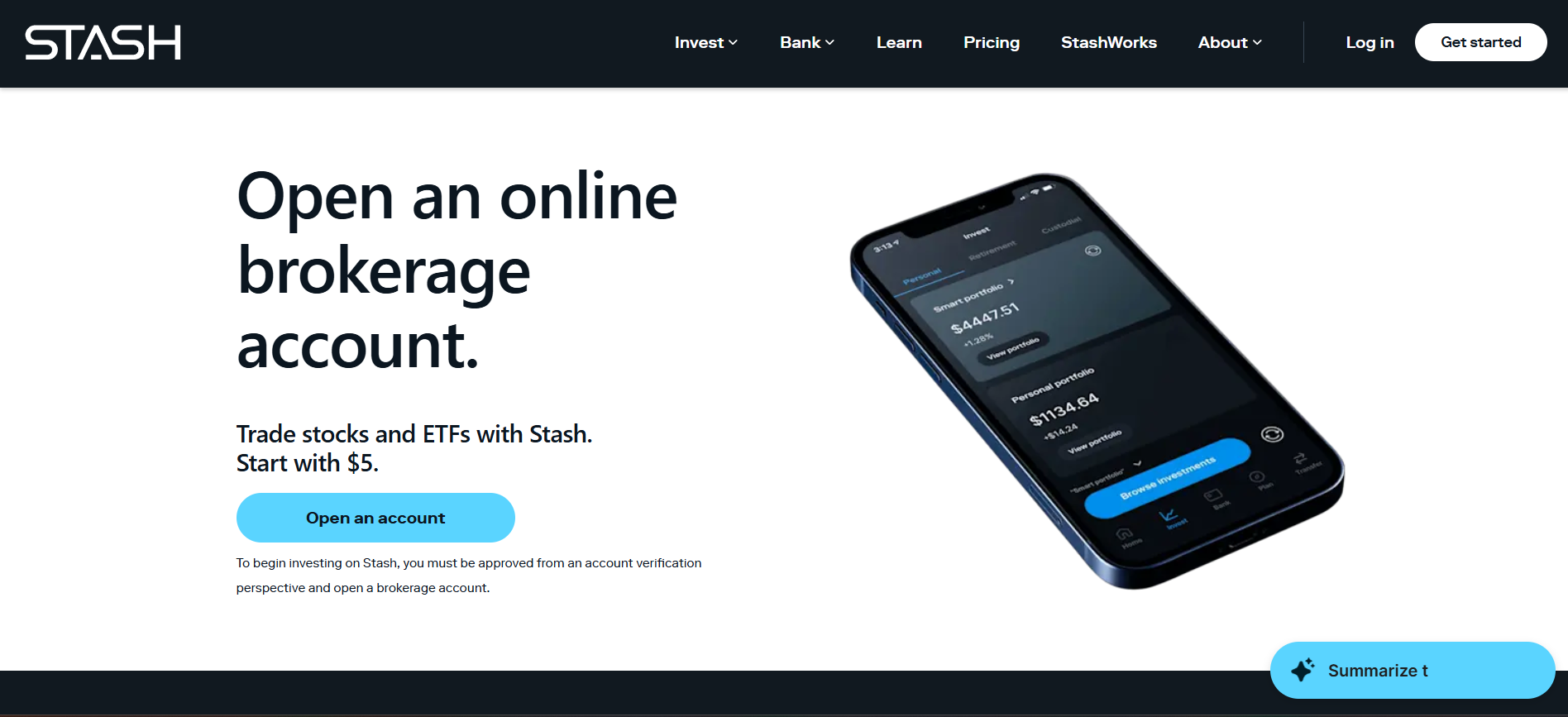
- Visit the official Stash page and click Get Started to begin creating your account.
- Provide a valid email address or sign up using your Google or Apple ID for faster registration.
- Create a strong password to secure your account.
- Enter your personal details and complete the onboarding survey to determine your investment profile and suitability.
- Link your bank account by securely connecting your banking details to enable deposits and withdrawals.
- Review and confirm your information, accept the platform’s terms and disclosures, then submit your application to complete account setup.
Stash Trading Platforms
Stash provides a mobile-first trading experience designed for beginners and long-term investors who prefer simplicity over complex trading tools. The primary platform is the stash app, a user-friendly investment platform available on iOS and Android devices. The stash app allows users to buy and sell stocks and ETFs, including fractional shares, manage retirement accounts, and access automated investing through Smart Portfolios. It supports various account types and is designed to make investment management accessible for new investors. The app also enables investors to set up recurring deposits and automatic investments, track portfolio performance, and access educational content that explains investment choices in simple terms. Banking features, including the Stock-Back® debit card dashboard, are also integrated directly into the app. To protect members’ investments and personal data, the stash app uses transport layer security for secure data transmission, employs 256-bit bank-level encryption, and is PCI DSS compliant.
In addition to mobile access, Stash offers a web-based platform that allows investors to manage their accounts through a desktop browser. The web platform provides similar functionality, including placing trades, reviewing portfolio performance, and accessing planning tools. Both platforms are synchronized for a seamless experience across devices. However, Stash does not offer advanced charting tools, complex order types, or professional-grade analytics, as the platform is built primarily for goal-based, long-term investing rather than active trading or short-term speculation.
What Can You Trade on Stash
On Stash, you can trade a selection of U.S. individual stocks and exchange-traded funds (ETFs), including the ability to buy fractional shares. Fractional investing lets you purchase portions of high-priced stocks or ETFs with smaller dollar amounts, making it easier to diversify a portfolio even with limited funds. The platform focuses on long-term market investing rather than active trading, so its offerings are centered around equity and fund ownership.
Stash does not currently support trading of options, futures, forex, cryptocurrencies, or other complex derivatives. Instead, its available instruments are geared toward investors who want straightforward access to the U.S. stock market and diversified ETF baskets for goal-based investing, retirement planning, or building long-term wealth. In addition, mutual funds are not available on Stash. This limited range of investment options compared to traditional brokerages may frustrate more experienced investors seeking broader diversification.
Stash Customer Support
Stash provides customer support primarily through digital channels designed to help investors get answers quickly and efficiently. Users can access in-app and online help resources, including a searchable help center with articles and step-by-step guides covering topics like account setup, trading basics, retirement accounts, billing questions, and investment features. In addition to these resources, Stash provides educational materials and market insights to help users learn about investing and stay informed about financial markets. The support library also includes educational content tailored to beginner investors, making it easier to understand how the platform works and how to use key tools such as recurring investments or Smart Portfolios.
For direct assistance, Stash offers email support and secure in-app messaging, allowing users to submit questions about their accounts, transactions, or technical issues. While there is no 24/7 phone support publicly advertised for all account types, Stash updates its support offerings regularly, and users can find the most current contact options through the Support & Learn section of the Stash website or app. The focus is on providing clear, accessible help materials backed by a support team that can respond to specific account inquiries and resolve issues related to trading, fees, or platform features.
Withdrawal Options and Fees
Stash provides several withdrawal methods designed to give investors flexible access to their funds, with most standard withdrawals available at low or no cost. Users can withdraw money by selling investments and transferring the cash to a linked external bank account or moving funds to their Stash banking account. Standard ACH bank transfers are generally free, and Stash does not charge fees for selling investments or withdrawing funds through regular transfers. Processing times typically depend on trade settlement and bank transfer timelines, which may take a few business days to complete.
For faster access, Stash offers instant transfers to an external bank, but this option carries a 1% instant transfer fee. Investors using the Stash debit account can also withdraw cash through ATMs, where out-of-network ATM withdrawals incur a $2.50 fee, while in-network ATM usage may be fee-free depending on location. Additionally, transferring an entire account to another brokerage through an ACAT transfer may involve a transfer-out fee (around $75–$100 per account). These withdrawal options allow flexibility between free standard transfers and faster paid withdrawals, depending on how quickly funds are needed.
Conclusion: Stash Review
Stash positions itself as a beginner-focused online stock broker built for investors who want a simple and structured way to start investing without needing large capital or advanced market knowledge. With features such as fractional share investing, Smart Portfolio automated investing, recurring deposits, and access to Traditional and Roth IRA retirement accounts, the platform focuses on helping users develop long-term investing habits rather than short-term trading strategies. Its subscription-based pricing model provides predictable costs, while its regulatory framework, including SEC registration, FINRA membership, and SIPC protection, adds an extra layer of credibility and investor confidence.
That said, Stash is best suited for long-term, hands-off investors rather than active traders. The platform offers a limited range of tradable assets, supports mainly stocks and ETFs, and does not include advanced trading tools, leverage products, or complex order types. While the monthly subscription fee may feel restrictive for very small accounts, the platform’s ease of use, educational resources, and automation features make it appealing for beginners looking to build wealth gradually and consistently. Investors seeking advanced analytics or multi-asset trading may prefer alternative brokers, but for straightforward investing and financial habit building, Stash remains a practical entry-level brokerage option.
Stash Review FAQs
What can I invest in on Stash?
Stash allows investments in U.S. stocks and exchange-traded funds (ETFs). The platform focuses on long-term portfolio building and diversification rather than complex trading instruments.
Can I automate my investments?
Yes. Stash offers Auto-Stash and Smart Portfolio features that automatically invest funds on a scheduled basis and maintain diversification according to your risk profile.
Can I day trade on Stash?
Stash is not designed for active day trading. It does not provide advanced charting tools, complex order types, or leverage products. The platform focuses on long-term investing strategies. OPEN AN ACCOUNT NOW WITH STASH AND GET YOUR BONUS
The verdict on Stash
Stash positions itself as a beginner-focused online stock broker built for investors who want a simple and structured way to start investing without needing large capital or advanced market knowledge. With features such as fractional share investing, Smart Portfolio automated investing, recurring deposits, and access to Traditional and Roth IRA retirement accounts, the platform focuses on helping users develop long-term investing habits rather than short-term trading strategies. Its subscription-based pricing model provides predictable costs, while its regulatory framework, including SEC registration, FINRA membership, and SIPC protection, adds an extra layer of credibility and investor conf
More stock brokers we’ve reviewed

