Learn To Trade Forex • Best Forex Trading Course • AsiaForexMentor

 English
 简体中文
简体中文 繁體中文
繁體中文 日本語
日本語 한국어
한국어 Bahasa Melayu
 Bahasa Indonesia
 Filipino
 ไทย
ไทย Tiếng Việt
 हिन्दी
 العربية
 Italiano
 Português
 Русский
 Español
 Français
- Best Forex BrokersRaw spreads, ECN execution and regulation — tested on live accounts.Best Stock BrokersCommissions, market access and platform depth, compared.Best Prop FirmsFunding rules, drawdown limits and real payout records.Best Crypto BrokersFees, custody and coin coverage across the major exchanges.AFM Top Pick
Every other site ranks ten brokers. We rank one — and show you exactly why.
See the #1 pick → - Articles
- Awards
- Events
- Newsletter
 Singapore
 Cambodia
 Myanmar
 Brunei
 Australia
  New Zealand
 Switzerland
 UAE
UAE United States
 Mexico
 Argentina
 South Africa
 IC Markets
 Pepperstone
 AvaTrade
 XM
XM Plus500
 RoboForex
 TMGM
TMGM Exness
 JustMarkets
 Orbex
Orbex Interactive Brokers
 Saxo
Saxo Tiger Brokers
 Binance
 Coinbase
 Gemini Exchange
 Kraken
 iFunds
 IC Funded
 The 5%ers
 TopStep
 IQ Option
 Pocket Option
 RaceOption
 IQCent
Keytrade Bank Review 2026
Keytrade Bank stands out as a well-established Belgian branch of Arkéa Direct Bank SA, backed by the Crédit Mutuel Arkéa group, with over 20 years of experience in digital banking and stock trading. As an online bank built from the ground up as a broker, it gives clients direct access to a full range of financial instruments across major stock market exchanges in Europe, the US, and Canada, all through a single trading account with no custody fees for private individuals. For investors focused on long-term savings and building real securities portfolios, the Keytrade Bank platform is a genuinely competitive option within Belgium and Luxembourg.
Risk warning: your capital is at risk. Forex and CFDs carry the potential for gains, but statistically only 11–25% of traders profit while 74–89% lose their investment. AFM earns a commission if you open an account through our links — it never changes how we score a broker.
- Belgium’s first online broker with over 20 years of operating history, giving it a track record that newer platforms lack
- Access to major international stock markets including Euronext, NYSE, Nasdaq, LSE, Xetra, and more from a single account
- No securities lending with client instruments, reducing counterparty risk compared to many discount brokers
- Two exclusive built-in analysis tools, the Global Analyzer and Idea Centre, available at no extra cost
- Strong regulatory oversight from both the FSMA and the National Bank of Belgium, with a clean compliance record
- Client assets are protected by the French FGDR scheme, covering securities up to 70,000 EUR, which is higher than the Belgian standard
- The platform is only available in Belgium and Luxembourg, limiting access for traders outside those markets
- No physical branches whatsoever, which can be a drawback for clients who prefer in-person support
- The mobile app and platform tutorials are primarily available in French and Dutch, with limited English-language guidance
- While entry-level fees are competitive, costs can scale up noticeably for larger orders or trades on non-Euronext markets
- This review was written by the Asia Forex Mentor team and has been reformatted into our current layout. The analysis below is our earlier work on Keytrade Bank, presented more clearly.
- It has not been re-verified against Keytrade Bank’s current published terms. Spreads, fees, leverage caps and account rules change, and so does the legal entity that serves a given country.
- Treat every figure here as a starting point for your own checks rather than a live quote.
- Before depositing, confirm the details on Keytrade Bank’s own site — above all, which company your client agreement names. That determines your regulator, your protections and who you can complain to.
- The score shown is Asia Forex Mentor’s own published rating for Keytrade Bank, carried over from this article and expressed out of 10. It reflects our earlier assessment, not a fresh re-scoring.
Reformatted September 2026. The details in this review have not been independently re-verified since it was written, so check Keytrade Bank’s own site before acting on anything here. Spotted something out of date? Tell us.

Ezekiel has traded foreign exchange for over two decades and built the One Core Program, the trading curriculum Asia Forex Mentor teaches to retail and institutional traders across Asia. He sets the scoring criteria these broker reviews are graded against.
On this page
- Keytrade Bank Review
- What is Keytrade Bank?
- Benefits of Trading with Keytrade Bank
- Keytrade Bank Regulation and Safety
- Keytrade Bank Customer Reviews
- Keytrade Bank Spreads, Fees, and Commissions
- Account Types
- Keytrade Bank Trading Platforms
- What Can You Trade on Keytrade Bank?
- Keytrade Bank Customer Support
- Withdrawal Options and Fees
- Conclusion: KeyTrade Bank Review
- FAQs
- Verdict
Keytrade Bank Review
Picking the right broker matters more than most beginners realize, as it directly affects your trading costs, overall experience, and long-term investment results. A dependable broker should provide a platform that is straightforward to use, with transparent fees that leave no room for surprises when managing a portfolio.
Keytrade Bank is a Belgian online stock broker and digital bank headquartered in Brussels. It operates entirely online with no physical branches, and serves both individual and corporate investors across Belgium and Luxembourg. The platform covers a wide range of financial products, from stock trading and ETFs to everyday banking services like current accounts, savings accounts, and mortgage loans, all accessible through a single login. The bank runs fully digitally, which keeps its overhead low and lets it pass some of those savings to clients through competitive trading commissions. It has a mobile app and a desktop transaction platform, both designed around giving traders direct control over their own portfolios without needing a financial advisor or a branch visit. For Belgian investors who prefer to manage their own money independently, Keytrade Bank has been one of the go-to options for over two decades. This Keytrade Bank review covers the platform’s core features, fee structure, available instruments, and regulatory standing to give investors a clearer picture of what the broker actually offers. The goal is to present straightforward and honest information so readers can determine whether Keytrade Bank is the right fit for their stock trading and investment needs.
What is Keytrade Bank?
Keytrade Bank holds the distinction of being Belgium’s first online investment broker, founded in 1998 under the name VMS-Keytrade. It was built specifically for self-directed investors who wanted to trade stocks without going through a traditional bank or human broker. In 2002, it acquired RealBank, which gave it full banking status and allowed it to expand beyond brokerage into standard banking products.
From 2005 to 2016, Keytrade Bank operated as a subsidiary of the Crelan Group, which at the time had ties to Crédit Agricole, one of Europe’s largest banking groups. In June 2016, ownership transferred to the Crédit Mutuel Arkéa banking group in France, where it remains today. In 2019, Keytrade Bank completed a merger and acquisition deal with ABN Amro’s Moneyou, absorbing its client base and further growing its deposit portfolio. Today, Keytrade Bank has over 20 years of digital banking experience and a staff of more than 250 people. It covers stocks, ETFs, options, bonds, funds, turbos, and standard banking services all within a single platform.
Benefits of Trading with Keytrade Bank
Keytrade Bank gives traders access to major markets including Euronext Brussels, Paris, and Amsterdam, the London Stock Exchange, Frankfurt (Xetra), Milan, Madrid, Switzerland, the US (NYSE, Nasdaq, AMEX), and Canada (TSX). That reach is wider than most retail-focused Belgian brokers, and it covers both European and North American equities from one account. Two in-house tools come included: the Global Analyzer, which provides instant stock diagnostics, and the Idea Centre, which lets traders search over 10,000 European and US stocks based on their own criteria. Real-time price feeds and customizable alerts via email, SMS, or push notification are also available at no additional cost. Trading fees on Euronext Brussels, Paris, and Amsterdam start from 2.45 EUR for orders up to 250 EUR. Keytrade Bank does not engage in securities lending with client instruments, which removes a layer of counterparty risk that is present with many newer discount brokers.
Keytrade Bank Regulation and Safety
Keytrade Bank sits under multiple regulatory bodies covering both Belgian and French financial law. It is supervised by the National Bank of Belgium (NBB) and the Financial Services and Markets Authority (FSMA), and as the Belgian branch of a French-licensed institution, it also falls under French prudential oversight. The FSMA enforces strict European conduct rules including MiFID compliance, covering transparency, conflict-of-interest management, and best execution standards. Keytrade Bank holds a clean regulatory record with no penalties or warnings from the FSMA on file. On the protection side, client cash deposits are covered up to 100,000 EUR through Belgium’s deposit guarantee scheme. For financial instruments, the French FGDR scheme covers securities up to 70,000 EUR per investor, which is notably higher than the 20,000 EUR standard applied by most purely Belgian brokers.
Keytrade Bank Customer Reviews
Customer sentiment toward Keytrade Bank is largely negative, based on reviews collected from verified user review platforms. The most reported issue by far is poor customer support, with multiple clients describing hour-long phone queues, unanswered emails, and unresolved problems that dragged on for weeks or even months.
App reliability and payment issues also come up repeatedly. Users reported the app failing to load for days at a time, cards being blocked without explanation, and transfers taking longer after a recent IT update rather than faster. Positive reviews do exist and tend to focus on the trading side of the platform. One client specifically praised the stock transfer team for their support during a securities migration from a foreign bank, while another highlighted the clean UI and the convenience of having banking and investing in one place.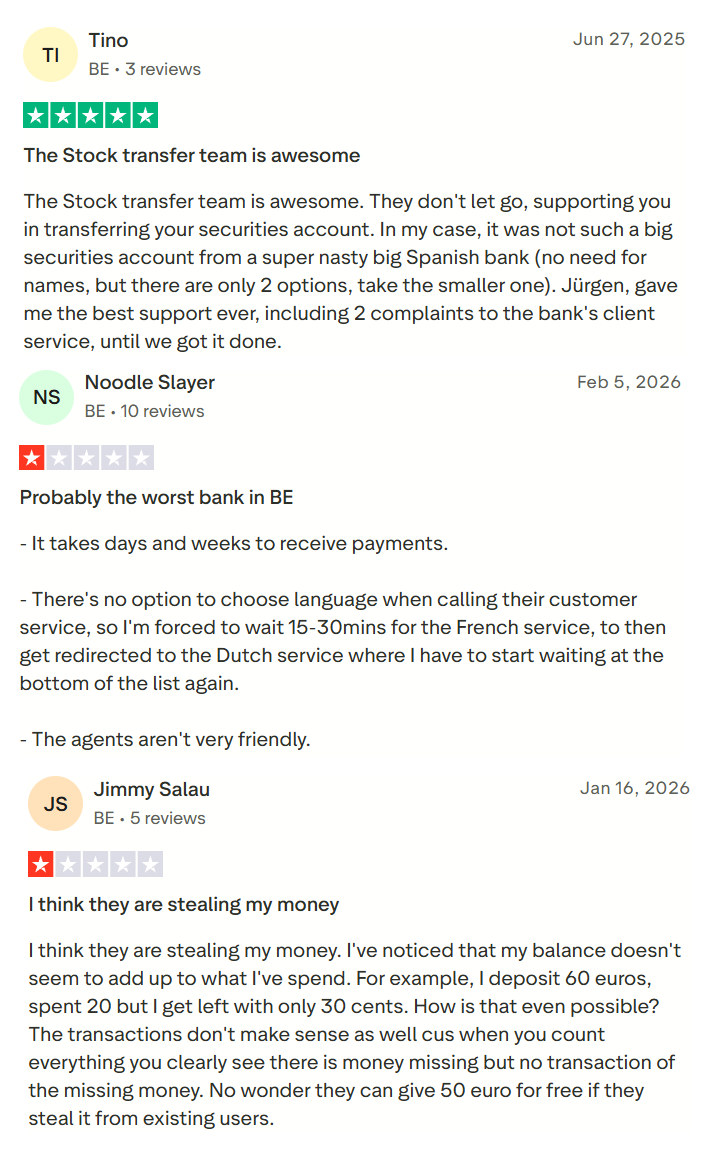
Keytrade Bank Spreads, Fees, and Commissions
Keytrade Bank rolled out a revised fee structure on January 22, 2025, replacing its previous pricing grid. Opening and closing a trading account is free, and there are no management fees or custodian fees for private individuals on financial instruments. That zero-custody-fee policy applies to stocks, ETFs, funds, and other instruments held in your portfolio, which is a tangible benefit for long-term investors. For stock trading on Euronext markets (Brussels, Amsterdam, Paris), fees are tiered: orders up to 250 EUR cost 2.45 EUR, orders between 250.01 EUR and 2,500 EUR cost 5.95 EUR, orders between 2,500.01 EUR and 10,000 EUR cost 14.95 EUR, and an additional 7.50 EUR is charged for each extra 10,000 EUR above that. These are among the more accessible entry-level fees for Belgian retail traders on Euronext. The picture changes considerably on non-Euronext European markets. Trading on Frankfurt (Xetra), Milan, or Madrid costs a flat 24.95 EUR per order regardless of order size up to 50,000 EUR. London (SETS/AIM) costs £29.95 plus a 0.50% stamp duty on purchases, while Zurich charges CHF 49.95 per order. For traders who frequently access these markets, those flat fees can add up quickly on smaller order sizes. On US markets, NYSE, Nasdaq, and AMEX orders up to $2,500 cost $14.95, orders between $2,500.01 and $10,000 cost $19.95, with an additional $7.50 for each extra $10,000. For options trading on Euronext, stock and index options are priced at 2.95 EUR per contract, while EUREX options cost 3 EUR per contract with a minimum of 14.95 EUR per transaction. For Turbos and warrants, the transaction fees follow the same structure as standard stock market transactions. On the funds side, entry and exit costs for online fund purchases are free, and the Keyplan investment plan also carries no entry or exit charges. Real-time quotes are not included by default. Euronext real-time pricing costs 2.50 EUR per month, US market real-time data costs 5 EUR per month, and Frankfurt (Xetra) real-time quotes cost 20 EUR per month. However, these fees are waived if you execute at least 3 transactions per month on that market group.
Account Types
Keytrade Bank offers one primary account type for stock trading, with additional investment account options depending on how hands-on you want to be with your money. Keytrade Bank’s Trading Account is its core brokerage offering and the main account for self-directed investors. It is the only dedicated stock trading account available on the platform, giving traders direct market access without any account management fees.
The Keytrade Bank Trading Account is free to open and close, with no management or custodian fees for private individuals. It gives traders direct access to major international stock markets including Euronext (Brussels, Paris, Amsterdam), NYSE, Nasdaq, LSE, Frankfurt (Xetra), Milan, Madrid, Zurich, and the Canadian TSX, covering a broad range of instruments such as stocks, ETFs, options, turbos, warrants, bonds, and structured products. Two built-in tools come included, the Global Analyzer for stock diagnostics and the Idea Centre for filtering over 10,000 European and US stocks, alongside real-time price alerts delivered via email, SMS, or push notification. Delayed quotes are free by default, while real-time quotes are available from 2.50 EUR per month per market group, automatically waived when you execute 3 or more trades per month on that market. Keytrade Bank does not engage in securities lending and does not use payment for order flow, which are practices that can work against a client’s interests at other brokers. Cash balances are protected up to 100,000 EUR through Belgium’s deposit guarantee scheme, and the account is fully accessible through both the Keytrade Bank mobile app and desktop transaction platform.
How to Open Your Account
- Visit the official Keytrade Bank website and click the “Become a Client” button on the homepage. This will direct you to the online application form where the account opening process begins.
- The application will prompt you to select what kind of account you want to open. Keytrade Bank offers four options to choose from. If you have a promo code, this is also the step where you can enter it before continuing. Once you have made your selection, click “Continue” to proceed to the next step of the application.
- Before filling in the application form, Keytrade Bank outlines a few things to have ready. You will need your identity card and mobile phone on hand, as these are required for identity verification during the process. You also have the option to use itsme®, Belgium’s digital identity app, to have your personal details filled in automatically instead of entering them manually. Note that if you plan to give a proxy to your account, this can only be arranged after the account has been successfully opened, not during the application itself.
- If you do not have itsme® yet, you can sign up for it using a Belgian eID card, your eID PIN code, a smartphone, and a card reader. This is the faster route, as itsme® allows your details to be verified digitally without any waiting period. If you cannot or prefer not to use itsme®, you can instead print, sign, and upload a registration form manually. This alternative method takes longer, with verification typically completed within 5 to 10 working days from the time your documents are submitted.
- Once your identity is verified, you will be directed to fill in your personal information, including your name, address, contact details, and tax identification number. This step is part of Keytrade Bank’s KYC (Know Your Customer) compliance requirements under Belgian and EU anti-money laundering regulations.
- Before submitting your application, you will need to read and agree to Keytrade Bank’s general terms and conditions and privacy policy. Take time to go through the key sections, particularly those covering trading account conditions and fee disclosures, before clicking to confirm.
- Once everything is filled in and signed electronically, submit your application for review. When the bank has received all the necessary documents, it will analyse the application and open a free current, savings, and trading account upon approval.
- After approval, Keytrade Bank will send you the necessary authentication methods to manage your accounts 100% online. This includes access to your Softkey or Hardkey device, which is used for secure login to both the desktop platform and mobile app.
Keytrade Bank Trading Platforms
Keytrade Bank does not use third-party platforms like MetaTrader. Instead, it operates through its own proprietary trading environment, which consists of a desktop transaction platform accessed via the website and a dedicated mobile app available on both iOS and Android. All trading, account management, and portfolio monitoring happens within these two channels.
The desktop platform is accessed directly through the Keytrade Bank website after logging in. It gives traders a full-screen view of their portfolio, market data, and order management tools, with direct access to all supported international stock markets. Built-in tools include the Global Analyzer for stock diagnostics and the Idea Centre for screening over 10,000 European and US stocks, alongside real-time and delayed quote feeds, and secure login via HardKey or SoftKey authentication. The Keytrade Bank mobile app is available on both the Apple App Store and Google Play Store as a free download for iOS and Android. It combines banking and trading in one place, allowing clients to monitor all accounts, follow live market movements, place orders, and analyze stocks through the Global Analyzer directly from their phone or tablet. Login is handled through the SoftKey, a software authentication method built into the app, and recent updates have added a refreshed design, dark mode, and a quicker view of the most traded instruments. Customizable price alerts can be delivered via push notification, email, or SMS.
What Can You Trade on Keytrade Bank?
Keytrade Bank covers a broad range of tradable instruments for retail investors, all accessible from the same trading account. The platform is built around stock market investing but extends into several other asset classes. Traders can access stocks, ETFs, options, turbos, warrants, bonds, funds, structured products, and trackers, all from a single login. For stock trading specifically, Keytrade Bank connects to a wide list of exchanges including Euronext (Brussels, Paris, Amsterdam), NYSE, Nasdaq, AMEX, LSE, Frankfurt (Xetra), Milan, Madrid, Zurich, Helsinki, Stockholm, Copenhagen, Oslo, and the Canadian TSX. Options trading is available on Euronext, EUREX, and US markets, while bonds can be purchased on both the primary and secondary market. Funds are accessible through an open-architecture supermarket with more than 660 funds available, and trackers are traded at the same fee structure as standard stock orders. It is worth noting that Keytrade Bank does not offer Forex trading or CFDs as standalone products. Its instrument range is built entirely around regulated exchange-listed securities, which reflects its identity as a stock broker rather than a speculative or leveraged trading platform. Traders looking for currency pairs or contracts for difference will need to look elsewhere.
Keytrade Bank Customer Support
Keytrade Bank offers several ways to get in touch, though all of them are digital by nature given that the bank operates entirely online. The primary support channels are a phone line, email, contact form, chatbot, and a FAQ library covering banking, investing, trading, borrowing, authentication, taxes, and legal topics. The contact center is reachable by phone at +32 2 679 90 00, Monday to Friday from 09:00 to 22:00, though from 17:00 onward support is limited to questions about cards, payments, and investments only.
For quicker access, Keytrade Bank recommends calling through the app, as it allows clients to be identified immediately without going through the standard verification process. A 24/7 chatbot is also available for instant answers outside of business hours. Email support is available at info@keytradebank.com, and clients can also submit queries through a contact form on the website. The FAQ section is organized into categories covering authentication, banking, investing, trading, borrowing, and legal information, making it relatively easy to find answers to common questions without contacting support directly. Social media is also listed as a contact option on the website.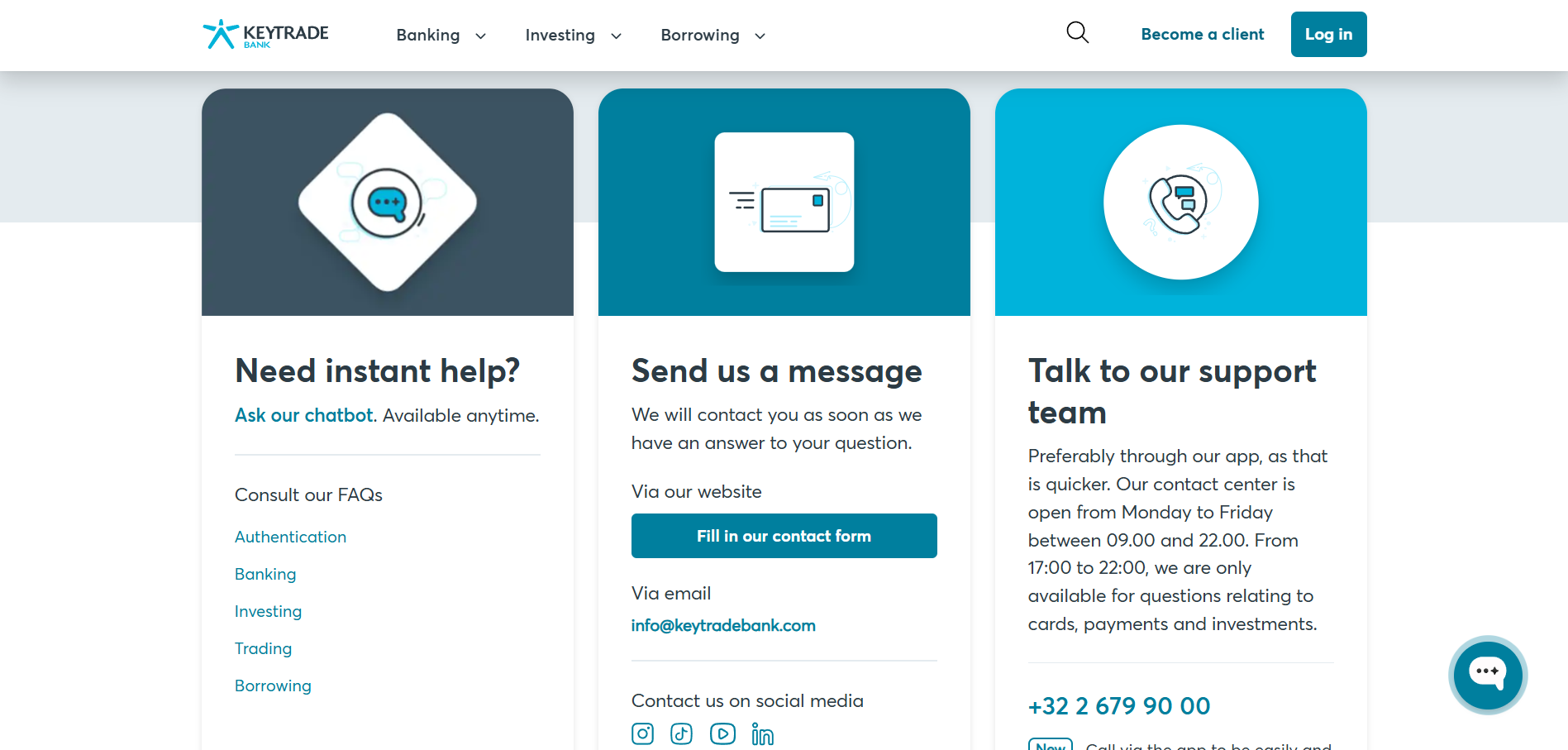
Withdrawal Options and Fees
Keytrade Bank handles withdrawals through bank transfers, as it is a fully digital bank with no cash counters or physical branches. For clients within the SEPA zone, transferring money out of your Keytrade account to another Belgian or European bank account is completely free of charge. SEPA transfers cover all EU member states plus Norway, Iceland, Liechtenstein, Switzerland, the United Kingdom, and Monaco, and can be initiated directly through the app or desktop platform.
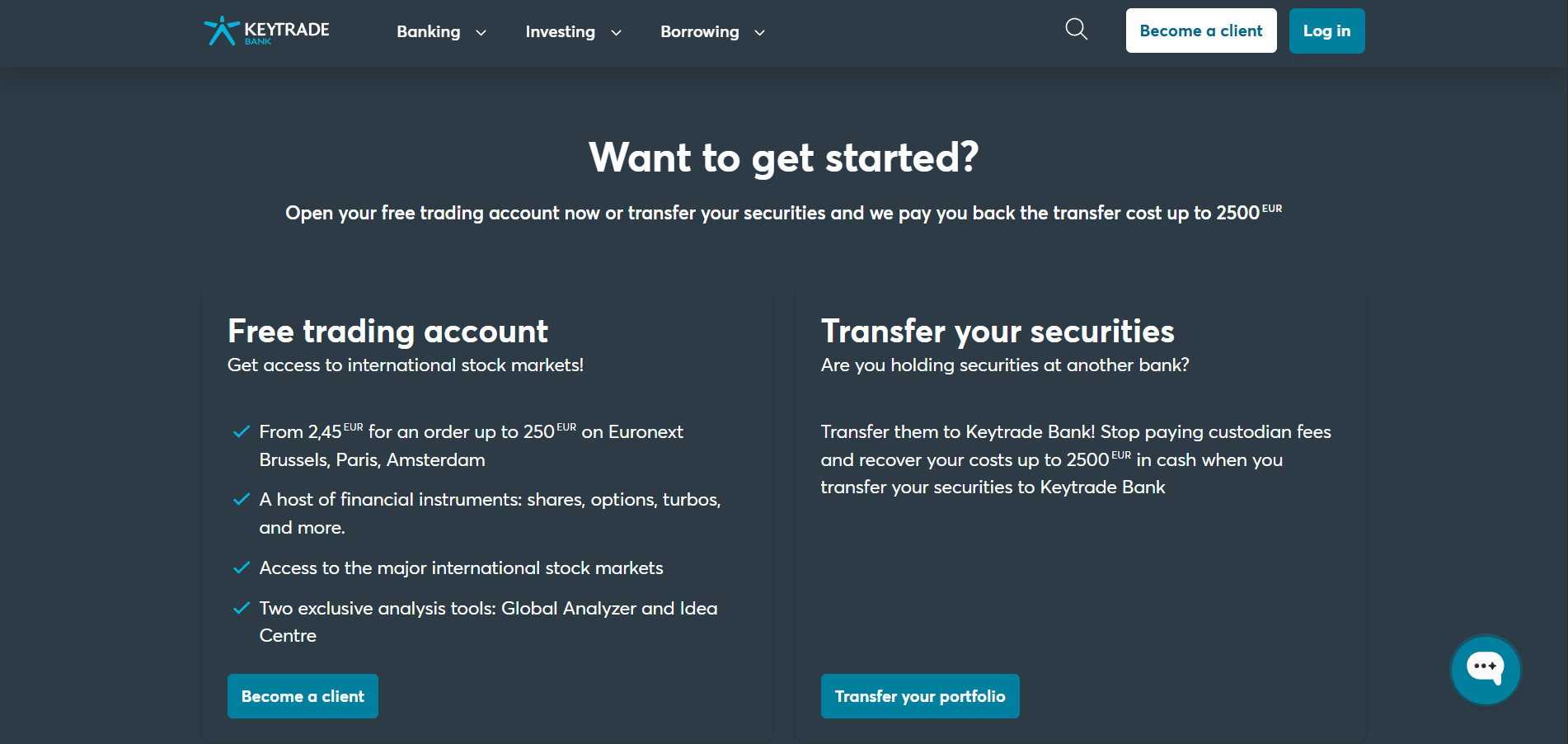
For international transfers outside the SEPA zone, or any transfer made in a foreign currency, fees apply. Transfers up to 12,500 EUR cost 15 EUR plus 0.30% of the transfer amount, while transfers above 12,500 EUR cost 15 EUR plus 0.10%, capped at a maximum of 125 EUR. Additional correspondent bank fees may also apply depending on the destination, and these are charged separately on top of Keytrade’s own fee. For outgoing securities transfers, meaning moving stocks or other financial instruments from your Keytrade trading account to another broker, a fee of 50 EUR excluding VAT per line applies. Internal transfers of securities between your own Keytrade accounts are free, while internal transfers to a third party’s Keytrade account cost 15 EUR excluding VAT per line. Keytrade Bank also offers to reimburse incoming securities transfer costs up to 2,500 EUR for clients moving their portfolio from another broker to Keytrade.
Conclusion: KeyTrade Bank Review
Keytrade Bank stands out as a well-established Belgian branch of Arkéa Direct Bank SA, backed by the Crédit Mutuel Arkéa group, with over 20 years of experience in digital banking and stock trading. As an online bank built from the ground up as a broker, it gives clients direct access to a full range of financial instruments across major stock market exchanges in Europe, the US, and Canada, all through a single trading account with no custody fees for private individuals. For investors focused on long-term savings and building real securities portfolios, the Keytrade Bank platform is a genuinely competitive option within Belgium and Luxembourg.
Where Keytrade Bank operates most effectively is in its core identity as a regulated stock broker. The online trading platform and trading app are purpose-built for self-directed traders who want to easily access global stocks, ETFs, bonds, options, and funds without paying high transaction costs. The absence of minimum deposits, combined with free account opening and zero custody fees, makes the Keytrade account accessible to both new and experienced investors looking to grow their investments over several years. That said, there are real concerns that potential clients should weigh carefully. Customer support has been a consistent pain point, with traders reporting long wait times by phone and slow responses to email queries. The trading platforms are proprietary and lack the depth of third-party tools that more advanced traders may expect, and there are no educational materials to help those still developing their trading skills. Payments and transfer issues have also surfaced in customer feedback, particularly for those relying on the bank for everyday cash and transaction needs. For investors whose primary goal is stock trading on regulated financial markets, Keytrade Bank delivers a solid, secure, and well-regulated experience under FSMA oversight. It is less suited to active forex traders or those looking for a speculative broker with leverage products, as its instrument range is built entirely around exchange-listed securities. If you are a Belgian retail investor looking to manage a real portfolio of assets through a trusted online bank with transparent fees and strong investor protections, Keytrade remains a credible choice worth considering.
Keytrade Bank Review FAQs
Are there custody fees on stocks held in a Keytrade Bank trading account?
No. Keytrade Bank charges no custody fees for private individuals holding stocks, ETFs, bonds, funds, or other financial instruments in their trading account. This applies to personal accounts, joint ownerships, and investment clubs, making it cost-efficient for long-term investors.
Does Keytrade Bank lend out client securities?
No. Keytrade Bank has a clear policy against securities lending, meaning your stocks are never loaned out to third parties to reduce platform costs. This removes a layer of counterparty risk that is present at several competing discount brokers.
What stock markets can you access through Keytrade Bank?
Keytrade Bank connects to a wide range of international exchanges including Euronext Brussels, Paris, and Amsterdam, the London Stock Exchange, Frankfurt (Xetra), Milan, Madrid, Zurich, Helsinki, Stockholm, Copenhagen, Oslo, NYSE, Nasdaq, AMEX, and the Canadian TSX. This gives retail investors access to both European and North American equities from a single account. OPEN AN ACCOUNT NOW WITH KEYTRADE BANK AND GET YOUR BONUS
The verdict on Keytrade Bank
Keytrade Bank stands out as a well-established Belgian branch of Arkéa Direct Bank SA, backed by the Crédit Mutuel Arkéa group, with over 20 years of experience in digital banking and stock trading. As an online bank built from the ground up as a broker, it gives clients direct access to a full range of financial instruments across major stock market exchanges in Europe, the US, and Canada, all through a single trading account with no custody fees for private individuals. For investors focused on long-term savings and building real securities portfolios, the Keytrade Bank platform is a genuinely competitive option within Belgium and Luxembourg.
More stock brokers we’ve reviewed

