Learn To Trade Forex • Best Forex Trading Course • AsiaForexMentor

 English
 简体中文
简体中文 繁體中文
繁體中文 日本語
日本語 한국어
한국어 Bahasa Melayu
 Bahasa Indonesia
 Filipino
 ไทย
ไทย Tiếng Việt
 हिन्दी
 العربية
 Italiano
 Português
 Русский
 Español
 Français
- Best Forex BrokersRaw spreads, ECN execution and regulation — tested on live accounts.Best Stock BrokersCommissions, market access and platform depth, compared.Best Prop FirmsFunding rules, drawdown limits and real payout records.Best Crypto BrokersFees, custody and coin coverage across the major exchanges.AFM Top Pick
Every other site ranks ten brokers. We rank one — and show you exactly why.
See the #1 pick → - Articles
- Awards
- Events
- Newsletter
 Singapore
 Cambodia
 Myanmar
 Brunei
 Australia
  New Zealand
 Switzerland
 UAE
UAE United States
 Mexico
 Argentina
 South Africa
 IC Markets
 Pepperstone
 AvaTrade
 XM
XM Plus500
 RoboForex
 TMGM
TMGM Exness
 JustMarkets
 Orbex
Orbex Interactive Brokers
 Saxo
Saxo Tiger Brokers
 Binance
 Coinbase
 Gemini Exchange
 Kraken
 iFunds
 IC Funded
 The 5%ers
 TopStep
 IQ Option
 Pocket Option
 RaceOption
 IQCent
TD Direct Investing Review 2026
TD Direct Investing is a solid pick for people who want a self-directed investing account backed by a major bank, with platform choices like WebBroker plus active-trader tools such as Advanced Dashboard and TD Active Trader. This TD Direct Investing review takeaway is simple: the platform range is strong, especially for investors who want research tools and a familiar ecosystem. Pricing is the main tradeoff.
Risk warning: your capital is at risk. Forex and CFDs carry the potential for gains, but statistically only 11–25% of traders profit while 74–89% lose their investment. AFM earns a commission if you open an account through our links — it never changes how we score a broker.
- Multiple trading platforms
- Streaming market data tools
- Advanced trading features
- Select ETFs at $0 commission: TD lists $0 online trading for select ETFs.
- Broad investment access: TD positions the account for trading products like equities, options, and ETFs.
- Regulation and investor protection: TD states it is a CIPF member and regulated by CIRO.
- Higher stock commissions
- Options add per-contract fees: TD lists options pricing as $9.99 + $1.25 per contract, which can add up fast.
- “$0 ETFs” are limited
- Active trader pricing needs high volume
- More tools can mean more complexity
- This review was written by the Asia Forex Mentor team and has been reformatted into our current layout. The analysis below is our earlier work on TD Direct Investing, presented more clearly.
- It has not been re-verified against TD Direct Investing’s current published terms. Spreads, fees, leverage caps and account rules change, and so does the legal entity that serves a given country.
- Treat every figure here as a starting point for your own checks rather than a live quote.
- Before depositing, confirm the details on TD Direct Investing’s own site — above all, which company your client agreement names. That determines your regulator, your protections and who you can complain to.
- The score shown is Asia Forex Mentor’s own published rating for TD Direct Investing, carried over from this article and expressed out of 10. It reflects our earlier assessment, not a fresh re-scoring.
Reformatted September 2026. The details in this review have not been independently re-verified since it was written, so check TD Direct Investing’s own site before acting on anything here. Spotted something out of date? Tell us.

Ezekiel has traded foreign exchange for over two decades and built the One Core Program, the trading curriculum Asia Forex Mentor teaches to retail and institutional traders across Asia. He sets the scoring criteria these broker reviews are graded against.
On this page
- TD Direct Investing Review
- What is TD Direct Investing?
- Benefits of Trading with TD Direct Investing
- TD Direct Investing Regulation and Safety
- TD Direct Investing Customer Reviews
- Account Types
- TD Direct Investing Trading Platforms
- What Can You Trade on TD Direct Investing
- TD Direct Investing Customer Support
- Withdrawal Options and Fees
- Conclusion: TD Direct Investing Review
- FAQs
- Verdict
TD Direct Investing Review
TD Direct Investing is TD’s self-directed investing service that lets investors buy and manage investments through its digital platforms. This TD Direct Investing review looks at the broker’s pricing, platform options, and the practical features that matter for everyday investors. The platform is operated by Toronto Dominion Bank, a major Canadian bank, and functions as an online brokerage designed for Canadian investors who want to manage their own investments. On costs, TD Direct Investing lists a standard online commission of $9.99 per stock trade, with a lower $7.00 rate for active traders who meet higher trading activity thresholds. The broker also promotes commission free trading on select ETFs, which can reduce trading fees for investors who rely heavily on ETF trades. However, investors who make frequent trades should still pay attention to overall trading costs, since they can feel like high trading fees compared with some newer online brokers. For trading access, TD highlights multiple trading platforms, including WebBroker, the TD app, and advanced tools designed for more active traders. WebBroker acts as the main web based platform, while the mobile app allows investors to manage their account online and monitor markets from anywhere. The upside is flexibility across web and mobile, but the full value depends on whether the tools match the investing style and how often trades are placed.
What is TD Direct Investing?
TD Direct Investing is TD’s self-directed investing service where investors can buy and manage investments on their own without using a managed portfolio. A TD Direct Investing account is designed for people who want to own investments directly and control their investment decisions. This direct investing approach appeals to individuals who prefer managing their portfolios independently. The core platform is WebBroker, which TD describes as its main online trading and investing platform with market data, charting, and various research tools. These include market research tools, analyst research, and access to market news, which can help investors evaluate potential trades. TD also highlights access to products like stocks, ETFs, options, bonds, and mutual funds, making it a full-service brokerage for DIY investors. On pricing, TD lists online commissions such as $9.99 for Canadian and U.S. stock trades of one full share or more, plus $0 trading for select ETFs when trading online or in the app. These TD Direct Investing fees matter for anyone comparing online brokers, especially if ETF trades or index funds are a big part of the strategy. 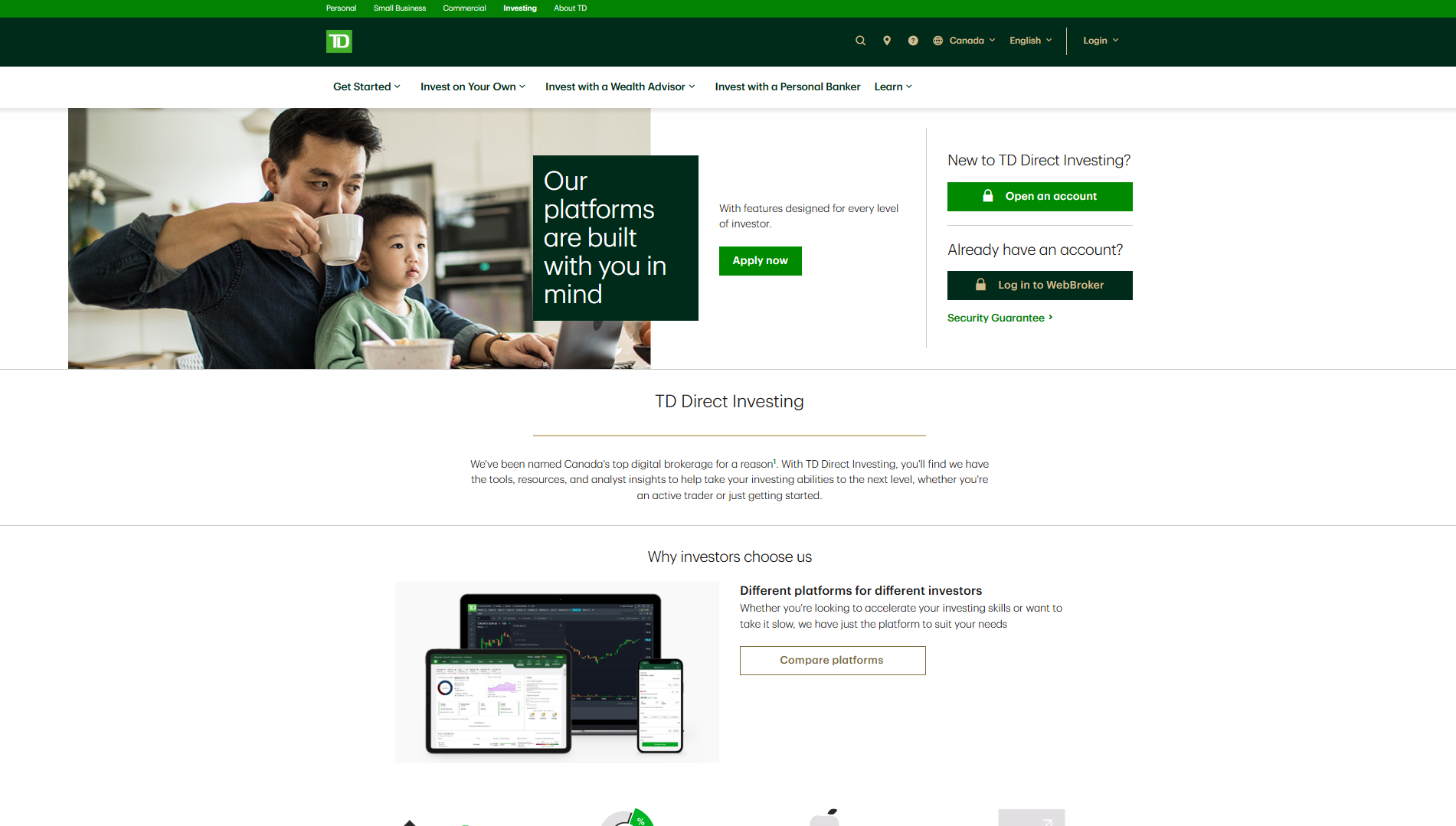
Benefits of Trading with TD Direct Investing
One big benefit is access to TD’s WebBroker platform, which TD describes as a core tool with market data, charting, and detailed investment tools. These include research tools, market news, and analyst research designed to help investors analyze opportunities before placing trades. For many users, WebBroker functions as a powerful trading platform that supports a wide range of investment strategies. Another advantage is flexibility in how trades are placed, since TD promotes using the TD app, WebBroker, and more advanced tools like Advanced Dashboard and TD Active Trader. These active trader platforms are designed for advanced traders and include features like streaming market data, customizable charting, and real time market data to help monitor price movement. Cost-wise, TD Direct Investing offers commission free trading on select ETFs when trades are placed online or in the app. This can help reduce trading fees for investors who rely heavily on ETF portfolios or index funds, although standard stock trades still involve commissions. 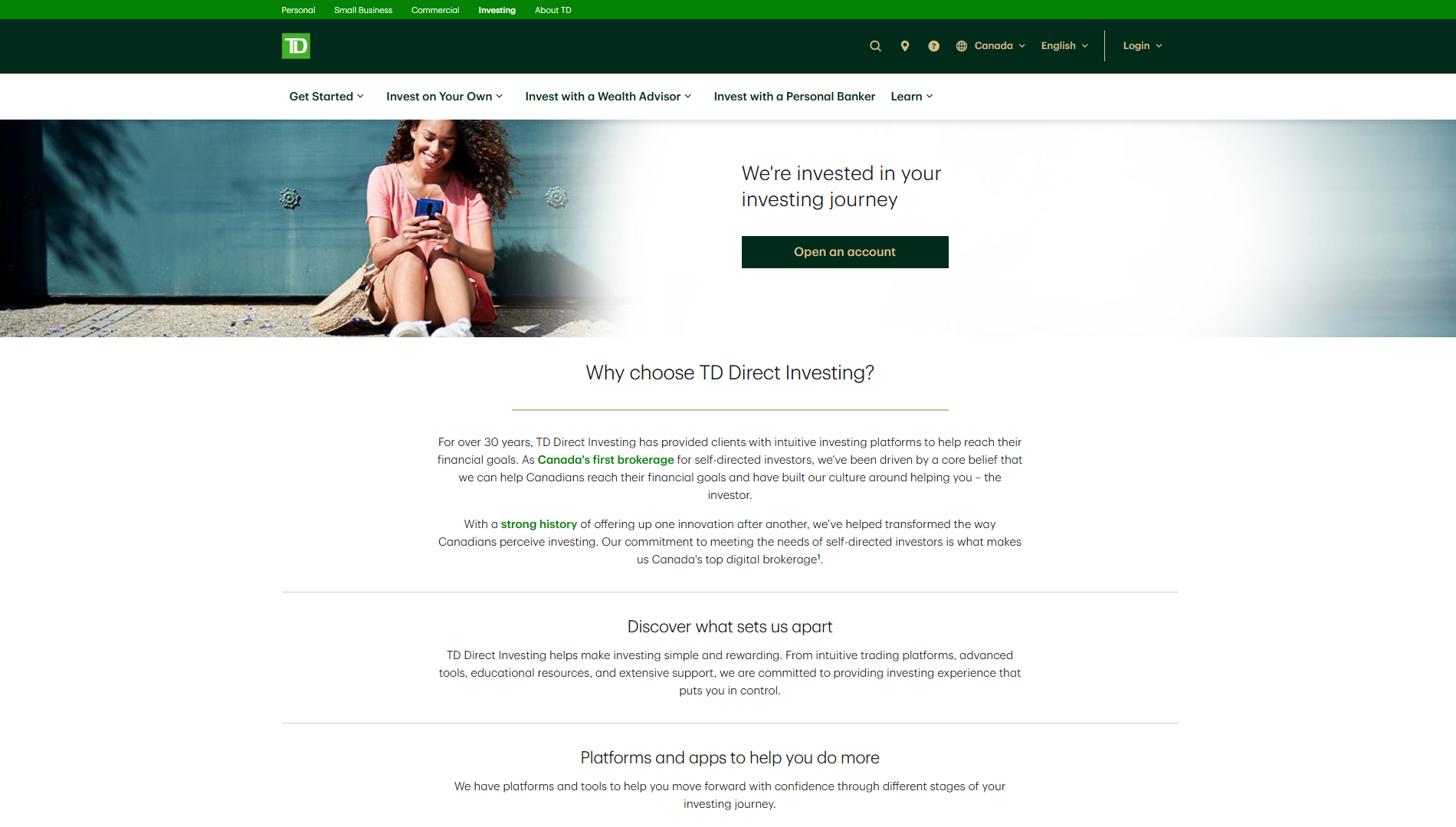
TD Direct Investing Regulation and Safety
TD Direct Investing operates through TD Waterhouse and is part of TD Wealth, the investment division of TD Bank. The brokerage is regulated by CIRO and is a member of CIPF, also known as the Canadian Investor Protection Fund. This regulatory structure is typical among big bank brokerages in Canada. For safety, CIPF protection covers missing property held by a member firm if the brokerage becomes insolvent. This means assets such as cash and securities may be protected within policy limits if the firm fails, though the coverage does not apply to losses caused by market volatility or poor investment decisions. TD also promotes a Security Guarantee designed to address certain cases of unauthorized account access. Because of these safeguards and regulatory oversight, some investors consider TD Direct Investing safe, though it remains important to understand that all investing still carries normal market risk.
TD Direct Investing Customer Reviews
People searching for TD Direct Investing customer reviews usually want to know if the trading experience feels reliable and if help is available when something breaks. TD markets Direct Investing as a platform with tools, resources, and analyst insights, with WebBroker positioned as its main platform for trading and managing investments. On Trustpilot, feedback about TD’s broader service experience often leans negative, with recurring complaints tied to customer communications, including long wait times when trying to get support. This matters for Direct Investing clients because account access issues, order questions, or transfer problems can quickly become stressful if response times are slow. Trustpilot’s category summary also flags frustration around payments and mentions concerns like hidden charges. Those comments are not Direct Investing only, but they still hint at the kind of service friction some customers report when money movement or account-related issues come up. 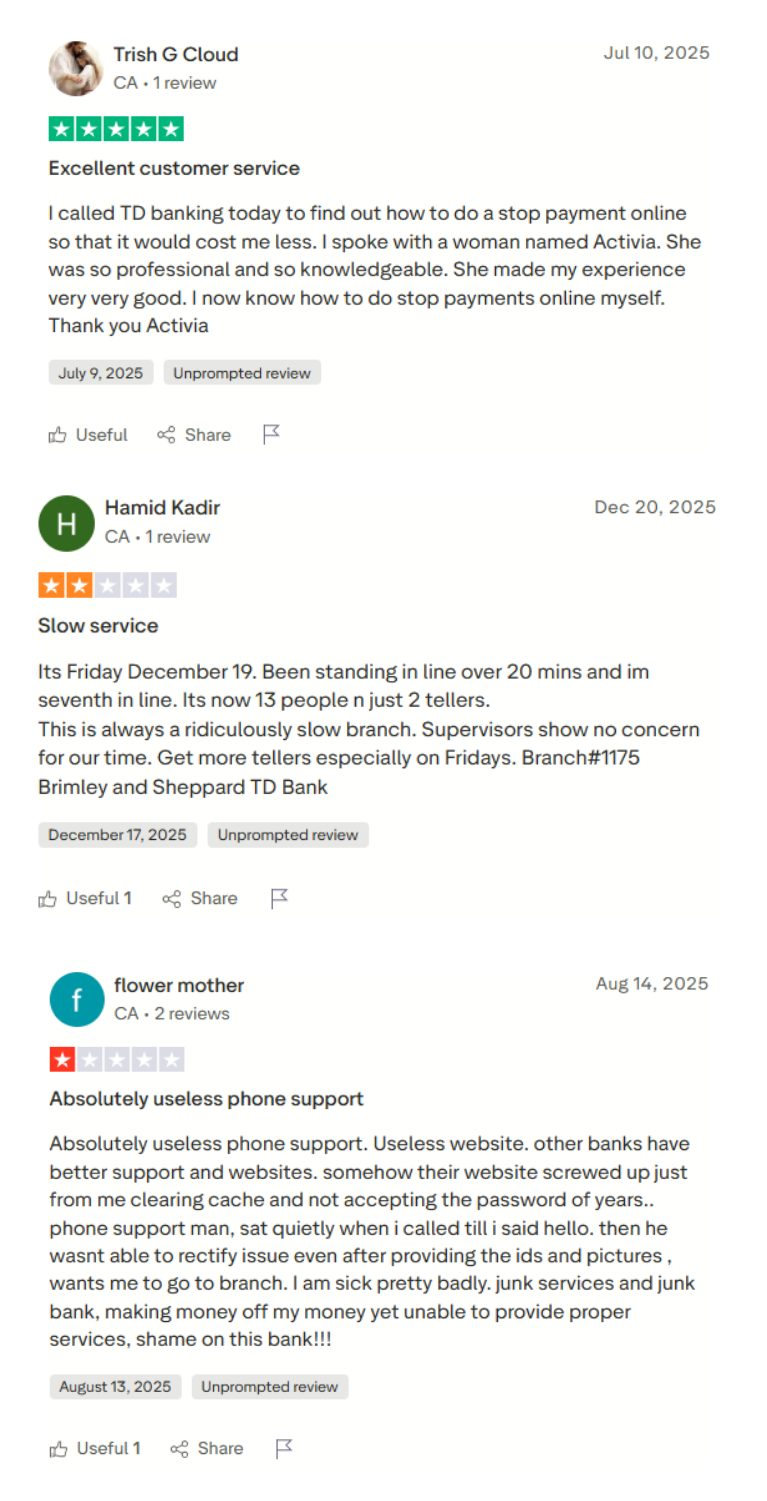
Account Types
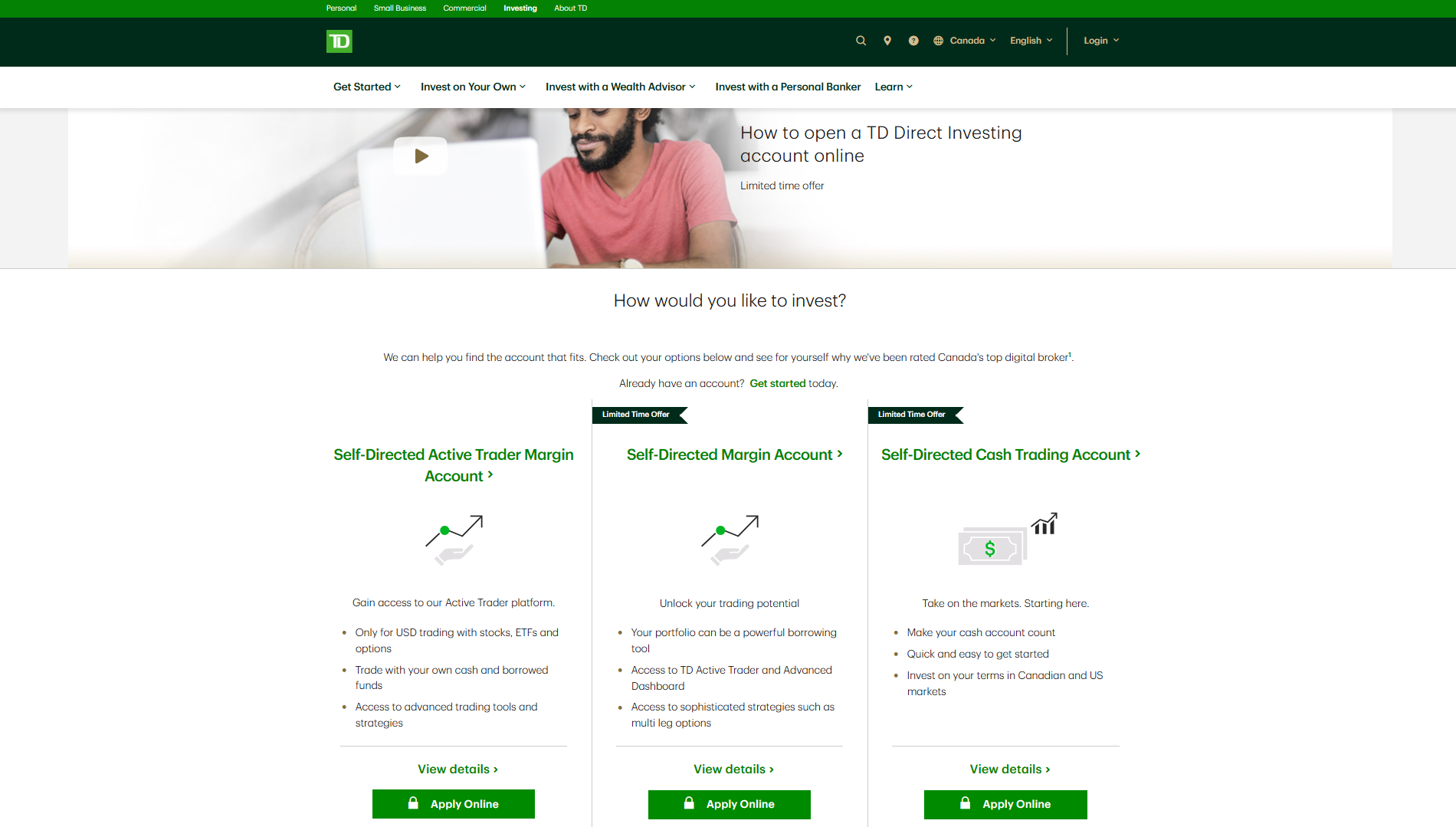
Self-Directed Cash Account
- A basic self-directed account for investing with cash, often used for general investing outside registered plans.
Self-Directed Margin Account
- Lets investors borrow to buy securities and adds features like options trading and short selling, and TD describes margin as a way to trade securities like stocks with leverage.
Self-Directed Active Trader Margin Account
- Only for USD trading with stocks, ETFs, and options, and includes access to the Active Trader platform and advanced tools.
Self-Directed TFSA
- A registered account for investing with potential tax-free growth and withdrawals, depending on rules.
Self-Directed RRSP
- A registered retirement account for long-term investing with tax advantages tied to retirement savings rules.
Self-Directed RRIF
- A registered income account used to draw retirement income after the RRSP stage.
Self-Directed Spousal RRSP (SRRSP)
- A retirement account structure that supports spousal contributions under program rules.
Self-Directed Spousal RRIF (SRRIF)
- A spousal retirement income account used for withdrawals under retirement income rules.
Self-Directed RDSP
- A registered plan for long-term investing tied to disability savings rules and eligibility.
Self-Directed RESP
- An education savings plan that supports investing for education costs and may connect to grants under program rules.
TD Direct Investing Trading Platforms
TD Direct Investing offers a lineup of trading platforms built around WebBroker, which TD describes as its most popular platform for online trading and investing. It’s designed to help build a portfolio with stocks, ETFs, options, and bonds in both Canadian and U.S. markets, with market data and research tools included. For mobile trading, TD points investors to the TD app, which is built to monitor portfolio performance, follow market events, and trade on the go. This matters if quick access is needed without being tied to a desktop. For more active traders, TD promotes Advanced Dashboard, which syncs orders and holdings across Advanced Dashboard, WebBroker, and the TD app in real time. TD also positions it as a more advanced setup for tracking positions and managing orders with more control. TD also offers TD Active Trader, which TD describes as a platform built to help execute trading strategies with confidence and manage complex trades from a phone. It’s clearly aimed at traders who want a more specialized experience than a basic investing screen.
What Can You Trade on TD Direct Investing
TD Direct Investing supports a range of investment types, including stocks, ETFs, mutual funds, GICs, fixed income investments, and options trading. This matters because it covers both long-term portfolio building and more active trading styles in one brokerage. If using WebBroker, TD says it is possible to build a diversified portfolio of stocks, ETFs, options, and bonds in both Canadian and U.S. markets. That’s useful for investors who want access to common markets without needing multiple platforms. Account type can affect what is practical to trade day to day. For example, TD’s cash account is described as a basic account to invest in stocks, ETFs, mutual funds, and bonds, which fits most buy and hold investors.
TD Direct Investing Customer Support
TD Direct Investing customer support is centered on phone support and self-serve help, with TD pointing users to the TD Direct Investing Help Centre for answers on WebBroker, Advanced Dashboard, and the TD app. If the issue is account-specific, TD also offers options like booking an appointment and requesting a call from a TD representative. For faster routing, TD highlights a “Call Us” path inside the TD app that lets users select TD Direct Investing, but that feature only works if the device is physically located in Canada. TD also lists separate technical support for issues like password resets, which is useful when logins block access to trading tools. If a problem is not resolved, TD provides steps for resolving complaints and a feedback form. As a reviewer, that escalation path matters because it shows there is a formal process when regular support channels are not enough. 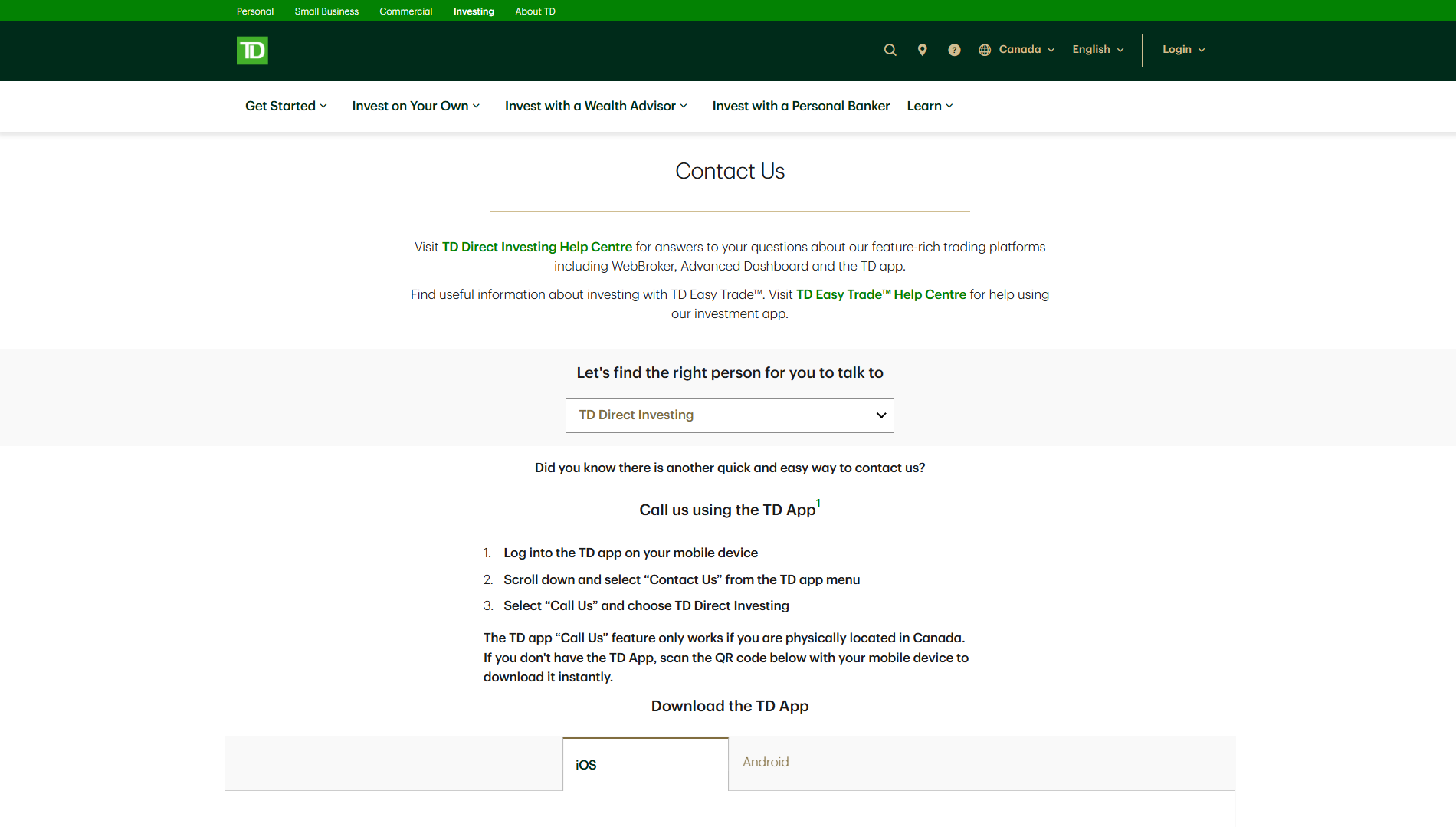
Withdrawal Options and Fees
TD Direct Investing withdrawal options are mainly built around moving cash out through Electronic Fund Transfer (EFT) or arranging a withdrawal for branch or TD Direct Investing location pick-up. TD also notes it can require a seven day notice for intended withdrawals, so it helps to plan ahead if funds are needed on a specific date. For everyday money movement, TD highlights ways to manage cash through WebBroker and the TD app, including transfers from a TD bank account or another financial institution. It also supports services like investment income sweeps and systematic mutual fund withdrawals for people who want regular cash flow. On fees, TD’s commission schedule lists a $150 transfer fee for partial or full transfers out for Direct Trading and registered accounts. For certain registered account withdrawals, the fee schedule lists $100 full withdrawal (excluding RDSP, RESP, TFSA and RRIF) and $25 partial withdrawal (RRSP, Basic RRSP, LIRA, LRSP only).
Conclusion: TD Direct Investing Review
TD Direct Investing is a solid pick for people who want a self-directed investing account backed by a major bank, with platform choices like WebBroker plus active-trader tools such as Advanced Dashboard and TD Active Trader. This TD Direct Investing review takeaway is simple: the platform range is strong, especially for investors who want research tools and a familiar ecosystem. Pricing is the main tradeoff. TD lists $9.99 online commissions for stock trades, but also offers select commission-free ETFs when trading online or in the app, which can lower costs for ETF-focused portfolios. For safety, TD Direct Investing points to CIRO oversight and CIPF coverage, which supports investor protection if a member firm becomes insolvent, within policy limits. On the practical side, anyone who might switch broker later should note that TD’s commission schedule includes an account transfer out fee, with the document showing $150 for full or partial transfers out.
TD Direct Investing Review FAQs
What is TD Direct Investing?
TD Direct Investing is TD’s self-directed investing service that lets investors place trades and manage a portfolio online. It’s built for people who want to invest in products like stocks, ETFs, mutual funds, GICs, fixed income investments, and options trading using TD’s investing platforms.
How much does TD Direct Investing cost?
TD Direct Investing lists a standard online commission of $9.99 for Canadian and U.S. stocks (for trades of 1 full share or more), and $9.99 + $1.25 per contract for Canadian and U.S. options. It also lists $0 for select ETFs when trades are placed online or in the app, and an active trader tier of $7.00 for stocks when a 150+ trades per quarter threshold is met.
What platforms can be used for TD Direct Investing?
TD highlights WebBroker as its main online trading and investing platform, and it also offers advanced options like Advanced Dashboard and TD Active Trader for more active trading needs. For most investors, the choice comes down to whether simple investing tools are enough, or if more advanced analytics and execution features are needed. OPEN AN ACCOUNT NOW WITH TD DIRECT INVESTING AND GET YOUR BONUS
The verdict on TD Direct Investing
TD Direct Investing is a solid pick for people who want a self-directed investing account backed by a major bank, with platform choices like WebBroker plus active-trader tools such as Advanced Dashboard and TD Active Trader. This TD Direct Investing review takeaway is simple: the platform range is strong, especially for investors who want research tools and a familiar ecosystem. Pricing is the main tradeoff.
More stock brokers we’ve reviewed

