Learn To Trade Forex • Best Forex Trading Course • AsiaForexMentor

What Is a Pip in Forex and Why It Matters

Written by

Ezekiel Chew

Updated on

May 5, 2026

i
Its a default text

What Is a Pip in Forex and Why It Matters

Written by:

Last updated on:

May 5, 2026

Most traders learn what is a pip in forex on day one, and most of them never learn the part that actually costs them money.

A pip is not just a definition. It is the unit that connects every price movement in the forex market to real profit, real loss, and real risk. Understanding pip value is what separates traders who manage risk consistently from those who are unknowingly using inconsistent position sizes on every trade.

This guide covers what a pip is, how pip value is calculated, and how to use pips correctly in every trading decision.

ABOUT THIS GUIDE Written by Ezekiel Chew, founder of Asia Forex Mentor and a former institutional trader with over 20 years of market experience. Ezekiel has coached thousands of traders across Singapore, the Philippines, Malaysia, and Indonesia through the AFM One Core Program.
QUICK ANSWER A pip, short for percentage in point or price interest point, is the smallest standard price movement in the forex market. For most currency pairs, one pip equals 0.0001, the fourth decimal place. For Japanese yen pairs like USD/JPY, however, one pip equals 0.01, the second decimal place. Pip value changes based on the currency pair, trade size, and account currency. On EUR/USD with a standard lot, one pip is worth $10.

What This Guide Covers

  • What a pip is in forex trading
  • The fourth decimal place and how pips are measured
  • The Japanese yen exception for JPY pairs
  • Fractional pips explained
  • How to calculate pip value across currency pairs
  • How pips connect to risk management
  • Frequently asked questions


What Is a Pip in Forex
what-is-a-pip-forex-eurusd

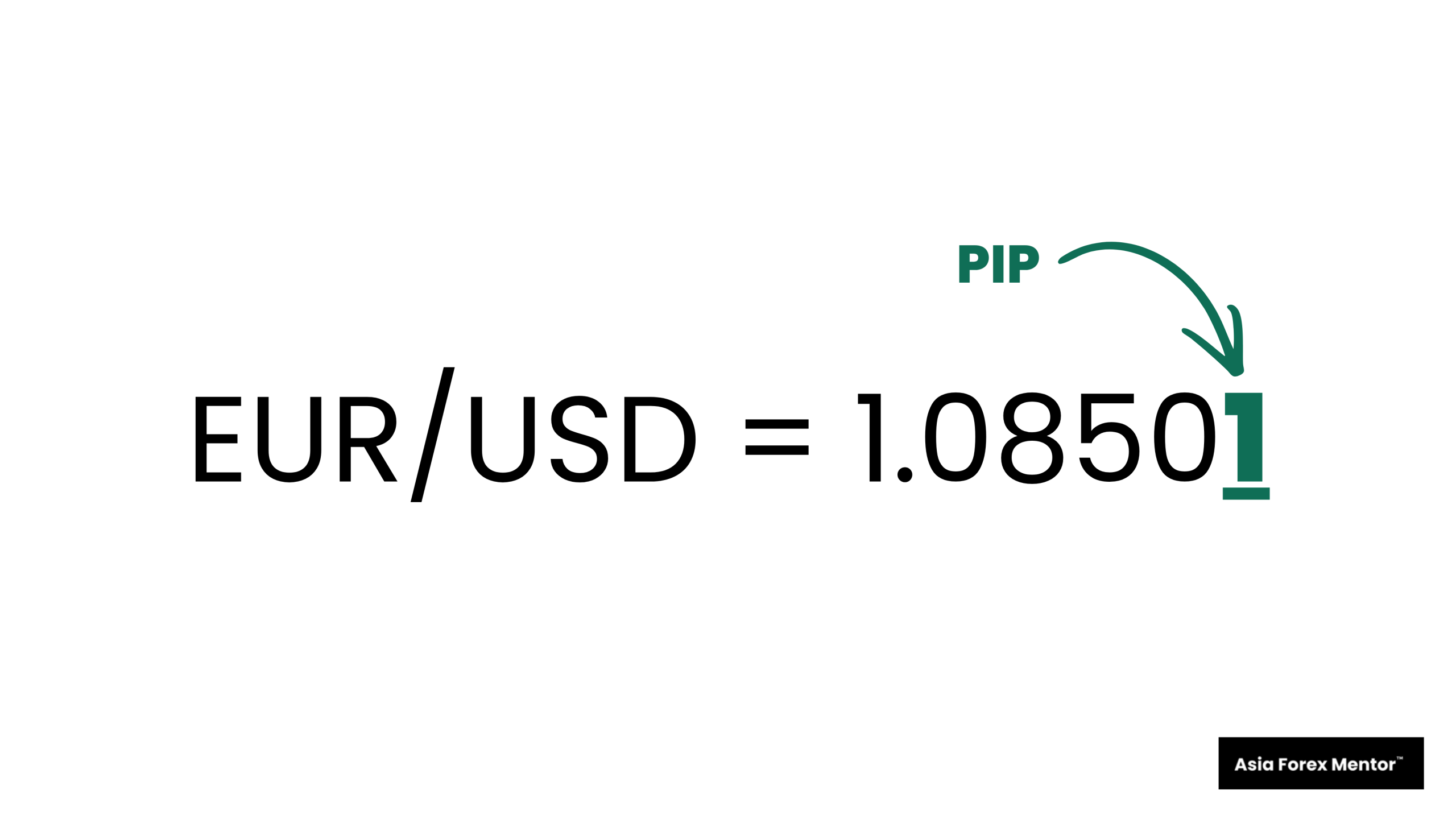
A pip is the standard unit used to measure price movements in the forex market. Every time a currency pair moves, for example, EUR/USD shifts from 1.08500 to 1.08510 that 0.00010 movement is exactly one pip. It is also the standard unit for measuring one pip movement when traders calculate profits or assess potential gains on any open position.

The word pip stands for percentage in point or price interest point. It is the universal language of price movement when any forex trader anywhere says EUR/USD moved 80 pips, everyone instantly knows how far the current price travelled, regardless of their trade size or account currency.

Think of it like centimetres on a ruler. The ruler measures distance, while the pip measures price movement. According to Investopedia, the pip has been the standardised unit price measurement across the global forex market since modern currency trading began.

One Pip and the Fourth Decimal Place

For most currency pairs, one pip sits at the fourth decimal place, 0.0001, or four decimal places after the decimal point. This applies to all major pairs that do not involve the Japanese yen, including EUR/USD, GBP/USD, AUD/USD, and USD/CAD. These pairs are also where the base currency and counter currency relationship determines the direction of pip value calculation.

EUR/USD moves from EUR/USD moves to Movement
1.08500 1.08510 1 pip — smallest price movement
1.08500 1.08600 10 pips
1.08500 1.09500 100 pips

Because the fourth decimal place is the standard, even a single pip move carries real dollar value, and that value changes depending on the two currencies involved, the trade size, and whether the US dollar is the base currency or the counter currency in the pair.

The Japanese Yen Exception for JPY Pairs

Japanese yen pairs are the notable exception to the four decimal places rule. Because the yen has a much lower value per unit compared to other currencies, yen pairs are quoted to two decimal places instead of four. As a result, one pip on USD/JPY, EUR/JPY, and all other JPY pairs sits at the second decimal place, one hundredth, or 0.01.

USD/JPY moves from USD/JPY moves to Movement
151.500 151.510 1 pip
151.500 151.600 10 pips
151.500 152.500 100 pip
WATCH OUT A 50-pip stop on USD/JPY is not the same dollar risk as a 50-pip stop on EUR/USD, even though the pip count looks identical. This is the most common real world example of pip value confusion, and it catches many traders off guard when switching between JPY pairs and other major pairs without recalculating.

Fractional Pips and the Fifth Decimal Place

Most modern trading platforms quote prices to five decimal places. That fifth decimal is called a fractional pip or pipette, and it equals one tenth of a pip, which is a key factor in reading spread costs accurately.

For example, a spread shown as 0.00012 on EUR/USD is 1.2 pips, not 12. Misreading this decimal point makes trading costs look ten times more expensive than they actually are, which leads traders to avoid perfectly good setups. For those using virtual funds on a demo account, this is especially important to understand before switching to live trading.

Calculating Pip Value Across Currency Pairs

Knowing what a pip is means nothing without knowing the value of a pip in the account currency. Three key factors determine pip value, the currency pair, the trade size , and the account currency. This is where most beginner guides stop, and it is exactly where the real decisions begin. An experienced trader never enters a position without running this calculation first.

Base Currency and the EUR/USD Formula

FORMULA Pip Value = 0.0001 x Trade Size

EUR/USD standard lot: 0.0001 x 100,000 = $10 per pip

EUR/USD micro lot: 0.0001 x 1,000 = $0.10 per pip

Percentage in Point Calculation for JPY Pairs

FORMULA Pip Value = (0.01 / Exchange Rate) x Trade Size

USD/JPY at 151.50, standard lot: (0.01 / 151.50) x 100,000 = ~$6.60 per pip

Pip Value Across the Forex Market

Currency pair One pip Standard lot Micro lot
EUR/USD 0.0001 $10.00 $0.10
GBP/USD 0.0001 $10.00 $0.10
AUD/USD 0.0001 $10.00 $0.10
USD/JPY 0.0100 ~$6.60 ~$0.07
USD/CAD 0.0001 ~$7.40 ~$0.07
EUR/JPY 0.0100 ~$7.20 ~$0.07

One of the most consistent patterns seen across AFM students, regardless of experience level, is setting the same pip stop on every pair without checking the actual dollar risk. For instance, a 30-pip stop on EUR/USD with a standard lot costs $300, while the same pip change on USD/JPY costs approximately $198. The pip size looks the same, but the underlying asset exposure and pip change in dollar terms is completely different. Once traders start calculating pip value before every trade, their risk management improves almost immediately.

How Pips Connect to Risk Management in Forex Trading

Pip value is only useful when it is connected to risk management. Professional traders who trade forex do not start with a pip count, instead, they start with a dollar risk amount and work backward. This is one of the three key factors that separates consistent traders from those who blow accounts: knowing the value of a pip before entering, not after.

  1. Decide the maximum dollar risk per trade. For example, 1% of a $5,000 account equals $50.
  2. Identify the correct stop loss level based on market structure, then count the pips from the current price to that level.
  3. Calculate required pip value: $50 divided by 35 pips equals $1.43 per pip.
  4. Calculate the correct trade size: $1.43 divided by $10 standard pip value on EUR/USD equals 0.143 lots.
  5. Enter that exact trade size, the size that produces the right dollar risk at the right stop level.

Without this sequence, traders are managing pip count rather than actual risk, and those are two completely different things. This approach works equally well for scalping strategies, swing trading, and CFD contract positions.

Also Read

Conclusion

A pip in forex trading is the standard unit of price measurement 0.0001 on most pairs and 0.01 on Japanese yen pairs. However, knowing the definition alone is not enough. What matters is knowing the value of a pip in the account currency, at the current trade size, on the specific pair being traded whether that is a basis point move on EUR/USD or a one pip move on USD/JPY.

In other words, pip value is the bridge between a stop loss on the chart and real money in the account. It is what makes risk management consistent across every currency pair and every trade. Learn the calculation, apply it before every position, and make it automatic.

Frequently Asked Questions

What does pip stand for in forex trading

Pip stands for percentage in point or price interest point. It is the standard unit used to measure price movements in the forex market. For most currency pairs, one pip equals 0.0001, the fourth decimal place. For Japanese yen pairs, however, one pip equals 0.01, the second decimal place.

How much is one pip worth in forex

It depends on the currency pair and trade size. On EUR/USD with a standard lot of 100,000 units, one pip is worth $10. With a micro lot of 1,000 units, one pip is worth $0.10. On USD/JPY at 151.50 with a standard lot, one pip is worth approximately $6.60. Always calculate pip value for the specific pair and trade size before entering any position.

Why do JPY pairs have a different pip location

The Japanese yen has a much lower value per unit compared to most other currencies. Because of this, yen pairs are quoted to two decimal places rather than four. As a result, one pip on USD/JPY, EUR/JPY, GBP/JPY, and other JPY pairs sits at the second decimal place, 0.01, instead of the fourth decimal place used by most other pairs.

What is a fractional pip in forex

A fractional pip, also called a pipette, is one tenth of a pip, sitting at the fifth decimal place on most pairs. Most modern trading platforms quote to this level of precision. For example, a spread of 0.00012 on EUR/USD is 1.2 pips, not 12. Misreading this causes traders to significantly overestimate their trading costs.

How do I calculate pip value on a currency pair

For pairs where USD is the quote currency such as EUR/USD or GBP/USD, multiply 0.0001 by the trade size. A standard lot therefore equals $10 per pip (0.0001 x 100,000). JPY pairs work differently: divide 0.01 by the current exchange rate and multiply by trade size. At USD/JPY 151.50 with a standard lot, that comes to approximately $6.60 per pip.

Does pip value change when the exchange rate moves

Yes, slightly. On pairs where USD is not the quote currency, pip value shifts as the exchange rate moves. The change is small on individual trades, however it becomes meaningful on larger positions over time. Most trading platforms update pip values in real time, so the number displayed always reflects the current exchange rate.

What is the difference between a pip and a point in forex

A pip is a standardized unit, 0.0001 for most pairs, 0.01 for yen pairs. A point, by contrast, is a vague term used inconsistently across platforms and brokers. Sometimes it means a pip, sometimes it means the smallest possible increment. To avoid confusion, always use the word pip specifically when discussing price movements.

Why is understanding pips important for risk management

Pip value is what connects a stop loss on the chart to an actual dollar amount in the trading account. Without knowing pip value, it is impossible to calculate how much is being risked on any given trade. A 30-pip stop on a standard lot of EUR/USD costs $300 if hit, while the same stop on a micro lot costs just $3. Pip value is what tells traders which one is appropriate for their account size.

About Ezekiel Chew​

Ezekiel Chew, founder and head of training at Asia Forex Mentor, is a renowned forex expert, frequently invited to speak at major industry events. Known for his deep market insights, Ezekiel is one of the top traders committed to supporting the trading community. Making six figures per trade, he also trains traders working in banks, fund management, and prop trading firms.

Why Keeping Crypto on Exchanges Could Cost You Everything

Risks of Storing Cryptocurrency on Centralized Exchanges Why a Lot of People Still Use Centralized Exchanges Centralized exchanges are still popular because they are easy to use. They offer a crypto exchange, storage, and access to fiat currency all in one place. Big companies advertise strong liquidity, easy onboarding, and

Read More

Stop Losing Money in Crypto: Analyze Projects the Smart Way

How to Analyze Cryptocurrency Projects Before Investing People can avoid hype, find weak ideas, and make wiser choices in a fast-moving crypto market if they learn how to examine cryptocurrency projects before investing. Because investing in cryptocurrencies is still very risky, it’s more important to do your study, analyze the

Read More

M1 Finance Review 2026 – REAL Traders Report

            OPEN AN ACCOUNT             M1 Finance Review M1 Finance is positioned as an all in one money platform that combines investing, cash management, and borrowing in a single app experience. On its official site, M1 highlights automated investing, commission-free investing

Read More

AFM Trading Summit Live

Date: Coming Soon

Join us at the AFM Trading Summit Live and learn from top industry experts through live trading sessions, market insights, and actionable strategies.

What Is a Pip in Forex and Why It Matters

4.0
Overall Trust Index

Written by:

Updated:

May 5, 2026

Most traders learn what is a pip in forex on day one, and most of them never learn the part that actually costs them money.

A pip is not just a definition. It is the unit that connects every price movement in the forex market to real profit, real loss, and real risk. Understanding pip value is what separates traders who manage risk consistently from those who are unknowingly using inconsistent position sizes on every trade. This guide covers what a pip is, how pip value is calculated, and how to use pips correctly in every trading decision.
ABOUT THIS GUIDE Written by Ezekiel Chew, founder of Asia Forex Mentor and a former institutional trader with over 20 years of market experience. Ezekiel has coached thousands of traders across Singapore, the Philippines, Malaysia, and Indonesia through the AFM One Core Program.
QUICK ANSWER A pip, short for percentage in point or price interest point, is the smallest standard price movement in the forex market. For most currency pairs, one pip equals 0.0001, the fourth decimal place. For Japanese yen pairs like USD/JPY, however, one pip equals 0.01, the second decimal place. Pip value changes based on the currency pair, trade size, and account currency. On EUR/USD with a standard lot, one pip is worth $10.

What This Guide Covers

  • What a pip is in forex trading
  • The fourth decimal place and how pips are measured
  • The Japanese yen exception for JPY pairs
  • Fractional pips explained
  • How to calculate pip value across currency pairs
  • How pips connect to risk management
  • Frequently asked questions
 

What Is a Pip in Forex

what-is-a-pip-forex-eurusd A pip is the standard unit used to measure price movements in the forex market. Every time a currency pair moves, for example, EUR/USD shifts from 1.08500 to 1.08510 that 0.00010 movement is exactly one pip. It is also the standard unit for measuring one pip movement when traders calculate profits or assess potential gains on any open position. The word pip stands for percentage in point or price interest point. It is the universal language of price movement when any forex trader anywhere says EUR/USD moved 80 pips, everyone instantly knows how far the current price travelled, regardless of their trade size or account currency. Think of it like centimetres on a ruler. The ruler measures distance, while the pip measures price movement. According to Investopedia, the pip has been the standardised unit price measurement across the global forex market since modern currency trading began.

One Pip and the Fourth Decimal Place

For most currency pairs, one pip sits at the fourth decimal place, 0.0001, or four decimal places after the decimal point. This applies to all major pairs that do not involve the Japanese yen, including EUR/USD, GBP/USD, AUD/USD, and USD/CAD. These pairs are also where the base currency and counter currency relationship determines the direction of pip value calculation.
EUR/USD moves from EUR/USD moves to Movement
1.08500 1.08510 1 pip — smallest price movement
1.08500 1.08600 10 pips
1.08500 1.09500 100 pips
Because the fourth decimal place is the standard, even a single pip move carries real dollar value, and that value changes depending on the two currencies involved, the trade size, and whether the US dollar is the base currency or the counter currency in the pair.

The Japanese Yen Exception for JPY Pairs

Japanese yen pairs are the notable exception to the four decimal places rule. Because the yen has a much lower value per unit compared to other currencies, yen pairs are quoted to two decimal places instead of four. As a result, one pip on USD/JPY, EUR/JPY, and all other JPY pairs sits at the second decimal place, one hundredth, or 0.01.
USD/JPY moves from USD/JPY moves to Movement
151.500 151.510 1 pip
151.500 151.600 10 pips
151.500 152.500 100 pip
WATCH OUT A 50-pip stop on USD/JPY is not the same dollar risk as a 50-pip stop on EUR/USD, even though the pip count looks identical. This is the most common real world example of pip value confusion, and it catches many traders off guard when switching between JPY pairs and other major pairs without recalculating.

Fractional Pips and the Fifth Decimal Place

Most modern trading platforms quote prices to five decimal places. That fifth decimal is called a fractional pip or pipette, and it equals one tenth of a pip, which is a key factor in reading spread costs accurately. For example, a spread shown as 0.00012 on EUR/USD is 1.2 pips, not 12. Misreading this decimal point makes trading costs look ten times more expensive than they actually are, which leads traders to avoid perfectly good setups. For those using virtual funds on a demo account, this is especially important to understand before switching to live trading.

Calculating Pip Value Across Currency Pairs

Knowing what a pip is means nothing without knowing the value of a pip in the account currency. Three key factors determine pip value, the currency pair, the trade size, and the account currency. This is where most beginner guides stop, and it is exactly where the real decisions begin. An experienced trader never enters a position without running this calculation first.

Base Currency and the EUR/USD Formula

FORMULA Pip Value = 0.0001 x Trade Size EUR/USD standard lot: 0.0001 x 100,000 = $10 per pip EUR/USD micro lot: 0.0001 x 1,000 = $0.10 per pip

Percentage in Point Calculation for JPY Pairs

FORMULA Pip Value = (0.01 / Exchange Rate) x Trade Size USD/JPY at 151.50, standard lot: (0.01 / 151.50) x 100,000 = ~$6.60 per pip

Pip Value Across the Forex Market

Currency pair One pip Standard lot Micro lot
EUR/USD 0.0001 $10.00 $0.10
GBP/USD 0.0001 $10.00 $0.10
AUD/USD 0.0001 $10.00 $0.10
USD/JPY 0.0100 ~$6.60 ~$0.07
USD/CAD 0.0001 ~$7.40 ~$0.07
EUR/JPY 0.0100 ~$7.20 ~$0.07
One of the most consistent patterns seen across AFM students, regardless of experience level, is setting the same pip stop on every pair without checking the actual dollar risk. For instance, a 30-pip stop on EUR/USD with a standard lot costs $300, while the same pip change on USD/JPY costs approximately $198. The pip size looks the same, but the underlying asset exposure and pip change in dollar terms is completely different. Once traders start calculating pip value before every trade, their risk management improves almost immediately.

How Pips Connect to Risk Management in Forex Trading

Pip value is only useful when it is connected to risk management. Professional traders who trade forex do not start with a pip count, instead, they start with a dollar risk amount and work backward. This is one of the three key factors that separates consistent traders from those who blow accounts: knowing the value of a pip before entering, not after.
  1. Decide the maximum dollar risk per trade. For example, 1% of a $5,000 account equals $50.
  2. Identify the correct stop loss level based on market structure, then count the pips from the current price to that level.
  3. Calculate required pip value: $50 divided by 35 pips equals $1.43 per pip.
  4. Calculate the correct trade size: $1.43 divided by $10 standard pip value on EUR/USD equals 0.143 lots.
  5. Enter that exact trade size, the size that produces the right dollar risk at the right stop level.
Without this sequence, traders are managing pip count rather than actual risk, and those are two completely different things. This approach works equally well for scalping strategies, swing trading, and CFD contract positions.

Also Read

Conclusion

A pip in forex trading is the standard unit of price measurement 0.0001 on most pairs and 0.01 on Japanese yen pairs. However, knowing the definition alone is not enough. What matters is knowing the value of a pip in the account currency, at the current trade size, on the specific pair being traded whether that is a basis point move on EUR/USD or a one pip move on USD/JPY. In other words, pip value is the bridge between a stop loss on the chart and real money in the account. It is what makes risk management consistent across every currency pair and every trade. Learn the calculation, apply it before every position, and make it automatic.

Frequently Asked Questions

What does pip stand for in forex trading

Pip stands for percentage in point or price interest point. It is the standard unit used to measure price movements in the forex market. For most currency pairs, one pip equals 0.0001, the fourth decimal place. For Japanese yen pairs, however, one pip equals 0.01, the second decimal place.

How much is one pip worth in forex

It depends on the currency pair and trade size. On EUR/USD with a standard lot of 100,000 units, one pip is worth $10. With a micro lot of 1,000 units, one pip is worth $0.10. On USD/JPY at 151.50 with a standard lot, one pip is worth approximately $6.60. Always calculate pip value for the specific pair and trade size before entering any position.

Why do JPY pairs have a different pip location

The Japanese yen has a much lower value per unit compared to most other currencies. Because of this, yen pairs are quoted to two decimal places rather than four. As a result, one pip on USD/JPY, EUR/JPY, GBP/JPY, and other JPY pairs sits at the second decimal place, 0.01, instead of the fourth decimal place used by most other pairs.

What is a fractional pip in forex

A fractional pip, also called a pipette, is one tenth of a pip, sitting at the fifth decimal place on most pairs. Most modern trading platforms quote to this level of precision. For example, a spread of 0.00012 on EUR/USD is 1.2 pips, not 12. Misreading this causes traders to significantly overestimate their trading costs.

How do I calculate pip value on a currency pair

For pairs where USD is the quote currency such as EUR/USD or GBP/USD, multiply 0.0001 by the trade size. A standard lot therefore equals $10 per pip (0.0001 x 100,000). JPY pairs work differently: divide 0.01 by the current exchange rate and multiply by trade size. At USD/JPY 151.50 with a standard lot, that comes to approximately $6.60 per pip.

Does pip value change when the exchange rate moves

Yes, slightly. On pairs where USD is not the quote currency, pip value shifts as the exchange rate moves. The change is small on individual trades, however it becomes meaningful on larger positions over time. Most trading platforms update pip values in real time, so the number displayed always reflects the current exchange rate.

What is the difference between a pip and a point in forex

A pip is a standardized unit, 0.0001 for most pairs, 0.01 for yen pairs. A point, by contrast, is a vague term used inconsistently across platforms and brokers. Sometimes it means a pip, sometimes it means the smallest possible increment. To avoid confusion, always use the word pip specifically when discussing price movements.

Why is understanding pips important for risk management

Pip value is what connects a stop loss on the chart to an actual dollar amount in the trading account. Without knowing pip value, it is impossible to calculate how much is being risked on any given trade. A 30-pip stop on a standard lot of EUR/USD costs $300 if hit, while the same stop on a micro lot costs just $3. Pip value is what tells traders which one is appropriate for their account size.
ezekiel chew asiaforexmentor

About Ezekiel Chew

Ezekiel Chew, founder and head of training at Asia Forex Mentor, is a renowned forex expert, frequently invited to speak at major industry events. Known for his deep market insights, Ezekiel is one of the top traders committed to supporting the trading community. Making six figures per trade, he also trains traders working in banks, fund management, and prop trading firms.

RELATED ARTICLES

What Is a Pip in Forex and Why It Matters

4.0
Overall Trust Index

Written by:

Updated:

May 5, 2026

Most traders learn what is a pip in forex on day one, and most of them never learn the part that actually costs them money.

A pip is not just a definition. It is the unit that connects every price movement in the forex market to real profit, real loss, and real risk. Understanding pip value is what separates traders who manage risk consistently from those who are unknowingly using inconsistent position sizes on every trade. This guide covers what a pip is, how pip value is calculated, and how to use pips correctly in every trading decision.
ABOUT THIS GUIDE Written by Ezekiel Chew, founder of Asia Forex Mentor and a former institutional trader with over 20 years of market experience. Ezekiel has coached thousands of traders across Singapore, the Philippines, Malaysia, and Indonesia through the AFM One Core Program.
QUICK ANSWER A pip, short for percentage in point or price interest point, is the smallest standard price movement in the forex market. For most currency pairs, one pip equals 0.0001, the fourth decimal place. For Japanese yen pairs like USD/JPY, however, one pip equals 0.01, the second decimal place. Pip value changes based on the currency pair, trade size, and account currency. On EUR/USD with a standard lot, one pip is worth $10.

What This Guide Covers

  • What a pip is in forex trading
  • The fourth decimal place and how pips are measured
  • The Japanese yen exception for JPY pairs
  • Fractional pips explained
  • How to calculate pip value across currency pairs
  • How pips connect to risk management
  • Frequently asked questions
 

What Is a Pip in Forex

what-is-a-pip-forex-eurusd A pip is the standard unit used to measure price movements in the forex market. Every time a currency pair moves, for example, EUR/USD shifts from 1.08500 to 1.08510 that 0.00010 movement is exactly one pip. It is also the standard unit for measuring one pip movement when traders calculate profits or assess potential gains on any open position. The word pip stands for percentage in point or price interest point. It is the universal language of price movement when any forex trader anywhere says EUR/USD moved 80 pips, everyone instantly knows how far the current price travelled, regardless of their trade size or account currency. Think of it like centimetres on a ruler. The ruler measures distance, while the pip measures price movement. According to Investopedia, the pip has been the standardised unit price measurement across the global forex market since modern currency trading began.

One Pip and the Fourth Decimal Place

For most currency pairs, one pip sits at the fourth decimal place, 0.0001, or four decimal places after the decimal point. This applies to all major pairs that do not involve the Japanese yen, including EUR/USD, GBP/USD, AUD/USD, and USD/CAD. These pairs are also where the base currency and counter currency relationship determines the direction of pip value calculation.
EUR/USD moves from EUR/USD moves to Movement
1.08500 1.08510 1 pip — smallest price movement
1.08500 1.08600 10 pips
1.08500 1.09500 100 pips
Because the fourth decimal place is the standard, even a single pip move carries real dollar value, and that value changes depending on the two currencies involved, the trade size, and whether the US dollar is the base currency or the counter currency in the pair.

The Japanese Yen Exception for JPY Pairs

Japanese yen pairs are the notable exception to the four decimal places rule. Because the yen has a much lower value per unit compared to other currencies, yen pairs are quoted to two decimal places instead of four. As a result, one pip on USD/JPY, EUR/JPY, and all other JPY pairs sits at the second decimal place, one hundredth, or 0.01.
USD/JPY moves from USD/JPY moves to Movement
151.500 151.510 1 pip
151.500 151.600 10 pips
151.500 152.500 100 pip
WATCH OUT A 50-pip stop on USD/JPY is not the same dollar risk as a 50-pip stop on EUR/USD, even though the pip count looks identical. This is the most common real world example of pip value confusion, and it catches many traders off guard when switching between JPY pairs and other major pairs without recalculating.

Fractional Pips and the Fifth Decimal Place

Most modern trading platforms quote prices to five decimal places. That fifth decimal is called a fractional pip or pipette, and it equals one tenth of a pip, which is a key factor in reading spread costs accurately. For example, a spread shown as 0.00012 on EUR/USD is 1.2 pips, not 12. Misreading this decimal point makes trading costs look ten times more expensive than they actually are, which leads traders to avoid perfectly good setups. For those using virtual funds on a demo account, this is especially important to understand before switching to live trading.

Calculating Pip Value Across Currency Pairs

Knowing what a pip is means nothing without knowing the value of a pip in the account currency. Three key factors determine pip value, the currency pair, the trade size, and the account currency. This is where most beginner guides stop, and it is exactly where the real decisions begin. An experienced trader never enters a position without running this calculation first.

Base Currency and the EUR/USD Formula

FORMULA Pip Value = 0.0001 x Trade Size EUR/USD standard lot: 0.0001 x 100,000 = $10 per pip EUR/USD micro lot: 0.0001 x 1,000 = $0.10 per pip

Percentage in Point Calculation for JPY Pairs

FORMULA Pip Value = (0.01 / Exchange Rate) x Trade Size USD/JPY at 151.50, standard lot: (0.01 / 151.50) x 100,000 = ~$6.60 per pip

Pip Value Across the Forex Market

Currency pair One pip Standard lot Micro lot
EUR/USD 0.0001 $10.00 $0.10
GBP/USD 0.0001 $10.00 $0.10
AUD/USD 0.0001 $10.00 $0.10
USD/JPY 0.0100 ~$6.60 ~$0.07
USD/CAD 0.0001 ~$7.40 ~$0.07
EUR/JPY 0.0100 ~$7.20 ~$0.07
One of the most consistent patterns seen across AFM students, regardless of experience level, is setting the same pip stop on every pair without checking the actual dollar risk. For instance, a 30-pip stop on EUR/USD with a standard lot costs $300, while the same pip change on USD/JPY costs approximately $198. The pip size looks the same, but the underlying asset exposure and pip change in dollar terms is completely different. Once traders start calculating pip value before every trade, their risk management improves almost immediately.

How Pips Connect to Risk Management in Forex Trading

Pip value is only useful when it is connected to risk management. Professional traders who trade forex do not start with a pip count, instead, they start with a dollar risk amount and work backward. This is one of the three key factors that separates consistent traders from those who blow accounts: knowing the value of a pip before entering, not after.
  1. Decide the maximum dollar risk per trade. For example, 1% of a $5,000 account equals $50.
  2. Identify the correct stop loss level based on market structure, then count the pips from the current price to that level.
  3. Calculate required pip value: $50 divided by 35 pips equals $1.43 per pip.
  4. Calculate the correct trade size: $1.43 divided by $10 standard pip value on EUR/USD equals 0.143 lots.
  5. Enter that exact trade size, the size that produces the right dollar risk at the right stop level.
Without this sequence, traders are managing pip count rather than actual risk, and those are two completely different things. This approach works equally well for scalping strategies, swing trading, and CFD contract positions.

Also Read

Conclusion

A pip in forex trading is the standard unit of price measurement 0.0001 on most pairs and 0.01 on Japanese yen pairs. However, knowing the definition alone is not enough. What matters is knowing the value of a pip in the account currency, at the current trade size, on the specific pair being traded whether that is a basis point move on EUR/USD or a one pip move on USD/JPY. In other words, pip value is the bridge between a stop loss on the chart and real money in the account. It is what makes risk management consistent across every currency pair and every trade. Learn the calculation, apply it before every position, and make it automatic.

Frequently Asked Questions

What does pip stand for in forex trading

Pip stands for percentage in point or price interest point. It is the standard unit used to measure price movements in the forex market. For most currency pairs, one pip equals 0.0001, the fourth decimal place. For Japanese yen pairs, however, one pip equals 0.01, the second decimal place.

How much is one pip worth in forex

It depends on the currency pair and trade size. On EUR/USD with a standard lot of 100,000 units, one pip is worth $10. With a micro lot of 1,000 units, one pip is worth $0.10. On USD/JPY at 151.50 with a standard lot, one pip is worth approximately $6.60. Always calculate pip value for the specific pair and trade size before entering any position.

Why do JPY pairs have a different pip location

The Japanese yen has a much lower value per unit compared to most other currencies. Because of this, yen pairs are quoted to two decimal places rather than four. As a result, one pip on USD/JPY, EUR/JPY, GBP/JPY, and other JPY pairs sits at the second decimal place, 0.01, instead of the fourth decimal place used by most other pairs.

What is a fractional pip in forex

A fractional pip, also called a pipette, is one tenth of a pip, sitting at the fifth decimal place on most pairs. Most modern trading platforms quote to this level of precision. For example, a spread of 0.00012 on EUR/USD is 1.2 pips, not 12. Misreading this causes traders to significantly overestimate their trading costs.

How do I calculate pip value on a currency pair

For pairs where USD is the quote currency such as EUR/USD or GBP/USD, multiply 0.0001 by the trade size. A standard lot therefore equals $10 per pip (0.0001 x 100,000). JPY pairs work differently: divide 0.01 by the current exchange rate and multiply by trade size. At USD/JPY 151.50 with a standard lot, that comes to approximately $6.60 per pip.

Does pip value change when the exchange rate moves

Yes, slightly. On pairs where USD is not the quote currency, pip value shifts as the exchange rate moves. The change is small on individual trades, however it becomes meaningful on larger positions over time. Most trading platforms update pip values in real time, so the number displayed always reflects the current exchange rate.

What is the difference between a pip and a point in forex

A pip is a standardized unit, 0.0001 for most pairs, 0.01 for yen pairs. A point, by contrast, is a vague term used inconsistently across platforms and brokers. Sometimes it means a pip, sometimes it means the smallest possible increment. To avoid confusion, always use the word pip specifically when discussing price movements.

Why is understanding pips important for risk management

Pip value is what connects a stop loss on the chart to an actual dollar amount in the trading account. Without knowing pip value, it is impossible to calculate how much is being risked on any given trade. A 30-pip stop on a standard lot of EUR/USD costs $300 if hit, while the same stop on a micro lot costs just $3. Pip value is what tells traders which one is appropriate for their account size.

ezekiel chew asiaforexmentor

About Ezekiel Chew

Ezekiel Chew, founder and head of training at Asia Forex Mentor, is a renowned forex expert, frequently invited to speak at major industry events. Known for his deep market insights, Ezekiel is one of the top traders committed to supporting the trading community. Making six figures per trade, he also trains traders working in banks, fund management, and prop trading firms.

RELATED ARTICLES

Join the Live Event
Get Your Free Ticket Now

I consent to receiving emails and/or text message reminders for this event.

REGISTER FOR THE MASTERCLASS!