Singapore
 Malaysia
 Indonesia
 Philippines
 Thailand
 Vietnam
 Cambodia
 Myanmar
 Brunei
 China
China Japan
Japan South Korea
 Taiwan
 India
India Australia
  New Zealand
 United Kingdom
 Switzerland
 Italy
Italy Spain
Spain UAE
UAE United States
 Mexico
 Argentina
 South Africa
 IC Markets
 Axon Markets
 Pepperstone
 AvaTrade
 XM
XM Plus500
 RoboForex
 TMGM
TMGM Exness
 JustMarkets
 Orbex
Orbex Interactive Brokers
 Saxo
Saxo Tiger Brokers
 Binance
 Coinbase
 Gemini Exchange
 Kraken
 iFunds
 IC Funded
 The 5%ers
 TopStep
 IQ Option
 Pocket Option
 RaceOption
 IQCent
Most traders pursuing the best funded trader programs fail not because they lack skill, but because they chose an evaluation model that does not match their strategy. Over 200 funded trading firms competed for challenge fees by mid-2026, yet independent payout records confirm fewer than a dozen pay out reliably at scale. Choosing wrong costs you time, money, and confidence.
This guide cuts through the noise. Every program below was assessed against payout reliability, drawdown structure, profit split fairness, and operational track record, not marketing claims.
|
ABOUT THIS GUIDE |
This review covers the 12 best funded trader programs available in 2026: futures programs, forex programs, instant-funded models, and one completely free option. Every listing reflects publicly verified current terms. |
|
QUICK ANSWER |
The best funded trader programs in 2026 are FTMO, Apex Trader Funding, and TopStep for verified payout records and transparent rules. Axi Select is the only free program offering up to $1 million in capital. The right choice depends on whether you trade forex or futures, your available evaluation budget, and how you manage drawdown pressure. |
What Is a Funded Trader Program?
A funded trader program gives skilled traders access to a firm’s capital in exchange for a share of the profits. You trade their money. The profits are split, so you keep an agreed percentage of what you earn. During live trading, none of your own capital is at risk.
Most programs start with an evaluation phase. You demonstrate your skill under defined rules, hit a profit target, stay within a drawdown limit, and trade consistently. Pass the challenge, and you gain access to a funded account ranging from $10,000 to $400,000 or more.
The concept exists because a real market inefficiency persists: many skilled traders lack capital, and many capital holders lack trading skill. These programs bridge that gap. The evaluation fee is the entry cost, and the profit split determines the long-term return.
By 2026, the industry has matured but also become crowded. Hundreds of firms have launched since 2020. Some are credible operations with years of verified payouts. Others have closed suddenly, changed rules mid-account, or disappeared entirely. The 12 programs below represent the credible end of that market.
How Funded Trader Programs Work
Most programs follow one of three models.
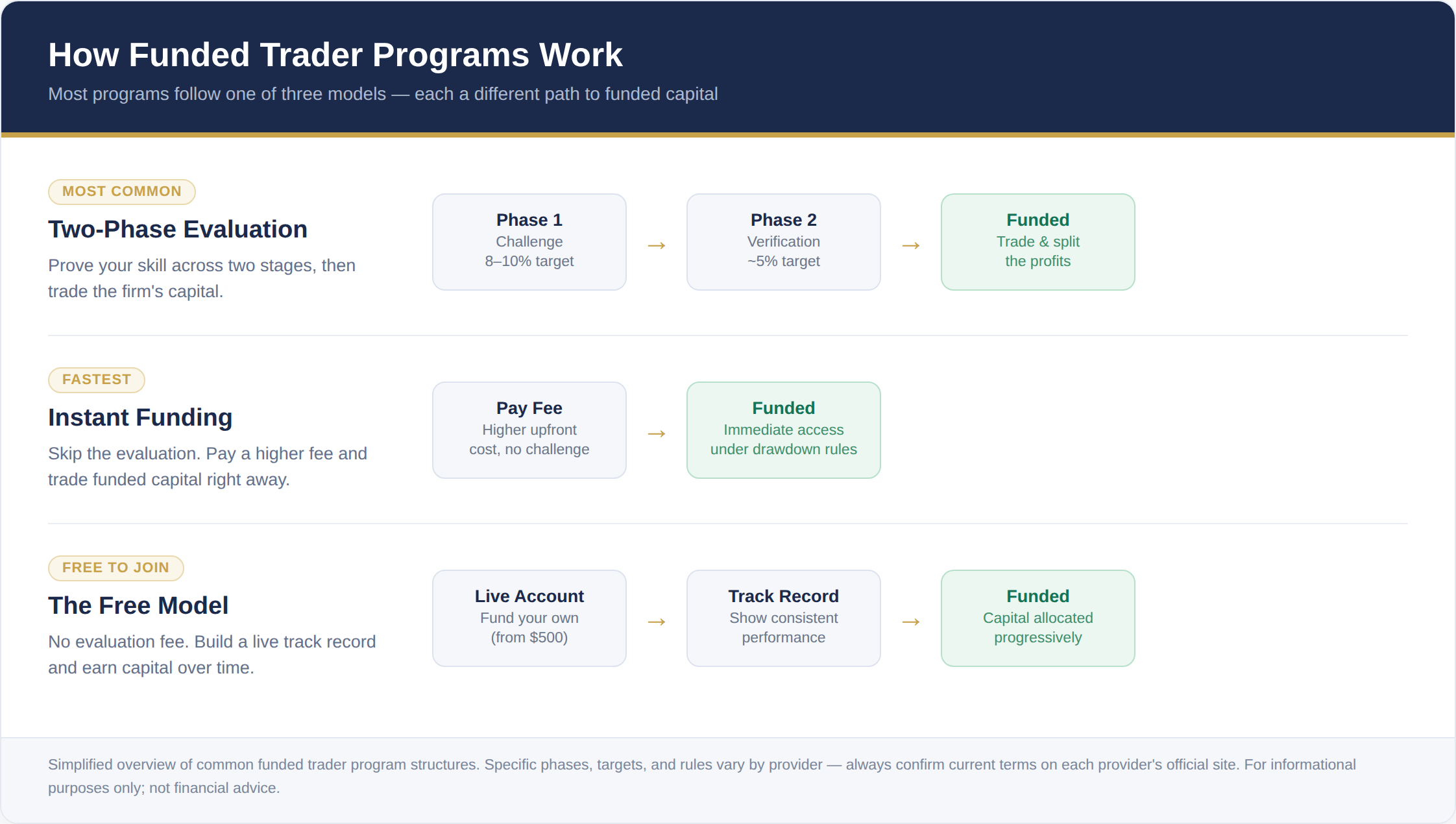
The Two-Phase Evaluation Model
This is the most common structure across forex and CFD-focused firms:
- Phase 1 (Challenge): Hit a profit target, typically 8 to 10%, without breaching drawdown limits.
- Phase 2 (Verification): Repeat at a lower target, typically 5%, to confirm consistency over time.
- Funded Account: Trade live or simulated capital, split profits per the agreed percentage.
The evaluation fee varies by account size. A $100,000 challenge typically costs $150 to $500. You keep none of the evaluation-phase profit. Once funded, payouts begin. Most firms give you no time limit to finish either phase, so you can trade at your own pace. Most also require you to trade on a minimum number of days, often around four per phase, so you cannot pass in a single lucky session. At FTMO, for example, both phases use a 5% daily loss limit and a 10% overall loss limit, and the challenge fee is refunded with your first payout once you pass.
The Instant Funding Model
Some firms skip the lengthy evaluation entirely. You pay a higher upfront fee and receive a funded account immediately, subject to ongoing drawdown rules and no traditional challenge phase. The trade-off is that these accounts usually cost more than a standard challenge of the same size and come with tighter risk rules, since the firm has not watched you trade before handing over capital. Instant accounts also often use a trailing drawdown, a loss limit that follows your balance up as you profit, which can be harder to manage than a fixed one.
The Free Model
Axi Select is the only program on this list with no evaluation fee. You open a live brokerage account, demonstrate performance over time, and Axi progressively allocates funded capital to you. No challenge purchase, no upfront cost. The catch is that you fund your own account to start, a minimum of $500 of your own money, and that stays yours to trade or withdraw, minus any losses. Your profit share starts around 40% at the entry stage and climbs toward 80% as you move up, and payouts are monthly rather than weekly, so cash flow is slower than paid programs that fund you in 30 to 60 days.
Free vs Paid Funded Programs
The emergence of broker-backed free programs is the biggest structural shift in this space since 2023.
Axi Select changed the entry calculus entirely. There is no evaluation fee to lose. You start trading on a live account, and capital allocation grows with your track record. The trade-off is a lower starting profit split (25%, scaling toward 80%) and a longer path to large capital. The one cost to know is that you fund your own account to begin, with a minimum of $500, and that money stays yours to trade or withdraw. Axi is a regulated broker (FCA and ASIC), so the capital comes from an established company rather than an unknown firm.
Asia Forex Mentor has watched traders spend thousands of dollars on repeated challenge resets chasing programs with 90% splits. For many of those traders, starting with a free program to build documented performance would have been the smarter path. The split matters less than getting funded consistently and building a track record. A trader who fails three $500 challenges chasing a high split has spent $1,500 and has nothing to show for it. A free program costs nothing to attempt, so the only thing at risk is time.
Paid programs offer more flexibility on instruments, platforms, trading styles, and profit targets. They are the faster path to a large funded account for traders who already have a consistent strategy and can pass a structured evaluation in 30 to 60 days. Most paid firms also refund your evaluation fee once you reach your first payout, so a challenge you pass effectively costs nothing in the end. The risk is only real if you fail, that is when the fee is lost.
The right choice comes down to your situation:
- Capital is tight, risk tolerance is low: Start with Axi Select. Zero financial exposure.
- You have a tested strategy and want fast capital: Choose a paid two-phase program. FTMO or Apex depending on your instrument.
- You want instant access without a long evaluation: Look at instant-funded models (The 5ers Hyper or FundingPips).
How to Choose the Right Program
Not every funded trading program suits every trader. These six factors are what actually matter.
Weigh each of these before paying for any challenge. A program can look attractive on the headline split or funding amount and still cost a trader money if the drawdown rules, scaling limits, or platform quietly work against their strategy. Read every point below against how you actually trade.
- Payout track record: Find verified payout proof from real traders on independent forums, not firm-produced screenshots. Third-party confirmation is the only reliable signal.
- Drawdown rules: Is drawdown calculated on balance (static) or equity (trailing)? Trailing drawdown is significantly harder to manage and eliminates many traders early. Know which one you are agreeing to before purchasing.
- Profit split: Base splits range from 25% to 100%. Check whether the advertised split applies from day one or only after hitting a scaling threshold.
- Instruments and trading style: Futures programs restrict you to futures. Forex programs cover pairs, indices, and commodities. Confirm crypto or stock availability if your strategy requires it. Confirm EA and algorithmic trading permissions if you run automated systems.
- Scaling plan: Can you grow beyond the initial funded amount? The best programs scale to $400,000 or more based on performance. A program with a hard ceiling at $25,000 limits long-term upside significantly.
- Platform and execution: MT4, MT5, or proprietary? Simulated or live market? This affects execution quality and strategy compatibility, particularly for EAs and scalping strategies.
The AFM system that our students across 50+ countries use is built on high-probability setups with defined risk rules. Those same principles are what funded program evaluations test. If you can read the market like a story, identify high-probability entries, and apply consistent position sizing, passing any structured evaluation becomes a process, not a gamble. See how the AFM framework builds funded-ready traders.
The 12 Best Funded Trader Programs in 2026
Comparison Table
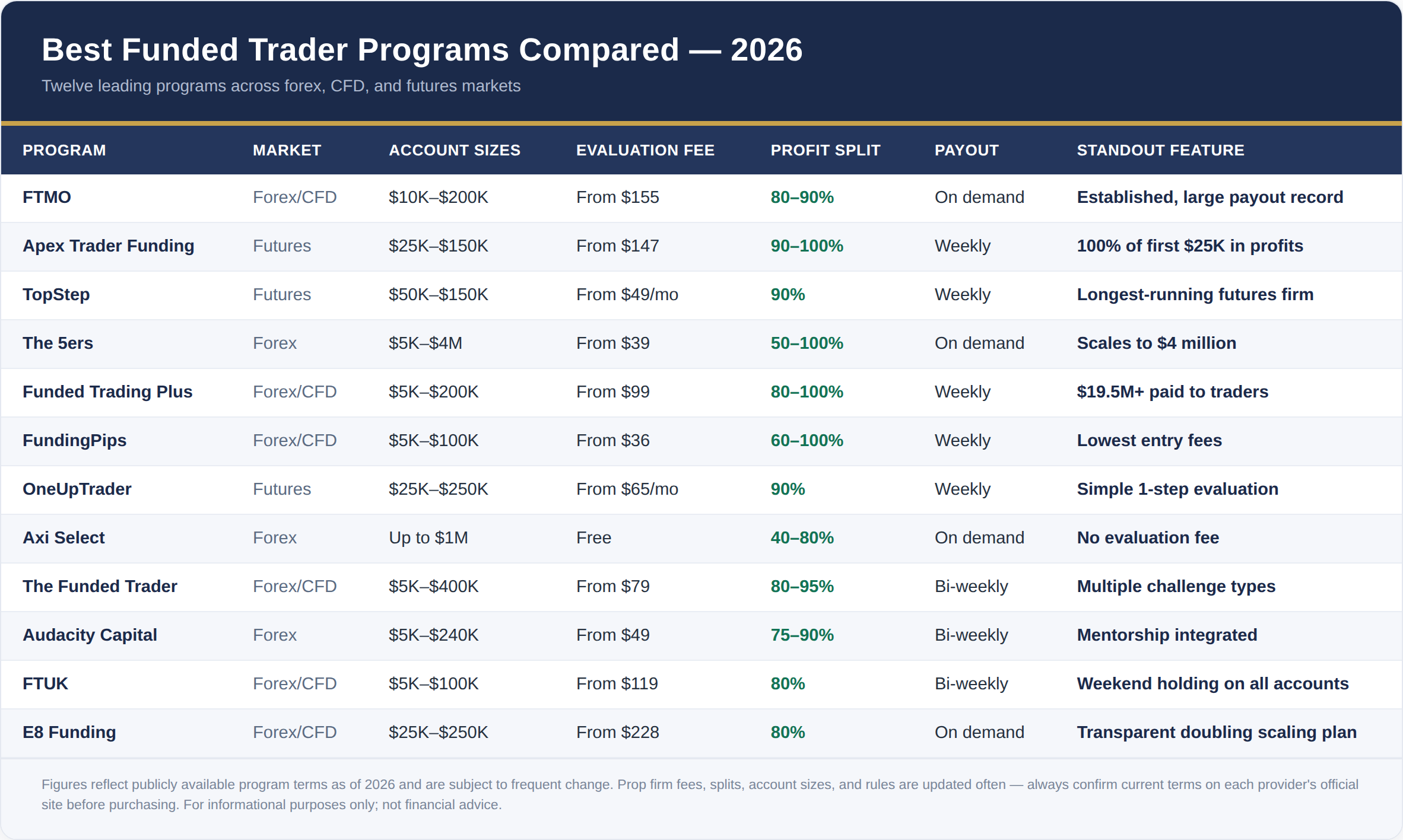
Fees and terms change frequently. Verify current details directly with each provider before purchasing any evaluation.*
1. FTMO
FTMO is the most established funded trading firm in the forex and CFD space, founded in Prague in 2015. It has paid out more than $300 million to funded traders since launch and remains the benchmark against which every other firm is measured.
The FTMO Challenge uses a two-phase evaluation. Phase 1 requires a 10% profit target with a 5% daily and 10% overall drawdown limit. Phase 2 requires 5% profit with the same drawdown limits. Standard account sizes run from $10,000 to $200,000.
- Evaluation fee: $155 (10K) to $1,080 (200K)
- Profit split: 80% base, scalable to 90%
- Payout frequency: On demand, with a minimum of one payout cycle per month
Advantages and Disadvantages of FTMO
 Advantages
 Disadvantages
FTMO suits traders with a consistent forex or CFD strategy who want the most credible firm name behind their funded account. The 90% scaling plan is straightforward and rewards long-term performance without hidden conditions.
2. Apex Trader Funding
Apex Trader Funding is the most popular futures-focused funded trading program by active trader volume, launched in 2021. It moved from monthly billing to one-time evaluation fees in its 2026 overhaul, with frequent promotional discounts.
Account sizes range from $25,000 to $150,000. The profit split is 90% on the first $25,000 earned per funded account, then 100% thereafter.
- Monthly fee: From about $147 (one-time, frequently discounted)
- Profit split: 90% initially, 100% after first $25K earned
- Payout frequency: Weekly
The evaluation structure is simpler than most. You hit a profit target, stay within the trailing drawdown limit, and pass consistency rules. There is no daily drawdown limit during the evaluation phase, a significant advantage for traders with higher-variance strategies.
Advantages and Disadvantages of Apex Trader Funding
Apex suits futures traders who need daily flexibility and want to scale multiple funded accounts simultaneously.
3. TopStep
TopStep is the oldest funded futures trading firm, running for over a decade. Its one of the longest-running funded futures firms track record and consistent compliance history make it the most conservative and trusted option in the futures space.
TopStep offers two account sizes: $50,000 and $150,000. The profit split starts at 90% and reaches 100% after the first $10,000 is earned, at which point traders keep all subsequent profits.
- Monthly fee: $49 (50K) to $149 (150K)
- Profit split: 90% (accounts opened before January 2026 keep 100% of the first $10,000, then 90%)
- Payout frequency: Weekly
The evaluation uses a Trading Combine model, typically 30 to 90 days of simulated futures trading before funding. The process is rigorous but fair.
Advantages and Disadvantages of TopStep
TopStep is the right choice for futures traders who prioritize stability and reputation over speed. If you want the safest firm in the futures space, this is it.
4. The 5ers
The 5ers launched in 2016 with an unusual model: a small live-funded account from day one, with a defined path to scale all the way to $4 million in allocated capital. No other program on this list offers that scaling ceiling.
The Hyper program gives you a $5,000 or $10,000 live-funded account immediately after payment, no challenge phase, no evaluation period. You trade live capital from the start, which changes the psychology of the evaluation entirely.
- Evaluation fee: From $95 (Bootcamp) to $470 (100K challenge)
- Profit split: Starts at 50%, scales to 100%
- Payout frequency: On demand
Advantages and Disadvantages of The 5ers
The 5ers suits forex traders with a long-term mindset who want to build toward institutional-level capital rather than front-load a large account immediately.
5. Funded Trading Plus
Funded Trading Plus (FT+) has paid over $19.5 million in real trader rewards across more than 60,000 traders. That verifiable payout record, on a relatively modest fee structure, makes it one of the stronger mid-tier programs available.
Two evaluation paths exist: a standard two-phase challenge and a more aggressive one-phase option with a higher profit target. Account sizes run from $5,000 to $200,000.
- Evaluation fee: From $99 (5K) to $999 (200K)
- Profit split: 80 to 90%
- Payout frequency: Weekly
Advantages and Disadvantages of Funded Trading Plus
Funded Trading Plus works best for traders who want fast, reliable payouts and can verify a strong community payout track record before committing.
6. FundingPips
FundingPips has grown quickly through competitive pricing and an instant funding option. Its 100% profit split, available on certain account types after meeting performance conditions, is a differentiator no established competitor consistently matches.
- Evaluation fee: From $49 to $799 depending on account size
- Profit split: 60% to 100% depending on payout frequency chosen
- Payout frequency: Weekly
The lowest entry fee for small accounts ($49 for a $5,000 challenge) makes FundingPips the most accessible option for traders testing a new strategy with limited capital.
Advantages and Disadvantages of FundingPips
FundingPips suits traders who want to maximize their profit share and are comfortable with a newer firm, or those who want instant funding access at the lowest possible upfront cost.
7. OneUpTrader
OneUpTrader simplifies the futures evaluation to a single step. Hit one profit target, stay within the drawdown limit, and get funded. No verification phase, no second challenge.
Account sizes range from $25,000 to $250,000. The 90% profit split applies from the first payout without requiring a threshold to be reached first.
- Monthly fee: From about $65/mo
- Profit split: 90% from day one of funding
- Payout frequency: Weekly
The 1-step model is the core differentiator. OneUpTrader also allows multiple active funded accounts simultaneously, which appeals to traders who want to deploy capital across more than one strategy.
Advantages and Disadvantages of OneUpTrader
OneUpTrader suits futures traders with a clear, tested strategy who want to get funded as quickly as possible and skip the two-phase cycle entirely.
8. Axi Select
Axi Select is a broker-backed funded trader program with no evaluation fee, no challenge purchase, and no upfront cost. It is the only genuinely free option on this list.
Axi is a globally regulated broker (FCA, ASIC regulated) that allocates its own capital to traders who demonstrate consistent performance on a live account. Funding scales from a small starting allocation up to $1,000,000 for top performers.
- Evaluation Fee: Zero
- Profit split: 40% initially, scaling toward 80%
- Payout frequency: Monthly
The model works differently from traditional programs. You open a live Axi account, deposit a small amount to confirm commitment, and trade your own strategy normally. Axi monitors performance metrics and increases your allocated capital at defined milestones.
Advantages and Disadvantages of Axi Select
Axi Select is the right starting point for traders who want to demonstrate performance with zero financial exposure, or those who are validating a new strategy before committing evaluation fees elsewhere.
9. The Funded Trader
The Funded Trader (TFT) offers three distinct challenge types — a Royal Challenge (2-phase), a Knight Challenge (1-phase), and a Rapid Challenge (higher target, lower fee). This flexibility lets traders choose the evaluation that fits their trading style rather than adapting to a single rigid model.
All accounts use simulated execution with real market quotes from liquidity providers. Account sizes run from $5,000 to $400,000.
- Evaluation fee: From $79 (5K) to $999 (200K)
- Profit split: 80% to 95%
- Payout frequency: Bi-weekly
Advantages and Disadvantages of Axi Select
The Funded Trader suits traders who want flexibility in how they take the evaluation rather than being locked into a single fixed model.
10. Audacity Capital
Audacity Capital is a London-based funded trading firm that integrates trader mentorship into the funding pathway. The Ability Challenge bypasses the standard evaluation model, you join a structured training program and receive a live funded account allocation upon completing it.
Account sizes range from $5,000 to $240,000. The firm’s UK base adds a layer of corporate transparency unusual in this industry.
- Entry cost: From $49
- Profit split: 75% to 90%
- Payout frequency: Bi-weekly
Advantages and Disadvantages of Audacity Capital
Audacity Capital works well for developing traders who want structure, mentorship, and capital access combined into one program.
11. FTUK
FTUK is a UK-based forex and CFD funded trading firm with one meaningful differentiator: weekend holding is permitted on all account types. For swing traders who need to hold positions across Friday close, this removes a significant restriction that eliminates them from most programs.
Standard evaluation follows a two-phase model (10% then 5% profit targets) with 5% daily and 10% maximum drawdown limits. Account sizes run from $5,000 to $100,000.
- Evaluation fee: From about $119
- Profit split: 80%
- Payout frequency: Bi-weekly
Advantages and Disadvantages of FTUK
FTUK suits swing-strategy forex traders, particularly those based in the UK or Europe, who need weekend holding and want a firm with a verifiable European registration.
12. E8 Funding
E8 Funding offers a transparent, rules-based scaling plan: your account doubles when you hit 10% profit and withdraw at least 10%. That clear trigger distinguishes it from firms with vague or discretionary scaling decisions.
Account sizes range from $25,000 to $250,000. E8 supports MT4 and MT5, allows algorithmic and copy trading, and imposes no overnight or weekend holding restrictions on most account types.
- Evaluation fee: From $228 (25K) to $1,048 (250K)
- Profit split: 80% base
- Payout frequency: On demand
Advantages and Disadvantages of E8 Funding
E8 Funding suits systematic and algorithmic traders who want a firm with clear, consistent scaling rules and no restrictions on trading methodology.
How We Selected These Programs
Every program on this list was evaluated against five criteria. Each one targets a specific way that funded trading programs either earn trust or quietly work against the trader, and a program had to hold up across all five to make the list.
- Payout legitimacy: We required verifiable evidence of consistent payouts, third-party confirmation and independent trader community records, not company-produced marketing claims.
- Rule fairness: Drawdown rules must be realistic for the strategy types the firm accepts. A trailing drawdown set too tight relative to the profit target is a structural trap. Firms designed to make passing difficult rather than to identify skilled traders were excluded.
- Transparency: The firm must clearly document its fee structures, refund policies, and funded account conditions, so understanding them does not require a deep read of a buried terms-of-service.
- Operational history: Firms with less than 12 months of verifiable operations carry higher risk of closure. Programs with two or more years of clean operations scored higher in this review.
- Value for money: The evaluation fee relative to account size and profit split determines whether the economics make sense. Some programs charge $1,000 for an 80% split on a $25,000 account, that math rarely works in the trader’s favor.
We excluded firms with verified reports of delayed or cancelled payouts without clear resolution, firms that changed trading rules after funding accounts, or firms with opaque ownership structures and no traceable corporate registration.
Most retail traders fail funded evaluations not because they cannot trade, but because they enter the wrong program for their strategy type. A scalper choosing a firm with a news-event restriction will fail at the first data release. A swing trader who chooses a firm that does not allow weekend holding will have to close good positions early. Match the program to the strategy before you purchase.</p&gt;</p>
For traders who want to build the underlying system before attempting any evaluation, the AFM One Core Program teaches the same high-probability framework that has helped students in over 50 countries develop consistent, rule-based trading, rated the “Most Comprehensive Course” by Investopedia and “Best Forex Trading Course” by Benzi
nga. Watch the free webinar to see the framework in action.
Also Read: The 10 Best Forex Brokers in 2026</a
>
Conclusion
The best funded trader programs in 2026 give skilled traders access to real capital without requiring them to risk their own. The right program depends on what you trade, how much you can commit to evaluation, and how quickly you need to be funded.
For forex and CFD traders, FTMO remains the gold standard. For futures, Apex Trader Funding and TopStep are the two most credible options with the longest track records. If the evaluation fee is the barrier, Axi Select removes it entirely. If you want the fastest path to a funded account, the 1-step models at OneUpTrader or FundingPips get you there fastest.</p></p>
The programs that pay out consistently reward one thing above all: a defined, repeatable trading proc
ess. That is what separates traders who pass once and lose the account from traders who pass, withdraw, and scale.</p>
Asia Forex Mentor has helped 100,000+ students across 50+ countries build that kind of process, the same framework that passes evaluations and holds funded accounts long-term. Join the free webinar to see the AFM system.
Frequently Asked Questions
What Is the Best Funded Trader Program in 2026?
The best funded trader program depends on what you trade. FTMO is the top choice for forex and CFD traders based on its payout track record, platform support, and 80 to 90% profit split. For futures traders, Apex Trader Funding and TopStep are the strongest options by track record and trader volume. If you want to start with no upfront cost, Axi Select is the only free option that offers up to $1 million in funded capital.</p>
How Much Does a Funded Trader Program Cost?
Evaluation fees range from zero (Axi Select) to over $1,000 for large account challenges at FTMO or E8 Funding. A standard $100,000 forex challenge costs approximately $150 to $500. Most firms refund the evaluation fee on your first successful funded payout. Monthly-fee models (Apex, TopStep, OneUpTrader) cost $50 to $657 per month and continue until you pass the evaluation.</p>
Are Funded Trader Programs Legitimate?
The established programs on this list are legitimate. FTMO has published payout records exceeding $300 million. Funded Trading Plus has paid out over $19.5 million. Axi Select is backed by a fully regulated broker. The industry also has a large number of firms with poor or non-existent payout histories. Always verify payout evidence from independent trader communities before purchasing any evaluation, not from firm-produced testimonials.</p>
Do Funded Trading Programs Pay Out Real Money?
Established programs pay out real money. FTMO has published payout records exceeding $300 million since 2015. Funded Trading Plus has documented over $19.5 million in payouts across 60,000+ traders. Axi Select payouts flow through Axi, a regulated broker. Some smaller or newer firms pay through simulated profit-sharing arrangements, always confirm whether the funded account trades live markets or a simulation before purchasing.</p>
Is There a Free Funded Trader Program?
Yes. Axi Select is the only genuinely free funded trader program on this list. There is no evaluation fee, no challenge cost, and no upfront payment. Axi allocates funded capital progressively as you demonstrate performance on a live trading account. The trade-off is a lower starting profit split (25%) and a longer path to large capital compared to paid challenge programs that fund you in 30 to 60 days.</p>