
Learn To Trade Forex • Best Forex Trading Course • AsiaForexMentor

Japanese Stocks Face Pressure Amid Yen Surge

Written by

Ezekiel Chew

Updated on

September 10, 2024

i
Its a default text

Japanese Stocks Face Pressure Amid Yen Surge

Written by:

Last updated on:

September 10, 2024

Yen’s Rise Spurs Reversal of Currency Hedges

The recent strengthening of the yen has led global investors to scale back exchange-rate hedges on Japanese stocks, as they no longer expect a sharp decline in the Japanese currency. Strategists at JPMorgan Chase & Co., UBS Group AG, and BNP Paribas Asset Management have advised unwinding these currency hedges, particularly on Japanese equities that have outperformed other regional markets, to potentially enhance returns in dollar terms.

Wei Li, a multi-asset quant solutions portfolio manager at BNP Paribas Asset Management, noted, “Investing in Japanese stocks without hedging the currency exposure allows for higher returns in dollar terms if the yen continues to appreciate.”

Hedging Adjustments Reflect New Yen Outlook

This shift reflects a broader change in sentiment towards the yen following the Bank of Japan’s decision to raise interest rates in July. The stronger currency suggests a healthier Japanese economy but poses a challenge for foreign investors, making equities more expensive and potentially impacting exporters' earnings.

UBS strategist Nozomi Moriya now favors investing in Japan without hedging against a weaker yen, after the firm revised its year-end forecast for the yen to 145 against the dollar, up from 160. Despite this, UBS has downgraded Japanese stocks to underweight in local-currency terms due to the risks the stronger yen presents to earnings forecasts.

Japanese Stocks Outperform, But Caution Remains
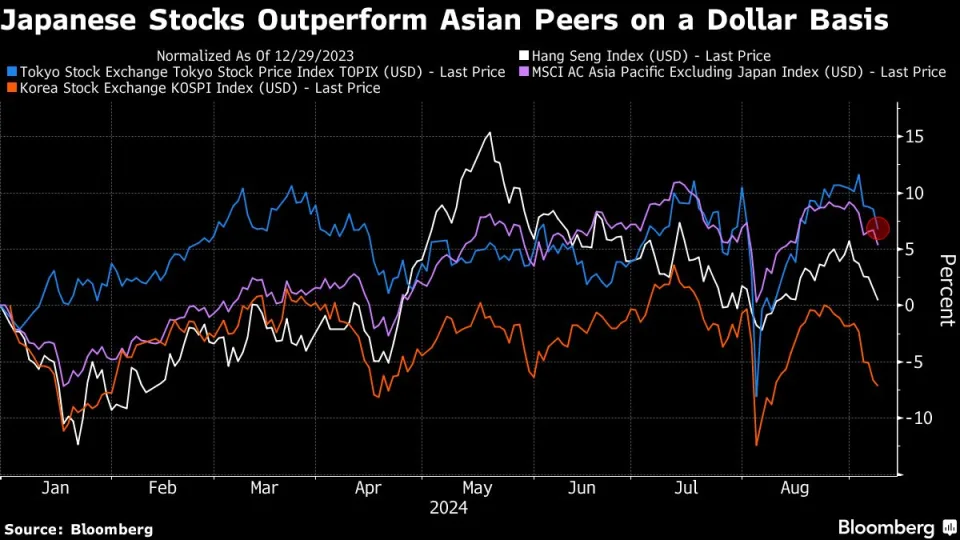
Asian Stocks Performance Comparison from January to August 2024 (Source: Bloomberg)

In dollar terms, the Topix has rebounded from its August 5 decline and hit a three-year high last week, although it has since retraced some gains amid concerns over global economic slowdown. The Topix’s year-to-date growth of 7.1% outperforms the MSCI AC Asia Pacific Excluding Japan Index's 5.4% rise, as well as the Hang Seng Index and South Korean Kospi.

Traditionally, many long-term investors avoid hedging their foreign stock investments against currency movements. However, the yen's consistent weakness in recent years led to the popularity of such hedging strategies, exemplified by the WisdomTree Japan Hedged Equity ETF’s size tripling over 2023. Yet, as the yen gained strength, this ETF experienced an outflow of $897 million since August, while the unhedged JPMorgan BetaBuilders Japan ETF saw an inflow of $687 million in the same period.

Focus Shifts from Yen to Other Earnings Drivers

Not all analysts view the yen’s movement as the primary factor influencing earnings. Masashi Akutsu, chief Japan equity strategist at Bank of America Securities, believes that Japanese earnings growth is now more influenced by a company's ability to raise prices in an inflationary environment than by the yen's weakness.

Still, the risk of a rapidly strengthening yen impacting corporate earnings remains a concern, leading some analysts to adopt a more cautious stance when selecting stocks. Charu Chanana, a strategist at Saxo Markets, emphasized the need to be selective in Japanese equities, focusing on long-term themes like corporate governance reforms and geopolitical plays. She added, “The short-term risk-reward is tilted towards a stronger yen and weaker Japanese equities in the current market environment.”


About Ezekiel Chew​

Ezekiel Chew, founder and head of training at Asia Forex Mentor, is a renowned forex expert, frequently invited to speak at major industry events. Known for his deep market insights, Ezekiel is one of the top traders committed to supporting the trading community. Making six figures per trade, he also trains traders working in banks, fund management, and prop trading firms.

Forex Trade Update After a 950% Crazy Growth Month

Imagine a single forex trade changing how you see on the foreign exchange market. Many retail traders dive into a forex trading account with high hopes but quickly encounter challenges. The constant price changes of major currency pairs, like EUR USD or the Japanese yen, create chances and challenges. As

Read More

Understanding Monad in Crypto: A New Chapter of Blockchain Innovation

As blockchain technology continues to evolve, new concepts and frameworks appear, targeting the traditional challenges of blockchain scalability, decentralization, and transaction efficiency. One such concept rising in interest in the cryptocurrency market is Monad. But what exactly is Monad as related to crypto? Let’s take a look at how Monad

Read More

FXCentrum Review 2026 – REAL Traders Report

            OPEN AN ACCOUNT             FXCentrum Review FXCentrum (FXC) is an online broker that offers 2,200 trading instruments, these includes Forex, stocks, indices, commodities, metals, cryptocurrencies, and CFDs. Traders can use the Trader platform of FXCentrum, available for both desktop and

Read More

LeoPrime Review 2026 – REAL Traders Report

            OPEN AN ACCOUNT             LeoPrime Review LeoPrime is an online forex and CFD broker regulated by the Financial Services Authority (FSA) of Seychelles. They offer several different account types, these include STP, ECN, and cent accounts, along with market execution,

Read More

EBC Financial Group Review 2026 – REAL Traders Report

            OPEN AN ACCOUNT             EBC Financial Group Review EBC Financial Group is an online trading broker offering access to over 200 global assets, including forex, U.S. stocks, indices, ETFs, cryptocurrencies, precious metals, and energies. With leverage up to 1:500 and

Read More

GFF Brokers Review 2026 – REAL Traders Report

              OPEN AN ACCOUNT             GFF Brokers Review Choosing a trustworthy broker is essential for long-term trading success. The broker must ensure transparent pricing, stable platforms, and secure fund management, minimizing risks from poor execution or system failures. While many

Read More

AFM Trading Summit Live

Date: Coming Soon

Join us at the AFM Trading Summit Live and learn from top industry experts through live trading sessions, market insights, and actionable strategies.

Japanese Stocks Face Pressure Amid Yen Surge

4.0
Overall Trust Index

Written by:

Updated:

September 10, 2024

Yen’s Rise Spurs Reversal of Currency Hedges

The recent strengthening of the yen has led global investors to scale back exchange-rate hedges on Japanese stocks, as they no longer expect a sharp decline in the Japanese currency. Strategists at JPMorgan Chase & Co., UBS Group AG, and BNP Paribas Asset Management have advised unwinding these currency hedges, particularly on Japanese equities that have outperformed other regional markets, to potentially enhance returns in dollar terms. Wei Li, a multi-asset quant solutions portfolio manager at BNP Paribas Asset Management, noted, "Investing in Japanese stocks without hedging the currency exposure allows for higher returns in dollar terms if the yen continues to appreciate."

Hedging Adjustments Reflect New Yen Outlook

This shift reflects a broader change in sentiment towards the yen following the Bank of Japan’s decision to raise interest rates in July. The stronger currency suggests a healthier Japanese economy but poses a challenge for foreign investors, making equities more expensive and potentially impacting exporters' earnings. UBS strategist Nozomi Moriya now favors investing in Japan without hedging against a weaker yen, after the firm revised its year-end forecast for the yen to 145 against the dollar, up from 160. Despite this, UBS has downgraded Japanese stocks to underweight in local-currency terms due to the risks the stronger yen presents to earnings forecasts.

Japanese Stocks Outperform, But Caution Remains

Asian Stocks Performance Comparison from January to August 2024 (Source: Bloomberg)
In dollar terms, the Topix has rebounded from its August 5 decline and hit a three-year high last week, although it has since retraced some gains amid concerns over global economic slowdown. The Topix’s year-to-date growth of 7.1% outperforms the MSCI AC Asia Pacific Excluding Japan Index's 5.4% rise, as well as the Hang Seng Index and South Korean Kospi. Traditionally, many long-term investors avoid hedging their foreign stock investments against currency movements. However, the yen's consistent weakness in recent years led to the popularity of such hedging strategies, exemplified by the WisdomTree Japan Hedged Equity ETF’s size tripling over 2023. Yet, as the yen gained strength, this ETF experienced an outflow of $897 million since August, while the unhedged JPMorgan BetaBuilders Japan ETF saw an inflow of $687 million in the same period.

Focus Shifts from Yen to Other Earnings Drivers

Not all analysts view the yen’s movement as the primary factor influencing earnings. Masashi Akutsu, chief Japan equity strategist at Bank of America Securities, believes that Japanese earnings growth is now more influenced by a company's ability to raise prices in an inflationary environment than by the yen's weakness. Still, the risk of a rapidly strengthening yen impacting corporate earnings remains a concern, leading some analysts to adopt a more cautious stance when selecting stocks. Charu Chanana, a strategist at Saxo Markets, emphasized the need to be selective in Japanese equities, focusing on long-term themes like corporate governance reforms and geopolitical plays. She added, "The short-term risk-reward is tilted towards a stronger yen and weaker Japanese equities in the current market environment."
ezekiel chew asiaforexmentor

About Ezekiel Chew

Ezekiel Chew, founder and head of training at Asia Forex Mentor, is a renowned forex expert, frequently invited to speak at major industry events. Known for his deep market insights, Ezekiel is one of the top traders committed to supporting the trading community. Making six figures per trade, he also trains traders working in banks, fund management, and prop trading firms.

RELATED ARTICLES

Japanese Stocks Face Pressure Amid Yen Surge

4.0
Overall Trust Index

Written by:

Updated:

September 10, 2024

Yen’s Rise Spurs Reversal of Currency Hedges

The recent strengthening of the yen has led global investors to scale back exchange-rate hedges on Japanese stocks, as they no longer expect a sharp decline in the Japanese currency. Strategists at JPMorgan Chase & Co., UBS Group AG, and BNP Paribas Asset Management have advised unwinding these currency hedges, particularly on Japanese equities that have outperformed other regional markets, to potentially enhance returns in dollar terms. Wei Li, a multi-asset quant solutions portfolio manager at BNP Paribas Asset Management, noted, "Investing in Japanese stocks without hedging the currency exposure allows for higher returns in dollar terms if the yen continues to appreciate."

Hedging Adjustments Reflect New Yen Outlook

This shift reflects a broader change in sentiment towards the yen following the Bank of Japan’s decision to raise interest rates in July. The stronger currency suggests a healthier Japanese economy but poses a challenge for foreign investors, making equities more expensive and potentially impacting exporters' earnings. UBS strategist Nozomi Moriya now favors investing in Japan without hedging against a weaker yen, after the firm revised its year-end forecast for the yen to 145 against the dollar, up from 160. Despite this, UBS has downgraded Japanese stocks to underweight in local-currency terms due to the risks the stronger yen presents to earnings forecasts.

Japanese Stocks Outperform, But Caution Remains

Asian Stocks Performance Comparison from January to August 2024 (Source: Bloomberg)
In dollar terms, the Topix has rebounded from its August 5 decline and hit a three-year high last week, although it has since retraced some gains amid concerns over global economic slowdown. The Topix’s year-to-date growth of 7.1% outperforms the MSCI AC Asia Pacific Excluding Japan Index's 5.4% rise, as well as the Hang Seng Index and South Korean Kospi. Traditionally, many long-term investors avoid hedging their foreign stock investments against currency movements. However, the yen's consistent weakness in recent years led to the popularity of such hedging strategies, exemplified by the WisdomTree Japan Hedged Equity ETF’s size tripling over 2023. Yet, as the yen gained strength, this ETF experienced an outflow of $897 million since August, while the unhedged JPMorgan BetaBuilders Japan ETF saw an inflow of $687 million in the same period.

Focus Shifts from Yen to Other Earnings Drivers

Not all analysts view the yen’s movement as the primary factor influencing earnings. Masashi Akutsu, chief Japan equity strategist at Bank of America Securities, believes that Japanese earnings growth is now more influenced by a company's ability to raise prices in an inflationary environment than by the yen's weakness. Still, the risk of a rapidly strengthening yen impacting corporate earnings remains a concern, leading some analysts to adopt a more cautious stance when selecting stocks. Charu Chanana, a strategist at Saxo Markets, emphasized the need to be selective in Japanese equities, focusing on long-term themes like corporate governance reforms and geopolitical plays. She added, "The short-term risk-reward is tilted towards a stronger yen and weaker Japanese equities in the current market environment."
ezekiel chew asiaforexmentor

About Ezekiel Chew

Ezekiel Chew, founder and head of training at Asia Forex Mentor, is a renowned forex expert, frequently invited to speak at major industry events. Known for his deep market insights, Ezekiel is one of the top traders committed to supporting the trading community. Making six figures per trade, he also trains traders working in banks, fund management, and prop trading firms.

RELATED ARTICLES

I consent to receiving emails and/or text message reminders for this event.

REGISTER FOR THE MASTERCLASS!