
Market structure trading stops working the moment traders ignore location and timing. Clean analysis on the wrong side of a level produces the same outcome every time. The move starts without you, and the chart tells you exactly why, after the fact.
|
ABOUT THIS GUIDE |
This guide covers three approaches to reading market structure in forex. It explains how to time pullback entries using the support and resistance flip, how to track dynamic structure using trend lines and moving averages, and how to identify market phase using the Wyckoff cycle. Each method stands on its own, and all three combine into a complete trading framework. |
|
QUICK ANSWER |
Market structure trading means reading trends, pullbacks, and market phases to find high-probability entries. The three core tools are the support and resistance flip for timing pullbacks, dynamic structure tools including trend lines and the 8/21 SMA for continuation setups, and the Wyckoff cycle for identifying accumulation, markup, distribution, and markdown phases before they complete. |
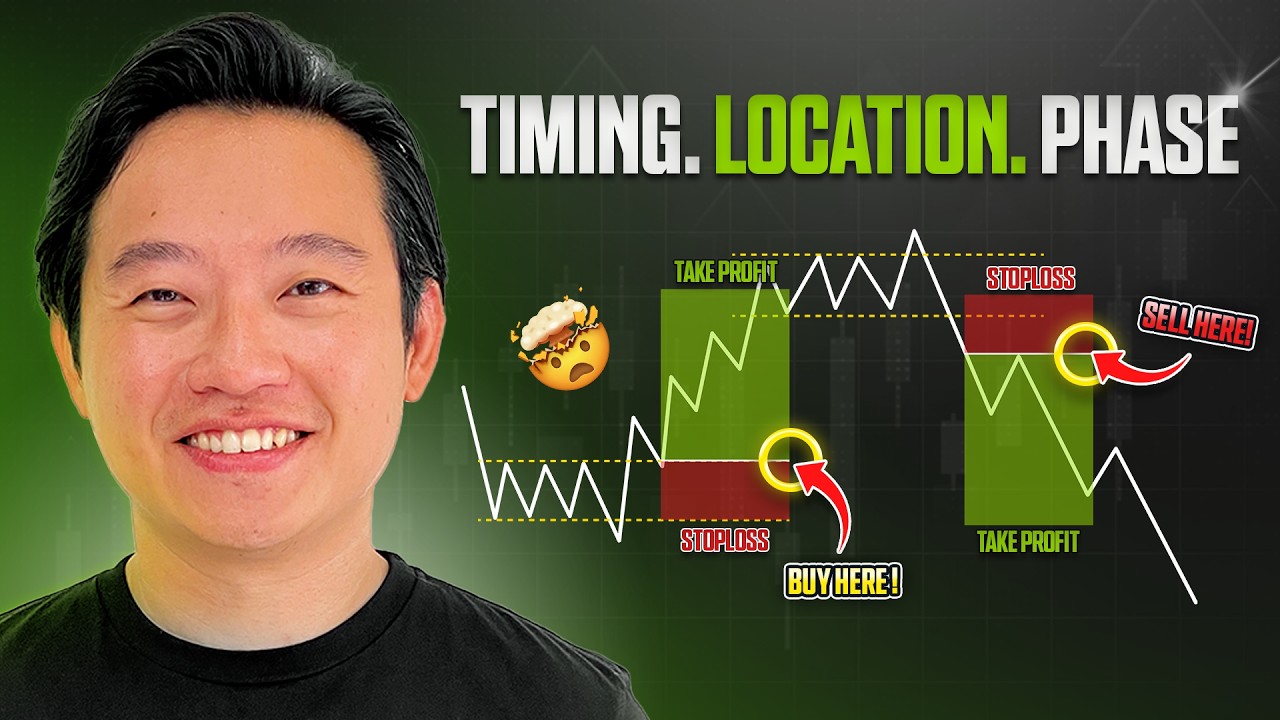
🎥 Watch the full method explained on video:
Key Takeaways
- The support and resistance flip turns a broken level into a low-risk re-entry zone for trend continuation.
- Trend lines and the 8/21 SMA provide dynamic pullback zones when price will not return to a fixed level.
- The Wyckoff cycle reveals what a ranging market means, whether it is building a base or setting a trap.
- A spring (false break below support) often signals the end of accumulation before markup begins.
- Matching the right structure tool to market behavior removes the need to force setups that are not there.
- Location and phase matter more than the entry pattern itself.
The Support and Resistance Flip Pullback Entry
The support and resistance flip is one of the cleanest pullback entry frameworks in market structure trading. It applies in trending markets where price has broken through a clear level with conviction.
When price breaks resistance in an uptrend, the breakout candle is not the entry. The real opportunity appears during the pullback. That broken resistance becomes the zone to watch closely. The market is testing whether buyers are willing to defend the area that was previously a ceiling.
If price returns to the broken level and holds, the structure confirms that old resistance has flipped into support. That confirmation is the signal, not the break itself. Entering on the breakout candle is chasing. Waiting for the flip defense is reading.
The Three-Step Pullback Entry Sequence
Here are the three steps that define a valid support and resistance flip entry:
- Price breaks resistance with conviction. The candle closes clearly above the level, not just piercing and rejecting.
- Price pulls back to the broken zone. The retracement returns to the area without overshooting it by a wide margin.
- Price rejects from that zone. A rejection candle confirms that buyers are defending the former resistance level.
The rejection candle is the confirmation. It signals that the pullback is ending and the next impulsive leg is starting. Retail traders often enter at Step 1 and get caught in the retest. High-probability continuation entries happen at Step 3, where the majority is already wrong and out.
How the Framework Inverts in a Downtrend
The same logic applies in a downtrend but in reverse. When support breaks, that broken support becomes resistance. Price pulls back into the zone from below. If it then rejects downward, the bearish continuation is resuming.
Many traders mistake this retest for a reversal. It is not. The trend is resetting before the next leg lower. Waiting for the rejection candle at the flipped level keeps traders aligned with the trend instead of fighting it.
Reading Dynamic Structure with Trend Lines and Moving Averages
Not every trend pulls back neatly to a horizontal level. When horizontal levels do not apply, forcing them creates bad setups and unnecessary losses. Dynamic structure tools solve this problem.
Trend Lines as Continuation Zones
When price makes higher highs and higher lows with shallower pullbacks along a slope, the market is often respecting a trend line rather than a horizontal zone. The task shifts from finding a fixed level to connecting the higher lows and tracking whether price is using that diagonal path as support.
A valid trend line shows repeated touch-and-reject behavior. Each time price touches the slope and turns higher, the line proves its value. It works not because a diagonal line is special, but because the market keeps using that path while the trend is healthy.
In a downtrend, the equivalent tool connects the lower highs. Each time price rises into the line and turns lower, the line acts as dynamic resistance. That repeated rejection is the signal for continuation to the downside.
The 8 SMA and 21 SMA as a Moving Pullback Zone
When a trend runs smoothly, the 8-period simple moving average and 21-period simple moving average create a moving pullback zone that updates with every candle. This removes the need to redraw levels as price progresses.
The 8 SMA stays close to price and tracks short-term momentum. The 21 SMA sits further from price and marks the deeper end of the dynamic pullback zone. Together they define a band where pullbacks in a healthy trend often end.
In an uptrend with strong structure, price frequently pulls into the space between the two averages. Deeper retracements tend to reach toward the 21 SMA before reversing. When the market is still making higher highs and higher lows and price reacts from that zone, the next impulsive leg is likely beginning.
Do not anticipate the move inside the zone. Wait for price to show a reaction before entering. If price cuts through both averages without reacting, the structure is weaker than it appeared and the setup is not valid.
Matching the Tool to Market Behavior
The choice between horizontal levels, trend lines, and moving averages is not a personal preference. It is determined by how the market is actually behaving. Here is the decision framework:
- Use horizontal levels when price has been returning cleanly to fixed zones after each impulse move.
- Use trend lines when pullbacks run along a slope and price is not respecting static horizontal areas.
- Use the 8/21 SMA zone when the trend is smooth and a moving reference point tracks the pullbacks more accurately than a redrawn line.
Forcing any single tool into every market condition produces the most common structure-based trading errors.
The Wyckoff Market Cycle Explained
The Wyckoff market cycle provides a framework for identifying the phase the market is in rather than just the candle it is on. Trading the wrong phase produces losses regardless of how precise the entry is. A perfect entry on the wrong side of the cycle is still a losing trade.
The cycle has four phases: accumulation, markup, distribution, and markdown. Each phase has a distinct behavior and a distinct set of signals.
The Four Wyckoff Phases
Here is how each phase functions within the cycle:
| Phase | What Happens | What To Watch For |
|---|---|---|
| Accumulation | Price ranges sideways after a downtrend as selling pressure is absorbed. | Sideways action after a prolonged drop, decreasing volatility, potential false break below support called the spring. |
| Markup | Price trends higher with clear momentum. Higher highs and higher lows form. | Clean breakout from the range, rising structure, increasing participation from buyers. |
| Distribution | Price ranges near the top as positions are unloaded into late buyers. | Sideways action after a prolonged rally, failed breakouts above resistance, increasing rejection at highs. |
| Markdown | Price trends lower as demand fades and selling pressure takes control. | Breakdown from the range, lower highs and lower lows forming, rejections at former support. |
The Spring and the Trap
Two specific events appear within the Wyckoff cycle that consistently trap traders on the wrong side of the market.
The spring occurs during accumulation. Price makes a false break below support, which looks exactly like the downtrend is continuing. But if price quickly recovers back into the range, that break was absorbing final sellers and gathering liquidity. Traders who short the break are then trapped as the market reverses higher. The spring is often the last significant move before markup begins.
The trap occurs during distribution. Price breaks above resistance and attracts breakout buyers. Then price falls back into the range, leaving those buyers trapped long near the top. This false breakout is a mirror of the spring but happens at the distribution phase instead of accumulation.
Recognizing how price targets liquidity pools before reversing is central to reading both the spring and the trap correctly.
Why Phase Matters More Than Pattern
A ranging market after a downtrend is not the same as a ranging market after a rally. The same sideways structure carries an entirely different meaning depending on what preceded it.
This is the core insight of the Wyckoff framework: context defines intent. A sweep below support that reclaims the range points to accumulation. A failed break above resistance points to distribution. The price pattern may look nearly identical in both cases, but the phase determines which continuation is more probable.
Retail traders who lose consistently in ranges are typically reading the shape of the range without asking what phase the market is in. Adding phase identification to the analysis changes the entire read.
Putting Market Structure Trading Into Practice
The three tools covered above each solve a different problem. Combined, they produce a complete approach to reading the market from phase to entry.
- Wyckoff phase answers the macro question first. Is the market building a base for a move higher, or is it setting a trap near the top? This is the primary filter. Taking long entries during markup aligns with the market. Taking long entries during distribution fights it at the worst possible time.
- Dynamic structure answers the trend question next. Is price trending cleanly enough to track with a trend line or the 8/21 SMA zone? This identifies where continuation entries sit once the phase is confirmed.
- The support and resistance flip answers the entry question last. Where exactly does the risk-defined entry wait within the pullback? This pinpoints the location once direction and structure are already established.
When to Use Static Versus Dynamic Structure
Here is a practical sequence for deciding which tool applies to any given chart:
1. Review recent swing history. Has price been returning to clean horizontal zones after impulse moves? Start with static levels.
2. Identify whether the trend is sloped. If pullbacks are shallower and running along a diagonal, shift to trend lines.
3. Assess trend smoothness. If the trend is progressing without sharp reversal-like pullbacks, the 8/21 SMA zone will track the retracements accurately.
4. Confirm phase before assigning meaning. A level that acts as support during markup is support. That same level during distribution is a trap. Phase determines meaning, not visual appearance alone.
Also Read: Smart Money Concepts Trading Strategy That Actually Works
Conclusion
Market structure trading is not about finding a perfect pattern. It is about knowing where the market is, what phase it is in, and where structure says to enter.
The support and resistance flip gives traders a precise, lower-risk entry after the trend has already proved itself at a broken level. Dynamic structure through trend lines and the 8/21 SMA zone keeps traders aligned when horizontal levels are not in play. The Wyckoff cycle reveals whether a range is preparing for a move higher or setting a trap for late buyers. Together these three elements replace guessing with reading.
The move does not need to be chased. The entry waits at the structure. The rejection confirms the defense. The phase confirms the direction. That is a complete framework for reading the market before acting on it.
Frequently Asked Questions
What is market structure trading?
Market structure trading means analyzing how price moves through trends, pullbacks, and phases to find high-probability trade entries. It focuses on identifying swing highs, swing lows, broken levels, and the context behind ranging periods rather than relying on standalone indicators. The goal is to read the market’s current state accurately before placing a trade, not to predict the next candle in isolation.
What is the support and resistance flip in forex?
The support and resistance flip occurs when a broken resistance level becomes a new support zone, or when a broken support level becomes new resistance. In an uptrend, traders wait for price to pull back to the formerly broken resistance zone and then look for a rejection candle confirming buyers are defending the area. The flip entry is valid when price holds the zone and begins moving in the direction of the original trend.
What are the four Wyckoff phases?
The four Wyckoff phases are accumulation, markup, distribution, and markdown. Accumulation is a sideways range after a downtrend where selling pressure is absorbed before a move higher. Markup is the trending advance that follows accumulation. Distribution is a sideways range near the top where positions are unloaded into late buyers. Markdown is the trending decline that follows distribution and completes the cycle.
What is a Wyckoff spring?
A Wyckoff spring is a false break below the support boundary of an accumulation range. Price dips below the level, trapping traders who expect the downtrend to continue, then quickly recovers back into the range. The spring absorbs final selling pressure and signals that the market is likely preparing for markup. Traders who recognize the spring early can position for the move higher with a tighter risk level than those who wait for the full markup to become visible.
What is the correct order to apply these three market structure tools?
Start with the Wyckoff phase to determine whether the market is likely heading higher or lower. Then use dynamic structure, including trend lines or the 8/21 SMA zone, to identify where pullbacks are ending within that trend. Finally, use the support and resistance flip to pinpoint the exact entry within the pullback zone. Working from phase to structure to entry produces higher-probability setups than starting with the entry signal alone.