The most effective forex trading scams do not announce themselves as threats. They arrive as opportunities, come through referrals and social media, and are often indistinguishable from legitimate services until the first withdrawal request is made.
|
ABOUT THIS GUIDE |
This guide covers the six most common forex trading scams, the specific red flags for each type, and a concrete pre-deposit verification checklist. Asia Forex Mentor has trained more than 100,000 traders across 50+ countries. The course has been named “Most Comprehensive Course” by Investopedia and “Best Forex Trading Course” by Benzinga |
|
QUICK ANSWER |
Forex is a legitimate global market, but scams are widespread. The six most common types are clone brokers, signal sellers, managed-account schemes, fake platforms, social media investment scams, and recovery fraud. The key red flags across all types: guaranteed profits, pressure to deposit fast, and unverifiable regulation. Always verify a broker’s license directly on the regulator’s official register before depositing money. |
Why Forex Attracts Scammers
Forex is the world’s largest financial market, with around $9.6 trillion in daily trading volume according to the Bank for International Settlements 2025 Triennial Survey. That scale, combined with high leverage and the widespread belief that fast profits are achievable, creates a continuous supply of motivated beginners and an equally continuous opportunity for fraud.
Beginners are the primary target. Someone newly drawn to forex understands leverage in theory but rarely in practice. They are drawn to screenshots of monthly returns and often do not know how to verify a broker’s regulatory status or read a client agreement before sending money.
Three features make forex especially attractive to scammers:
- High leverage means small accounts can show dramatic percentage swings, making fabricated performance screenshots easy to produce and difficult for a new trader to question.
- Decentralization means there is no single global regulator. A fraudster can register an entity offshore and operate beyond the reach of meaningful enforcement.
- Constant beginner inflow means a steady stream of people who deposit before they have learned how to evaluate a broker, a signal seller, or a trading system properly.
Understanding how forex trading actually works before depositing money is the most basic protection available. The traders most often targeted are those who have not yet learned what legitimate regulation requires or what a verifiable track record looks like.
The 6 Most Common Forex Trading Scams
1. Unregulated and Clone Brokers
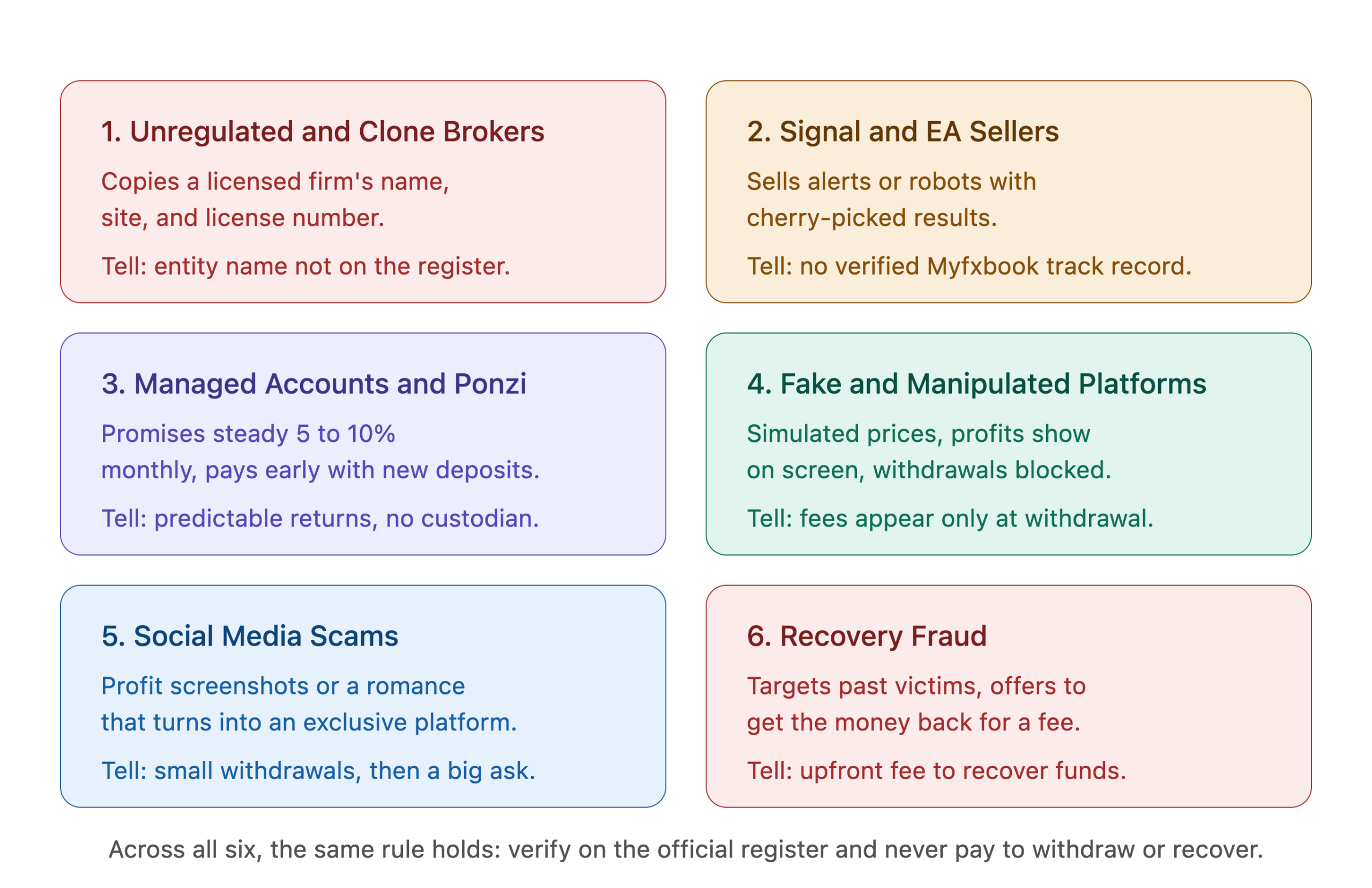
An unregulated broker operates without accountability to any financial authority. There is no requirement to segregate client funds, no external audit of pricing, and no regulatory body a defrauded client can complain to. A clone broker adds a layer of deliberate deception by copying the branding, website design, and regulatory details of a legitimate, licensed firm and running a fraudulent site alongside the real one.
Clone fraud has grown sharply in recent years. A trader searching for a well-known broker may land on the clone without realizing it. The domain is slightly different, the support team recites the same script as the real firm, and the license number shown belongs to the legitimate entity rather than the fraudulent one holding the client funds.
Red flags for unregulated and clone brokers:
- The broker’s name on the website does not exactly match the legal entity name on the regulator’s official register.
- The license number shown returns no result when entered directly into the regulator’s search tool.
- The website URL differs from the registered entity’s official address by a word, letter, or domain suffix.
- Customer support cannot identify the specific legal entity under which the account will be held.
- Terms and conditions are vague about which jurisdiction’s law governs the contract.
How to check: Go directly to the regulator’s own website. For UK brokers, use the FCA Financial Services Register at fca.org.uk/firms/financial-services-register. For Australia, use ASIC’s Connect register at connectonline.asic.gov.au. Search by the exact legal entity name and confirm the status shows as currently authorized, not lapsed or under investigation.
2. Signal Sellers and EA Robot Scams
Signal sellers charge a subscription fee or one-time payment for buy and sell trade alerts. Expert Advisor robots promise to automate trading and produce consistent profits without manual input. Both are widely sold, and a significant proportion of both categories are outright fraud.
Fraudulent signal services follow a recognizable structure. They display cherry-picked historical trades, refuse independent verification of their track record, and typically require the buyer to open a trading account through a referral link. That referral earns the seller commission on deposits, not from genuinely profitable trading signals.
Red flags for signal sellers and EA robots:
- Win rates of 80 to 95 percent with little or no drawdown shown in the historical record.
- Performance presented only as screenshots rather than a verified track record from a platform such as Myfxbook or FX Blue.
- The seller cannot explain the entry and exit logic or describe the market conditions the system was designed for.
- Opening a trading account through the seller’s affiliate link is a requirement to access the service.
- Testimonials exist but none link to a verifiable live trading account.
How to check: Request an audited live-account track record from a verified third-party platform covering at least six months of real trading, not a demo account. Confirm whether the seller is licensed as an investment advisor in their jurisdiction. Selling financial advice for a fee without regulatory authorization is often a legal violation in itself.
3. Managed Accounts and Ponzi Schemes
In a managed account scam, a trader transfers control of their funds to a third party who promises regular returns, typically five to ten percent per month, presented as reliable and consistent. The manager fabricates account statements, pays early investors with deposits from later ones, and eventually disappears with the capital.
This is the Ponzi structure applied to forex. It persists because early “returns” feel real and the promise of hands-off income is genuinely attractive to people who are busy or risk-averse. By the time the scheme collapses, most participants have already reinvested their initial returns and lost substantially more than they first deposited.
Red flags for managed accounts and Ponzi schemes:
- Monthly returns above five percent presented as predictable rather than variable across changing market conditions.
- No audited financial statements and no independent third-party custodian holding client funds separately from the operator’s money.
- The manager refuses to describe the trading strategy in specific, testable terms.
- Withdrawals are reinvested by default and require additional steps, unexplained delays, or new conditions to access.
- Participants are encouraged to recruit other investors, whose deposits fund the returns paid to earlier participants.
How to check: In most jurisdictions, anyone managing client funds must be registered with a financial regulator. Search the NFA BASIC system (US), the FCA Register (UK), or ASIC Connect (Australia) for both the company name and the individual manager’s name. If neither appears, the operation is not lawfully authorized to manage money.
4. Fake and Manipulated Trading Platforms
Some scam operations build or rebrand a trading interface that looks like a standard platform but runs on simulated prices disconnected from real markets. Trades execute on screen, apparent profits accumulate, and withdrawal requests trigger a sequence of delays, invented fees, or account freezes.
The design is intentional. A functioning demo phase and convincing performance interface build enough confidence for the trader to deposit increasing amounts. The fraud only becomes visible when a withdrawal is attempted for the first time.
Red flags for fake and manipulated platforms:
- The broker offers only a proprietary web platform rather than a widely audited system such as MT4, MT5, or cTrader.
- Withdrawal fees not disclosed in the original terms appear only after the account is funded.
- Platform prices diverge from prices on TradingView or another independent data source for the same pair at the same moment.
- The equity curve shows unusually smooth growth with minimal drawdown even during high-volatility news events.
- After profits accumulate, a “tax clearance,” “compliance fee,” or “release charge” appears as a requirement before any funds can be withdrawn.
How to check: Before depositing, open a demo account and compare the broker’s quoted price for EUR/USD against an independent live data source at the same moment. Small spread differences are normal. Large or persistent price divergences are a structural warning sign. Review the full withdrawal terms before funding, not after.
5. Social Media Investment Scams
Social media investment scams take two common forms. The first involves a trader posting forex profit screenshots on Instagram, TikTok, or YouTube and offering to trade on behalf of followers for a percentage of profits. The second, known as pig butchering, involves a scammer building a personal or romantic relationship with a target over weeks before introducing an exclusive trading platform and encouraging larger and larger deposits.
Both formats rely on manufactured trust and fabricated evidence. Screenshots can be created in seconds. In pig-butchering operations the relationship itself is scripted and run by organized groups. Small early withdrawals are permitted deliberately to build confidence before a substantially larger sum is locked in.
Red flags for social media investment scams:
- Unsolicited contact from someone claiming exceptional trading results and offering to manage funds.
- Communication limited to WhatsApp, Telegram, or Instagram DM with no independently verifiable identity.
- An exclusive platform not publicly searchable and with no independent third-party reviews.
- Pressure to deposit more capital after initial profits appear on screen.
- A personal or romantic relationship that develops quickly, before the scammer introduces any financial topics.
- The scammer permits early small withdrawals, then encourages a substantially larger deposit.
How to check: Run the contact’s profile photo through a reverse image search. Check how long the social media account has existed and how many genuine connections or followers it shows. Search the platform name together with “scam” or “fraud” before any financial interaction. No legitimate investment opportunity requires secrecy from family members or financial advisors.
6. Recovery Fraud
Recovery fraud targets traders who have already lost money to a forex scam. A fraudster contacts the victim, often within days of the victim discovering the original loss, and offers to recover the funds for an upfront fee. The victim pays the fee, no recovery takes place, and loses a second amount on top of the first.
Scammers source their targets from leaked victim lists, dark web data, and in some cases from the original fraud operation itself. The approach is calculated. A distressed victim, motivated to recover losses, is more likely to bypass normal skepticism.
Red flags for recovery fraud:
- Unsolicited contact from someone claiming to be a fund recovery specialist, fraud investigator, or legal recovery firm.
- An upfront fee is required before any recovery work begins.
- Claims of inside access to the original scammer’s accounts or special relationships with regulators.
- No verifiable regulatory registration, professional credentials, or documented recovery precedents.
- Urgency framing around a time-limited window that requires immediate payment.
How to check: Legitimate recovery routes through bodies such as the FCA, ASIC, the FBI’s Internet Crime Complaint Center, or Action Fraud in the UK do not charge advance fees. Treat any private service that demands payment before recovering money as a second fraud. Report the original loss to the relevant authority before engaging any third party.
Warning Signs That Appear Across All Forex Scams
Regardless of the specific scam type, certain warning signs appear consistently. Any single one of these is sufficient reason to stop and investigate before sending money.
- Guaranteed profits. No trading strategy produces guaranteed returns. Forex carries genuine risk. Any claim of consistent monthly returns or a guaranteed win rate is a factually false statement.
- Urgency to deposit. Legitimate brokers and services do not manufacture time pressure. A message framing an offer as expiring within hours, or requiring immediate funding to catch a trade, is a manipulation tactic rather than an opportunity.
- Withdrawal problems. An inability to withdraw on reasonable request is the clearest indicator of fraud. Testing with a small withdrawal before depositing more exposes this before the main loss occurs.
- Unverifiable regulation. If you cannot confirm a broker’s license number by entering it directly into the official regulator register, treat the broker as unregulated until proven otherwise.
- No identifiable legal entity. A regulated broker must disclose the legal entity name and registered address in its terms and conditions. The absence of this information is a structural warning sign.
- Referral incentive pressure. Bonus schemes tied to recruiting friends or family are a structural feature of Ponzi schemes, not legitimate trading businesses.
The Pre-Deposit Verification Checklist
Here is what to verify before depositing money with any forex broker or sending funds to any trading service. Each step takes fewer than ten minutes.
- Find the exact legal entity name. Read the broker’s terms and conditions to the end. Note the company name that will hold the account, along with the jurisdiction of registration.
- Check regulation directly on the regulator’s register. Go to the regulator’s own website, not a review aggregator. For the UK: register.fca.org.uk. For the US: nfa.futures.org. For Australia: connectonline.asic.gov.au. Enter the legal entity name or license number and confirm the authorization status is currently active, not lapsed, withdrawn, or under investigation.
- Check clone broker and unauthorized firm alert lists. The FCA maintains a warning list at fca.org.uk/scamsmart/warning-list. ASIC maintains the Moneysmart Investor Alert List at moneysmart.gov.au. Most major regulators publish lists of firms confirmed to be operating without authorization.
- Search for withdrawal complaints. Search the broker’s name alongside “withdrawal problem,” “withdrawal delay,” or “scam” on Trustpilot, Forex Peace Army, and Reddit. A pattern of recent complaints is more informative than an aggregate review score.
- Verify platform prices against an independent data source. Open a demo account and compare the bid/ask price for EUR/USD on the platform with the same pair on TradingView at the same moment. Small spread differences are expected. Large or persistent discrepancies are a structural warning sign.
- Confirm client fund segregation. Verify that the broker holds client funds in segregated accounts, separate from company operating funds. Tier-1 regulators require this as standard, and it protects client funds if the broker becomes insolvent.
- Test with the minimum deposit first. If everything checks out but uncertainty remains, deposit only the minimum amount and attempt a small withdrawal before sending more. A legitimate broker processes this without delay or added conditions.
- Verify any signal or EA seller independently. Request a live-account Myfxbook or FX Blue track record covering at least six months of real trading. Confirm whether the seller holds any required regulatory authorization. Verify the track record URL leads to a live account profile, not a static screenshot.
What to Do If You Have Already Been Scammed
If you have already sent money to a fraudulent broker or scheme, act on these steps in order.
Stop sending money immediately. Every argument for additional deposits, whether framed as taxes, release fees, or compliance charges, is part of the same fraud. No legitimate recovery ever requires further deposits from the victim.
Document everything now. Screenshot every communication, account statement, deposit confirmation, and the broker’s website as it currently appears. Do this before the site disappears or account access is revoked. Comprehensive documentation significantly improves the outcome of any formal complaint.
Report to the relevant authority. Here are the reporting contacts by region:
- UK: Action Fraud at actionfraud.police.uk and the FCA at fca.org.uk/scamsmart
- US: CFTC at cftc.gov, NFA at nfa.futures.org, and the FBI IC3 at ic3.gov
- Australia: ASIC at asic.gov.au and Scamwatch at scamwatch.gov.au
- EU: The national financial regulator in the country of residence
Contact your bank or payment provider immediately. Credit card and debit card payments may be recoverable through a chargeback claim. Bank transfer recovery depends on the speed of reporting and the payment provider’s policies. The earlier the contact, the higher the probability of at least partial recovery.
Reject any service that charges upfront recovery fees. Any unsolicited contact offering to recover lost funds in exchange for an advance payment is a second fraud. Legitimate recovery assistance comes through the regulatory and law enforcement bodies listed above, not private companies with advance-fee models.
Also Read: Best Forex Brokers in UAE
Conclusion
Forex is a legitimate market. Millions of traders operate in it every day through regulated brokers with verifiable track records. The problem is not the market itself. It is the layer of unverified participants who exploit the market’s credibility to take money from people who have not yet learned how to evaluate them.
Every scam type covered in this guide shares one structural vulnerability on the scammer’s side: their claims cannot survive basic verification. A regulated broker’s license check takes two minutes on the regulator’s register. A signal seller’s track record request takes one email. The pre-deposit checklist above requires no specialist expertise, only ten minutes and the willingness to ask the right questions. Legitimate participants pass these checks without hesitation. Fraudulent ones create reasons to skip them.
Frequently Asked Questions
Is Forex Trading Itself a Scam?
No. Forex is a legitimate, globally regulated financial market with around $9.6 trillion in daily volume according to the BIS 2025 Triennial Survey. Regulated brokers, licensed educators, and professional traders all operate within it legally. The scams covered in this guide operate around the market’s legitimacy, not within the market itself. Distinguishing between the regulated market and the unverified participants operating alongside it is the foundation of staying safe.
How Do I Verify Whether a Forex Broker Is Regulated?
Go to the regulator’s official website and search by the broker’s legal entity name or license number. UK brokers can be checked on the FCA Register at register.fca.org.uk. In the US, use the NFA BASIC system at nfa.futures.org. Australian firms appear on ASIC Connect at connectonline.asic.gov.au. Do not rely on the broker’s own website as confirmation of regulation. Always search the regulator’s database directly and confirm the authorization status is currently active, not lapsed or withdrawn.
What Are the Most Common Red Flags of a Forex Scam?
Guaranteed profits or win rates, artificial urgency to deposit quickly, withdrawal problems or unexplained delays, and regulation that cannot be verified directly on an official register. Unsolicited contact from someone offering to trade on your behalf or manage your funds is also a consistent early warning. Any single red flag warrants investigation before sending money. Multiple red flags appearing together indicate near-certain fraud.
What Is a Clone Broker?
A clone broker is a fraudulent operation that copies the branding, website design, and regulatory details of a real, licensed firm and operates an unauthorized site alongside the legitimate one. A trader landing on the clone sees a convincing site with a genuine-looking license number that actually belongs to a different entity. To avoid a clone, verify the exact legal entity name and license number directly on the regulator’s register and confirm the site URL matches the entity’s officially registered details exactly.
How Do I Report a Forex Scam?
UK residents should report to Action Fraud at actionfraud.police.uk and the FCA at fca.org.uk/scamsmart. In the US, file with the CFTC at cftc.gov, the NFA at nfa.futures.org, and the FBI Internet Crime Complaint Center at ic3.gov. Australian victims can report to ASIC at asic.gov.au and Scamwatch at scamwatch.gov.au. Within the EU, contact the national financial regulator in your country of residence. Document all communications, account statements, and deposit confirmations before submitting any report.