Singapore
 Malaysia
 Indonesia
 Philippines
 Thailand
 Vietnam
 Cambodia
 Myanmar
 Brunei
 China
China Japan
Japan South Korea
 Taiwan
 India
India Australia
  New Zealand
 United Kingdom
 Switzerland
 Italy
Italy Spain
Spain UAE
UAE United States
 Mexico
 Argentina
 South Africa
 IC Markets
 Pepperstone
 AvaTrade
 XM
XM Plus500
 RoboForex
 TMGM
TMGM Exness
 JustMarkets
 Orbex
Orbex Interactive Brokers
 Saxo
Saxo Tiger Brokers
 Binance
 Coinbase
 Gemini Exchange
 Kraken
 iFunds
 IC Funded
 The 5%ers
 TopStep
 IQ Option
 Pocket Option
 RaceOption
 IQCent
Knowing how to use an economic calendar is the difference between the trader who steps aside 30 seconds before the chaos and the one who gets stopped out in it. The one who loses is rarely using the wrong strategy. They are trading at the wrong time, stepping into the market exactly when professional edge disappears and random price spikes take over. The calendar is a timing filter, not a signal to trade.
|
ABOUT THIS GUIDE |
This guide explains how to read an economic calendar as a trade filter, not a source of signals. It covers what the calendar shows, how to interpret the consensus vs. actual gap, which events carry the most weight, and how to build a simple pre-session routine that removes most news-related trade risk. |
|
QUICK ANSWER |
An economic calendar is a filter, not a trade signal. Before each session, identify any scheduled high-impact releases. Avoid entering new trades 30 minutes before and after those events. What moves price is the gap between the consensus forecast and the actual figure released, not the absolute number itself. Stand aside during releases unless you run a specific news-trading system. |
What an Economic Calendar Shows
An economic calendar is a schedule of planned government and central bank data releases, policy decisions, and speeches that affect currency markets. Every major release carries a release time, a currency it affects, and three figures that tell traders what the market expected versus what actually printed.
The calendar doesn’t tell traders what to buy or sell. It tells them when the market is about to receive new information that could cause large, unpredictable price moves. That distinction is what separates traders who use it well from traders who treat it like a tip sheet.
Most free economic calendars are available through platforms such as Forex Factory, Investing.com, and DailyFX. The data and impact ratings are broadly consistent across all three. The layout varies slightly, but the five key columns are the same on every platform.
How to Read the Five Key Columns
Every row in an economic calendar covers one scheduled event. Reading those rows correctly takes less than a minute per event, but the information in each column changes what a trader does next.
Here are the five columns that matter on every platform:
- Date and time: Shows exactly when the data releases. Always confirm the time zone matches your local setting. A release listed at 8:30 AM EST fires at different clock times across every region. Most platforms allow a custom home time zone.
- Currency: Identifies which currency the release directly affects. A US Non-Farm Payrolls release affects USD pairs. A Bank of England rate decision affects GBP. EUR/USD reacts to Eurozone CPI. The affected currency appears in the second column of every row.
- Event name: Describes the data being released. Common examples include CPI, GDP, PMI, and Non-Farm Payrolls. Each type measures a different aspect of the economy and carries different weight depending on what the central bank is currently focused on.
- Impact rating: Uses a color or star system to show expected market sensitivity. Low-impact events are green or one star. Medium-impact events are yellow or two stars. High-impact events are red or three stars. High-impact releases are the ones capable of spiking price 50 to 100 pips in seconds.
- Forecast, Previous, and Actual: The previous figure is what the last release showed. The forecast, also called consensus, is what analysts expect this time. The actual is the number published at release time. The relationship between forecast and actual is what drives the reaction.
Why the Calendar Is a Filter, Not a Signal
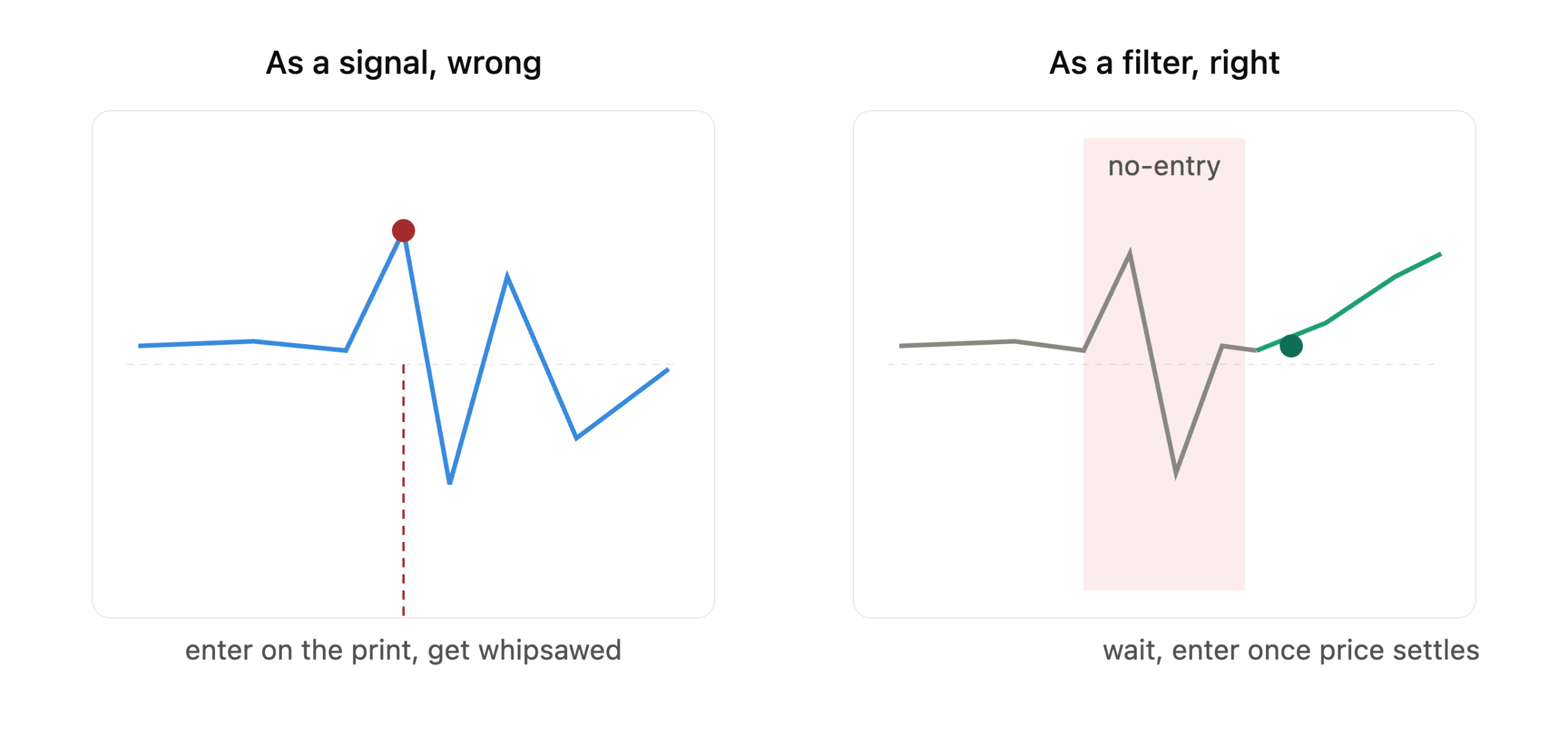
The most common misuse of the economic calendar is treating a strong data print as a direct buy or sell signal. A strong US jobs number reads as bullish for USD, so the instinct is to buy USD pairs the moment the number drops. That instinct consistently loses money.
The market doesn’t react to whether a number is strong or weak in absolute terms. It reacts to whether that number is stronger or weaker than what was already expected. By the time a release fires, the consensus forecast has been priced into the pair over the preceding hours and days. Traders positioned ahead of the release have already moved price toward the expected outcome.
What the calendar actually identifies is when to step out of the market. Entering a new trade on a technical setup with a high-impact release 20 minutes away means accepting that a single data print can invalidate that setup instantly. The setup doesn’t become invalid because the analysis was wrong. It becomes invalid because the timing was wrong.
The Consensus vs. Actual Gap That Moves Price
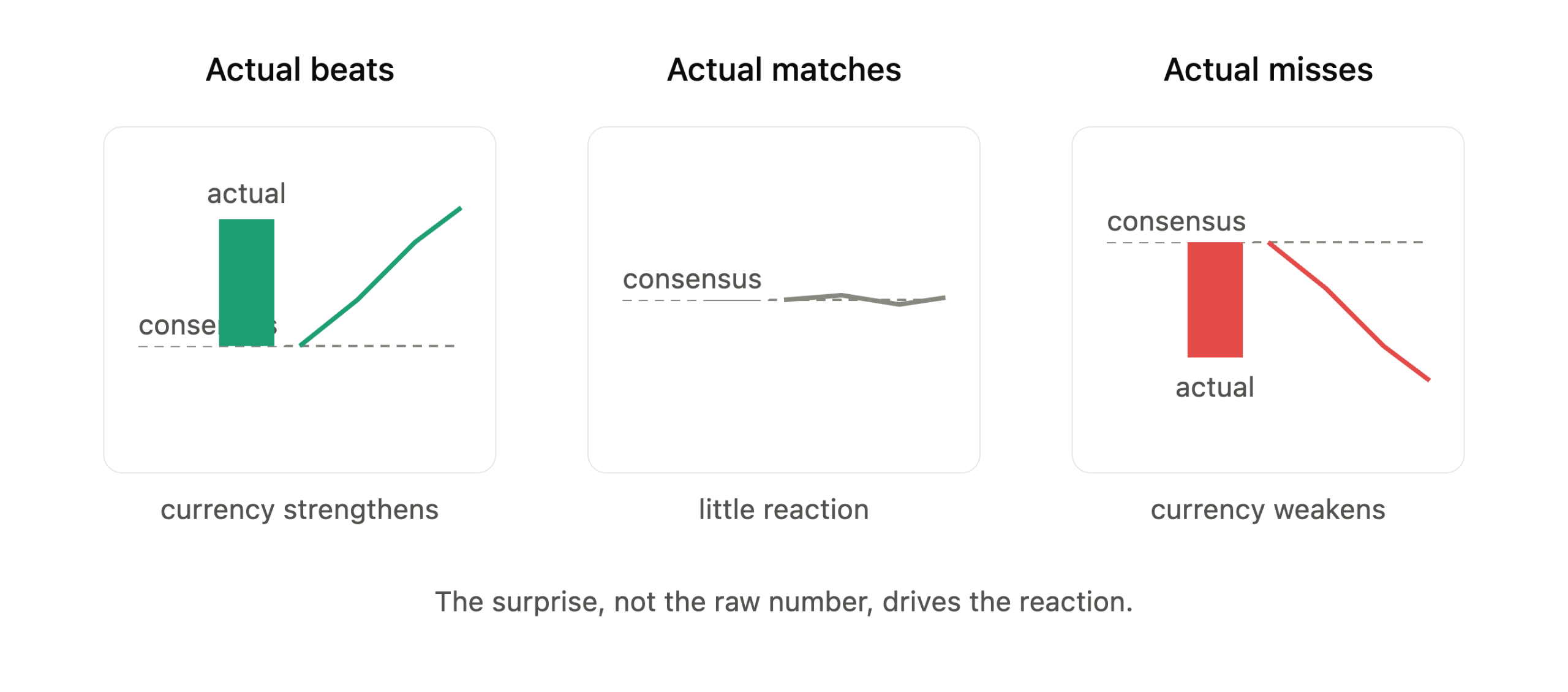
The figure that actually moves currency pairs is not the data number itself. It’s the surprise, meaning the distance between what the market expected (consensus) and what actually printed (actual).
Here is how the market typically interprets that gap:
- Actual beats consensus: The releasing currency tends to strengthen. Better-than-expected data signals economic health and raises the probability of tighter monetary policy from the central bank.
- Actual matches consensus: Minimal reaction. The market already priced in the expected figure and there is no new information to act on.
- Actual misses consensus: The releasing currency tends to weaken. Worse-than-expected data raises concerns about economic health and lowers rate-hike expectations.
The size of the move scales roughly with the size of the surprise. A minor beat or miss produces a small reaction. A significant surprise where the actual differs sharply from the consensus can trigger a 50 to 150 pip move on major pairs within minutes.
Revised data adds another layer of complexity. Economic figures often get revised in the following month’s release. A major upward or downward revision to previous data can move price even when the new actual lands in line with consensus. Reading the previous and revision columns together matters most for releases like GDP and Non-Farm Payrolls.
There is also the concept of buy the rumor, sell the news. If a central bank is widely expected to raise rates, traders buy the currency ahead of the decision. When the decision confirms expectations, those traders close for profit. The selling pressure from those exits can drive the currency down despite positive news. The key question is always whether the actual beat or missed the consensus, not whether the raw figure looked impressive.
The High-Impact Events Every Forex Trader Watches
Not all economic releases carry equal weight. The table below covers the events that produce the largest and most consistent reactions on major currency pairs:
| Event | Currency Affected | Release Frequency | Why It Matters |
|---|---|---|---|
| Non-Farm Payrolls (NFP) | USD | Monthly, first Friday | Biggest US labor market report; drives Fed rate expectations |
| CPI (Consumer Price Index) | USD, EUR, GBP, AUD | Monthly | Inflation measure; directly tied to central bank rate decisions |
| Interest Rate Decision | USD, EUR, GBP, JPY, AUD | 6 to 8 times per year | Biggest single-event mover; sets the cost of money |
| Central Bank Press Conference | USD, EUR, GBP | After rate decisions | Often more impactful than the rate itself; forward guidance moves pairs |
| GDP (Gross Domestic Product) | USD, EUR, GBP | Quarterly | Broad economic health; revisions often create second reactions |
| PMI (Purchasing Managers Index) | USD, EUR, GBP | Monthly | Forward-looking survey data; frequent 30 to 50 pip surprises |
| Retail Sales | USD, GBP, AUD | Monthly | Consumer spending indicator; high sensitivity on USD pairs |
| Employment Change and Unemployment | AUD, CAD, GBP | Monthly | Country-specific labor data; largest mover for AUD and CAD pairs |
Interest rate decisions sit at the top of the hierarchy. When the Federal Reserve, European Central Bank, Bank of England, or Bank of Japan sets rates, every currency pair connected to those currencies reacts. The rate itself is rarely a surprise. What moves pairs is the tone of the accompanying statement and the press conference that follows.
Central bank press conferences deserve specific attention. The language a central bank governor uses around the pace of future rate changes carries more market impact than most retail traders expect. A single shift from “committed to tightening” to “data dependent” can move a pair 80 to 100 pips on its own, independent of where the rate was set.
How to Use the Calendar to Time Your Entries
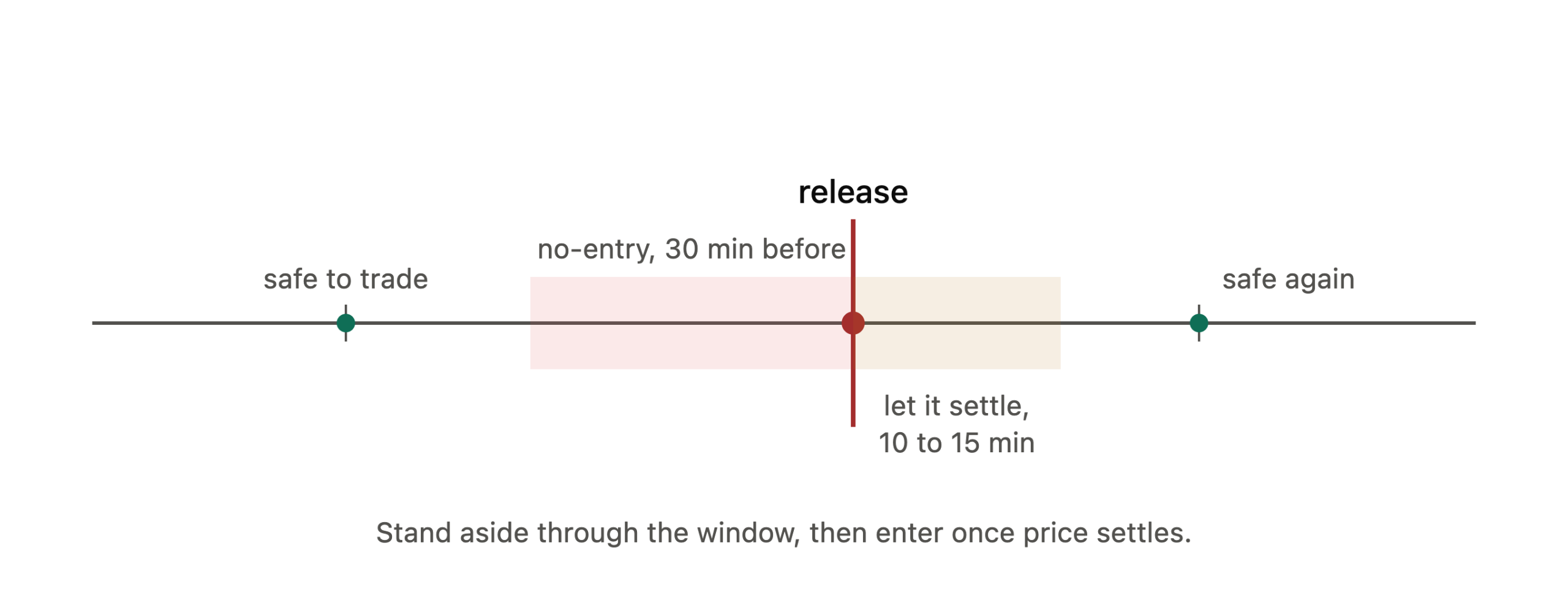
The calendar becomes most useful when checked at the start of each session rather than during it. A two-minute calendar check before looking at a single chart prevents the majority of news-related trade disasters.
Before entering any position, a disciplined approach runs through four questions:
- Is there a high-impact release scheduled in the next 30 to 60 minutes on the currency being traded?
- If yes, does holding through that release fit the trade’s time frame and risk tolerance?
- Would a news spike hit the stop loss before price has a chance to recover?
- Would waiting until after the release still offer a valid entry, or does the setup depend on current market conditions?
Most of the time, the right answer is to wait. A clean setup that appears after a high-impact release resolves is typically higher probability than the same setup entered 15 minutes before it fires. Understanding the best time to trade forex connects directly to the calendar because session overlaps already create elevated volatility. Adding a scheduled high-impact release on top of peak session hours makes price behavior harder to read, not easier.
Pairs tied to how forex trading works at a macro level, particularly the major USD pairs, react to the widest range of calendar events. Knowing which events affect which currencies lets traders focus their attention instead of monitoring every release that appears on the calendar.
Common Mistakes Traders Make With the Calendar
The calendar is a simple tool, but several patterns of misuse show up consistently across retail traders. These are the ones worth understanding before the next session.
- Trading directly into a high-impact release: Spreads widen, slippage increases, and price can spike 50 to 100 pips in either direction before settling. A technically valid setup entered 10 minutes before NFP can hit its stop loss on the spike before price moves in the expected direction. The calendar marks exactly when this risk is highest.
- Ignoring time zone differences: A release listed at 8:30 AM EST fires at 1:30 PM GMT and at different clock times across every region. Traders who do not convert correctly either miss the release entirely or, worse, enter a position thinking they have hours of calm ahead when the release fires in 20 minutes.
- Treating the actual number as a buy signal without checking consensus: If Non-Farm Payrolls adds 250,000 jobs but the consensus was 280,000, that is a miss. USD often sells off on that print even though 250,000 new jobs sounds strong in isolation. The consensus is the benchmark, not zero.
- Holding intraday positions through releases they were not built for: A swing trade held for several days can tolerate medium-impact releases without issue. A short-term intraday trade built on a 20-pip range has no business surviving an NFP release. Matching the trade’s timeframe to the news environment resolves most of this.
- Ignoring the revision column: When a previous figure gets revised sharply upward or downward, the market reacts to that revision alongside the new actual. Read both columns together, particularly for GDP and Non-Farm Payrolls.
Tracking which releases affected which trades is one reason forex journaling matters as a separate habit. A trade log that includes the news environment at entry gives a clearer picture over time of which release types create problems in a specific strategy.
A Pre-Session Checklist Using the Economic Calendar
A consistent calendar routine takes less than three minutes and removes most news-related trade risk. This process works as the first step of every session, before any charts are opened.
Here is the repeatable pre-session flow:
- Open the economic calendar and filter for the current session’s time window only.
- Identify all high-impact releases (red or three-star) scheduled during the session.
- Note which currencies each release affects.
- Mark a 30-minute no-entry window before and after each high-impact event.
- For any open positions, check whether the trade will be live through a release and whether the stop loss can absorb a spike without triggering early.
- After each release fires, wait 10 to 15 minutes for price to settle before evaluating new setups.
Reviewing how releases affected price after the session closes is as valuable as the pre-session check. Watching the currency strength shifts that followed a major surprise builds intuition for how specific pairs respond to specific release types over time.
Conclusion
The economic calendar is one of the most practical tools in forex, and it’s almost always misread. Most traders look at it to find trades. The correct use is the opposite: look at it to know when not to trade.
Reading the consensus vs. actual gap correctly, respecting the no-entry window around high-impact releases, and matching position time frames to the news environment removes an entire category of losses that has nothing to do with analysis quality and everything to do with timing.
Frequently Asked Questions
What Is an Economic Calendar in Forex?
An economic calendar is a schedule of planned government and central bank data releases that affect currency markets. Each entry shows the release time, the currency affected, the impact rating, and the forecast and actual figures. Forex traders use it to identify high-volatility periods and time entries around scheduled events rather than trading directly into them.
How Do I Read the Consensus Versus Actual Figures?
The consensus, or forecast, is what analysts expected. The actual is what was released. The gap between them is the surprise, and the surprise is what moves price. When the actual beats consensus, the affected currency tends to strengthen. A miss tends to weaken it. And when actual matches consensus exactly, the reaction is usually minimal because the expected figure was already priced in.
Should I Trade During High-Impact News Releases?
For most retail traders, no. Spreads widen, slippage increases, and price can spike sharply in either direction before settling. Unless a trader runs a specific news-trading system with position sizing built for those conditions, the risk-to-reward on entries taken during a release is poor. The better approach is to wait for price to settle after the release and look for setups in calmer conditions.
Which Economic Events Move Forex the Most?
Interest rate decisions from major central banks produce the largest sustained moves. Non-Farm Payrolls and CPI data releases are the highest-impact single data prints for USD pairs. Central bank press conferences after rate decisions often move markets more than the rate decision itself, because forward guidance on the pace of future changes creates new positioning.
What Time Zone Does the Economic Calendar Use?
Most platforms default to EST or GMT, and most also let traders set a personal home time zone so releases display in local time. Always confirm the time zone setting before a session. A release at 8:30 AM EST fires at 1:30 PM GMT, at 9:30 PM Singapore time, and at 10:30 PM Sydney time. Getting this wrong is one of the most common causes of accidentally holding through a release.