Free margin in forex is the one figure on the MT4 or MT5 account panel that determines whether another position can open right now, and it is consistently the last number most traders learn to read.
|
ABOUT THIS GUIDE |
This guide explains what free margin is and how it connects to used margin, equity, and margin level on the live account panel. It covers the exact formula, a worked example with real dollar figures, and the steps that protect free margin before a margin call becomes a real problem. Asia Forex Mentor has trained more than 100,000 traders across 50+ countries. Misreading the account panel is one of the most consistent gaps in newer trading accounts. |
|
QUICK ANSWER |
Free margin is the equity in a forex trading account not locked up as collateral for open positions. It equals equity minus used margin. On MT4 and MT5, it updates live in the account panel as prices move. When free margin reaches zero, no new trades can open. When it drops to the broker’s stop-out level, existing positions close automatically. |
What the MT4 and MT5 Account Panel Shows
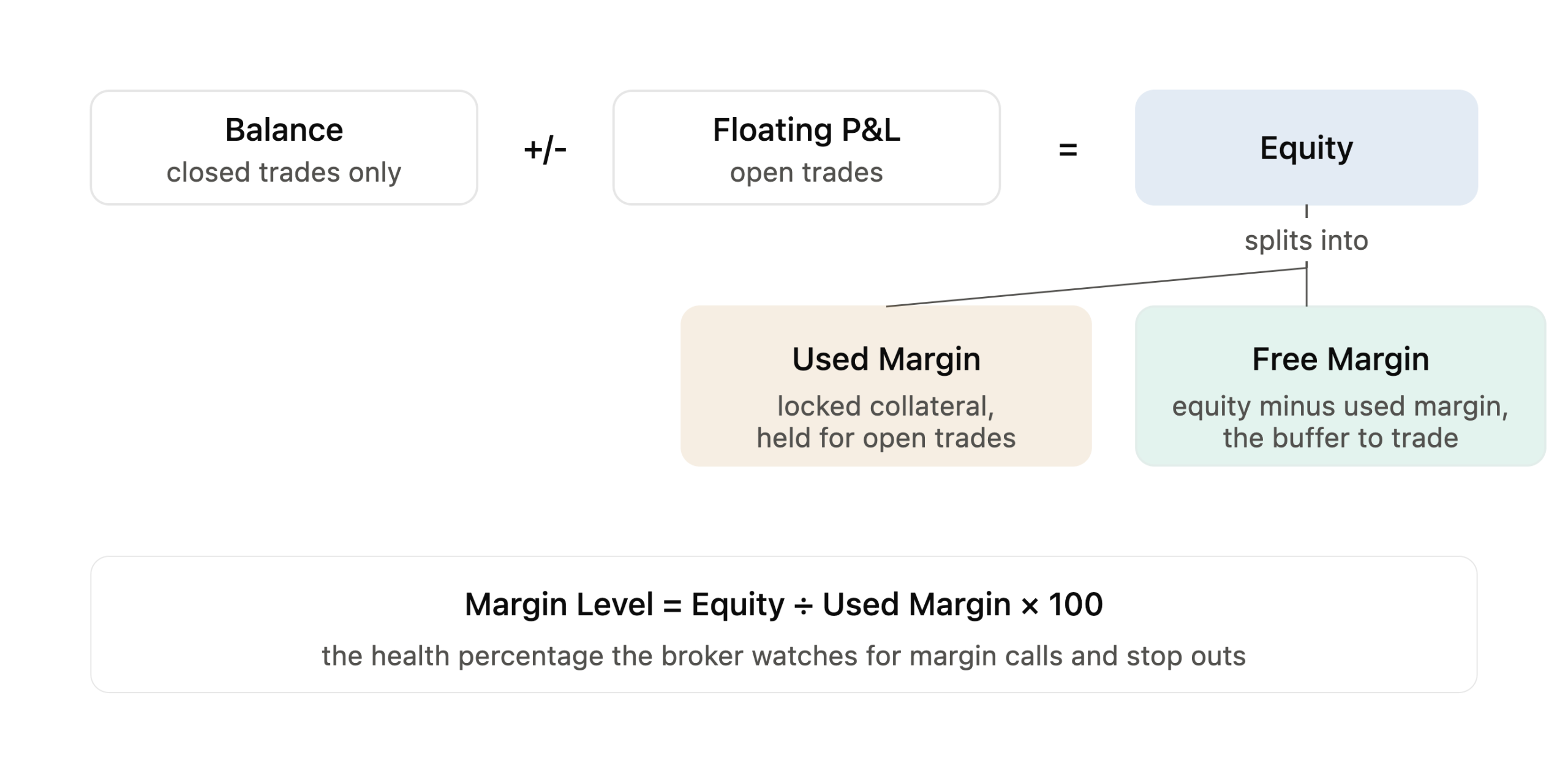
The account panel sits at the bottom of every MT4 and MT5 terminal window. Five figures run across it in real time: Balance, Equity, Margin, Free Margin, and Margin Level. Each one measures something different, and treating them as interchangeable is where most account problems start.
Balance is the cumulative result of all completed trades. It stays fixed while any position remains open. A trade can run 300 pips in the trader’s favor and the balance will not move until that position closes.
Equity is the live account value. It equals balance adjusted by the floating profit or loss on all open positions combined. When no trades are active, balance and equity are identical. The moment a position opens, equity starts ticking with every pip.
The remaining three figures, Margin, Free Margin, and Margin Level, only become active once a trade is open. Until then, Free Margin equals equity and Margin Level shows no value.
What Free Margin Is
Free margin is the portion of equity that is not locked away as security for open trades. It is the breathing room in the account.
The figure does two jobs at once. First, it funds new positions. Second, it acts as the buffer that absorbs floating losses on existing trades before the account reaches a warning level. When free margin drops to zero, the trading platform blocks all new order entries.
Some brokers label the same figure as “available margin” or “usable margin.” Both mean exactly what MT4 and MT5 call Free Margin in the terminal panel. The label changes across platforms. The calculation does not.
Free margin updates with every price tick on every open position. A trader who places a trade and steps away from the screen has no live sense of how much buffer remains in the account.
Used Margin, Equity, and Margin Level Defined
Three companion terms give free margin its full context. Understanding all four together turns a row of confusing figures into a readable instrument.
Here are the four core terms and what each one represents:
- Balance is the fixed total of all closed trades. It does not change while any trade is open.
- Equity is balance adjusted for the current floating profit or loss across all open positions. It moves with every price tick.
- Used Margin (labeled “Margin” in the MT4 panel) is the total collateral the broker holds as security against all open positions. It is locked and unavailable while those positions are active.
- Free Margin is the equity remaining after used margin is subtracted. It is available for new trades and for absorbing losses on existing ones.
Margin Level is not a dollar amount. It is a percentage calculated by dividing equity by used margin and multiplying by 100. A margin level of 500% means equity is five times the amount locked as used margin. Most brokers issue margin call warnings when margin level falls to around 100% and begin automatic position closures between 20% and 50%, though the exact thresholds differ by broker.
The Free Margin Formula and a Worked Example
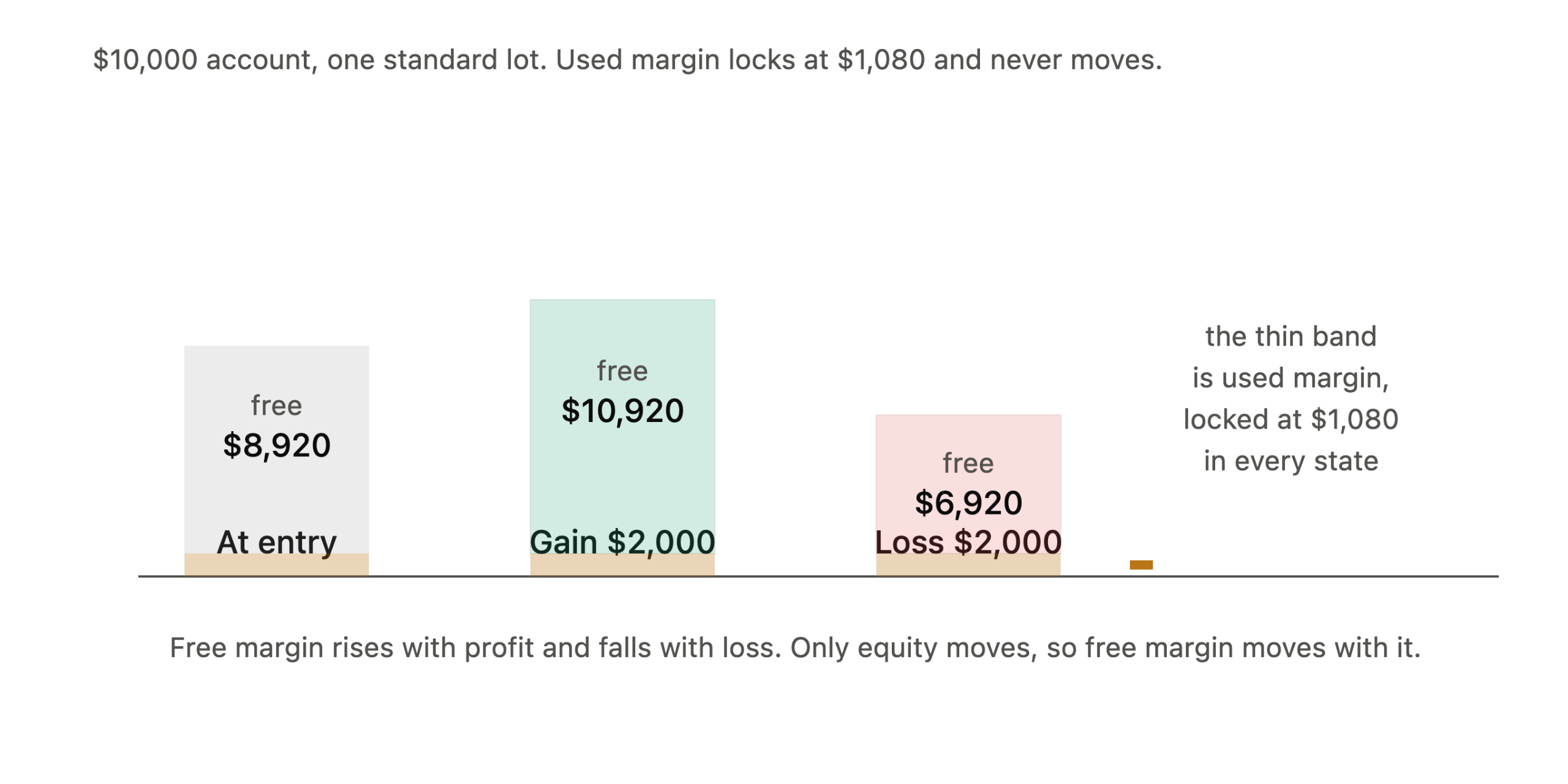
The formula has one step.
Free Margin = Equity – Used Margin
A concrete example shows how the account panel responds as a position moves. Assume a $10,000 account with no open trades.
| Account Figure | Starting State |
|---|---|
| Balance | $10,000 |
| Floating P&L | $0 |
| Equity | $10,000 |
| Used Margin | $0 |
| Free Margin | $10,000 |
| Margin Level | N/A |
The trader opens one standard lot of EUR/USD at 1:100 leverage. At a price of approximately 1.0800, the broker requires $1,080 as a deposit for that position.
| Account Figure | After Trade Opens |
|---|---|
| Balance | $10,000 |
| Floating P&L | $0 |
| Equity | $10,000 |
| Used Margin | $1,080 |
| Free Margin | $8,920 |
| Margin Level | 926% |
The position then moves 200 pips in the trader’s favor. Each pip on a standard EUR/USD lot is worth approximately $10, producing a $2,000 floating profit.
| Account Figure | With 200-Pip Gain |
|---|---|
| Balance | $10,000 |
| Floating P&L | +$2,000 |
| Equity | $12,000 |
| Used Margin | $1,080 |
| Free Margin | $10,920 |
| Margin Level | 1,111% |
The trade then reverses 400 pips from entry and now sits 200 pips below entry, producing a $2,000 floating loss.
| Account Figure | With 200-Pip Loss |
|---|---|
| Balance | $10,000 |
| Floating P&L | -$2,000 |
| Equity | $8,000 |
| Used Margin | $1,080 |
| Free Margin | $6,920 |
| Margin Level | 741% |
Used margin stays fixed throughout all three states. Free margin rises when the position profits and falls when it loses, because equity is the only moving variable in the formula.
How Free Margin Changes as Trades Move
Free margin tracks equity directly. Every pip that shifts equity shifts free margin by the same amount in the same direction.
Here is how free margin responds in three situations every active trader will encounter:
- A trade moves into profit. Equity rises. Used margin holds steady. Free margin rises. The account gains more room to absorb future losses or open additional positions.
- A trade moves into loss. Equity falls. Used margin holds steady. Free margin falls. The buffer between the current account state and a broker warning shrinks.
- A new trade opens. Used margin increases by the deposit required for the new position. Equity stays the same at the moment of entry. Free margin drops by the new used margin amount immediately.
Adding positions when free margin is already under pressure compounds the risk from two directions. Each new trade increases used margin and introduces another source of floating loss that can drag equity down further.
How Leverage and Position Size Affect Free Margin
Leverage determines how large a position a trader can hold relative to the margin deposited. Higher leverage means a smaller deposit per lot, which keeps used margin lower and free margin higher for the same trade size.
Here is how used margin changes across leverage levels for one standard lot of EUR/USD at approximately 1.0800:
| Leverage | Position Value | Used Margin Required |
|---|---|---|
| 1:500 | $108,000 | $216 |
| 1:100 | $108,000 | $1,080 |
| 1:50 | $108,000 | $2,160 |
| 1:30 | $108,000 | $3,600 |
| 1:10 | $108,000 | $10,800 |
At 1:500, one standard lot locks up only $216 in used margin. At 1:10, the same position requires $10,800. Lower leverage means the broker demands more real capital as a deposit, which directly cuts into free margin.
Position size works in the same direction. Two standard lots at 1:100 need $2,160 in used margin rather than $1,080, reducing free margin by an additional $1,080. Before entering any trade, running the numbers through a position size calculator confirms whether the required deposit fits within the available free margin buffer.
For the complete picture of how leverage in forex magnifies both gains and losses alongside margin requirements, the linked guide covers each mechanism in detail. Higher leverage reduces the margin deposit per trade, which frees up more margin to open larger positions. A larger position means each pip produces a bigger floating gain or loss, so free margin can shift faster in either direction.
What Happens When Free Margin Runs Low
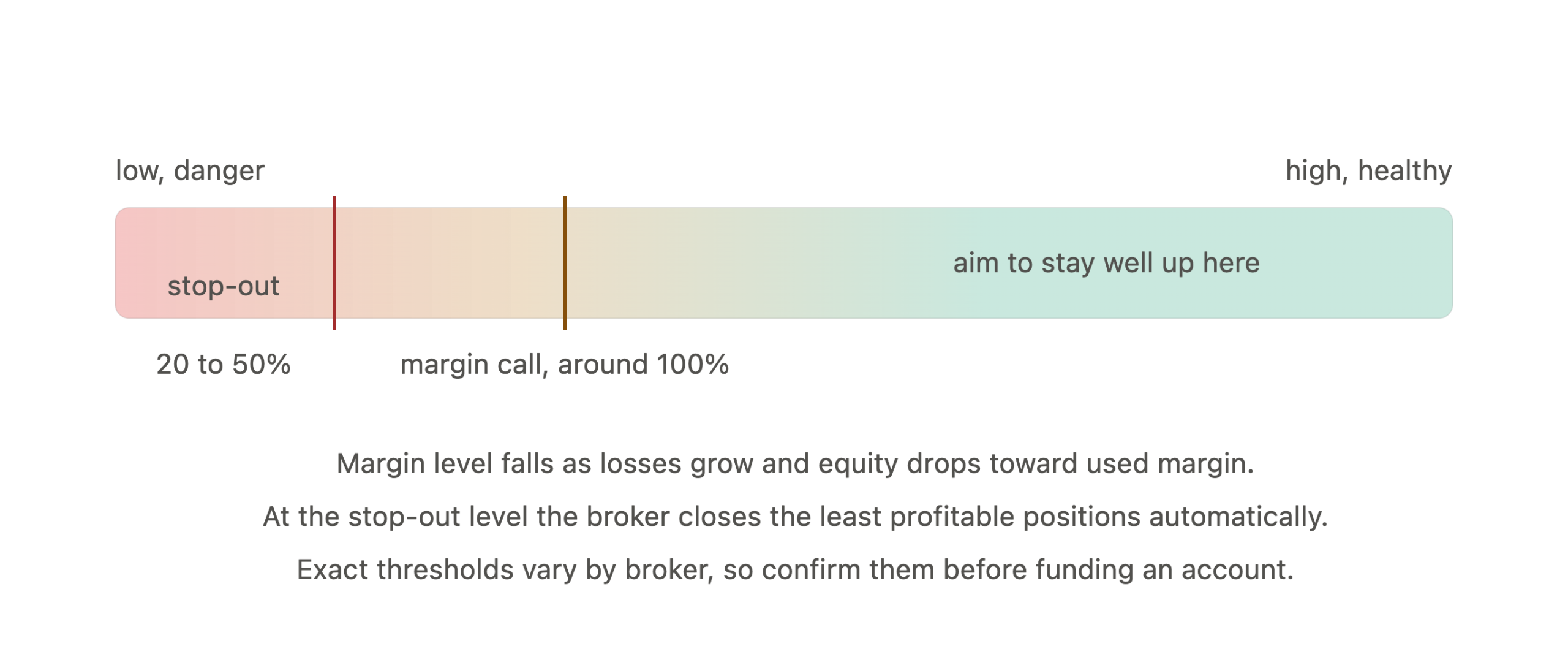
When free margin approaches zero, two things follow in sequence.
First, the platform blocks new trade entries. Any attempt to open a position when free margin is insufficient returns an error. The terminal displays “not enough money” or “insufficient margin.” No broker action is required at this stage.
Second, if losses continue and margin level keeps falling, the broker steps in. The sequence runs through two thresholds:
- Margin Call Level. The broker sends a warning when margin level falls to their defined alert threshold, typically around 100%. This is a notification, not an automatic closure. The trader can respond by depositing more funds, closing losing positions, or reducing lot sizes. Investopedia’s explanation of margin calls covers how this mechanism works across different markets.
- Stop-Out Level. If margin level continues falling to the stop-out threshold, typically between 20% and 50%, the broker begins closing the least profitable open positions automatically. This happens without the trader’s input and cannot be reversed once it starts.
Exact margin call and stop-out levels differ between brokers. Both are published in the broker’s client agreement and account documentation. Checking these numbers before funding an account is part of basic due diligence. The full picture of what margin in forex means from a structural standpoint covers why brokers set these levels and how they enforce them.
For traders who want to build the habits that prevent this scenario, the guide on how to avoid blowing a forex account covers position sizing and margin management as a combined discipline.
How to Keep Free Margin Healthy
Maintaining healthy free margin is a discipline built into every trade decision before entry, not a check performed after the fact.
Here are the core practices that protect free margin across all market conditions:
- Size positions proportionally to account balance. A trade requiring 2% of account equity as used margin leaves far more free margin than one requiring 15%. Smaller sizes preserve the buffer without eliminating participation.
- Limit the number of simultaneous open positions. Each active trade adds to used margin and introduces another source of floating loss. Five modest positions can apply the same collective pressure as one large one.
- Apply a stop-loss order to every trade. A stop-loss caps how far any single position can drain equity. Without one, a losing trade reduces free margin indefinitely as the market moves further against it.
- Check free margin before adding a new position. Before opening a second or third trade, confirm that free margin is sufficient to absorb further drawdown on existing positions and still cover the deposit for the new one.
- Know the broker’s stop-out level before it becomes relevant. Acting when margin level has already dropped to 60% is reactive. Knowing the exact threshold from the start, and monitoring margin level throughout a trading session, is proactive.
Also Read: What Is Forex Trading and How Does It Work
Conclusion
Free margin in forex is the live health indicator of a trading account. Balance does not tell the full story. Equity alone does not either. Free margin, calculated as equity minus used margin, is the figure that shows how much room remains for the next market move before a broker warning becomes a real risk.
Understanding how free margin responds to a profitable trade, a losing trade, and a newly added position gives a trader real-time awareness that the balance figure alone cannot provide. Factoring in leverage and position size before a trade is placed, not after, completes the picture.
Frequently Asked Questions
What Is Free Margin in Forex?
Free margin is the equity in a forex trading account that is not committed as collateral for open positions. It equals equity minus used margin and updates live in the MT4 and MT5 account panel with every price movement on open trades. When free margin reaches zero, the platform prevents any new trade entries from being placed.
What Is the Difference Between Free Margin and Used Margin?
Used margin is the deposit the broker holds as security against open positions. It is locked and cannot be accessed while those trades remain active. Free margin is the equity that remains after used margin is subtracted. Used margin is committed capital. Free margin is liquid capital. Together they account for total equity when positions are open.
What Is a Margin Call in Forex?
A margin call is a broker alert triggered when margin level falls to the broker’s defined warning threshold, typically around 100%. It signals that equity is close to equaling used margin and the account buffer is nearly exhausted. It is a notification, not an automatic trade closure. The trader can respond by adding funds, closing losing positions, or reducing lot sizes. If margin level continues to fall to the stop-out threshold, the broker closes positions automatically without further notice.
How Does Leverage Affect Free Margin?
Higher leverage reduces the used margin required per trade, leaving more free margin available for the same position size. Lower leverage increases used margin per trade, reducing free margin. Higher leverage also lets a trader open a larger position for the same deposit, so each pip produces a bigger floating gain or loss and free margin can shift in larger increments per tick.
What Is a Healthy Margin Level in Forex?
Many experienced traders aim to keep margin level above 300% to 500% while holding open positions. Levels below 200% indicate limited room to absorb further losses before the broker’s warning thresholds become relevant. Most brokers trigger margin call warnings at around 100% and stop outs between 20% and 50%. Staying well above those levels, rather than trading close to them, is the consistent objective.