Learn To Trade Forex • Best Forex Trading Course • AsiaForexMentor

Position Size Calculator Every Forex Trader Needs

Written by

Ezekiel Chew

Updated on

August 7, 2026

i
Its a default text

Position Size Calculator Every Forex Trader Needs

Written by:

Last updated on:

August 7, 2026

Most traders lose their accounts not because of a bad entry call but because they put too much on the line. The position size calculator is what stops that from happening before an order is ever placed.

ABOUT THIS GUIDE

This guide covers what a position size calculator actually does, the exact formula that drives it, and how to run the calculation manually on any forex pair. It also explains why position sizing matters more than entry timing and how to build it into every trade plan from the start. 


QUICK ANSWER

A position size calculator tells you exactly how many lots to trade on a given setup. It takes four inputs: your account balance, your risk percentage, your stop loss distance in pips, and the pip value of the pair. The output is a lot size that keeps your dollar risk fixed regardless of how wide or tight your stop is.

What a Position Size Calculator Does and the Formula Behind It

A position size calculator solves one specific problem. It tells you exactly how many lots to trade so your maximum loss matches the dollar amount you decided to risk before you open the chart.

Without this tool, traders guess. They round to the nearest whole lot, copy last week's size, or pick a number that feels comfortable. Adjusting for a wider stop or a different pair rarely happens. That guessing creates unpredictable losses even when trade direction is right.

The formula is:

Lot Size = (Account Balance x Risk%) / (Stop Loss in Pips x Pip Value per Lot)

Every position size calculator runs this same formula. The interface looks different depending on the platform. The math underneath stays the same.
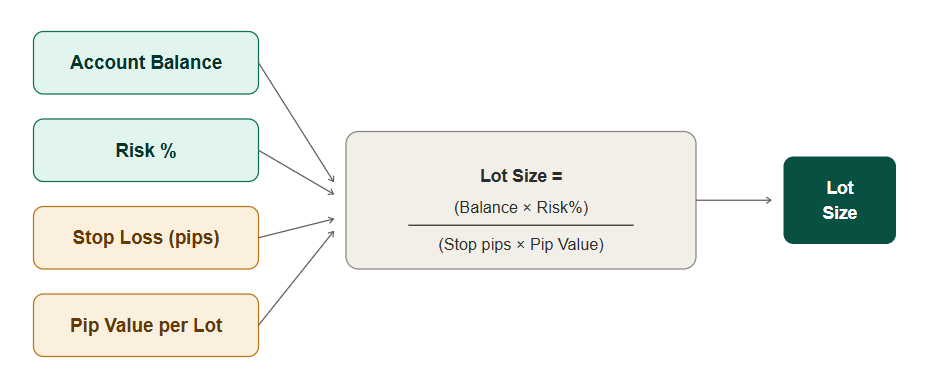
Four inputs, one formula, one output — the lot size that keeps dollar risk fixed.

Breaking Down Each Input

Four variables feed this formula, and each one matters:

  • Account balance is your current equity, not your original deposit. If your account grew from $10,000 to $12,400, calculate off $12,400.
  • Risk percentage is the share of that balance you are willing to lose on this single trade. Most disciplined traders work within 1% to 2%.
  • Stop loss distance is the pip count from your entry to your stop loss level, measured on the chart before placing any order.
  • Pip value per lot is the dollar amount one pip of movement produces on a single standard lot of the pair you are trading. This figure differs across pairs.

The result is a position size in standard lots . One standard lot equals 100,000 units of the base currency. Most retail brokers also offer mini lots (10,000 units) and micro lots (1,000 units) for smaller account sizes.

Why Position Sizing Beats Entry Timing for Account Survival

Most traders believe that finding the right entry separates winners from losers. The actual record disagrees. Entry timing influences whether individual trades profit. Position sizing determines whether the account survives long enough to compound.

The math behind this is straightforward. A trader with a 50% win rate and a 1:2 risk-to-reward ratio grows an account over time. That same trader with a 60% win rate but no sizing discipline can still lose money. Oversized losses wipe out multiple winning trades during normal variance.
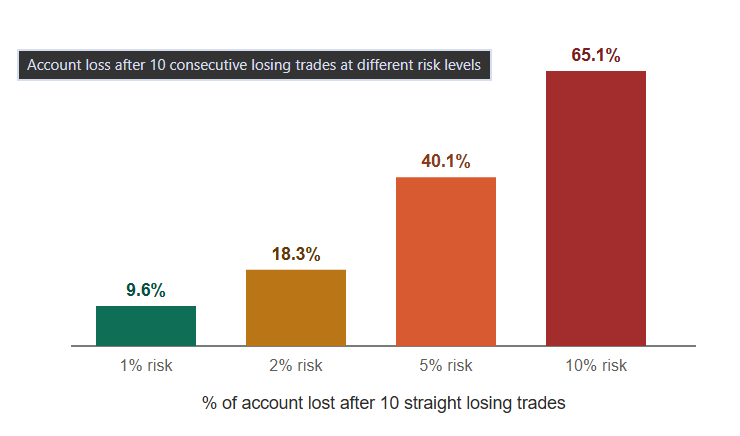
The same losing streak costs 9.6% of the account at 1% risk and 65.1% at 10% risk — the risk percentage decides how much room there is for a normal losing streak.

Asia Forex Mentor has trained more than 100,000 traders across 50+ countries, and the pattern that shows up consistently is this: students who identify decent setups but size inconsistently produce scattered results. Students who find average setups but cap every trade at 1% to 2% of equity build accounts progressively. The math forces this outcome regardless of which setups appear stronger.

Position sizing is the only variable in a trade that you fully control. The market decides whether direction was right. The trader decides how much of the account is exposed. That asymmetry is why institutional desks treat sizing as non-negotiable while most retail accounts treat it as optional.

The Compounding Case for Percentage-Based Risk

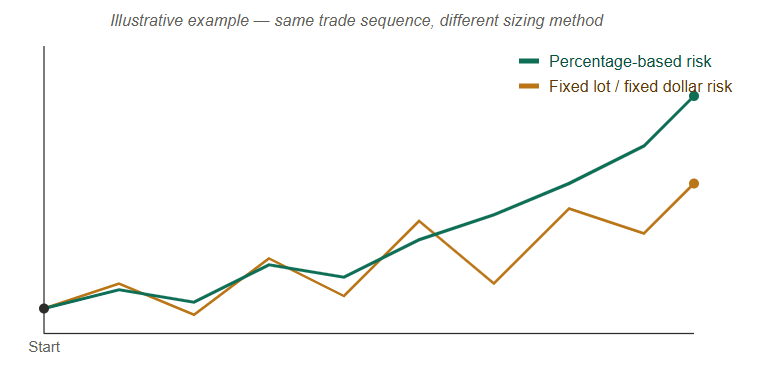
Percentage-based sizing carries a second advantage beyond capping losses. When you risk a fixed percentage per trade, dollar risk scales automatically as the account grows or shrinks. Position size expands during winning runs and contracts during drawdowns without any manual adjustment.
Percentage-based sizing shrinks risk automatically during a rough patch. Fixed sizing keeps risking the same dollar amount into a shrinking account, which widens the swings.

Traders who size by a fixed lot or fixed dollar amount lose this entirely. Risk stays static while equity moves. Over hundreds of trades, the final account balance gap between the two approaches becomes significant, even when entries and win rates are identical.

How to Calculate Position Size Manually Step by Step

A dedicated tool is not required to run this calculation. Knowing the manual method means you can verify any calculator result and size positions correctly even when a specific tool is unavailable.

Follow these steps in order before placing any trade:

  1. Find your dollar risk. Multiply your account balance by your risk percentage. On a $10,000 account risking 1%, that is $100.
  2. Measure your stop distance in pips. Find the level where the trade setup is invalidated on your chart. Count the pips from your entry to that level. A EUR/USD entry at 1.0850 with a stop at 1.0820 gives a 30-pip stop. Reading forex candle patterns helps identify rejection and invalidation points precisely.
  3. Identify the pip value for the pair. For USD-quote pairs like EUR/USD, GBP/USD, and AUD/USD, pip value on a standard lot is a fixed $10. For other pairs, pip value varies with the current exchange rate.
  4. Apply the formula. Divide your dollar risk by the product of stop distance and pip value. Using the example: $100 / (30 pips x $10) = $100 / $300 = 0.33 lots.
  5. Round down to the nearest lot increment your broker offers. Most brokers accept 0.01-lot increments. In this example, 0.33 standard lots equals 33 micro lots, which keeps the maximum loss at $99.

The result is 0.33 lots on EUR/USD, which caps the maximum loss at $99 on a $10,000 account risking 1% with a 30-pip stop.

A Second Example With a Wider Stop

Now run the same account and 1% risk with a 60-pip stop instead.

Dollar risk stays at $100. The stop distance is now 60 pips. Pip value remains $10 per standard lot on EUR/USD.

$100 / (60 x $10) = $100 / $600 = 0.17 lots.

The wider stop requires half the position size to maintain the same dollar risk. Traders who keep the same lot size regardless of stop width are effectively doubling their exposure on wider-stop setups. That inconsistency breaks risk management regardless of how strong the entry signal appears.

How Stop Distance and Pip Value Change Your Lot Size

Stop distance and pip value shift the most between setups and pairs. These are the two inputs where position sizing either holds together or quietly falls apart.

Stop Distance and Its Effect on Lot Size

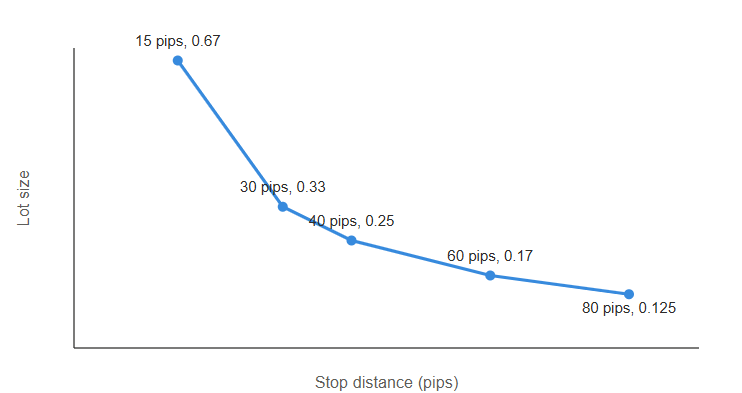
Stop distance and position size move in opposite directions. Widen the stop and the lot size shrinks. Tighten it and the lot size grows. Dollar risk stays constant because that is the fixed input set before running the calculation.
Same account, same 1% risk — the lot size does all the adjusting so the dollar risk never moves.

This matters because stops go where the chart structure dictates, not where the risk budget runs out. One valid setup may call for a 20-pip stop. Another may require 70 pips. The formula normalizes both so actual dollar risk stays consistent across every trade.

Pip Value Across Currency Pairs

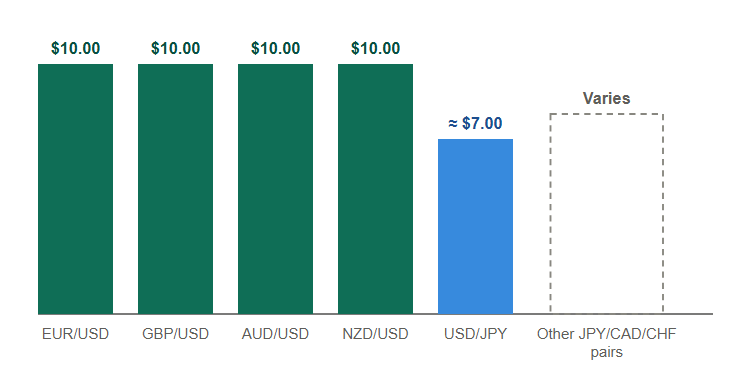
Pip value is not identical across every pair. Traders who assume $10 per pip across all setups are mismeasuring risk on most of the pairs in their portfolio.

Currency Pair Pip Value Per Standard Lot Notes
EUR/USD $10.00 Fixed. USD is the quote currency.
GBP/USD $10.00 Fixed. USD is the quote currency.
AUD/USD $10.00 Fixed. USD is the quote currency.
NZD/USD $10.00 Fixed. USD is the quote currency.
USD/JPY Varies with exchange rate JPY is the quote currency. Recalculate before each trade.
USD/CAD Varies with exchange rate CAD is the quote currency. Recalculate before each trade.
EUR/JPY Varies with exchange rate JPY is the quote currency. Recalculate before each trade.
GBP/JPY Varies with exchange rate JPY is the quote currency. Recalculate before each trade.
USD/CHF Varies with exchange rate CHF is the quote currency. Recalculate before each trade.

Only USD-quote pairs hold a fixed pip value. Everything else needs recalculating before each trade.

When USD is the quote currency, pip value is exactly $10 per standard lot and stays fixed. For every other pair, it shifts with the current exchange rate. A live calculator handles this automatically. When running the calculation manually, look up the current mid-rate and convert before applying the formula.

How Lot Size Shifts Across Three Different Setups

This table shows how lot size changes across three setups on the same $10,000 account risking 1% ($100 maximum per trade):

Setup Pair Stop Distance Pip Value Correct Lot Size
Tight breakout EUR/USD 15 pips $10.00 0.67 lots
Standard swing trade EUR/USD 40 pips $10.00 0.25 lots
Wide trend trade USD/JPY 80 pips Approx. $7.00 (rate-dependent) 0.18 lots

Same account. Same 1% risk. Three completely different lot sizes because the stop width and pair are different. The goal is consistent dollar risk per trade, not consistent lot size per trade.

How to Integrate Position Sizing Into a Full Trade Plan

Knowing the formula is the starting point. Applying it on every trade without exception is what actually protects an account over time. Many traders run the calculation when they first learn it and revert to guessing once a setup looks obvious or a candle is closing fast. That selective inconsistency is exactly where drawdowns get out of control.

Asia Forex Mentor teaches a specific workflow inside the One Core Program designed to make position sizing automatic rather than occasional. The five steps below are what that looks like in practice:

The Five Step Workflow
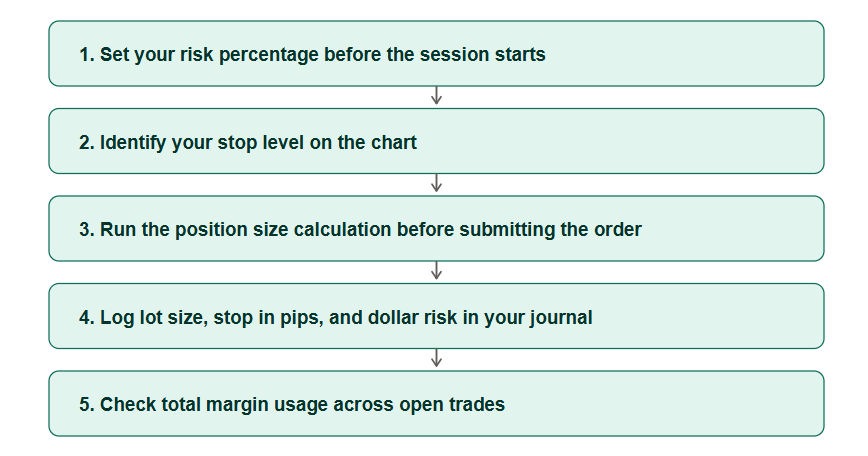
The sequence matters as much as the math, sizing has to happen before the order goes in, every time.

  • Set your risk percentage before the session starts. Write it down. Do not change it based on how confident you feel about any specific setup.
  • Identify your stop level on the chart before calculating lot size. The stop goes where price action invalidates the setup, not where your risk budget expires.
  • Run the position size calculation before submitting the order. Not during. Not after. The sequence matters because it keeps emotion out of the sizing decision entirely.
  • Log the calculated lot size, stop in pips, and dollar risk in your trade journal. Reviewing this weekly reveals whether sizing is genuinely consistent across different setups and pairs.
  • Check total margin usage if you carry multiple open trades. A correctly sized individual trade can still create overexposure across several concurrent positions. Understanding how margin in forex works alongside position size is part of the same risk management foundation.

Making It Part of Every Trade Plan

Identifying where to place that stop is a distinct skill from the sizing calculation itself. The guide on market structure trading explains how to find structurally valid invalidation levels before a trade is placed.

Asia Forex Mentor describes this approach as reading the market like a story. The structure on the chart tells you where risk sits. The formula tells you how much to commit. From there, the trade develops on its own terms. Adjustments based on conviction level have no place in this process. The formula is the rule, and consistent use of that rule is what makes outcomes repeatable.

The One Core Programme is rated the “Most Comprehensive Course” by Investopedia and “Best Forex Trading Course” by Benzinga. It teaches position sizing, entry identification, and trade management as one integrated system rather than three separate topics.

Also Read: The Truth About Margin in Forex Most Traders Miss

Conclusion

Position sizing is not a finishing touch added after building a trading strategy. It is the foundation the strategy runs on. Correct sizing with an average strategy outperforms incorrect sizing with a great one over enough trades.

The formula is straightforward. Account balance times risk percentage, divided by stop distance in pips times pip value per lot. Run it before every trade, log the result, and review that log each week. The formula itself never changes. Only the inputs do.

Retail traders who size by feel or fixed lot count are competing against traders who run the formula on every trade without exception. Pairing this discipline with a structured entry approach such as smart money concepts trading compounds the edge further. The gap in account survival between consistent and inconsistent sizing is not small.

Frequently Asked Questions

What Is a Position Size Calculator in Forex

A position size calculator is a tool that computes the correct lot size for a forex trade using your account balance, risk percentage, stop loss in pips, and the pip value of the pair. The output is a specific lot size that caps your maximum dollar loss at the amount you set before placing the trade. Most brokers and forex platforms provide one for free, but knowing the manual formula means you never depend on any specific tool.

What Is the Position Sizing Formula in Forex

The position sizing formula is: Lot Size = (Account Balance x Risk%) / (Stop Loss in Pips x Pip Value per Lot). On a $10,000 account risking 1% with a 30-pip stop on EUR/USD, this gives $100 / (30 x $10) = 0.33 lots. The same formula applies to all currency pairs once you use the correct pip value for the specific pair you are trading.

How Much Should I Risk Per Trade in Forex

Most structured traders risk 1% to 2% of account equity per trade. At 1% on a $10,000 account, the maximum loss per trade is $100. This level allows 20 consecutive losing trades before the account drops 20%, which provides enough runway to continue trading through normal variance without any single loss becoming account-threatening.

Does a Wider Stop Loss Require a Smaller Position Size

Yes, and the relationship is direct. Stop loss distance and lot size move inversely in the position sizing formula. A wider stop demands a smaller position to keep dollar risk constant. Traders who maintain the same lot size regardless of stop width are risking different dollar amounts on each trade, which prevents any systematic risk framework from working correctly over time.

Why Does Pip Value Differ Across Currency Pairs

Pip value is fixed at $10 per standard lot only for pairs where USD is the quote currency, such as EUR/USD, GBP/USD, and AUD/USD. For all other pairs, pip value shifts with the current exchange rate. Using an incorrect pip value produces an incorrect lot size and incorrect actual dollar risk on every trade placed on that pair.

About Ezekiel Chew​

Ezekiel Chew, founder and head of training at Asia Forex Mentor, is a renowned forex expert, frequently invited to speak at major industry events. Known for his deep market insights, Ezekiel is one of the top traders committed to supporting the trading community. Making six figures per trade, he also trains traders working in banks, fund management, and prop trading firms.

Average True Range Most Traders Use It Wrong

Most traders treat the average true range as a background indicator and use it the same way beginners do: glance at the number and guess at a stop loss. ABOUT THIS GUIDE This guide covers how professional forex traders actually apply the average true range. It goes from ATR stop

Read More

8 Best Day Trading Books That Actually Works

The best day trading books on most recommended lists were written for markets that no longer exist the way they once did. Traders buy the top-rated titles, work through them, and find that the strategies fail in a live account. The problem is rarely the trader. Most lists recommend books

Read More

How to Draw Trend Lines in Trading the Right Way 2026

Most traders drawing trend lines in trading are connecting random price points and calling it technical analysis, which is why their supposed support turns into thin air the moment price actually touches it. ABOUT THIS GUIDE This guide covers the institutional method for drawing valid trend lines in forex. It

Read More

Head and Shoulders Pattern Forex Guide 2026

Recognizing the head and shoulders pattern and trading it correctly are two entirely different skills. Most forex traders who spot the formation still end up stopped out before the move begins. The pattern appears in virtually every technical analysis curriculum and across all forex pairs and timeframes, yet the entry

Read More

Traders Dynamic Index 2026 Complete Forex Guide

Most traders carry three separate indicators on their chart to do what the Traders Dynamic Index accomplishes in a single window. The TDI combines a 13-period RSI, two signal line moving averages, and a 34-period Bollinger Band applied directly to the RSI oscillator. The result is one panel that shows

Read More

AFM Trading Summit Live

Date: Coming Soon

Join us at the AFM Trading Summit Live and learn from top industry experts through live trading sessions, market insights, and actionable strategies.

Position Size Calculator Every Forex Trader Needs

4.0
Overall Trust Index

Written by:

Updated:

August 7, 2026
Most traders lose their accounts not because of a bad entry call but because they put too much on the line. The position size calculator is what stops that from happening before an order is ever placed.

ABOUT THIS GUIDE

This guide covers what a position size calculator actually does, the exact formula that drives it, and how to run the calculation manually on any forex pair. It also explains why position sizing matters more than entry timing and how to build it into every trade plan from the start. 
 

QUICK ANSWER

A position size calculator tells you exactly how many lots to trade on a given setup. It takes four inputs: your account balance, your risk percentage, your stop loss distance in pips, and the pip value of the pair. The output is a lot size that keeps your dollar risk fixed regardless of how wide or tight your stop is.

What a Position Size Calculator Does and the Formula Behind It

A position size calculator solves one specific problem. It tells you exactly how many lots to trade so your maximum loss matches the dollar amount you decided to risk before you open the chart. Without this tool, traders guess. They round to the nearest whole lot, copy last week's size, or pick a number that feels comfortable. Adjusting for a wider stop or a different pair rarely happens. That guessing creates unpredictable losses even when trade direction is right. The formula is: Lot Size = (Account Balance x Risk%) / (Stop Loss in Pips x Pip Value per Lot) Every position size calculator runs this same formula. The interface looks different depending on the platform. The math underneath stays the same.

Four inputs, one formula, one output — the lot size that keeps dollar risk fixed.

Breaking Down Each Input

Four variables feed this formula, and each one matters:
  • Account balance is your current equity, not your original deposit. If your account grew from $10,000 to $12,400, calculate off $12,400.
  • Risk percentage is the share of that balance you are willing to lose on this single trade. Most disciplined traders work within 1% to 2%.
  • Stop loss distance is the pip count from your entry to your stop loss level, measured on the chart before placing any order.
  • Pip value per lot is the dollar amount one pip of movement produces on a single standard lot of the pair you are trading. This figure differs across pairs.
The result is a position size in standard lots. One standard lot equals 100,000 units of the base currency. Most retail brokers also offer mini lots (10,000 units) and micro lots (1,000 units) for smaller account sizes.

Why Position Sizing Beats Entry Timing for Account Survival

Most traders believe that finding the right entry separates winners from losers. The actual record disagrees. Entry timing influences whether individual trades profit. Position sizing determines whether the account survives long enough to compound. The math behind this is straightforward. A trader with a 50% win rate and a 1:2 risk-to-reward ratio grows an account over time. That same trader with a 60% win rate but no sizing discipline can still lose money. Oversized losses wipe out multiple winning trades during normal variance.

The same losing streak costs 9.6% of the account at 1% risk and 65.1% at 10% risk — the risk percentage decides how much room there is for a normal losing streak.

Asia Forex Mentor has trained more than 100,000 traders across 50+ countries, and the pattern that shows up consistently is this: students who identify decent setups but size inconsistently produce scattered results. Students who find average setups but cap every trade at 1% to 2% of equity build accounts progressively. The math forces this outcome regardless of which setups appear stronger. Position sizing is the only variable in a trade that you fully control. The market decides whether direction was right. The trader decides how much of the account is exposed. That asymmetry is why institutional desks treat sizing as non-negotiable while most retail accounts treat it as optional.

The Compounding Case for Percentage-Based Risk

Percentage-based sizing carries a second advantage beyond capping losses. When you risk a fixed percentage per trade, dollar risk scales automatically as the account grows or shrinks. Position size expands during winning runs and contracts during drawdowns without any manual adjustment.

Percentage-based sizing shrinks risk automatically during a rough patch. Fixed sizing keeps risking the same dollar amount into a shrinking account, which widens the swings.

Traders who size by a fixed lot or fixed dollar amount lose this entirely. Risk stays static while equity moves. Over hundreds of trades, the final account balance gap between the two approaches becomes significant, even when entries and win rates are identical.

How to Calculate Position Size Manually Step by Step

A dedicated tool is not required to run this calculation. Knowing the manual method means you can verify any calculator result and size positions correctly even when a specific tool is unavailable. Follow these steps in order before placing any trade:
  1. Find your dollar risk. Multiply your account balance by your risk percentage. On a $10,000 account risking 1%, that is $100.
  2. Measure your stop distance in pips. Find the level where the trade setup is invalidated on your chart. Count the pips from your entry to that level. A EUR/USD entry at 1.0850 with a stop at 1.0820 gives a 30-pip stop. Reading forex candle patterns helps identify rejection and invalidation points precisely.
  3. Identify the pip value for the pair. For USD-quote pairs like EUR/USD, GBP/USD, and AUD/USD, pip value on a standard lot is a fixed $10. For other pairs, pip value varies with the current exchange rate.
  4. Apply the formula. Divide your dollar risk by the product of stop distance and pip value. Using the example: $100 / (30 pips x $10) = $100 / $300 = 0.33 lots.
  5. Round down to the nearest lot increment your broker offers. Most brokers accept 0.01-lot increments. In this example, 0.33 standard lots equals 33 micro lots, which keeps the maximum loss at $99.
The result is 0.33 lots on EUR/USD, which caps the maximum loss at $99 on a $10,000 account risking 1% with a 30-pip stop.

A Second Example With a Wider Stop

Now run the same account and 1% risk with a 60-pip stop instead. Dollar risk stays at $100. The stop distance is now 60 pips. Pip value remains $10 per standard lot on EUR/USD. $100 / (60 x $10) = $100 / $600 = 0.17 lots. The wider stop requires half the position size to maintain the same dollar risk. Traders who keep the same lot size regardless of stop width are effectively doubling their exposure on wider-stop setups. That inconsistency breaks risk management regardless of how strong the entry signal appears.

How Stop Distance and Pip Value Change Your Lot Size

Stop distance and pip value shift the most between setups and pairs. These are the two inputs where position sizing either holds together or quietly falls apart.

Stop Distance and Its Effect on Lot Size

Stop distance and position size move in opposite directions. Widen the stop and the lot size shrinks. Tighten it and the lot size grows. Dollar risk stays constant because that is the fixed input set before running the calculation.

Same account, same 1% risk — the lot size does all the adjusting so the dollar risk never moves.

This matters because stops go where the chart structure dictates, not where the risk budget runs out. One valid setup may call for a 20-pip stop. Another may require 70 pips. The formula normalizes both so actual dollar risk stays consistent across every trade.

Pip Value Across Currency Pairs

Pip value is not identical across every pair. Traders who assume $10 per pip across all setups are mismeasuring risk on most of the pairs in their portfolio.
Currency Pair Pip Value Per Standard Lot Notes
EUR/USD $10.00 Fixed. USD is the quote currency.
GBP/USD $10.00 Fixed. USD is the quote currency.
AUD/USD $10.00 Fixed. USD is the quote currency.
NZD/USD $10.00 Fixed. USD is the quote currency.
USD/JPY Varies with exchange rate JPY is the quote currency. Recalculate before each trade.
USD/CAD Varies with exchange rate CAD is the quote currency. Recalculate before each trade.
EUR/JPY Varies with exchange rate JPY is the quote currency. Recalculate before each trade.
GBP/JPY Varies with exchange rate JPY is the quote currency. Recalculate before each trade.
USD/CHF Varies with exchange rate CHF is the quote currency. Recalculate before each trade.

Only USD-quote pairs hold a fixed pip value. Everything else needs recalculating before each trade.

When USD is the quote currency, pip value is exactly $10 per standard lot and stays fixed. For every other pair, it shifts with the current exchange rate. A live calculator handles this automatically. When running the calculation manually, look up the current mid-rate and convert before applying the formula.

How Lot Size Shifts Across Three Different Setups

This table shows how lot size changes across three setups on the same $10,000 account risking 1% ($100 maximum per trade):
Setup Pair Stop Distance Pip Value Correct Lot Size
Tight breakout EUR/USD 15 pips $10.00 0.67 lots
Standard swing trade EUR/USD 40 pips $10.00 0.25 lots
Wide trend trade USD/JPY 80 pips Approx. $7.00 (rate-dependent) 0.18 lots
Same account. Same 1% risk. Three completely different lot sizes because the stop width and pair are different. The goal is consistent dollar risk per trade, not consistent lot size per trade.

How to Integrate Position Sizing Into a Full Trade Plan

Knowing the formula is the starting point. Applying it on every trade without exception is what actually protects an account over time. Many traders run the calculation when they first learn it and revert to guessing once a setup looks obvious or a candle is closing fast. That selective inconsistency is exactly where drawdowns get out of control. Asia Forex Mentor teaches a specific workflow inside the One Core Program designed to make position sizing automatic rather than occasional. The five steps below are what that looks like in practice:

The Five Step Workflow

The sequence matters as much as the math, sizing has to happen before the order goes in, every time.

  • Set your risk percentage before the session starts. Write it down. Do not change it based on how confident you feel about any specific setup.
  • Identify your stop level on the chart before calculating lot size. The stop goes where price action invalidates the setup, not where your risk budget expires.
  • Run the position size calculation before submitting the order. Not during. Not after. The sequence matters because it keeps emotion out of the sizing decision entirely.
  • Log the calculated lot size, stop in pips, and dollar risk in your trade journal. Reviewing this weekly reveals whether sizing is genuinely consistent across different setups and pairs.
  • Check total margin usage if you carry multiple open trades. A correctly sized individual trade can still create overexposure across several concurrent positions. Understanding how margin in forex works alongside position size is part of the same risk management foundation.

Making It Part of Every Trade Plan

Identifying where to place that stop is a distinct skill from the sizing calculation itself. The guide on market structure trading explains how to find structurally valid invalidation levels before a trade is placed. Asia Forex Mentor describes this approach as reading the market like a story. The structure on the chart tells you where risk sits. The formula tells you how much to commit. From there, the trade develops on its own terms. Adjustments based on conviction level have no place in this process. The formula is the rule, and consistent use of that rule is what makes outcomes repeatable. The One Core Programme is rated the "Most Comprehensive Course" by Investopedia and "Best Forex Trading Course" by Benzinga. It teaches position sizing, entry identification, and trade management as one integrated system rather than three separate topics.

Also Read: The Truth About Margin in Forex Most Traders Miss

Conclusion

Position sizing is not a finishing touch added after building a trading strategy. It is the foundation the strategy runs on. Correct sizing with an average strategy outperforms incorrect sizing with a great one over enough trades. The formula is straightforward. Account balance times risk percentage, divided by stop distance in pips times pip value per lot. Run it before every trade, log the result, and review that log each week. The formula itself never changes. Only the inputs do. Retail traders who size by feel or fixed lot count are competing against traders who run the formula on every trade without exception. Pairing this discipline with a structured entry approach such as smart money concepts trading compounds the edge further. The gap in account survival between consistent and inconsistent sizing is not small.

Frequently Asked Questions

What Is a Position Size Calculator in Forex

A position size calculator is a tool that computes the correct lot size for a forex trade using your account balance, risk percentage, stop loss in pips, and the pip value of the pair. The output is a specific lot size that caps your maximum dollar loss at the amount you set before placing the trade. Most brokers and forex platforms provide one for free, but knowing the manual formula means you never depend on any specific tool.

What Is the Position Sizing Formula in Forex

The position sizing formula is: Lot Size = (Account Balance x Risk%) / (Stop Loss in Pips x Pip Value per Lot). On a $10,000 account risking 1% with a 30-pip stop on EUR/USD, this gives $100 / (30 x $10) = 0.33 lots. The same formula applies to all currency pairs once you use the correct pip value for the specific pair you are trading.

How Much Should I Risk Per Trade in Forex

Most structured traders risk 1% to 2% of account equity per trade. At 1% on a $10,000 account, the maximum loss per trade is $100. This level allows 20 consecutive losing trades before the account drops 20%, which provides enough runway to continue trading through normal variance without any single loss becoming account-threatening.

Does a Wider Stop Loss Require a Smaller Position Size

Yes, and the relationship is direct. Stop loss distance and lot size move inversely in the position sizing formula. A wider stop demands a smaller position to keep dollar risk constant. Traders who maintain the same lot size regardless of stop width are risking different dollar amounts on each trade, which prevents any systematic risk framework from working correctly over time.

Why Does Pip Value Differ Across Currency Pairs

Pip value is fixed at $10 per standard lot only for pairs where USD is the quote currency, such as EUR/USD, GBP/USD, and AUD/USD. For all other pairs, pip value shifts with the current exchange rate. Using an incorrect pip value produces an incorrect lot size and incorrect actual dollar risk on every trade placed on that pair.
ezekiel chew asiaforexmentor

About Ezekiel Chew

Ezekiel Chew, founder and head of training at Asia Forex Mentor, is a renowned forex expert, frequently invited to speak at major industry events. Known for his deep market insights, Ezekiel is one of the top traders committed to supporting the trading community. Making six figures per trade, he also trains traders working in banks, fund management, and prop trading firms.

RELATED ARTICLES

Position Size Calculator Every Forex Trader Needs

4.0
Overall Trust Index

Written by:

Updated:

August 7, 2026
Most traders lose their accounts not because of a bad entry call but because they put too much on the line. The position size calculator is what stops that from happening before an order is ever placed.

ABOUT THIS GUIDE

This guide covers what a position size calculator actually does, the exact formula that drives it, and how to run the calculation manually on any forex pair. It also explains why position sizing matters more than entry timing and how to build it into every trade plan from the start. 
 

QUICK ANSWER

A position size calculator tells you exactly how many lots to trade on a given setup. It takes four inputs: your account balance, your risk percentage, your stop loss distance in pips, and the pip value of the pair. The output is a lot size that keeps your dollar risk fixed regardless of how wide or tight your stop is.

What a Position Size Calculator Does and the Formula Behind It

A position size calculator solves one specific problem. It tells you exactly how many lots to trade so your maximum loss matches the dollar amount you decided to risk before you open the chart. Without this tool, traders guess. They round to the nearest whole lot, copy last week's size, or pick a number that feels comfortable. Adjusting for a wider stop or a different pair rarely happens. That guessing creates unpredictable losses even when trade direction is right. The formula is: Lot Size = (Account Balance x Risk%) / (Stop Loss in Pips x Pip Value per Lot) Every position size calculator runs this same formula. The interface looks different depending on the platform. The math underneath stays the same.

Four inputs, one formula, one output — the lot size that keeps dollar risk fixed.

Breaking Down Each Input

Four variables feed this formula, and each one matters:
  • Account balance is your current equity, not your original deposit. If your account grew from $10,000 to $12,400, calculate off $12,400.
  • Risk percentage is the share of that balance you are willing to lose on this single trade. Most disciplined traders work within 1% to 2%.
  • Stop loss distance is the pip count from your entry to your stop loss level, measured on the chart before placing any order.
  • Pip value per lot is the dollar amount one pip of movement produces on a single standard lot of the pair you are trading. This figure differs across pairs.
The result is a position size in standard lots. One standard lot equals 100,000 units of the base currency. Most retail brokers also offer mini lots (10,000 units) and micro lots (1,000 units) for smaller account sizes.

Why Position Sizing Beats Entry Timing for Account Survival

Most traders believe that finding the right entry separates winners from losers. The actual record disagrees. Entry timing influences whether individual trades profit. Position sizing determines whether the account survives long enough to compound. The math behind this is straightforward. A trader with a 50% win rate and a 1:2 risk-to-reward ratio grows an account over time. That same trader with a 60% win rate but no sizing discipline can still lose money. Oversized losses wipe out multiple winning trades during normal variance.

The same losing streak costs 9.6% of the account at 1% risk and 65.1% at 10% risk — the risk percentage decides how much room there is for a normal losing streak.

Asia Forex Mentor has trained more than 100,000 traders across 50+ countries, and the pattern that shows up consistently is this: students who identify decent setups but size inconsistently produce scattered results. Students who find average setups but cap every trade at 1% to 2% of equity build accounts progressively. The math forces this outcome regardless of which setups appear stronger. Position sizing is the only variable in a trade that you fully control. The market decides whether direction was right. The trader decides how much of the account is exposed. That asymmetry is why institutional desks treat sizing as non-negotiable while most retail accounts treat it as optional.

The Compounding Case for Percentage-Based Risk

Percentage-based sizing carries a second advantage beyond capping losses. When you risk a fixed percentage per trade, dollar risk scales automatically as the account grows or shrinks. Position size expands during winning runs and contracts during drawdowns without any manual adjustment.

Percentage-based sizing shrinks risk automatically during a rough patch. Fixed sizing keeps risking the same dollar amount into a shrinking account, which widens the swings.

Traders who size by a fixed lot or fixed dollar amount lose this entirely. Risk stays static while equity moves. Over hundreds of trades, the final account balance gap between the two approaches becomes significant, even when entries and win rates are identical.

How to Calculate Position Size Manually Step by Step

A dedicated tool is not required to run this calculation. Knowing the manual method means you can verify any calculator result and size positions correctly even when a specific tool is unavailable. Follow these steps in order before placing any trade:
  1. Find your dollar risk. Multiply your account balance by your risk percentage. On a $10,000 account risking 1%, that is $100.
  2. Measure your stop distance in pips. Find the level where the trade setup is invalidated on your chart. Count the pips from your entry to that level. A EUR/USD entry at 1.0850 with a stop at 1.0820 gives a 30-pip stop. Reading forex candle patterns helps identify rejection and invalidation points precisely.
  3. Identify the pip value for the pair. For USD-quote pairs like EUR/USD, GBP/USD, and AUD/USD, pip value on a standard lot is a fixed $10. For other pairs, pip value varies with the current exchange rate.
  4. Apply the formula. Divide your dollar risk by the product of stop distance and pip value. Using the example: $100 / (30 pips x $10) = $100 / $300 = 0.33 lots.
  5. Round down to the nearest lot increment your broker offers. Most brokers accept 0.01-lot increments. In this example, 0.33 standard lots equals 33 micro lots, which keeps the maximum loss at $99.
The result is 0.33 lots on EUR/USD, which caps the maximum loss at $99 on a $10,000 account risking 1% with a 30-pip stop.

A Second Example With a Wider Stop

Now run the same account and 1% risk with a 60-pip stop instead. Dollar risk stays at $100. The stop distance is now 60 pips. Pip value remains $10 per standard lot on EUR/USD. $100 / (60 x $10) = $100 / $600 = 0.17 lots. The wider stop requires half the position size to maintain the same dollar risk. Traders who keep the same lot size regardless of stop width are effectively doubling their exposure on wider-stop setups. That inconsistency breaks risk management regardless of how strong the entry signal appears.

How Stop Distance and Pip Value Change Your Lot Size

Stop distance and pip value shift the most between setups and pairs. These are the two inputs where position sizing either holds together or quietly falls apart.

Stop Distance and Its Effect on Lot Size

Stop distance and position size move in opposite directions. Widen the stop and the lot size shrinks. Tighten it and the lot size grows. Dollar risk stays constant because that is the fixed input set before running the calculation.

Same account, same 1% risk — the lot size does all the adjusting so the dollar risk never moves.

This matters because stops go where the chart structure dictates, not where the risk budget runs out. One valid setup may call for a 20-pip stop. Another may require 70 pips. The formula normalizes both so actual dollar risk stays consistent across every trade.

Pip Value Across Currency Pairs

Pip value is not identical across every pair. Traders who assume $10 per pip across all setups are mismeasuring risk on most of the pairs in their portfolio.
Currency Pair Pip Value Per Standard Lot Notes
EUR/USD $10.00 Fixed. USD is the quote currency.
GBP/USD $10.00 Fixed. USD is the quote currency.
AUD/USD $10.00 Fixed. USD is the quote currency.
NZD/USD $10.00 Fixed. USD is the quote currency.
USD/JPY Varies with exchange rate JPY is the quote currency. Recalculate before each trade.
USD/CAD Varies with exchange rate CAD is the quote currency. Recalculate before each trade.
EUR/JPY Varies with exchange rate JPY is the quote currency. Recalculate before each trade.
GBP/JPY Varies with exchange rate JPY is the quote currency. Recalculate before each trade.
USD/CHF Varies with exchange rate CHF is the quote currency. Recalculate before each trade.

Only USD-quote pairs hold a fixed pip value. Everything else needs recalculating before each trade.

When USD is the quote currency, pip value is exactly $10 per standard lot and stays fixed. For every other pair, it shifts with the current exchange rate. A live calculator handles this automatically. When running the calculation manually, look up the current mid-rate and convert before applying the formula.

How Lot Size Shifts Across Three Different Setups

This table shows how lot size changes across three setups on the same $10,000 account risking 1% ($100 maximum per trade):
Setup Pair Stop Distance Pip Value Correct Lot Size
Tight breakout EUR/USD 15 pips $10.00 0.67 lots
Standard swing trade EUR/USD 40 pips $10.00 0.25 lots
Wide trend trade USD/JPY 80 pips Approx. $7.00 (rate-dependent) 0.18 lots
Same account. Same 1% risk. Three completely different lot sizes because the stop width and pair are different. The goal is consistent dollar risk per trade, not consistent lot size per trade.

How to Integrate Position Sizing Into a Full Trade Plan

Knowing the formula is the starting point. Applying it on every trade without exception is what actually protects an account over time. Many traders run the calculation when they first learn it and revert to guessing once a setup looks obvious or a candle is closing fast. That selective inconsistency is exactly where drawdowns get out of control. Asia Forex Mentor teaches a specific workflow inside the One Core Program designed to make position sizing automatic rather than occasional. The five steps below are what that looks like in practice:

The Five Step Workflow

The sequence matters as much as the math, sizing has to happen before the order goes in, every time.

  • Set your risk percentage before the session starts. Write it down. Do not change it based on how confident you feel about any specific setup.
  • Identify your stop level on the chart before calculating lot size. The stop goes where price action invalidates the setup, not where your risk budget expires.
  • Run the position size calculation before submitting the order. Not during. Not after. The sequence matters because it keeps emotion out of the sizing decision entirely.
  • Log the calculated lot size, stop in pips, and dollar risk in your trade journal. Reviewing this weekly reveals whether sizing is genuinely consistent across different setups and pairs.
  • Check total margin usage if you carry multiple open trades. A correctly sized individual trade can still create overexposure across several concurrent positions. Understanding how margin in forex works alongside position size is part of the same risk management foundation.

Making It Part of Every Trade Plan

Identifying where to place that stop is a distinct skill from the sizing calculation itself. The guide on market structure trading explains how to find structurally valid invalidation levels before a trade is placed. Asia Forex Mentor describes this approach as reading the market like a story. The structure on the chart tells you where risk sits. The formula tells you how much to commit. From there, the trade develops on its own terms. Adjustments based on conviction level have no place in this process. The formula is the rule, and consistent use of that rule is what makes outcomes repeatable. The One Core Programme is rated the "Most Comprehensive Course" by Investopedia and "Best Forex Trading Course" by Benzinga. It teaches position sizing, entry identification, and trade management as one integrated system rather than three separate topics.

Also Read: The Truth About Margin in Forex Most Traders Miss

Conclusion

Position sizing is not a finishing touch added after building a trading strategy. It is the foundation the strategy runs on. Correct sizing with an average strategy outperforms incorrect sizing with a great one over enough trades. The formula is straightforward. Account balance times risk percentage, divided by stop distance in pips times pip value per lot. Run it before every trade, log the result, and review that log each week. The formula itself never changes. Only the inputs do. Retail traders who size by feel or fixed lot count are competing against traders who run the formula on every trade without exception. Pairing this discipline with a structured entry approach such as smart money concepts trading compounds the edge further. The gap in account survival between consistent and inconsistent sizing is not small.

Frequently Asked Questions

What Is a Position Size Calculator in Forex

A position size calculator is a tool that computes the correct lot size for a forex trade using your account balance, risk percentage, stop loss in pips, and the pip value of the pair. The output is a specific lot size that caps your maximum dollar loss at the amount you set before placing the trade. Most brokers and forex platforms provide one for free, but knowing the manual formula means you never depend on any specific tool.

What Is the Position Sizing Formula in Forex

The position sizing formula is: Lot Size = (Account Balance x Risk%) / (Stop Loss in Pips x Pip Value per Lot). On a $10,000 account risking 1% with a 30-pip stop on EUR/USD, this gives $100 / (30 x $10) = 0.33 lots. The same formula applies to all currency pairs once you use the correct pip value for the specific pair you are trading.

How Much Should I Risk Per Trade in Forex

Most structured traders risk 1% to 2% of account equity per trade. At 1% on a $10,000 account, the maximum loss per trade is $100. This level allows 20 consecutive losing trades before the account drops 20%, which provides enough runway to continue trading through normal variance without any single loss becoming account-threatening.

Does a Wider Stop Loss Require a Smaller Position Size

Yes, and the relationship is direct. Stop loss distance and lot size move inversely in the position sizing formula. A wider stop demands a smaller position to keep dollar risk constant. Traders who maintain the same lot size regardless of stop width are risking different dollar amounts on each trade, which prevents any systematic risk framework from working correctly over time.

Why Does Pip Value Differ Across Currency Pairs

Pip value is fixed at $10 per standard lot only for pairs where USD is the quote currency, such as EUR/USD, GBP/USD, and AUD/USD. For all other pairs, pip value shifts with the current exchange rate. Using an incorrect pip value produces an incorrect lot size and incorrect actual dollar risk on every trade placed on that pair.

ezekiel chew asiaforexmentor

About Ezekiel Chew

Ezekiel Chew, founder and head of training at Asia Forex Mentor, is a renowned forex expert, frequently invited to speak at major industry events. Known for his deep market insights, Ezekiel is one of the top traders committed to supporting the trading community. Making six figures per trade, he also trains traders working in banks, fund management, and prop trading firms.

RELATED ARTICLES

Join the Live Event
Get Your Free Ticket Now

I consent to receiving emails and/or text message reminders for this event.

REGISTER FOR THE MASTERCLASS!