Learn To Trade Forex • Best Forex Trading Course • AsiaForexMentor

London Trading Session 90 Minute Playbook for 2026

Written by

Ezekiel Chew

Updated on

August 10, 2026

i
Its a default text

London Trading Session 90 Minute Playbook for 2026

Written by:

Last updated on:

August 10, 2026

Most traders lose money during the London trading session . The setup is not the problem. They enter before the real move begins.

ABOUT THIS GUIDE This guide covers the specific price-action setups that form in the first 90 minutes of the London forex market open, the institutional order-flow mechanics behind them, and a step-by-step method for identifying high-probability entries in real time.


QUICK ANSWER The London trading session opens at 8:00 AM GMT. In the first 90 minutes, institutional order flow sweeps liquidity above or below the Asian session range before reversing into the day's directional move. Identifying that sweep and waiting for reversal confirmation is the core setup.

When the London Trading Session Opens

The London trading session opens at 8:00 AM London local time, Monday through Friday. In winter (November to March), London runs on GMT (UTC+0), so the open is 8:00 AM GMT. In summer (March to October), the UK shifts to British Summer Time (BST, UTC+1), which moves the open to 7:00 AM GMT but keeps it at 8:00 AM local London time.

Most forex traders use 8:00 AM GMT as the standard reference and adjust manually for the BST shift. The key trading window runs from 8:00 AM to 9:30 AM GMT. Most institutional price action around the London open unfolds inside this 90-minute frame.

The table below converts the London open to major trader time zones.

Time Zone London Open (Winter / GMT) London Open (Summer / BST)
GMT (UK winter) 8:00 AM 7:00 AM
EST (New York winter) 3:00 AM 4:00 AM EDT
SGT (Singapore) 4:00 PM 3:00 PM
JST (Tokyo) 5:00 PM 4:00 PM
AEDT (Sydney summer) 7:00 PM 6:00 PM
CET (Frankfurt/Paris winter) 9:00 AM 8:00 AM CEST

The 90-minute window closes at 9:30 AM GMT. After that point, the initial directional move is typically established and the high-probability entry window for the London open setup has passed.

Why London Commands 38% of Daily Forex Volume

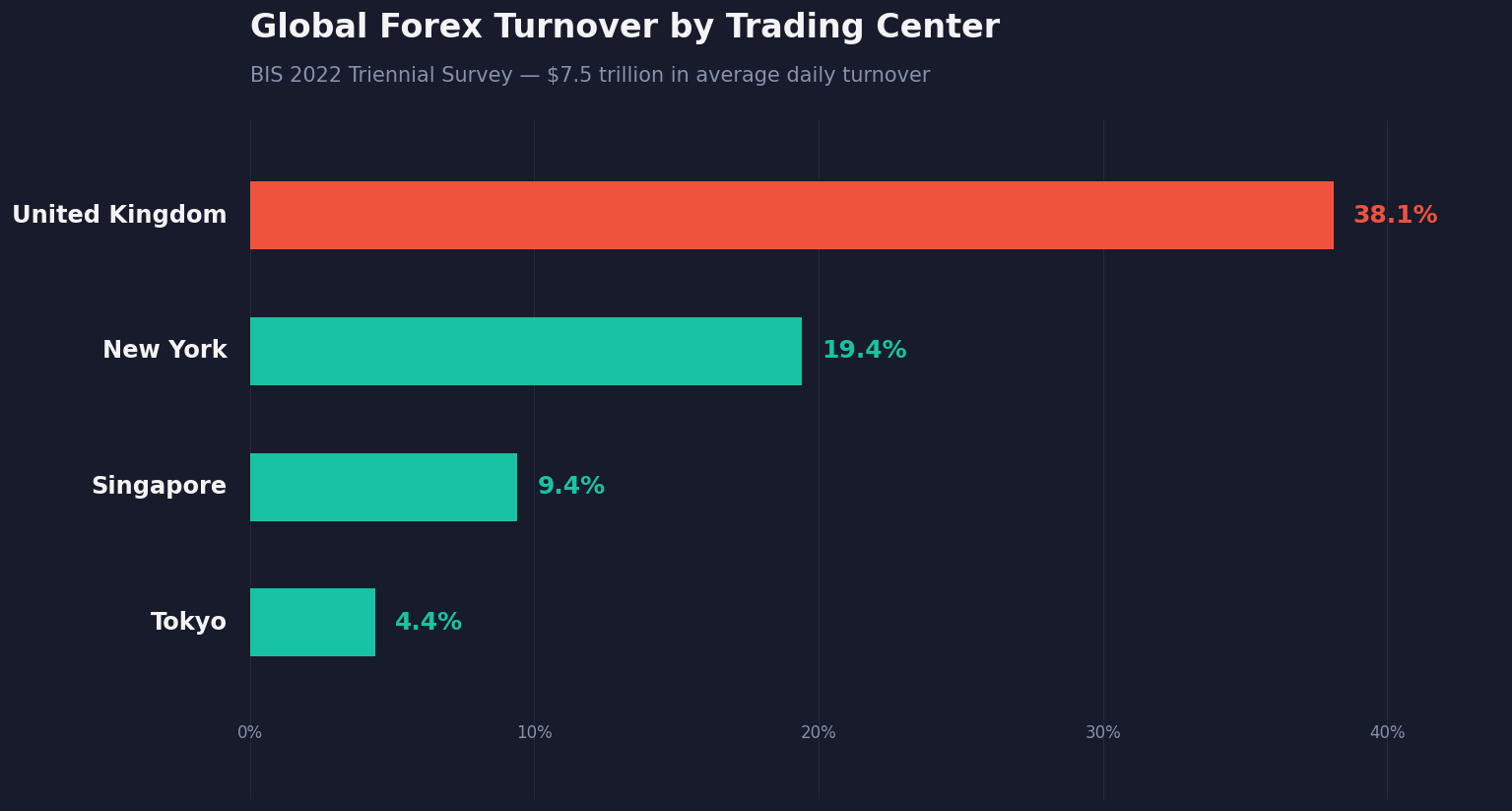
The Bank for International Settlements 2022 Triennial Survey recorded global daily forex turnover at $7.5 trillion. The United Kingdom accounted for 38.1% of that total. New York came second at 19.4%. Singapore ranked third at 9.4%. Tokyo came fourth at 4.4%.global forex
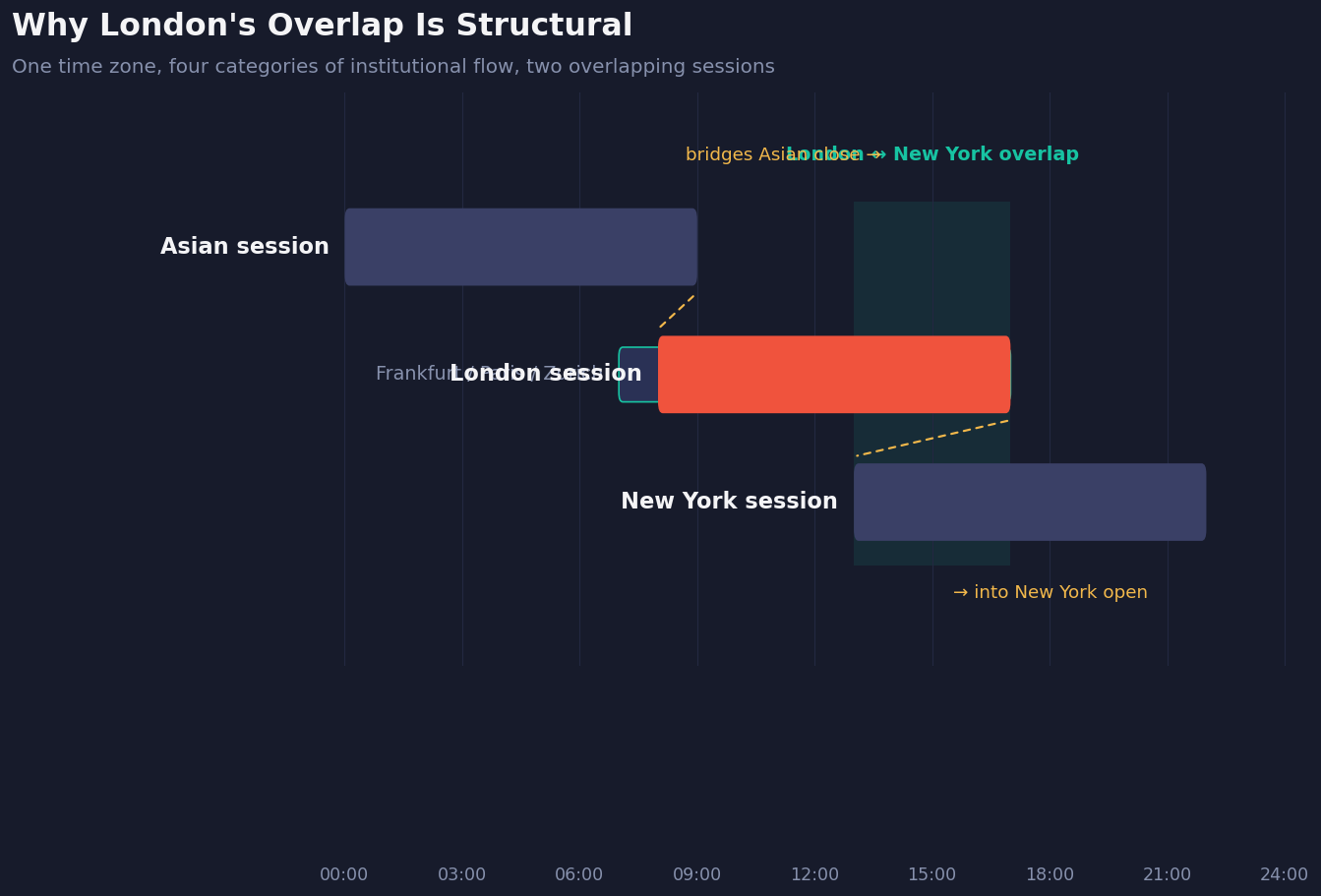
London's dominance is structural, not historical. It sits in a time zone that bridges the close of Asian trading and the open of North American trading. European banking centers in Frankfurt, Paris, and Zurich operate in the same morning window. The combined flow from commercial banks, hedge funds, central bank execution desks, and asset managers creates a concentration of order flow that no other session matches.London's dominance is structural
When London opens at 8:00 AM GMT, the transition from thin Asian liquidity to dense European liquidity happens in minutes, not hours. That transition creates the conditions for the 90-minute setup. Without the volume surge, the sweeps would be smaller and less consistent.

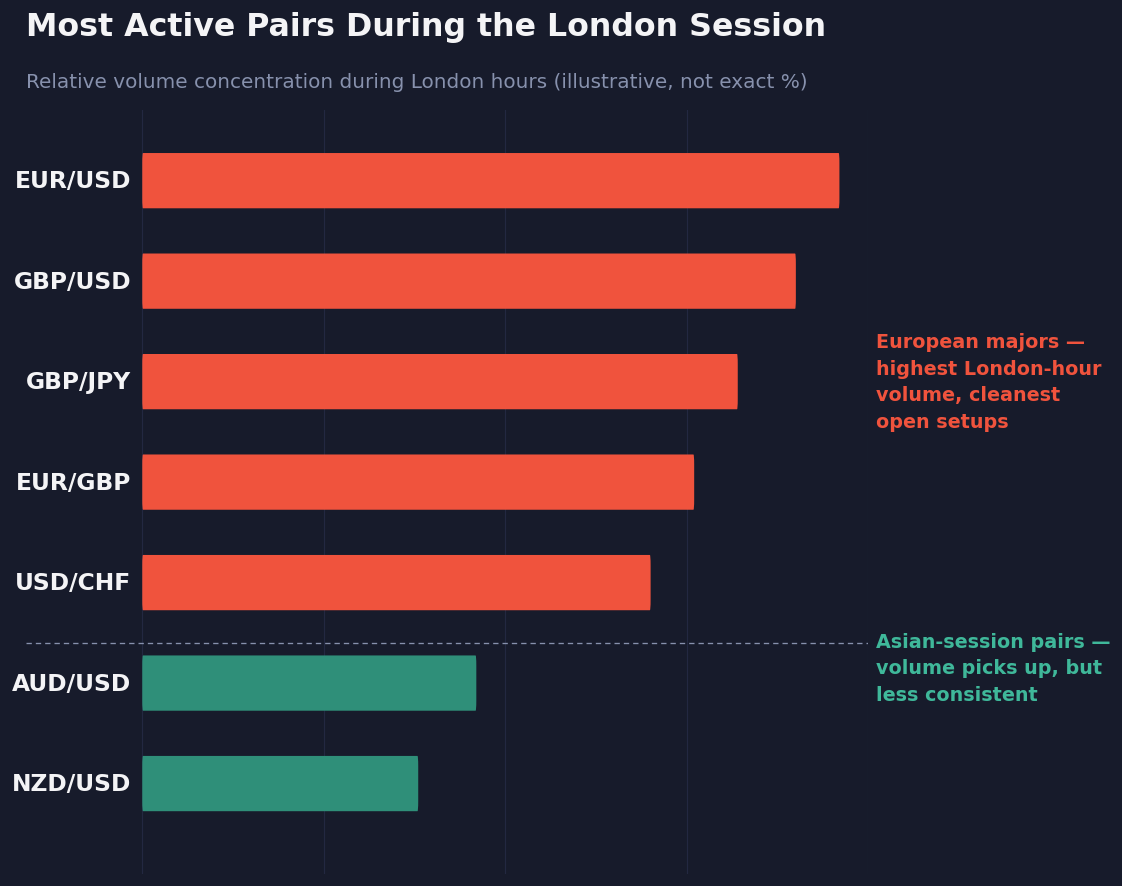
The most active currency pairs during the London session reflect where that volume concentrates. EUR/USD, GBP/USD, GBP/JPY, EUR/GBP, and USD/CHF all see their highest daily volume during London hours. Wider Asian-session pairs like AUD/USD and NZD/USD also see a volume increase, but the cleanest London open setups consistently form on the European majors.most active currency pairs
How the Asian Session Range Sets the Trap
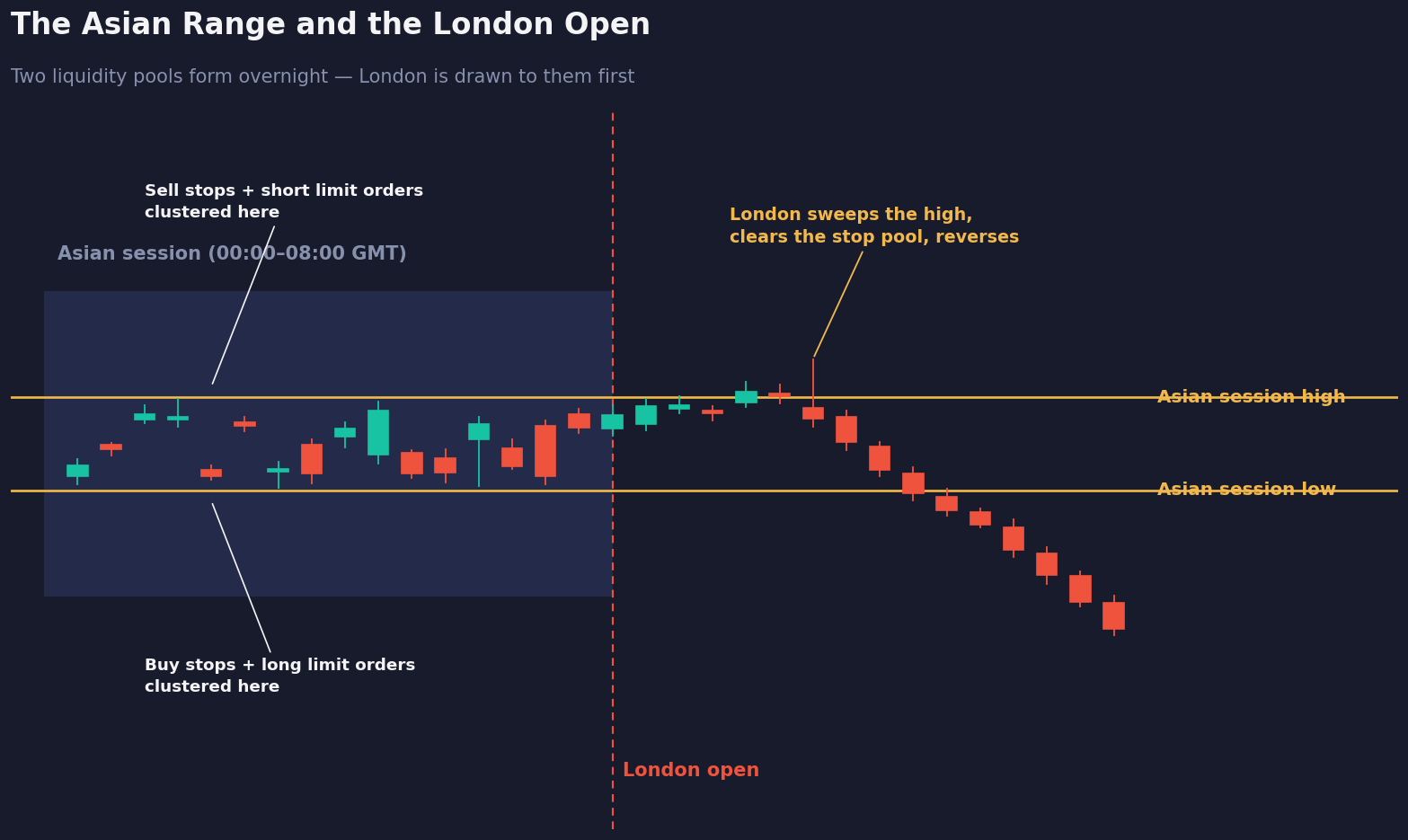
How the Asian Session Range Sets the Trap

The Asian forex session runs from approximately 12:00 AM to 8:00 AM GMT. Liquidity during this window is considerably thinner than London. Price tends to consolidate inside a relatively narrow range on most trading days.

That range creates two boundaries that matter for the London open: the Asian session high and the Asian session low. Both levels carry significant liquidity. Retail traders who sold during the Asian session placed their stop-losses above the high. Retail traders who bought placed their stop-losses below the low. Limit orders from traders waiting to enter short sit just above the high. Limit orders from traders waiting to enter long sit just below the low.

The result is two pools of clustered orders sitting untouched at the start of the London session. These pools are public information, visible on any price chart to any participant. Institutional desks know exactly where they are. This is the foundation of why the London open setup repeats with the consistency it does.

Traders who understand liquidity in trading recognize that price is always drawn toward these pools before committing to a directional move. The Asian range creates the clearest example of this dynamic every single trading day.

The 90-Minute Liquidity Sweep Setup

The London kill zone setup follows a four-stage sequence. This is not a mechanical rule that fires every session without variation. It is a repeatable pattern grounded in institutional order-flow mechanics. Here are the four stages in order.

  • Mark the Asian range: At or just before 8:00 AM GMT, identify the Asian session high (the highest price from 12:00 AM to 8:00 AM GMT) and the Asian session low. Draw a horizontal line at each level on a 15-minute or 5-minute chart.
  • Watch for the sweep: In the first 15 to 45 minutes after the London open, price typically pushes above the Asian high or below the Asian low. This spike triggers the cluster of stop-losses and pending orders sitting at that level.
  • Look for rejection: The sweep appears as a wick or a short-lived price spike, not a sustained breakout. After triggering the stops, price reverses sharply. A strong rejection candle confirms the sweep is complete.
  • Enter on the reversal: Once the rejection candle closes, enter in the direction opposite to the sweep. Place the stop-loss 3 to 5 pips beyond the sweep wick. The first profit target is the opposite side of the Asian range. A second target is the prior day's high or low, or the nearest major structure level.

The most active pairs for this setup are EUR/USD, GBP/USD, and GBP/JPY. On EUR/USD, the Asian range typically spans 20 to 40 pips. The directional move after a confirmed sweep often covers 50 to 100 pips or more in a single London session.

A sweep that does not reverse within two 15-minute candles is a warning sign. If price sweeps the Asian high and continues closing candles above it, the setup has failed. Do not chase the original trade idea.

Why Institutional Order Flow Creates These Patterns

Understanding the mechanics behind the pattern is as important as knowing the pattern itself. Large institutions manage positions worth hundreds of millions to billions of dollars. Filling an order of that size in a thin market pushes price against the institution before the full position is built.

A desk filling a $500 million EUR/USD sell order pushes price down as it sells. The later fills in that order come at worse prices. The solution is to fill where liquidity already exists in large volume. The clusters of stop-losses and pending orders around the Asian session high and low provide exactly that liquidity.

When the institution pushes price above the Asian high, it triggers a flood of sell stop-orders from retail traders who held long positions through the Asian session. Those sell orders become the liquidity the institution needs to build a large short position at levels it has targeted. Once the position is built, the buying pressure that was pushing price up stops. Price reverses under the weight of the new short position.

This process is not manipulation in any legal sense. It is the mechanics of large-volume execution in a market with deeply unequal participant sizes. The smart money concepts trading strategy framework maps out how these institutional mechanics create the price-structure patterns visible on retail charts. Most retail traders see a false breakout. Traders who understand institutional order flow see a liquidity collection event followed by a directional move. The difference in framing determines whether the same price action generates a loss or a profit.

How to Identify the Setup in Real Time

Identifying the London open liquidity sweep requires a structured pre-session and in-session checklist. Here is how to approach each trading day.

Before 8:00 AM GMT, complete the following preparation steps.

  1. Mark the Asian session high on the current-day chart (highest price from 12:00 AM to 7:55 AM GMT).
  2. Mark the Asian session low (lowest price in the same window).
  3. Note the range size in pips and compare it to the 20-day average Asian range for that pair.
  4. Check the economic calendar for any scheduled releases in the first 90 minutes of London.

At 8:00 AM GMT, move to in-session observation.

  1. Watch the first 15-minute candle for directional bias. Does it push toward the Asian high or low?
  2. Note which side of the range is being targeted. This tells you which liquidity pool is likely to be swept first.
  3. Wait. Do not enter on the spike itself. Wait for the candle to close.

After the sweep candle closes, execute the trade.

  1. Confirm rejection with a pin bar, bearish or bullish engulfing candle, or a strong opposing close.
  2. Enter in the direction of the reversal.
  3. Set the stop-loss 3 to 5 pips beyond the wick of the sweep candle.
  4. Set the first target at the opposite end of the Asian range, and a second target at the prior day's major structure.

Understanding what is price action trading gives the foundation for reading the rejection candles that confirm the sweep is complete. Without that foundation, the entry timing is guesswork.

On days with a major news release in the first 90 minutes, the economic data can amplify or override the sweep. PMI releases, central bank speeches, and CPI prints can all push price far beyond the Asian range without the typical rejection.

Risk Management During the London Open

The London open is the highest-volatility window of the trading day. That volatility creates the edge, but it also creates specific risk management challenges that do not apply to other trading windows.

Spread widening occurs in the 5 to 10 minutes immediately around 8:00 AM GMT. On major pairs like EUR/USD, broker spreads can temporarily widen to 2 to 4 times their normal levels. Entering inside that window means paying an inflated spread that can push a tight-stop trade into an immediate loss. Waiting for the first complete 15-minute candle to close after 8:00 AM typically avoids the worst of this widening.

False sweeps happen when price pushes beyond the Asian range and continues without reversing. These occur most often on days with a strong directional catalyst, such as an unexpected economic release or central bank comment. The rule is straightforward: if price does not close a reversal candle within two 15-minute candles after the sweep, exit the position and treat the session as no-trade.

Stop placement should not use fixed pip values during the London open. A more reliable method is to place the stop 3 to 5 pips beyond the actual sweep wick, then calculate position size to keep that stop within 1 to 2% of account equity. More on this approach in the guide on what is a stop loss and how to size around it correctly.

Overtrading is the most common mistake traders make in this window. The fast-moving candles generate multiple apparent signals in rapid succession. The structure is clear only in hindsight. Taking more than one or two trades inside the 90-minute window multiplies risk without multiplying edge. The guide on how-to-stop-overtradinghow to stop overtrading in forex addresses the behavioral side of this problem directly.

How the London New York Overlap Changes the Setup

The London and New York sessions overlap from approximately 1:00 PM to 5:00 PM GMT. This window carries the highest aggregate volume of the entire forex trading day, because two of the three largest market centers are simultaneously active.

The directional move established during the London morning frequently extends into the overlap. A confirmed reversal short on EUR/USD at 8:30 AM GMT often continues declining as New York desks activate at 1:00 PM GMT and add selling pressure in the same direction. Traders who hold a partial position from the London open trade into the overlap frequently capture an additional 30 to 60 pips beyond the initial target.

Overlap also generates its own liquidity collection events. Price often forms a fresh consolidation range between 10:00 AM and 12:30 PM GMT, sometimes called the London pre-New York consolidation. When New York opens at 1:00 PM GMT, a second sweep can form off that range. This is a separate setup from the 8:00 AM London open trade and should be treated as such.

The bias established in the London morning is the most reliable filter for the overlap period. If the London morning setup generated a downside sweep and a confirmed long reversal on EUR/USD, the default approach in the overlap is to look for continuation long setups, not new shorts. Counter-trend positions during the overlap require a strong technical justification that overrides the morning bias.

Also Read: Liquidity in Trading: Smart Money Is Using It Against You

Conclusion

The London trading session is not just the busiest period in forex. It is a structured 90-minute sequence where institutional order flow follows a recognizable pattern every trading day. The Asian session builds the range. London opens and sweeps one side of that range to collect liquidity. The directional move follows the sweep, not the other way around.

Retail traders who treat the London open as simply the best time to trade miss the edge entirely. The edge comes from understanding the sequence and entering after the sweep is confirmed, not before. Timing the entry to the sweep reversal, rather than reacting to the first candle that looks tradable, is the single biggest factor separating profitable London open trades from losing ones.

Frequently Asked Questions

What time does the London trading session open in GMT?

The London trading session opens at 8:00 AM London local time every trading day. In winter (November to March), that equals 8:00 AM GMT because the UK is on Greenwich Mean Time. In summer (March to October), the UK operates on British Summer Time (BST, UTC+1), which moves the London open to 7:00 AM GMT while remaining 8:00 AM local time. Most forex traders use 8:00 AM GMT as the reference and adjust during the BST period.

What is the London kill zone in forex trading?

The London kill zone refers to the first 90 minutes of the London trading session, from 8:00 AM to 9:30 AM GMT. During this window, institutional order flow sweeps the Asian session range high or low to collect liquidity before reversing into the day's directional trend. Traders who identify this sweep and enter on the confirmed reversal access one of the highest-probability setups in forex.

Why does price sweep the Asian session range at the London open?

Large institutions need liquidity to fill large positions without pushing price against themselves. The clusters of retail stop-losses and pending orders sitting above the Asian session high and below the Asian session low provide that liquidity. By pushing price briefly beyond those levels and triggering the retail orders, institutional desks collect the liquidity they need to build directional positions at targeted price levels.

Which currency pairs are best for the London open setup?

EUR/USD, GBP/USD, and GBP/JPY consistently produce the clearest London open setups because they carry the highest volume during the London session. EUR/GBP and EUR/CHF also form reliable setups. Low-volume exotic pairs are not suitable for this strategy because the sweeps are less predictable and the spreads during the volatile open window are significantly wider.

How does the London New York overlap affect forex trading?

The London New York overlap runs from approximately 1:00 PM to 5:00 PM GMT and carries the highest volume of the trading day. The directional move established in the London morning frequently extends into this window. Traders holding partial positions from a London open setup can often capture additional movement during the overlap. The bias from the London morning is the primary filter for determining trade direction during the overlap.


About Ezekiel Chew​

Ezekiel Chew, founder and head of training at Asia Forex Mentor, is a renowned forex expert, frequently invited to speak at major industry events. Known for his deep market insights, Ezekiel is one of the top traders committed to supporting the trading community. Making six figures per trade, he also trains traders working in banks, fund management, and prop trading firms.

Forex Trading Techniques The Pros Actually Use In 2026

Most traders lose with good forex trading techniques, not bad ones. They apply the right method at the wrong time, in the wrong market, against the wrong trend. The technique gets blamed, but the real failure is in the timing and the context. This guide covers the part that actually

Read More

12 Forex Candlestick Indicators Ranked by Reliability

Candlestick indicators fail traders not because the patterns are wrong, but because memorizing shapes without market context is not a strategy. ABOUT THIS GUIDE This guide ranks 12 candlestick indicators by reliability in forex, explains the buyer and seller behavior behind each pattern, and gives exact entry triggers and stop

Read More

Average True Range Most Traders Use It Wrong

Most traders treat the average true range as a background indicator and use it the same way beginners do: glance at the number and guess at a stop loss. ABOUT THIS GUIDE This guide covers how professional forex traders actually apply the average true range. It goes from ATR stop

Read More

8 Best Day Trading Books That Actually Works

The best day trading books on most recommended lists were written for markets that no longer exist the way they once did. Traders buy the top-rated titles, work through them, and find that the strategies fail in a live account. The problem is rarely the trader. Most lists recommend books

Read More

Position Size Calculator Every Forex Trader Needs

Most traders lose their accounts not because of a bad entry call but because they put too much on the line. The position size calculator is what stops that from happening before an order is ever placed. ABOUT THIS GUIDE This guide covers what a position size calculator actually does,

Read More

AFM Trading Summit Live

Date: Coming Soon

Join us at the AFM Trading Summit Live and learn from top industry experts through live trading sessions, market insights, and actionable strategies.

London Trading Session 90 Minute Playbook for 2026

4.0
Overall Trust Index

Written by:

Updated:

August 10, 2026
Most traders lose money during the London trading session. The setup is not the problem. They enter before the real move begins.
ABOUT THIS GUIDE This guide covers the specific price-action setups that form in the first 90 minutes of the London forex market open, the institutional order-flow mechanics behind them, and a step-by-step method for identifying high-probability entries in real time.
 
QUICK ANSWER The London trading session opens at 8:00 AM GMT. In the first 90 minutes, institutional order flow sweeps liquidity above or below the Asian session range before reversing into the day's directional move. Identifying that sweep and waiting for reversal confirmation is the core setup.

When the London Trading Session Opens

The London trading session opens at 8:00 AM London local time, Monday through Friday. In winter (November to March), London runs on GMT (UTC+0), so the open is 8:00 AM GMT. In summer (March to October), the UK shifts to British Summer Time (BST, UTC+1), which moves the open to 7:00 AM GMT but keeps it at 8:00 AM local London time. Most forex traders use 8:00 AM GMT as the standard reference and adjust manually for the BST shift. The key trading window runs from 8:00 AM to 9:30 AM GMT. Most institutional price action around the London open unfolds inside this 90-minute frame. The table below converts the London open to major trader time zones.
Time Zone London Open (Winter / GMT) London Open (Summer / BST)
GMT (UK winter) 8:00 AM 7:00 AM
EST (New York winter) 3:00 AM 4:00 AM EDT
SGT (Singapore) 4:00 PM 3:00 PM
JST (Tokyo) 5:00 PM 4:00 PM
AEDT (Sydney summer) 7:00 PM 6:00 PM
CET (Frankfurt/Paris winter) 9:00 AM 8:00 AM CEST
The 90-minute window closes at 9:30 AM GMT. After that point, the initial directional move is typically established and the high-probability entry window for the London open setup has passed.

Why London Commands 38% of Daily Forex Volume

The Bank for International Settlements 2022 Triennial Survey recorded global daily forex turnover at $7.5 trillion. The United Kingdom accounted for 38.1% of that total. New York came second at 19.4%. Singapore ranked third at 9.4%. Tokyo came fourth at 4.4%.global forex London's dominance is structural, not historical. It sits in a time zone that bridges the close of Asian trading and the open of North American trading. European banking centers in Frankfurt, Paris, and Zurich operate in the same morning window. The combined flow from commercial banks, hedge funds, central bank execution desks, and asset managers creates a concentration of order flow that no other session matches.London's dominance is structural When London opens at 8:00 AM GMT, the transition from thin Asian liquidity to dense European liquidity happens in minutes, not hours. That transition creates the conditions for the 90-minute setup. Without the volume surge, the sweeps would be smaller and less consistent. The most active currency pairs during the London session reflect where that volume concentrates. EUR/USD, GBP/USD, GBP/JPY, EUR/GBP, and USD/CHF all see their highest daily volume during London hours. Wider Asian-session pairs like AUD/USD and NZD/USD also see a volume increase, but the cleanest London open setups consistently form on the European majors.most active currency pairs

How the Asian Session Range Sets the Trap

How the Asian Session Range Sets the Trap The Asian forex session runs from approximately 12:00 AM to 8:00 AM GMT. Liquidity during this window is considerably thinner than London. Price tends to consolidate inside a relatively narrow range on most trading days. That range creates two boundaries that matter for the London open: the Asian session high and the Asian session low. Both levels carry significant liquidity. Retail traders who sold during the Asian session placed their stop-losses above the high. Retail traders who bought placed their stop-losses below the low. Limit orders from traders waiting to enter short sit just above the high. Limit orders from traders waiting to enter long sit just below the low. The result is two pools of clustered orders sitting untouched at the start of the London session. These pools are public information, visible on any price chart to any participant. Institutional desks know exactly where they are. This is the foundation of why the London open setup repeats with the consistency it does. Traders who understand liquidity in trading recognize that price is always drawn toward these pools before committing to a directional move. The Asian range creates the clearest example of this dynamic every single trading day.

The 90-Minute Liquidity Sweep Setup

The London kill zone setup follows a four-stage sequence. This is not a mechanical rule that fires every session without variation. It is a repeatable pattern grounded in institutional order-flow mechanics. Here are the four stages in order.
  • Mark the Asian range: At or just before 8:00 AM GMT, identify the Asian session high (the highest price from 12:00 AM to 8:00 AM GMT) and the Asian session low. Draw a horizontal line at each level on a 15-minute or 5-minute chart.
  • Watch for the sweep: In the first 15 to 45 minutes after the London open, price typically pushes above the Asian high or below the Asian low. This spike triggers the cluster of stop-losses and pending orders sitting at that level.
  • Look for rejection: The sweep appears as a wick or a short-lived price spike, not a sustained breakout. After triggering the stops, price reverses sharply. A strong rejection candle confirms the sweep is complete.
  • Enter on the reversal: Once the rejection candle closes, enter in the direction opposite to the sweep. Place the stop-loss 3 to 5 pips beyond the sweep wick. The first profit target is the opposite side of the Asian range. A second target is the prior day's high or low, or the nearest major structure level.
The most active pairs for this setup are EUR/USD, GBP/USD, and GBP/JPY. On EUR/USD, the Asian range typically spans 20 to 40 pips. The directional move after a confirmed sweep often covers 50 to 100 pips or more in a single London session. A sweep that does not reverse within two 15-minute candles is a warning sign. If price sweeps the Asian high and continues closing candles above it, the setup has failed. Do not chase the original trade idea.

Why Institutional Order Flow Creates These Patterns

Understanding the mechanics behind the pattern is as important as knowing the pattern itself. Large institutions manage positions worth hundreds of millions to billions of dollars. Filling an order of that size in a thin market pushes price against the institution before the full position is built. A desk filling a $500 million EUR/USD sell order pushes price down as it sells. The later fills in that order come at worse prices. The solution is to fill where liquidity already exists in large volume. The clusters of stop-losses and pending orders around the Asian session high and low provide exactly that liquidity. When the institution pushes price above the Asian high, it triggers a flood of sell stop-orders from retail traders who held long positions through the Asian session. Those sell orders become the liquidity the institution needs to build a large short position at levels it has targeted. Once the position is built, the buying pressure that was pushing price up stops. Price reverses under the weight of the new short position. This process is not manipulation in any legal sense. It is the mechanics of large-volume execution in a market with deeply unequal participant sizes. The smart money concepts trading strategy framework maps out how these institutional mechanics create the price-structure patterns visible on retail charts. Most retail traders see a false breakout. Traders who understand institutional order flow see a liquidity collection event followed by a directional move. The difference in framing determines whether the same price action generates a loss or a profit.

How to Identify the Setup in Real Time

Identifying the London open liquidity sweep requires a structured pre-session and in-session checklist. Here is how to approach each trading day. Before 8:00 AM GMT, complete the following preparation steps.
  1. Mark the Asian session high on the current-day chart (highest price from 12:00 AM to 7:55 AM GMT).
  2. Mark the Asian session low (lowest price in the same window).
  3. Note the range size in pips and compare it to the 20-day average Asian range for that pair.
  4. Check the economic calendar for any scheduled releases in the first 90 minutes of London.
At 8:00 AM GMT, move to in-session observation.
  1. Watch the first 15-minute candle for directional bias. Does it push toward the Asian high or low?
  2. Note which side of the range is being targeted. This tells you which liquidity pool is likely to be swept first.
  3. Wait. Do not enter on the spike itself. Wait for the candle to close.
After the sweep candle closes, execute the trade.
  1. Confirm rejection with a pin bar, bearish or bullish engulfing candle, or a strong opposing close.
  2. Enter in the direction of the reversal.
  3. Set the stop-loss 3 to 5 pips beyond the wick of the sweep candle.
  4. Set the first target at the opposite end of the Asian range, and a second target at the prior day's major structure.
Understanding what is price action trading gives the foundation for reading the rejection candles that confirm the sweep is complete. Without that foundation, the entry timing is guesswork. On days with a major news release in the first 90 minutes, the economic data can amplify or override the sweep. PMI releases, central bank speeches, and CPI prints can all push price far beyond the Asian range without the typical rejection.

Risk Management During the London Open

The London open is the highest-volatility window of the trading day. That volatility creates the edge, but it also creates specific risk management challenges that do not apply to other trading windows. Spread widening occurs in the 5 to 10 minutes immediately around 8:00 AM GMT. On major pairs like EUR/USD, broker spreads can temporarily widen to 2 to 4 times their normal levels. Entering inside that window means paying an inflated spread that can push a tight-stop trade into an immediate loss. Waiting for the first complete 15-minute candle to close after 8:00 AM typically avoids the worst of this widening. False sweeps happen when price pushes beyond the Asian range and continues without reversing. These occur most often on days with a strong directional catalyst, such as an unexpected economic release or central bank comment. The rule is straightforward: if price does not close a reversal candle within two 15-minute candles after the sweep, exit the position and treat the session as no-trade. Stop placement should not use fixed pip values during the London open. A more reliable method is to place the stop 3 to 5 pips beyond the actual sweep wick, then calculate position size to keep that stop within 1 to 2% of account equity. More on this approach in the guide on what is a stop loss and how to size around it correctly. Overtrading is the most common mistake traders make in this window. The fast-moving candles generate multiple apparent signals in rapid succession. The structure is clear only in hindsight. Taking more than one or two trades inside the 90-minute window multiplies risk without multiplying edge. The guide on how-to-stop-overtradinghow to stop overtrading in forex addresses the behavioral side of this problem directly.

How the London New York Overlap Changes the Setup

The London and New York sessions overlap from approximately 1:00 PM to 5:00 PM GMT. This window carries the highest aggregate volume of the entire forex trading day, because two of the three largest market centers are simultaneously active. The directional move established during the London morning frequently extends into the overlap. A confirmed reversal short on EUR/USD at 8:30 AM GMT often continues declining as New York desks activate at 1:00 PM GMT and add selling pressure in the same direction. Traders who hold a partial position from the London open trade into the overlap frequently capture an additional 30 to 60 pips beyond the initial target. Overlap also generates its own liquidity collection events. Price often forms a fresh consolidation range between 10:00 AM and 12:30 PM GMT, sometimes called the London pre-New York consolidation. When New York opens at 1:00 PM GMT, a second sweep can form off that range. This is a separate setup from the 8:00 AM London open trade and should be treated as such. The bias established in the London morning is the most reliable filter for the overlap period. If the London morning setup generated a downside sweep and a confirmed long reversal on EUR/USD, the default approach in the overlap is to look for continuation long setups, not new shorts. Counter-trend positions during the overlap require a strong technical justification that overrides the morning bias.

Also Read: Liquidity in Trading: Smart Money Is Using It Against You

Conclusion

The London trading session is not just the busiest period in forex. It is a structured 90-minute sequence where institutional order flow follows a recognizable pattern every trading day. The Asian session builds the range. London opens and sweeps one side of that range to collect liquidity. The directional move follows the sweep, not the other way around. Retail traders who treat the London open as simply the best time to trade miss the edge entirely. The edge comes from understanding the sequence and entering after the sweep is confirmed, not before. Timing the entry to the sweep reversal, rather than reacting to the first candle that looks tradable, is the single biggest factor separating profitable London open trades from losing ones.

Frequently Asked Questions

What time does the London trading session open in GMT?

The London trading session opens at 8:00 AM London local time every trading day. In winter (November to March), that equals 8:00 AM GMT because the UK is on Greenwich Mean Time. In summer (March to October), the UK operates on British Summer Time (BST, UTC+1), which moves the London open to 7:00 AM GMT while remaining 8:00 AM local time. Most forex traders use 8:00 AM GMT as the reference and adjust during the BST period.

What is the London kill zone in forex trading?

The London kill zone refers to the first 90 minutes of the London trading session, from 8:00 AM to 9:30 AM GMT. During this window, institutional order flow sweeps the Asian session range high or low to collect liquidity before reversing into the day's directional trend. Traders who identify this sweep and enter on the confirmed reversal access one of the highest-probability setups in forex.

Why does price sweep the Asian session range at the London open?

Large institutions need liquidity to fill large positions without pushing price against themselves. The clusters of retail stop-losses and pending orders sitting above the Asian session high and below the Asian session low provide that liquidity. By pushing price briefly beyond those levels and triggering the retail orders, institutional desks collect the liquidity they need to build directional positions at targeted price levels.

Which currency pairs are best for the London open setup?

EUR/USD, GBP/USD, and GBP/JPY consistently produce the clearest London open setups because they carry the highest volume during the London session. EUR/GBP and EUR/CHF also form reliable setups. Low-volume exotic pairs are not suitable for this strategy because the sweeps are less predictable and the spreads during the volatile open window are significantly wider.

How does the London New York overlap affect forex trading?

The London New York overlap runs from approximately 1:00 PM to 5:00 PM GMT and carries the highest volume of the trading day. The directional move established in the London morning frequently extends into this window. Traders holding partial positions from a London open setup can often capture additional movement during the overlap. The bias from the London morning is the primary filter for determining trade direction during the overlap.
ezekiel chew asiaforexmentor

About Ezekiel Chew

Ezekiel Chew, founder and head of training at Asia Forex Mentor, is a renowned forex expert, frequently invited to speak at major industry events. Known for his deep market insights, Ezekiel is one of the top traders committed to supporting the trading community. Making six figures per trade, he also trains traders working in banks, fund management, and prop trading firms.

RELATED ARTICLES

London Trading Session 90 Minute Playbook for 2026

4.0
Overall Trust Index

Written by:

Updated:

August 10, 2026
Most traders lose money during the London trading session. The setup is not the problem. They enter before the real move begins.
ABOUT THIS GUIDE This guide covers the specific price-action setups that form in the first 90 minutes of the London forex market open, the institutional order-flow mechanics behind them, and a step-by-step method for identifying high-probability entries in real time.
 
QUICK ANSWER The London trading session opens at 8:00 AM GMT. In the first 90 minutes, institutional order flow sweeps liquidity above or below the Asian session range before reversing into the day's directional move. Identifying that sweep and waiting for reversal confirmation is the core setup.

When the London Trading Session Opens

The London trading session opens at 8:00 AM London local time, Monday through Friday. In winter (November to March), London runs on GMT (UTC+0), so the open is 8:00 AM GMT. In summer (March to October), the UK shifts to British Summer Time (BST, UTC+1), which moves the open to 7:00 AM GMT but keeps it at 8:00 AM local London time. Most forex traders use 8:00 AM GMT as the standard reference and adjust manually for the BST shift. The key trading window runs from 8:00 AM to 9:30 AM GMT. Most institutional price action around the London open unfolds inside this 90-minute frame. The table below converts the London open to major trader time zones.
Time Zone London Open (Winter / GMT) London Open (Summer / BST)
GMT (UK winter) 8:00 AM 7:00 AM
EST (New York winter) 3:00 AM 4:00 AM EDT
SGT (Singapore) 4:00 PM 3:00 PM
JST (Tokyo) 5:00 PM 4:00 PM
AEDT (Sydney summer) 7:00 PM 6:00 PM
CET (Frankfurt/Paris winter) 9:00 AM 8:00 AM CEST
The 90-minute window closes at 9:30 AM GMT. After that point, the initial directional move is typically established and the high-probability entry window for the London open setup has passed.

Why London Commands 38% of Daily Forex Volume

The Bank for International Settlements 2022 Triennial Survey recorded global daily forex turnover at $7.5 trillion. The United Kingdom accounted for 38.1% of that total. New York came second at 19.4%. Singapore ranked third at 9.4%. Tokyo came fourth at 4.4%.global forex London's dominance is structural, not historical. It sits in a time zone that bridges the close of Asian trading and the open of North American trading. European banking centers in Frankfurt, Paris, and Zurich operate in the same morning window. The combined flow from commercial banks, hedge funds, central bank execution desks, and asset managers creates a concentration of order flow that no other session matches.London's dominance is structural When London opens at 8:00 AM GMT, the transition from thin Asian liquidity to dense European liquidity happens in minutes, not hours. That transition creates the conditions for the 90-minute setup. Without the volume surge, the sweeps would be smaller and less consistent. The most active currency pairs during the London session reflect where that volume concentrates. EUR/USD, GBP/USD, GBP/JPY, EUR/GBP, and USD/CHF all see their highest daily volume during London hours. Wider Asian-session pairs like AUD/USD and NZD/USD also see a volume increase, but the cleanest London open setups consistently form on the European majors.most active currency pairs

How the Asian Session Range Sets the Trap

How the Asian Session Range Sets the Trap The Asian forex session runs from approximately 12:00 AM to 8:00 AM GMT. Liquidity during this window is considerably thinner than London. Price tends to consolidate inside a relatively narrow range on most trading days. That range creates two boundaries that matter for the London open: the Asian session high and the Asian session low. Both levels carry significant liquidity. Retail traders who sold during the Asian session placed their stop-losses above the high. Retail traders who bought placed their stop-losses below the low. Limit orders from traders waiting to enter short sit just above the high. Limit orders from traders waiting to enter long sit just below the low. The result is two pools of clustered orders sitting untouched at the start of the London session. These pools are public information, visible on any price chart to any participant. Institutional desks know exactly where they are. This is the foundation of why the London open setup repeats with the consistency it does. Traders who understand liquidity in trading recognize that price is always drawn toward these pools before committing to a directional move. The Asian range creates the clearest example of this dynamic every single trading day.

The 90-Minute Liquidity Sweep Setup

The London kill zone setup follows a four-stage sequence. This is not a mechanical rule that fires every session without variation. It is a repeatable pattern grounded in institutional order-flow mechanics. Here are the four stages in order.
  • Mark the Asian range: At or just before 8:00 AM GMT, identify the Asian session high (the highest price from 12:00 AM to 8:00 AM GMT) and the Asian session low. Draw a horizontal line at each level on a 15-minute or 5-minute chart.
  • Watch for the sweep: In the first 15 to 45 minutes after the London open, price typically pushes above the Asian high or below the Asian low. This spike triggers the cluster of stop-losses and pending orders sitting at that level.
  • Look for rejection: The sweep appears as a wick or a short-lived price spike, not a sustained breakout. After triggering the stops, price reverses sharply. A strong rejection candle confirms the sweep is complete.
  • Enter on the reversal: Once the rejection candle closes, enter in the direction opposite to the sweep. Place the stop-loss 3 to 5 pips beyond the sweep wick. The first profit target is the opposite side of the Asian range. A second target is the prior day's high or low, or the nearest major structure level.
The most active pairs for this setup are EUR/USD, GBP/USD, and GBP/JPY. On EUR/USD, the Asian range typically spans 20 to 40 pips. The directional move after a confirmed sweep often covers 50 to 100 pips or more in a single London session. A sweep that does not reverse within two 15-minute candles is a warning sign. If price sweeps the Asian high and continues closing candles above it, the setup has failed. Do not chase the original trade idea.

Why Institutional Order Flow Creates These Patterns

Understanding the mechanics behind the pattern is as important as knowing the pattern itself. Large institutions manage positions worth hundreds of millions to billions of dollars. Filling an order of that size in a thin market pushes price against the institution before the full position is built. A desk filling a $500 million EUR/USD sell order pushes price down as it sells. The later fills in that order come at worse prices. The solution is to fill where liquidity already exists in large volume. The clusters of stop-losses and pending orders around the Asian session high and low provide exactly that liquidity. When the institution pushes price above the Asian high, it triggers a flood of sell stop-orders from retail traders who held long positions through the Asian session. Those sell orders become the liquidity the institution needs to build a large short position at levels it has targeted. Once the position is built, the buying pressure that was pushing price up stops. Price reverses under the weight of the new short position. This process is not manipulation in any legal sense. It is the mechanics of large-volume execution in a market with deeply unequal participant sizes. The smart money concepts trading strategy framework maps out how these institutional mechanics create the price-structure patterns visible on retail charts. Most retail traders see a false breakout. Traders who understand institutional order flow see a liquidity collection event followed by a directional move. The difference in framing determines whether the same price action generates a loss or a profit.

How to Identify the Setup in Real Time

Identifying the London open liquidity sweep requires a structured pre-session and in-session checklist. Here is how to approach each trading day. Before 8:00 AM GMT, complete the following preparation steps.
  1. Mark the Asian session high on the current-day chart (highest price from 12:00 AM to 7:55 AM GMT).
  2. Mark the Asian session low (lowest price in the same window).
  3. Note the range size in pips and compare it to the 20-day average Asian range for that pair.
  4. Check the economic calendar for any scheduled releases in the first 90 minutes of London.
At 8:00 AM GMT, move to in-session observation.
  1. Watch the first 15-minute candle for directional bias. Does it push toward the Asian high or low?
  2. Note which side of the range is being targeted. This tells you which liquidity pool is likely to be swept first.
  3. Wait. Do not enter on the spike itself. Wait for the candle to close.
After the sweep candle closes, execute the trade.
  1. Confirm rejection with a pin bar, bearish or bullish engulfing candle, or a strong opposing close.
  2. Enter in the direction of the reversal.
  3. Set the stop-loss 3 to 5 pips beyond the wick of the sweep candle.
  4. Set the first target at the opposite end of the Asian range, and a second target at the prior day's major structure.
Understanding what is price action trading gives the foundation for reading the rejection candles that confirm the sweep is complete. Without that foundation, the entry timing is guesswork. On days with a major news release in the first 90 minutes, the economic data can amplify or override the sweep. PMI releases, central bank speeches, and CPI prints can all push price far beyond the Asian range without the typical rejection.

Risk Management During the London Open

The London open is the highest-volatility window of the trading day. That volatility creates the edge, but it also creates specific risk management challenges that do not apply to other trading windows. Spread widening occurs in the 5 to 10 minutes immediately around 8:00 AM GMT. On major pairs like EUR/USD, broker spreads can temporarily widen to 2 to 4 times their normal levels. Entering inside that window means paying an inflated spread that can push a tight-stop trade into an immediate loss. Waiting for the first complete 15-minute candle to close after 8:00 AM typically avoids the worst of this widening. False sweeps happen when price pushes beyond the Asian range and continues without reversing. These occur most often on days with a strong directional catalyst, such as an unexpected economic release or central bank comment. The rule is straightforward: if price does not close a reversal candle within two 15-minute candles after the sweep, exit the position and treat the session as no-trade. Stop placement should not use fixed pip values during the London open. A more reliable method is to place the stop 3 to 5 pips beyond the actual sweep wick, then calculate position size to keep that stop within 1 to 2% of account equity. More on this approach in the guide on what is a stop loss and how to size around it correctly. Overtrading is the most common mistake traders make in this window. The fast-moving candles generate multiple apparent signals in rapid succession. The structure is clear only in hindsight. Taking more than one or two trades inside the 90-minute window multiplies risk without multiplying edge. The guide on how-to-stop-overtradinghow to stop overtrading in forex addresses the behavioral side of this problem directly.

How the London New York Overlap Changes the Setup

The London and New York sessions overlap from approximately 1:00 PM to 5:00 PM GMT. This window carries the highest aggregate volume of the entire forex trading day, because two of the three largest market centers are simultaneously active. The directional move established during the London morning frequently extends into the overlap. A confirmed reversal short on EUR/USD at 8:30 AM GMT often continues declining as New York desks activate at 1:00 PM GMT and add selling pressure in the same direction. Traders who hold a partial position from the London open trade into the overlap frequently capture an additional 30 to 60 pips beyond the initial target. Overlap also generates its own liquidity collection events. Price often forms a fresh consolidation range between 10:00 AM and 12:30 PM GMT, sometimes called the London pre-New York consolidation. When New York opens at 1:00 PM GMT, a second sweep can form off that range. This is a separate setup from the 8:00 AM London open trade and should be treated as such. The bias established in the London morning is the most reliable filter for the overlap period. If the London morning setup generated a downside sweep and a confirmed long reversal on EUR/USD, the default approach in the overlap is to look for continuation long setups, not new shorts. Counter-trend positions during the overlap require a strong technical justification that overrides the morning bias.

Also Read: Liquidity in Trading: Smart Money Is Using It Against You

Conclusion

The London trading session is not just the busiest period in forex. It is a structured 90-minute sequence where institutional order flow follows a recognizable pattern every trading day. The Asian session builds the range. London opens and sweeps one side of that range to collect liquidity. The directional move follows the sweep, not the other way around. Retail traders who treat the London open as simply the best time to trade miss the edge entirely. The edge comes from understanding the sequence and entering after the sweep is confirmed, not before. Timing the entry to the sweep reversal, rather than reacting to the first candle that looks tradable, is the single biggest factor separating profitable London open trades from losing ones.

Frequently Asked Questions

What time does the London trading session open in GMT?

The London trading session opens at 8:00 AM London local time every trading day. In winter (November to March), that equals 8:00 AM GMT because the UK is on Greenwich Mean Time. In summer (March to October), the UK operates on British Summer Time (BST, UTC+1), which moves the London open to 7:00 AM GMT while remaining 8:00 AM local time. Most forex traders use 8:00 AM GMT as the reference and adjust during the BST period.

What is the London kill zone in forex trading?

The London kill zone refers to the first 90 minutes of the London trading session, from 8:00 AM to 9:30 AM GMT. During this window, institutional order flow sweeps the Asian session range high or low to collect liquidity before reversing into the day's directional trend. Traders who identify this sweep and enter on the confirmed reversal access one of the highest-probability setups in forex.

Why does price sweep the Asian session range at the London open?

Large institutions need liquidity to fill large positions without pushing price against themselves. The clusters of retail stop-losses and pending orders sitting above the Asian session high and below the Asian session low provide that liquidity. By pushing price briefly beyond those levels and triggering the retail orders, institutional desks collect the liquidity they need to build directional positions at targeted price levels.

Which currency pairs are best for the London open setup?

EUR/USD, GBP/USD, and GBP/JPY consistently produce the clearest London open setups because they carry the highest volume during the London session. EUR/GBP and EUR/CHF also form reliable setups. Low-volume exotic pairs are not suitable for this strategy because the sweeps are less predictable and the spreads during the volatile open window are significantly wider.

How does the London New York overlap affect forex trading?

The London New York overlap runs from approximately 1:00 PM to 5:00 PM GMT and carries the highest volume of the trading day. The directional move established in the London morning frequently extends into this window. Traders holding partial positions from a London open setup can often capture additional movement during the overlap. The bias from the London morning is the primary filter for determining trade direction during the overlap.

ezekiel chew asiaforexmentor

About Ezekiel Chew

Ezekiel Chew, founder and head of training at Asia Forex Mentor, is a renowned forex expert, frequently invited to speak at major industry events. Known for his deep market insights, Ezekiel is one of the top traders committed to supporting the trading community. Making six figures per trade, he also trains traders working in banks, fund management, and prop trading firms.

RELATED ARTICLES

Join the Live Event
Get Your Free Ticket Now

I consent to receiving emails and/or text message reminders for this event.

REGISTER FOR THE MASTERCLASS!