
Learn To Trade Forex • Best Forex Trading Course • AsiaForexMentor

Why Oil Just Tanked The Trump-OPEC+ Showdown

Written by

Ezekiel Chew

Updated on

May 30, 2025

i
Its a default text

Why Oil Just Tanked The Trump-OPEC+ Showdown

Written by:

Last updated on:

May 30, 2025

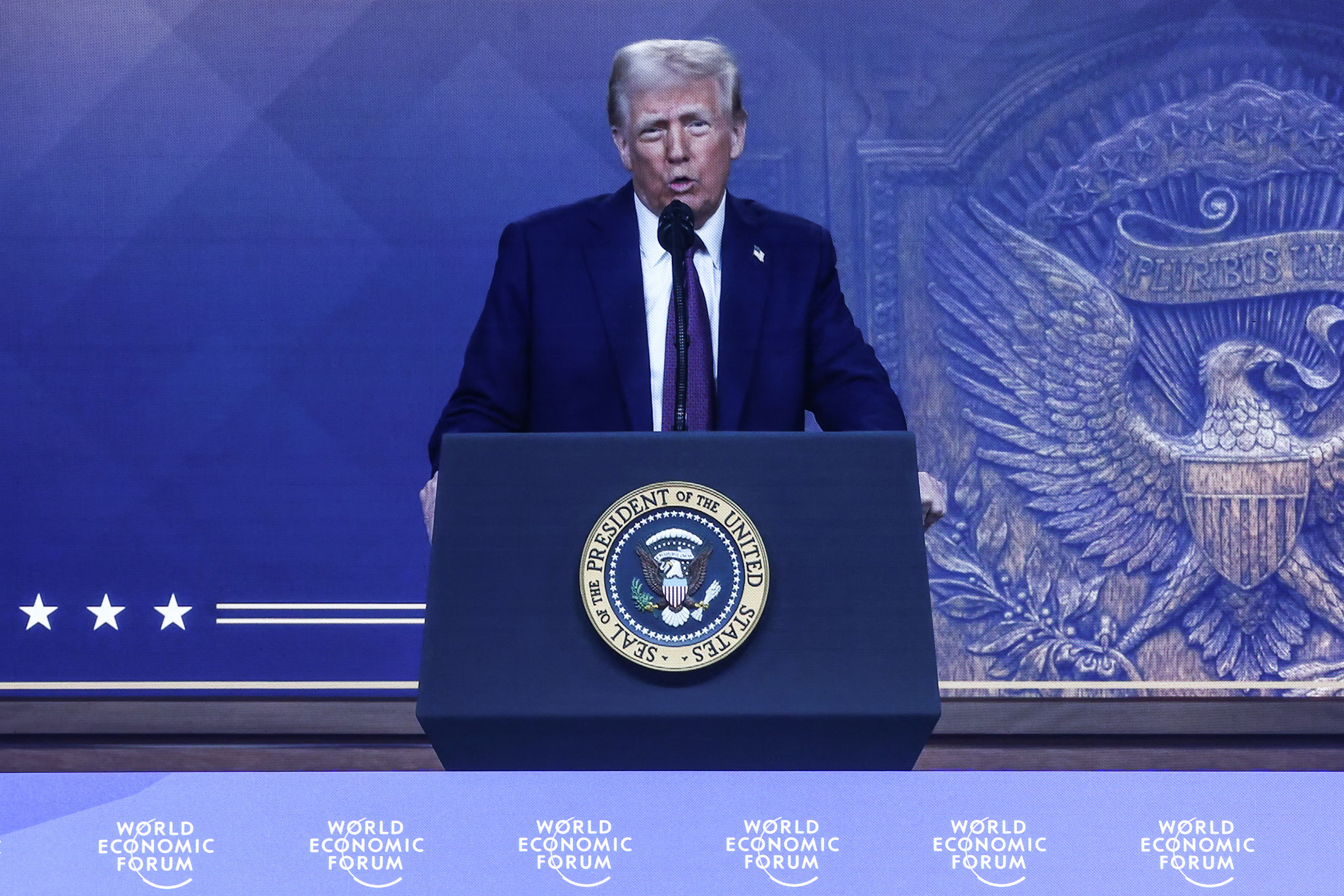
Global oil prices are experiencing a period of volatility, slipping as markets grapple with a dual threat: the persistent uncertainty surrounding President Donald Trump's trade policies and the keenly anticipated output decisions from the OPEC+ alliance. The intricate interplay of these geopolitical and supply-side factors is creating a complex landscape for energy investors.

Trump's Tariff Gambit Casts a Long Shadow

The renewed focus on Trump's trade agenda stems from recent legal developments. Just this week, on May 28, 2025, the U.S. Court of International Trade (CIT) delivered a significant ruling, deeming some of the sweeping tariffs imposed by his administration under the International Emergency Economic Powers Act (IEEPA) to be illegal. These tariffs included a baseline 10% levy on nearly all U.S. imports, with higher rates targeting countries like China, Canada, and Mexico.

However, the legal saga is far from over. An appeals court swiftly granted the administration's request for a stay on the CIT's decision on May 29, 2025, effectively keeping the tariffs in place until at least June 9. This creates palpable uncertainty, as businesses and consumers remain unsure whether these import taxes will be permanently lifted or continue to burden global supply chains.

The market's concern is well-founded. Tariffs, particularly those on steel and other crucial capital goods, directly increase the cost of operations for the oil and gas industry. More broadly, they are viewed as a potential catalyst for a global economic slowdown, which would inevitably translate to reduced demand for crude oil and its derivatives. Indeed, the Organization of the Petroleum Exporting Countries (OPEC) has already cited U.S. trade tariffs as a reason for downgrading its oil demand growth forecasts for both 2025 and 2026.

OPEC+'s Delicate Balancing Act

Adding to the market's unease is the upcoming meeting of the OPEC+ alliance. The eight core producers within the group, including Saudi Arabia and Russia, are set to convene virtually on May 31, 2025, a day earlier than initially scheduled, to finalize their July production levels.

This meeting takes place against the backdrop of their earlier May 3rd decision to gradually return 2.2 million barrels per day (bpd) of voluntary output adjustments to the market, starting from April 1, 2025, with monthly increments of 411,000 bpd. While market expectations largely anticipate another 411,000 bpd increase for July, the flexibility of the OPEC+ agreement allows for adjustments based on evolving market conditions. The group has emphasized its commitment to holding monthly reviews to ensure market stability.

A Tense Supply-Demand Dynamic

As of Friday, May 30, 2025, both Brent Crude and West Texas Intermediate (WTI) have seen slight dips, hovering around $64.10 per barrel and $60.87 per barrel, respectively. These price movements reflect the market's attempts to price in the conflicting signals from a potentially demand-sapping trade war and a supply side carefully managed by OPEC+.

The confluence of these factors creates a challenging environment for forecasting. On one hand, the prospect of prolonged trade disputes and a global economic deceleration could dampen energy consumption. On the other, OPEC+'s measured approach to supply increases aims to prevent a significant oversupply that could send prices spiraling downwards.

Market participants will be keenly watching developments from both Washington D.C. regarding trade policy and Vienna, where OPEC+ convenes. The decisions made and the rhetoric employed in the coming days will be critical in shaping the short-to-medium term trajectory of global oil prices.
About Ezekiel Chew​

Ezekiel Chew, founder and head of training at Asia Forex Mentor, is a renowned forex expert, frequently invited to speak at major industry events. Known for his deep market insights, Ezekiel is one of the top traders committed to supporting the trading community. Making six figures per trade, he also trains traders working in banks, fund management, and prop trading firms.

Ever chased a seemingly perfect signal only to watch the market turn on you? Or perhaps you tried using tools like Lux Algo for straightforward buy-and-sell signals, ending up more perplexed instead. If so, don’t worry—this is a common experience among traders of all levels. At Asia Forex Mentor, we

Read More

Bollinger Bands Trading Strategy and How to Trade Like Pros

Hey, what’s up guys, traders. It’s Ezekiel Chew here. Let me hit you with this. Most traders think they know how to use Bollinger Bands, but the Bands are actually the reason they keep blowing trades. They chase breakouts after the move is already gone. They short reversals before the

Read More

Reversal Trading Strategy: How Market Reversals Really Happen

Hey, what’s up guys, traders. It’s Ezekiel Chew here. Let me hit you with this. Most traders think they are catching reversals, but in reality, they are catching traps. The market does not reverse randomly. It reverses when smart money sweeps liquidity, traps traders, and flips the move while retail

Read More

VWAP Trading Strategy and How Pros Use VWAP

Hey, what’s up guys? It’s Ezekiel Chew here. So let me hit you with this. If you’ve ever taken what felt like a perfect trade, only to watch price reverse the moment you enter, boom, that’s not bad luck. That’s you trading right into institutional zones. Most traders chase candles.

Read More

What Is Volume Profile Trading for Sniper Entries?

Hey, what’s up, traders! It’s Ezekiel Chew here, and today we’re going to talk about volume profile, one of the most powerful trading strategies that can make or break your success in the markets. Let me hit you with this: Most traders lose not because their strategy is broken, but

Read More

AFM Trading Summit Live

Date: Coming Soon

Join us at the AFM Trading Summit Live and learn from top industry experts through live trading sessions, market insights, and actionable strategies.

Why Oil Just Tanked The Trump-OPEC+ Showdown

4.0
Overall Trust Index

Written by:

Updated:

May 30, 2025

Global oil prices are experiencing a period of volatility, slipping as markets grapple with a dual threat: the persistent uncertainty surrounding President Donald Trump's trade policies and the keenly anticipated output decisions from the OPEC+ alliance. The intricate interplay of these geopolitical and supply-side factors is creating a complex landscape for energy investors.

Trump's Tariff Gambit Casts a Long Shadow

The renewed focus on Trump's trade agenda stems from recent legal developments. Just this week, on May 28, 2025, the U.S. Court of International Trade (CIT) delivered a significant ruling, deeming some of the sweeping tariffs imposed by his administration under the International Emergency Economic Powers Act (IEEPA) to be illegal. These tariffs included a baseline 10% levy on nearly all U.S. imports, with higher rates targeting countries like China, Canada, and Mexico.

However, the legal saga is far from over. An appeals court swiftly granted the administration's request for a stay on the CIT's decision on May 29, 2025, effectively keeping the tariffs in place until at least June 9. This creates palpable uncertainty, as businesses and consumers remain unsure whether these import taxes will be permanently lifted or continue to burden global supply chains.

The market's concern is well-founded. Tariffs, particularly those on steel and other crucial capital goods, directly increase the cost of operations for the oil and gas industry. More broadly, they are viewed as a potential catalyst for a global economic slowdown, which would inevitably translate to reduced demand for crude oil and its derivatives. Indeed, the Organization of the Petroleum Exporting Countries (OPEC) has already cited U.S. trade tariffs as a reason for downgrading its oil demand growth forecasts for both 2025 and 2026.

OPEC+'s Delicate Balancing Act

Adding to the market's unease is the upcoming meeting of the OPEC+ alliance. The eight core producers within the group, including Saudi Arabia and Russia, are set to convene virtually on May 31, 2025, a day earlier than initially scheduled, to finalize their July production levels.

This meeting takes place against the backdrop of their earlier May 3rd decision to gradually return 2.2 million barrels per day (bpd) of voluntary output adjustments to the market, starting from April 1, 2025, with monthly increments of 411,000 bpd. While market expectations largely anticipate another 411,000 bpd increase for July, the flexibility of the OPEC+ agreement allows for adjustments based on evolving market conditions. The group has emphasized its commitment to holding monthly reviews to ensure market stability.

A Tense Supply-Demand Dynamic

As of Friday, May 30, 2025, both Brent Crude and West Texas Intermediate (WTI) have seen slight dips, hovering around $64.10 per barrel and $60.87 per barrel, respectively. These price movements reflect the market's attempts to price in the conflicting signals from a potentially demand-sapping trade war and a supply side carefully managed by OPEC+.

The confluence of these factors creates a challenging environment for forecasting. On one hand, the prospect of prolonged trade disputes and a global economic deceleration could dampen energy consumption. On the other, OPEC+'s measured approach to supply increases aims to prevent a significant oversupply that could send prices spiraling downwards.

Market participants will be keenly watching developments from both Washington D.C. regarding trade policy and Vienna, where OPEC+ convenes. The decisions made and the rhetoric employed in the coming days will be critical in shaping the short-to-medium term trajectory of global oil prices.
ezekiel chew asiaforexmentor

About Ezekiel Chew

Ezekiel Chew, founder and head of training at Asia Forex Mentor, is a renowned forex expert, frequently invited to speak at major industry events. Known for his deep market insights, Ezekiel is one of the top traders committed to supporting the trading community. Making six figures per trade, he also trains traders working in banks, fund management, and prop trading firms.

RELATED ARTICLES

Why Oil Just Tanked The Trump-OPEC+ Showdown

4.0
Overall Trust Index

Written by:

Updated:

May 30, 2025

Global oil prices are experiencing a period of volatility, slipping as markets grapple with a dual threat: the persistent uncertainty surrounding President Donald Trump's trade policies and the keenly anticipated output decisions from the OPEC+ alliance. The intricate interplay of these geopolitical and supply-side factors is creating a complex landscape for energy investors.

Trump's Tariff Gambit Casts a Long Shadow

The renewed focus on Trump's trade agenda stems from recent legal developments. Just this week, on May 28, 2025, the U.S. Court of International Trade (CIT) delivered a significant ruling, deeming some of the sweeping tariffs imposed by his administration under the International Emergency Economic Powers Act (IEEPA) to be illegal. These tariffs included a baseline 10% levy on nearly all U.S. imports, with higher rates targeting countries like China, Canada, and Mexico.

However, the legal saga is far from over. An appeals court swiftly granted the administration's request for a stay on the CIT's decision on May 29, 2025, effectively keeping the tariffs in place until at least June 9. This creates palpable uncertainty, as businesses and consumers remain unsure whether these import taxes will be permanently lifted or continue to burden global supply chains.

The market's concern is well-founded. Tariffs, particularly those on steel and other crucial capital goods, directly increase the cost of operations for the oil and gas industry. More broadly, they are viewed as a potential catalyst for a global economic slowdown, which would inevitably translate to reduced demand for crude oil and its derivatives. Indeed, the Organization of the Petroleum Exporting Countries (OPEC) has already cited U.S. trade tariffs as a reason for downgrading its oil demand growth forecasts for both 2025 and 2026.

OPEC+'s Delicate Balancing Act

Adding to the market's unease is the upcoming meeting of the OPEC+ alliance. The eight core producers within the group, including Saudi Arabia and Russia, are set to convene virtually on May 31, 2025, a day earlier than initially scheduled, to finalize their July production levels.

This meeting takes place against the backdrop of their earlier May 3rd decision to gradually return 2.2 million barrels per day (bpd) of voluntary output adjustments to the market, starting from April 1, 2025, with monthly increments of 411,000 bpd. While market expectations largely anticipate another 411,000 bpd increase for July, the flexibility of the OPEC+ agreement allows for adjustments based on evolving market conditions. The group has emphasized its commitment to holding monthly reviews to ensure market stability.

A Tense Supply-Demand Dynamic

As of Friday, May 30, 2025, both Brent Crude and West Texas Intermediate (WTI) have seen slight dips, hovering around $64.10 per barrel and $60.87 per barrel, respectively. These price movements reflect the market's attempts to price in the conflicting signals from a potentially demand-sapping trade war and a supply side carefully managed by OPEC+.

The confluence of these factors creates a challenging environment for forecasting. On one hand, the prospect of prolonged trade disputes and a global economic deceleration could dampen energy consumption. On the other, OPEC+'s measured approach to supply increases aims to prevent a significant oversupply that could send prices spiraling downwards.

Market participants will be keenly watching developments from both Washington D.C. regarding trade policy and Vienna, where OPEC+ convenes. The decisions made and the rhetoric employed in the coming days will be critical in shaping the short-to-medium term trajectory of global oil prices.

ezekiel chew asiaforexmentor

About Ezekiel Chew

Ezekiel Chew, founder and head of training at Asia Forex Mentor, is a renowned forex expert, frequently invited to speak at major industry events. Known for his deep market insights, Ezekiel is one of the top traders committed to supporting the trading community. Making six figures per trade, he also trains traders working in banks, fund management, and prop trading firms.

RELATED ARTICLES

I consent to receiving emails and/or text message reminders for this event.

REGISTER FOR THE MASTERCLASS!