English
 简体中文
简体中文 繁體中文
繁體中文 日本語
日本語 한국어
한국어 Bahasa Melayu
 Bahasa Indonesia
 Filipino
 ไทย
ไทย Tiếng Việt
 हिन्दी
 العربية
 Italiano
 Português
 Русский
 Español
 Français
 Singapore
 Cambodia
 Myanmar
 Brunei
 Australia
  New Zealand
 Switzerland
 UAE
UAE United States
 Mexico
 Argentina
 South Africa
 IC Markets
 Pepperstone
 AvaTrade
 XM
XM Plus500
 RoboForex
 TMGM
TMGM Exness
 JustMarkets
 Orbex
Orbex Interactive Brokers
 Saxo
Saxo Tiger Brokers
 Binance
 Coinbase
 Gemini Exchange
 Kraken
 iFunds
 IC Funded
 The 5%ers
 TopStep
 IQ Option
 Pocket Option
 RaceOption
 IQCent
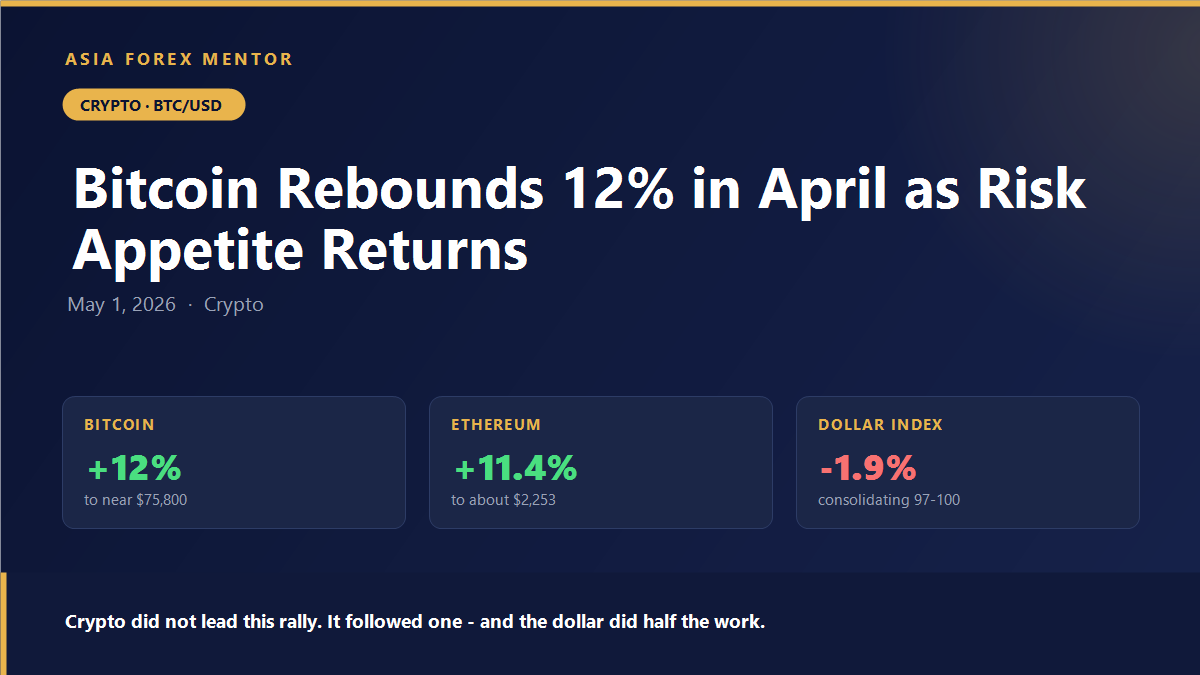
Bitcoin has just closed its strongest month since April 2025, and it did so alongside a 10% rally in US equities and a falling dollar — a combination that says something specific about what was actually driving crypto in April.
Bitcoin gained roughly 12% over the month to finish near $75,800, while Ethereum added 11.4% to close around $2,253. The US Dollar Index fell 1.9%, continuing to consolidate in the 97–100 range it has held for the better part of ten months. Gold and silver, by contrast, slipped about 1% and 2% respectively after their violent drawdowns in February and March.
Crypto did not lead this rally. It followed one.
What April Actually Rewarded
The month’s asset performance table is unusually legible. Equities up hard, crypto up hard, dollar down, gold flat to lower. That is a textbook risk-on month — and it tells you Bitcoin traded as a risk asset in April, not as a haven.
This matters because the two narratives lead to opposite trades. If Bitcoin is digital gold, it should have rallied in March when the Iran conflict erupted and gold hit $5,400. It did not — it fell with equities. If Bitcoin is a high-beta risk asset, it should have fallen in March and rebounded hard in April when risk appetite returned. That is precisely what happened.
April was not a vote of confidence in Bitcoin as a crisis hedge. It was a beta rally.
The Dollar Did Half the Work
The DXY’s 1.9% decline deserves more attention than it usually gets from crypto traders.
Bitcoin is priced in dollars. When the dollar weakens, the dollar price of a fixed-supply asset rises mechanically, before any change in demand for the asset itself. A meaningful share of April’s 12% gain is simply the denominator moving.
The dollar index has now spent roughly ten months consolidating between 97 and 100 following the steep downtrend through the first half of 2025. For crypto traders, that range is worth watching directly: a decisive break above 100 removes a tailwind that has quietly supported dollar-denominated crypto prices for months.

Gold’s Absence Is the Interesting Part
Gold fell about 1% in April after losing roughly a quarter of its value from the $5,400 spike in early March.
That drawdown was not a rejection of gold as a haven — it was a liquidity event, in which institutions sold their most liquid protective asset to raise dollars. But the aftermath is instructive: gold has not recovered, even with Brent making new crisis highs at $126.41 and the Strait of Hormuz still contested.
When the crisis asset does not rally on crisis news, it usually means the marginal buyer is exhausted. Traders positioning for a renewed safe-haven bid should note that April did not deliver one.
What This Means for the Months Ahead
Two forces will determine whether April’s rebound extends.
The rate path. The Fed held in April, and that hold was a significant part of why risk assets rallied. With energy prices still climbing and the inflation impulse still working through supply chains, the easing that markets assumed at the start of the year has been priced out. If policy expectations turn genuinely restrictive, the high-beta end of the risk spectrum — which April demonstrated includes Bitcoin — feels it first.
The dollar. A break out of the 97–100 range in either direction has a direct, mechanical effect on dollar-priced crypto.
Notably, neither of these is a crypto-native factor. There was no halving, no major protocol upgrade, no regulatory breakthrough driving April. The move was macro, and the risks are macro too.
Practical Takeaways
Know which correlation you are actually trading. Bitcoin’s relationship to equities and to gold changes with the regime. April was decisively a risk-asset month. Position for the correlation the market is currently expressing, not the one the narrative prefers.
Separate the numerator from the denominator. Some of a dollar-priced gain is dollar weakness. Checking Bitcoin against a basket, or against gold, tells you how much of the move was real demand.
Recovery months follow capitulation months. April’s strength was partly a function of how much was sold in March. That is a positioning effect, not a fundamental one, and it does not repeat indefinitely.
Watch DXY 100. It is the cleanest single level for crypto traders to monitor right now.
For traders comparing where to hold and trade these assets, our crypto broker reviews cover fees, custody and regional availability.
The Bottom Line
Bitcoin’s best month in a year came from returning risk appetite and a weaker dollar rather than anything specific to crypto. That makes the rebound real but conditional — and the condition is a macro backdrop that remains unresolved, with oil at crisis highs and a central bank whose next move is genuinely uncertain.
Figures cited are as of 30 April 2026. Cryptocurrency markets are highly volatile; verify current levels before trading. This article is general information, not personal financial advice.