English
 简体中文
简体中文 繁體中文
繁體中文 日本語
日本語 한국어
한국어 Bahasa Melayu
 Bahasa Indonesia
 Filipino
 ไทย
ไทย Tiếng Việt
 हिन्दी
 العربية
 Italiano
 Português
 Русский
 Español
 Français
 Singapore
 Cambodia
 Myanmar
 Brunei
 Australia
  New Zealand
 Switzerland
 UAE
UAE United States
 Mexico
 Argentina
 South Africa
 IC Markets
 Pepperstone
 AvaTrade
 XM
XM Plus500
 RoboForex
 TMGM
TMGM Exness
 JustMarkets
 Orbex
Orbex Interactive Brokers
 Saxo
Saxo Tiger Brokers
 Binance
 Coinbase
 Gemini Exchange
 Kraken
 iFunds
 IC Funded
 The 5%ers
 TopStep
 IQ Option
 Pocket Option
 RaceOption
 IQCent
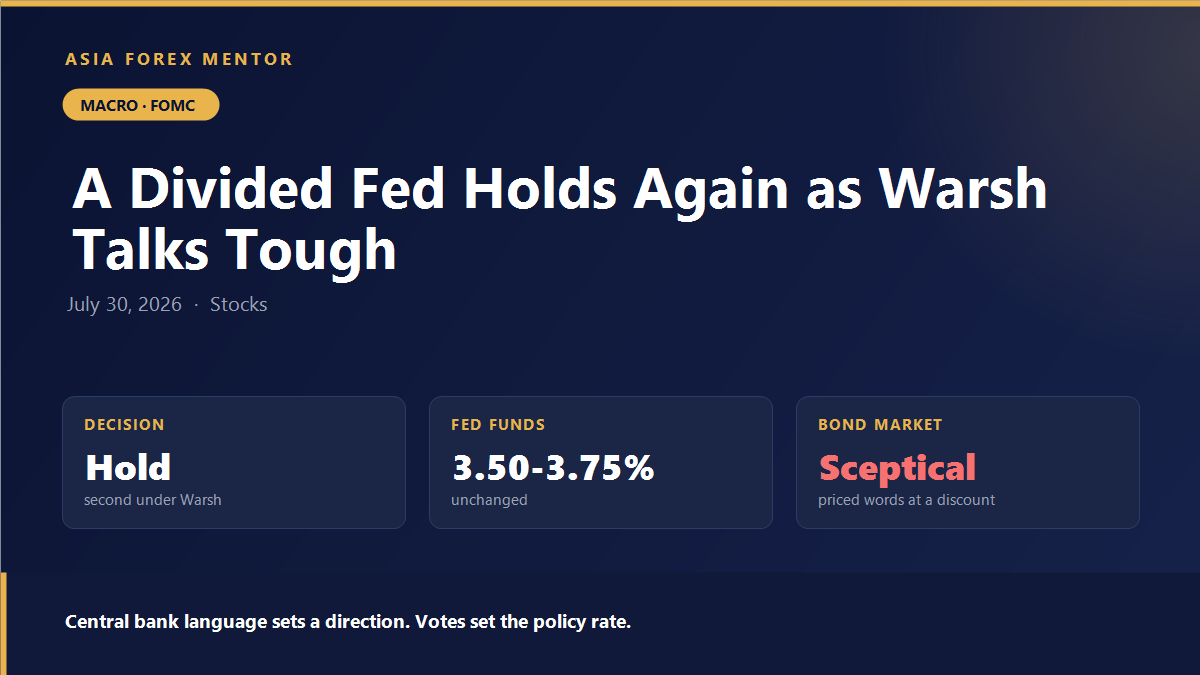
Kevin Warsh told markets the Federal Reserve “won’t hesitate” to stop inflation. The bond market listened politely and priced something different.
The FOMC held the federal funds rate at 3.50%–3.75% on 29 July, its second consecutive hold under Warsh, in a decision that exposed a committee more openly divided than at any point this year. The chair’s message afterwards was unambiguously hawkish. The reaction in rates was not.
That gap — between what a central bank says and what the market believes it will do — is one of the more useful things a trader can learn to read.
A Divided Committee, Openly
June’s split was visible only in the projections; the vote itself was unanimous. July’s division was harder to paper over. The committee that produced a nine-eight-one split on the 2026 rate path in June has spent the intervening weeks watching inflation data that did not settle the argument either way.
The core disagreement has not moved. One bloc holds that an energy shock driven by the Iran conflict and a contested Strait of Hormuz is a supply problem monetary policy cannot fix. The other holds that four months is long enough for a supply shock to contaminate expectations, and that the committee’s own 2026 projections — 3.6% headline, 3.3% core — represent a credibility problem rather than a forecast.
Warsh’s “won’t hesitate” framing was aimed squarely at that second concern. It was a statement about resolve, not about a scheduled action.
Why the Bond Market Was Sceptical
Markets discount talk and price behaviour. On behaviour, the Fed has now held twice under a chair widely read as hawkish, while inflation projections have risen.
There are reasonable grounds for the scepticism.
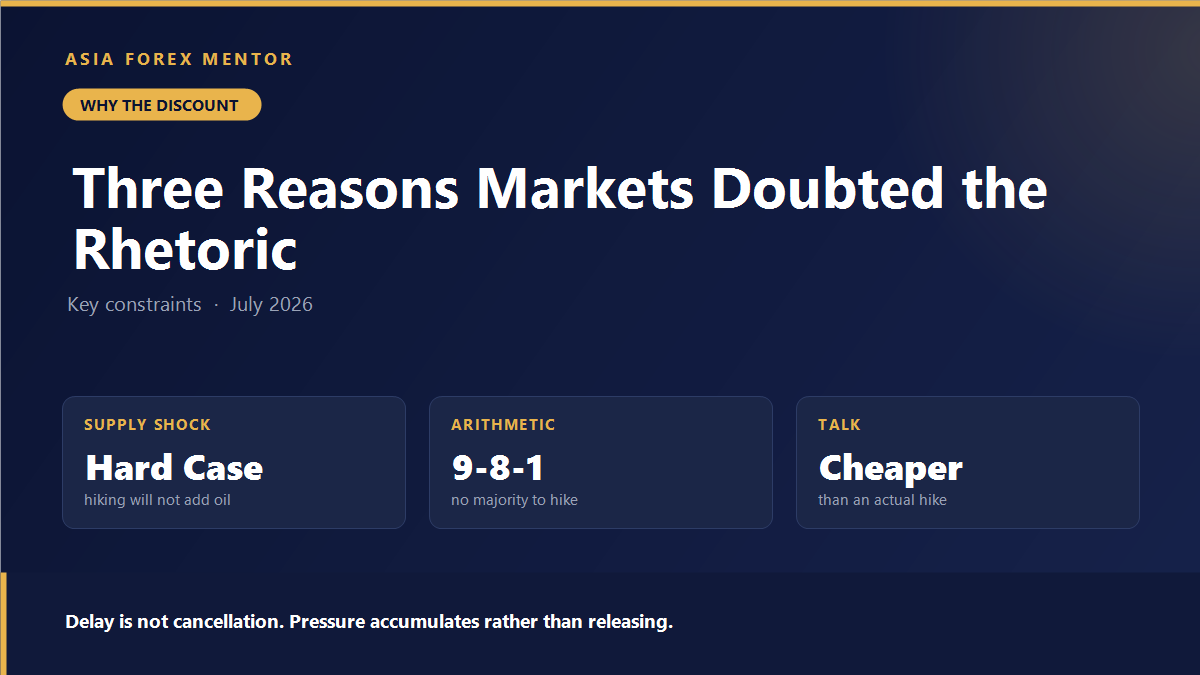
Hiking into a supply shock is genuinely hard to justify. Raising rates does not reopen the Strait of Hormuz or lower the price of Brent crude. It tightens conditions onto an economy already absorbing higher input costs. Every member of the committee understands this, which is why the hawks have not been able to convert their projections into votes.
The committee arithmetic constrains him. A chair confirmed by the narrowest margin in modern history, leading a body split nine-eight-one, does not have the standing to force a contested hike. The FOMC votes.
Talk is the cheaper tool. A chair worried about inflation expectations can address them rhetorically without incurring the economic cost of an actual hike. Markets know this, and discount verbal hawkishness accordingly.
The Communication Paradox
There is a genuine tension in Warsh’s approach worth naming.
He has deliberately reduced forward guidance — declining to submit his own dot in June, stripping easing-leaning language from the statement. The stated rationale is that markets should price fundamentals rather than depend on central bank signalling.
But a chair who reduces guidance and then relies on strong rhetoric to shape expectations is asking markets to take his words seriously while giving them less structure for doing so. When the bond market has fewer formal signals to anchor on, it weights observed behaviour more heavily — and observed behaviour is two holds.
This is not a criticism of the strategy so much as a description of its cost. Reduced guidance raises the burden of proof on rhetoric.
What This Means for Positioning
Rates. The market continues to price a better than 70% chance of at least one hike by year-end, roughly consistent with the committee’s 3.8% median dot. What July changed was not the destination but confidence in the timing.
The dollar. A Fed that talks hawkish but holds provides less support than one that acts. The DXY has spent close to a year consolidating between 97 and 100, and verbal hawkishness alone has not been enough to break it.
Equities. A hold is the near-term friendly outcome. The risk is that a committee which delays while inflation projections rise eventually has to move faster than a market at elevated valuations can comfortably absorb.
Yen crosses. The Bank of Japan is at 1%, its highest since 1995, and moving. A Fed that holds while the BOJ tightens compresses the differential that has driven USD/JPY for years.
Practical Takeaways
Price behaviour, not rhetoric. Central bank language sets a direction. Votes set the policy rate. When the two diverge, the market usually sides with the votes.
Count the committee. A chair’s personal view matters far less than whether he can assemble a majority. Nine-eight-one is not a majority for hiking.
Delay is not cancellation. A Fed that holds while raising inflation forecasts is accumulating pressure, not releasing it. That raises the risk of a larger move later.
Watch the swing bloc. The eight participants projecting no change decide this. Their movement, not hawkish speeches, is the signal.
For traders building a framework around central bank meetings, our forex trading guides cover trading policy events systematically.
The Bottom Line
Two holds, rising inflation projections, an openly divided committee and a chair promising resolve he has not yet had to demonstrate. The bond market’s scepticism is not defiance — it is a reasonable reading of a Fed whose actions and language have not yet aligned. Whether they converge on a hike or on continued patience is the defining question of the second half.
Figures cited are as of 29 July 2026. Market data moves quickly; verify current levels before trading. This article is general information, not personal financial advice.