English
 简体中文
简体中文 繁體中文
繁體中文 日本語
日本語 한국어
한국어 Bahasa Melayu
 Bahasa Indonesia
 Filipino
 ไทย
ไทย Tiếng Việt
 हिन्दी
 العربية
 Italiano
 Português
 Русский
 Español
 Français
 Singapore
 Cambodia
 Myanmar
 Brunei
 Australia
  New Zealand
 Switzerland
 UAE
UAE United States
 Mexico
 Argentina
 South Africa
 IC Markets
 Pepperstone
 AvaTrade
 XM
XM Plus500
 RoboForex
 TMGM
TMGM Exness
 JustMarkets
 Orbex
Orbex Interactive Brokers
 Saxo
Saxo Tiger Brokers
 Binance
 Coinbase
 Gemini Exchange
 Kraken
 iFunds
 IC Funded
 The 5%ers
 TopStep
 IQ Option
 Pocket Option
 RaceOption
 IQCent
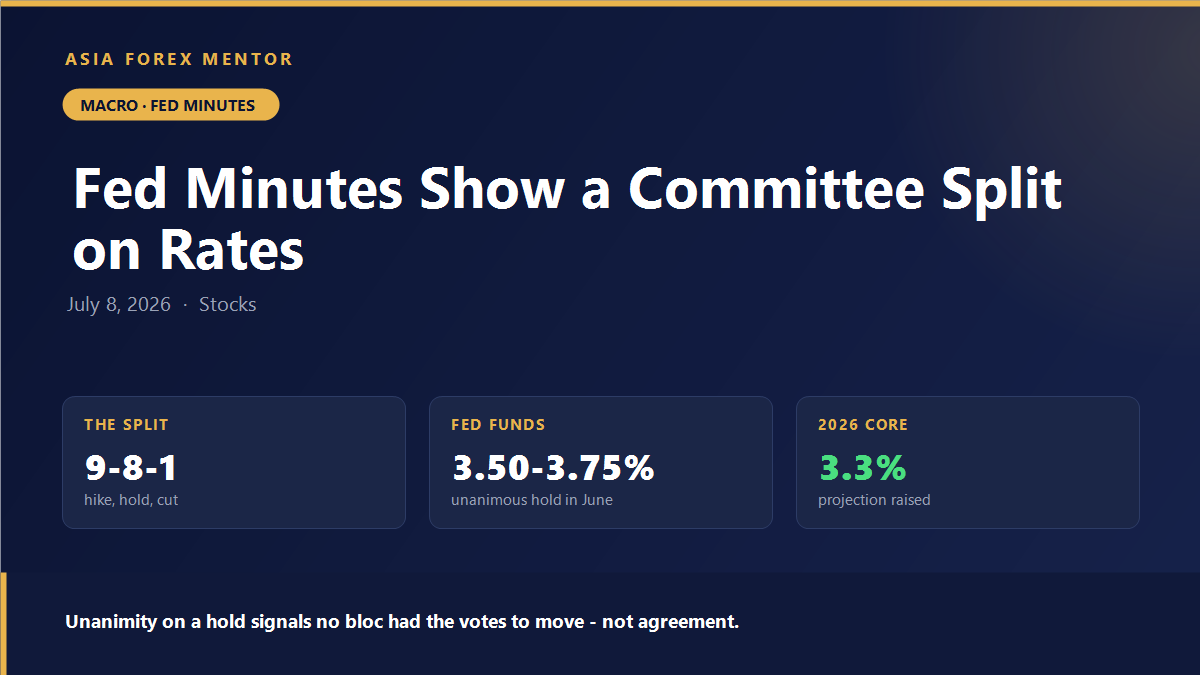
The minutes of the June FOMC meeting have confirmed what the dot plot implied: this is a genuinely divided Federal Reserve, and the division is about direction rather than degree.
Released on 8 July, the minutes from the 17 June meeting show officials split on the path for rates — the first meeting chaired by Kevin Warsh, at which the committee voted unanimously to hold the federal funds rate at 3.50%–3.75% while raising its 2026 median projection to 3.8% from 3.4%.
A unanimous vote layered on top of a fundamental disagreement is an unusual combination, and it has a specific implication for how traders should price upcoming meetings.
Unanimous on Today, Split on Tomorrow
The June projections showed nine participants anticipating at least one hike this year, eight expecting no change, and one seeing a cut. The minutes fill in the reasoning behind that near-even split.
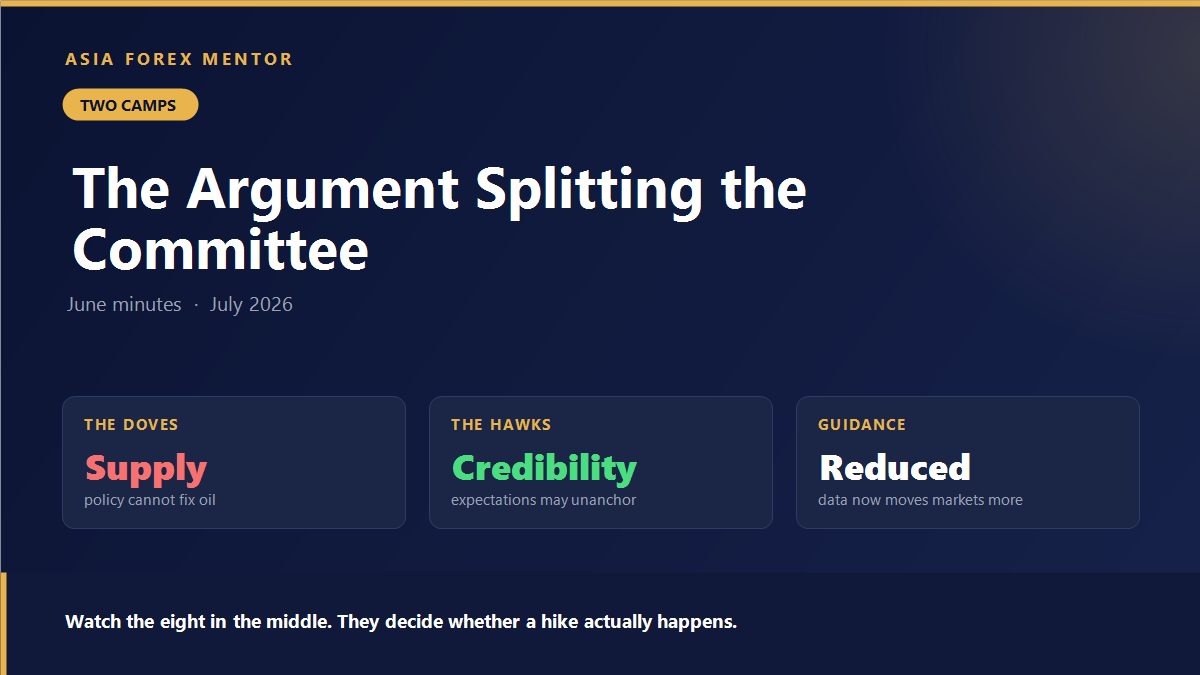
The disagreement runs along a familiar fault line, sharpened by unusual circumstances. One camp argues the inflation impulse is a supply shock — driven by the Iran conflict, Brent crude at crisis highs above $126, and the closure of the Strait of Hormuz — and that monetary policy cannot restore oil supply. Tightening into it would compound the damage to demand without addressing the cause.
The other camp argues that the source of an inflation shock stops mattering once it persists long enough to move inflation expectations. Four months into the disruption, with the committee’s own 2026 projections raised to 3.6% headline and 3.3% core, they see credibility risk in continued patience.
Both positions are defensible. That is precisely why the committee is split, and why the split is unlikely to resolve on its own.
Why Unanimity Held Anyway
It is worth understanding why a committee this divided still voted 12–0 to hold.
A hold is the natural compromise. The hawks did not have the votes for a hike, the single dove did not have the votes for a cut, and holding preserves optionality while more data arrives. Unanimity on a hold does not signal agreement; it signals that no bloc had the numbers to move.
Traders who read the unanimous vote as a sign of a settled committee misread it. The projections were the honest signal, and the minutes have now confirmed it.
The Communication Problem
This is where the current setup differs meaningfully from the past decade.
Warsh declined to submit his own rate projection in June, consistent with his long-held view that the Fed provides too much forward guidance. The June statement also removed language that had leaned toward future easing.
Put those together with the minutes and a specific problem emerges for market participants: the committee is split roughly down the middle, the chair is not signalling which way he leans, and the guidance that would normally resolve the ambiguity has been deliberately withdrawn.
The result is that each upcoming data release carries more weight than it used to. When the Fed tells you less about its reaction function, the market has to infer it from data in real time — and inference produces larger moves than confirmation does.
What the Market Is Pricing
Rate traders have moved decisively away from the easing path assumed at the start of the year, pricing a better than 70% chance of at least one hike by the end of 2026 since Warsh’s confirmation in May.
That is broadly consistent with a median dot at 3.8% against a current range of 3.50%–3.75%. Market pricing and the committee’s central projection are, for once, roughly aligned.
The risk is in the tails. With a nine-eight-one split, the distribution of outcomes is wide. A couple of hot inflation prints could push the eight who currently see no change into the hawkish camp quickly; a genuine growth scare or a de-escalation in the Gulf could do the reverse.
Practical Takeaways
Minutes matter more when guidance is scarce. With the chair reducing forward guidance, the minutes become one of the few windows into committee thinking. Read them rather than the headline summary.
A unanimous vote is not a consensus committee. Check the projections and the dispersion before drawing conclusions from the vote count.
Data releases carry more weight now. Less guidance means each CPI and payrolls print does more of the work in setting expectations. Size accordingly.
Watch the eight in the middle. The participants currently projecting no change are the swing bloc. Their movement, not the existing hawks, determines whether a hike actually happens.
For traders building a process around central bank communication, our market analysis section covers reading policy signals systematically.
The Bottom Line
The June minutes confirm a Fed divided almost evenly on whether to hike this year, chaired by someone deliberately saying less about his own view. That combination — genuine uncertainty plus reduced guidance — argues for wider expected ranges around every remaining meeting of 2026.
Figures cited are as of 8 July 2026. Market data moves quickly; verify current levels before trading. This article is general information, not personal financial advice.