English
 简体中文
简体中文 繁體中文
繁體中文 日本語
日本語 한국어
한국어 Bahasa Melayu
 Bahasa Indonesia
 Filipino
 ไทย
ไทย Tiếng Việt
 हिन्दी
 العربية
 Italiano
 Português
 Русский
 Español
 Français
 Singapore
 Cambodia
 Myanmar
 Brunei
 Australia
  New Zealand
 Switzerland
 UAE
UAE United States
 Mexico
 Argentina
 South Africa
 IC Markets
 Pepperstone
 AvaTrade
 XM
XM Plus500
 RoboForex
 TMGM
TMGM Exness
 JustMarkets
 Orbex
Orbex Interactive Brokers
 Saxo
Saxo Tiger Brokers
 Binance
 Coinbase
 Gemini Exchange
 Kraken
 iFunds
 IC Funded
 The 5%ers
 TopStep
 IQ Option
 Pocket Option
 RaceOption
 IQCent
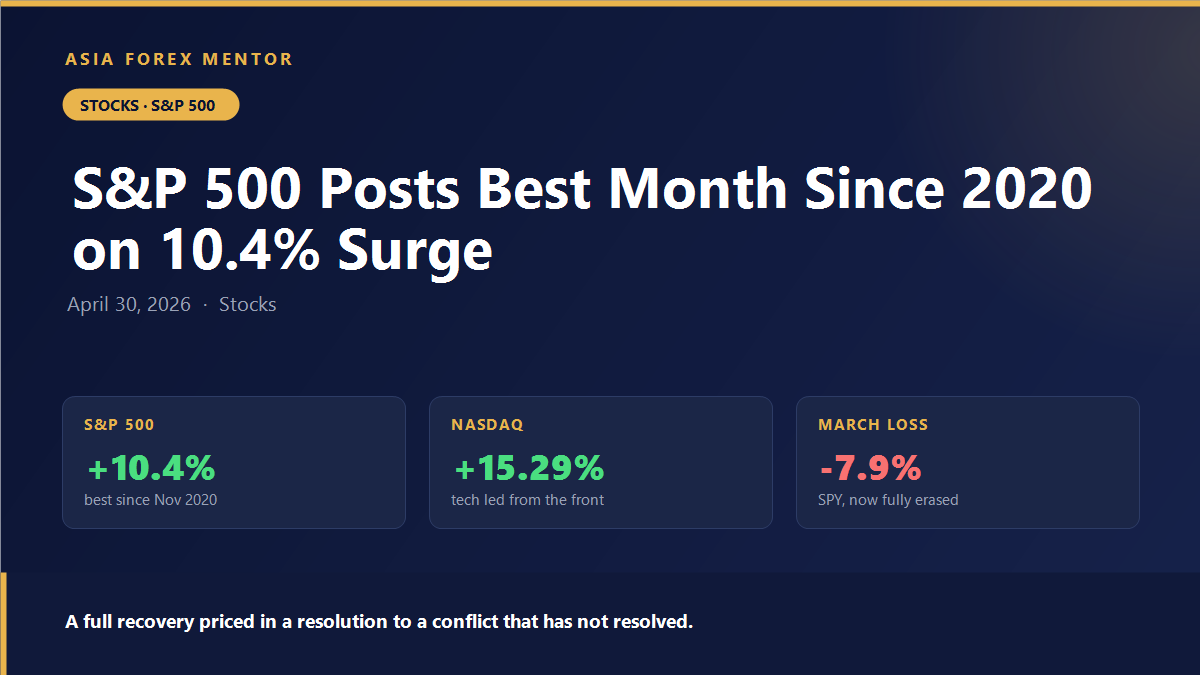
Six weeks ago the S&P 500 was in the middle of its worst drawdown since 2022. It has just closed its best month since November 2020.
The S&P 500 gained 10.4% in April and set new all-time highs, while the Nasdaq Composite surged 15.29% as technology led from the front. The rally erased March’s war-driven selloff — SPY had lost roughly 7.9% over that month, with QQQ down 8.2% and DIA off 7.6% — and then some.
The obvious question is how an equity market posts a double-digit month while Brent crude makes new crisis highs.
What Actually Drove the Rally
Three things, in order of importance.
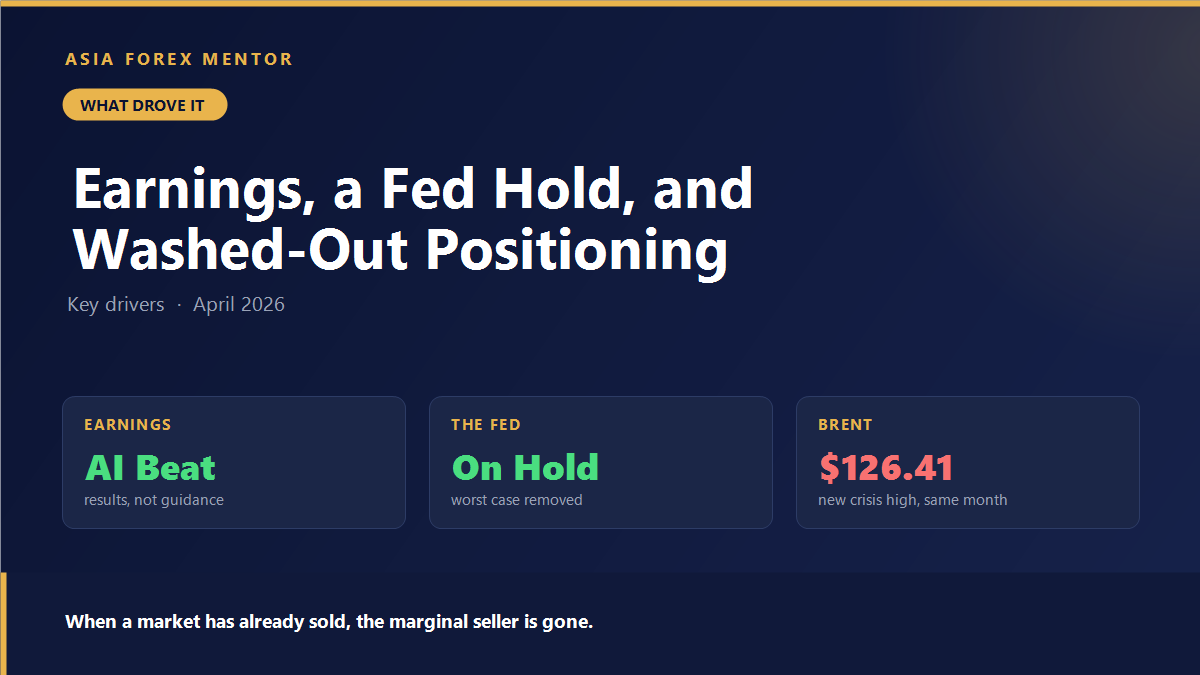
Earnings, particularly in AI. Corporate results came in well ahead of the lowered expectations set during March, and the AI infrastructure complex delivered the strongest numbers. Crucially, these were results, not guidance — hard figures that landed while the market was still positioned for a slowdown.
The Fed held rates steady. Going into April there was genuine concern that an energy-driven inflation shock would force tightening into a weakening economy. Holding rates removed the worst case, and markets rallied on the absence of bad news as much as on the presence of good.
Positioning was washed out. March forced a great deal of de-risking. When a market has already sold, the marginal seller is gone, and it takes far less buying to move price. April’s move was amplified by the size of March’s fall.
The Divergence Nobody Should Ignore
Here is the uncomfortable part. Equities recovered fully while the shock that caused the selloff did not resolve.
Brent hit a fresh crisis high of $126.41 in late April. The Strait of Hormuz remains contested. The inflation impulse from energy is still building through supply chains. None of the conditions that produced March’s drawdown have gone away — the market has simply decided to look past them.
That is not necessarily irrational. Equity markets are discounting mechanisms, and if participants believe the conflict resolves within a reasonable horizon, pricing through it is defensible. But it does mean the April rally rests on an assumption about the future rather than on an improvement in present conditions.
Assumptions of that kind are exactly what get repriced when the next headline contradicts them.
Breadth Deserves Scrutiny
A 15.29% Nasdaq gain against a 10.4% S&P gain tells you leadership was concentrated in technology, and within technology, concentrated in AI infrastructure.
Concentrated leadership is normal in the early stage of a recovery — the highest-quality, most liquid names get bought first. It becomes a problem when it persists, because index-level strength then depends on a small number of stocks continuing to deliver.
For anyone holding a broad index product, it is worth understanding that your exposure to this rally is considerably less diversified than the label implies.
The Rate Question Has Not Gone Away
The Fed held in April. That is a decision about one meeting, not a policy path.
With crude making new highs and the energy shock now two months old, the argument that inflation is transitory is weaker than it was in March. Rate expectations have already shifted away from the easing path assumed at the start of the year, and a market trading at record highs has priced in essentially none of the risk that policy turns restrictive.
That asymmetry — record highs, unresolved supply shock, and a central bank whose next move is genuinely uncertain — is the defining feature of the current setup.
What Traders Should Take From April
Recovery speed is a function of how much was sold, not how much improved. The violence of March’s selloff created the conditions for April’s rally. Neither told you much about underlying fundamentals.
Do not confuse a new high with resolved risk. The index recovering to a record does not mean the conflict, the oil price or the inflation impulse resolved. It means the market repriced its expectations about them.
Check your concentration. If AI infrastructure names drove the bulk of the gain, your index position is a more focused bet than it appears.
The next catalyst is inflation data, not earnings. Earnings did their work in April. What determines whether these levels hold is whether the energy shock shows up in core inflation.
For traders navigating equity exposure through a volatile macro backdrop, our stock trading guides cover position sizing and risk management.
The Bottom Line
April was the best month for US equities in more than five years, driven by genuine earnings strength and a Fed that stayed on hold. It was also a recovery that priced in a resolution to a conflict that has not been resolved, with Brent at record crisis highs on the last day of the month. Both facts are true, and the second one is the risk.
Figures cited are as of 30 April 2026. Market data moves quickly; verify current levels before trading. This article is general information, not personal financial advice.