English
 简体中文
简体中文 繁體中文
繁體中文 日本語
日本語 한국어
한국어 Bahasa Melayu
 Bahasa Indonesia
 Filipino
 ไทย
ไทย Tiếng Việt
 हिन्दी
 العربية
 Italiano
 Português
 Русский
 Español
 Français
 Singapore
 Cambodia
 Myanmar
 Brunei
 Australia
  New Zealand
 Switzerland
 UAE
UAE United States
 Mexico
 Argentina
 South Africa
 IC Markets
 Pepperstone
 AvaTrade
 XM
XM Plus500
 RoboForex
 TMGM
TMGM Exness
 JustMarkets
 Orbex
Orbex Interactive Brokers
 Saxo
Saxo Tiger Brokers
 Binance
 Coinbase
 Gemini Exchange
 Kraken
 iFunds
 IC Funded
 The 5%ers
 TopStep
 IQ Option
 Pocket Option
 RaceOption
 IQCent
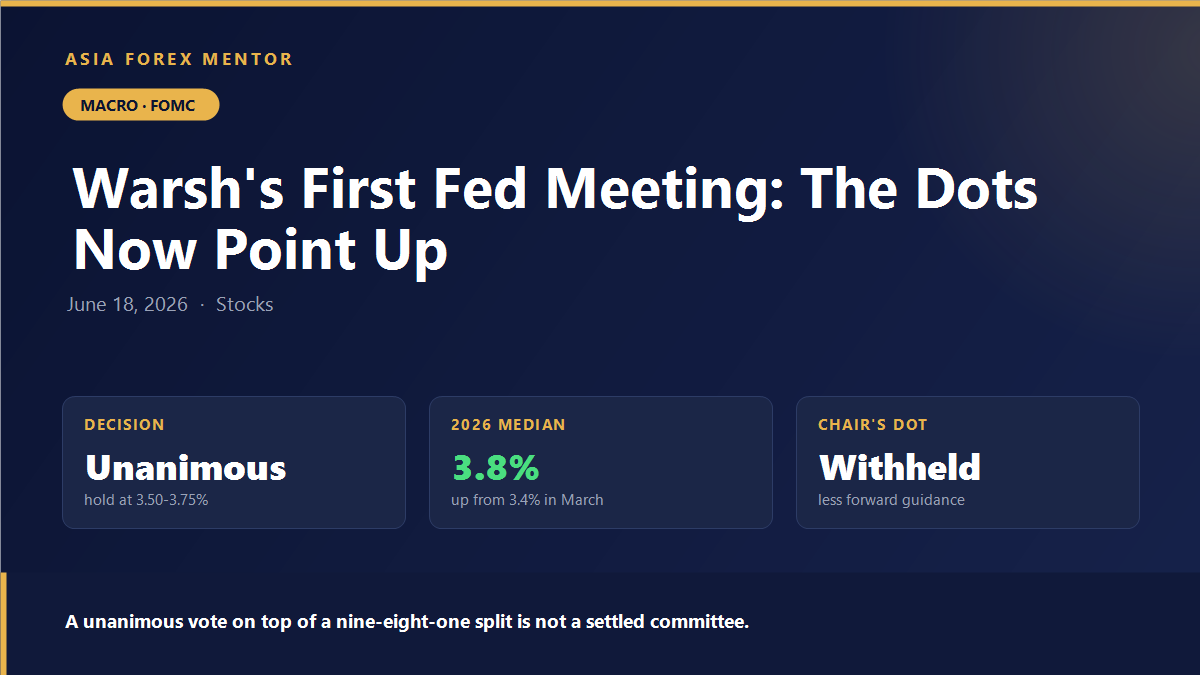
Kevin Warsh held rates at his first meeting as Fed Chair. The decision was unanimous. Markets still read it as one of the more hawkish FOMC outcomes in recent memory — and they were right to.
The committee voted unanimously on 17 June to hold the federal funds rate at 3.50%–3.75%, which was widely expected. Everything that moved markets was in the accompanying projections and the statement language.
The Dots Moved, and That Was the Message
The median estimate for the fed funds rate at the end of 2026 rose to 3.8%, up from 3.4% in the March projections. That is not a rounding adjustment. It signals the committee now sees at least one rate hike as necessary this year.
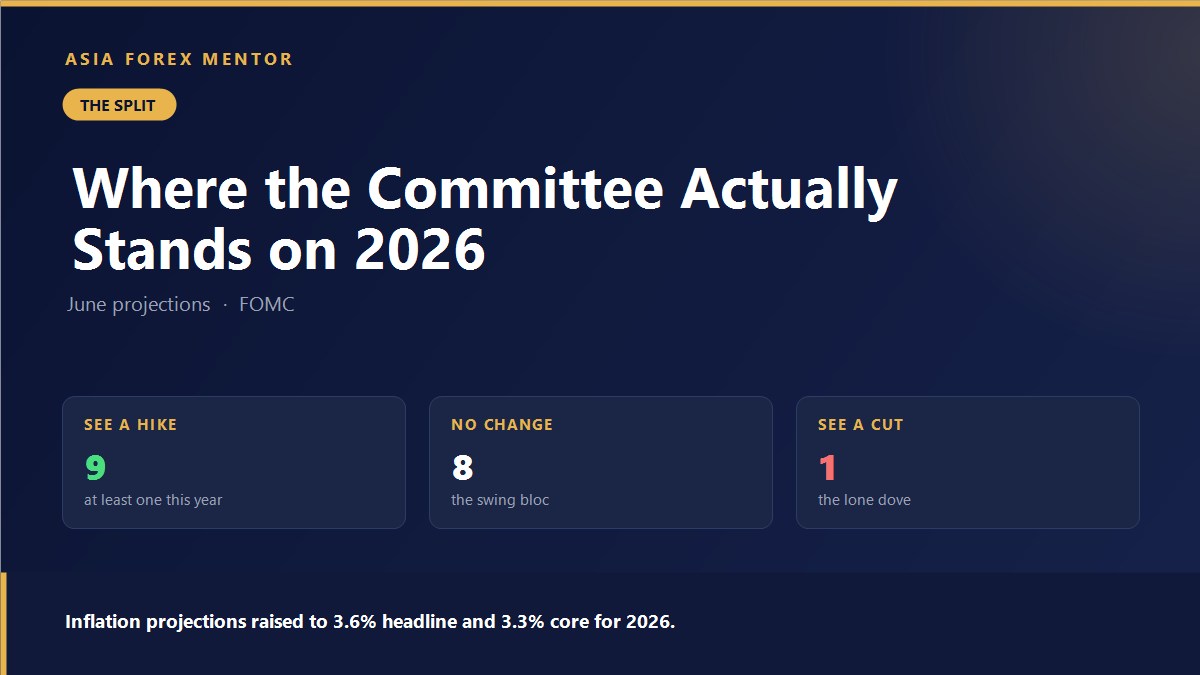
The distribution beneath the median is more revealing than the median itself. Of the participants submitting projections, nine anticipated at least one hike, eight expected no change, and one saw a cut.
That is a committee split almost exactly down the middle, with the plurality leaning toward tightening. A unanimous vote to hold, sitting on top of a nine-eight-one split about where rates go next, describes a Fed that agrees about today and disagrees about the direction of travel.
Inflation projections explain the shift. The committee raised its 2026 outlook to 3.6% headline and 3.3% core — both significantly above the March projections, and both reflecting an energy shock that has now had time to work through supply chains into underlying prices.
The Language Change Nobody Should Skip
The post-meeting statement removed prior language seen as a nod toward future easing.
Forward guidance is one of the Fed’s most powerful tools precisely because markets price it. Removing an easing-leaning phrase does not commit the committee to anything, but it withdraws a commitment markets had been relying on. In a market that had already priced out most of its rate-cut expectations, that withdrawal confirmed the direction.
Combined with the upward revision to the dots, the message was consistent: this committee is not planning to cut, and a meaningful bloc wants to hike.
Warsh Withheld His Own Projection
The most distinctive feature of the meeting had nothing to do with rates. Warsh did not submit his own interest rate projections, consistent with his long-stated preference for reducing forward guidance.
This is a genuine institutional shift. For more than a decade, markets have been trained to read the dot plot as a signal of the chair’s intentions. If the chair’s dot is absent, the plot becomes a survey of the committee rather than a guide to leadership thinking.
The consequences cut both ways. Less guidance means markets have less information, which mechanically increases volatility around each meeting and each data release — traders must price the reaction function themselves rather than being told it. Warsh’s argument, made consistently over years, is that this is healthier: a market that prices risk on fundamentals rather than on central bank hand-holding is a market that allocates capital better.
Whichever view you take, the practical effect for traders is the same. Expect wider distributions of outcomes around Fed events than you have been used to.
What This Means Across Markets
Rates. A median dot at 3.8% against a current range of 3.50%–3.75% points to one hike this year as the committee’s base case.
The dollar. A Fed leaning toward hikes while most peers are static is dollar-supportive. The DXY has consolidated between 97 and 100 for roughly ten months; the hawkish repricing puts pressure on the top of that range.
Equities. Awkward. April delivered the best month since November 2020, with the S&P up 10.4% and the Nasdaq up 15.29%, driven partly by the assumption the Fed would stay on hold. A higher discount rate compresses multiples across a market already trading at elevated valuations.
Yen crosses. The Bank of Japan hiked to 1% the previous day, its highest since 1995. Both banks are now tightening, which may leave the differential roughly unchanged while raising volatility on both legs.
Practical Takeaways
Read the distribution, not the median. A nine-eight-one split tells you far more about the risk of a surprise than a single median figure does.
Less guidance means bigger surprises. Position sizes calibrated to a well-telegraphed Fed are too large for one that deliberately says less.
Watch the inflation projections. Headline at 3.6% and core at 3.3% are the numbers that would justify a hike. Incoming data either confirms that path or undermines it.
A unanimous hold is not a dovish hold. The vote covered this meeting. The projections covered the year.
For traders adapting to a Fed that communicates less, our market analysis section covers building a framework for central bank events.
The Bottom Line
Warsh’s first meeting produced no rate change and a substantial shift in expectations. The dots moved up, easing language came out, inflation forecasts rose, and the chair declined to publish his own projection. Markets now price a Fed whose next move is more likely up than down — and one that intends to tell them less about it.
Figures cited are as of 17 June 2026. Market data moves quickly; verify current levels before trading. This article is general information, not personal financial advice.