
Most best day trading platform lists were built for stock traders, and traders who follow them to choose a forex setup end up with the wrong tool for the job.
|
ABOUT THIS GUIDE |
This guide covers what forex day traders and scalpers actually need from a trading platform, a direct comparison of MT4, MT5, cTrader, and TradingView on the factors that matter for short-term trading, and how to match the right platform to your specific style. It also covers what to look for in the broker behind the platform, since execution quality is determined by the broker, not the software. |
|
QUICK ANSWER |
The best forex day trading platform depends on trading style. MT4 is the most widely supported platform with the largest ecosystem of indicators and automated tools. MT5 adds more timeframes, order types, and depth of market. cTrader is the top choice for scalpers on ECN accounts who need fast, transparent execution. Any platform is only as good as the broker running it. |
Why Most Best Day Trading Platform Lists Miss Forex Traders
Search for the best day trading platform and the top results push tools built for stocks. Thinkorswim, TradeStation, Interactive Brokers, Webull. These are powerful platforms, but they are not what a forex day trader needs.
Forex runs on a decentralized over-the-counter market, 24 hours a day, five days a week. There is no central exchange. The platforms built for it, specifically MT4, MT5, and cTrader, were designed around variable spreads, pip-based profit and loss, and direct access to forex liquidity providers. Stock platforms were not built for any of that.
The execution model is fundamentally different too. Stock platforms route orders through regulated exchanges. Forex platforms are built for ECN, STP, and direct market access models where brokers connect traders to liquidity providers directly. That changes how orders are filled, how costs are structured, and what tools are needed to manage trades.
Traders searching for a forex day trading platform need a guide that starts with forex and stays there. That is what this one does.
What Forex Day Traders Need From a Platform
Position traders can absorb wider spreads and slower execution without much impact. Day traders and scalpers cannot. Every pip of spread and every millisecond of execution delay matters when trades last minutes rather than days.
Here are the five criteria every forex day trader should evaluate before committing to a platform and broker combination:
- MT4 or MT5 availability from the broker, since these two platforms cover the vast majority of forex-capable automated tools and indicators
- Spread width on major pairs, because even a 0.3-pip difference compounds fast across dozens of trades per week
- One-click execution, which removes confirmation dialogs and lets traders enter or exit at exactly the intended price
- Execution speed and latency, measured by how quickly an order goes from click to confirmed fill
- Total cost per trade, meaning spread plus commission combined, not just the headline spread number
MT4 and MT5 Availability
MT4 and MT5 are made by MetaQuotes and are licensed by more forex brokers than any other platform in the world. Choosing a broker that supports one of them gives traders access to a large ecosystem of Expert Advisors, custom indicators, and community-built tools. That ecosystem has no real equivalent in the forex world.
MT4 was released in 2005 and became the global standard for retail forex. It supports 9 timeframes, 30 built-in indicators, and all three main order types. MT5 followed in 2010 and expanded that to 21 timeframes, 6 pending order types, a built-in economic calendar, and a depth of market display. MT5 also backtests faster due to a more efficient code architecture.
Neither platform costs the trader anything. Brokers pay the MetaQuotes licensing fee and offer the platform as part of their account structure. The practical question for day traders is which brokers provide the best execution and tightest spreads while supporting the platform they want to use.
Tight Spreads on Major Pairs
For a day trader, the spread is a cost taken out of every single trade. On EUR/USD, a 1-pip spread on a standard lot costs $10. A trader placing 8 trades per day on standard lots pays $80 in spread costs alone, or roughly $1,600 per month across 20 trading days. Understanding what a pip costs in dollar terms at different lot sizes is one of the first things a serious day trader should calculate before going live.
ECN brokers typically offer raw spreads between 0.0 and 0.3 pips on EUR/USD with a separate per-lot commission of roughly $3 to $7 per side. Zero-commission accounts bundle both costs into a wider spread, usually between 0.6 and 1.2 pips on major pairs. At high trade frequency, raw-spread accounts tend to produce lower total costs, but the math depends on lot size and trade count.
Spreads also widen sharply during high-impact news events. No platform prevents this. It is a broker and liquidity provider issue. Day traders who trade around major events need to check each broker’s spread behavior during event windows separately, since this varies significantly across brokers.
One-Click Execution
One-click trading removes the confirmation dialog and lets a trader open or close a position with a single mouse click. At fast-moving market moments, the 1 to 2 seconds lost on a confirmation dialog can mean the difference between entering at the intended price and accepting a worse fill.
MT4 has one-click trading built in as an opt-in setting. It appears on the chart as a compact buy/sell panel once enabled. MT5 includes the same feature. cTrader builds one-click execution into its interface by default and handles it more cleanly than either MT platform. Any trader setting up MT4 or MT5 for day trading should enable one-click trading before placing their first live order.
Execution Speed and Latency
Execution speed is the time between placing an order and receiving a confirmed fill. In a moving market, 200 milliseconds of extra latency can produce 2 to 5 pips of slippage, where the fill price differs from the price shown at order entry. For scalpers working on 5 to 20 pip targets per trade, that slippage takes a meaningful portion of each trade’s expected return.
ECN and STP brokers route orders directly to liquidity providers without a dealing desk in the middle. This typically produces faster fills and fewer requotes compared to market makers, where orders are processed through a dealer or automated book management system. Server location matters too. Brokers with trading servers co-located near major liquidity hubs in London or New York offer faster execution than brokers running on general cloud infrastructure.
Commissions and Total Cost Per Trade
The total cost of a trade is spread plus commission. Many traders look only at the headline spread and miss that a zero-spread account with a large commission can cost more per trade than a standard account with a 1-pip spread and no commission.
On a standard lot, a $6 round-turn commission is the equivalent of 0.6 pips of spread. A raw-spread account showing 0.1 pip on EUR/USD with a $6 round-turn commission costs 0.7 pips total per trade. A zero-commission account quoting 0.7 pips costs the same. The number that matters is always total cost per trade, calculated across spread and commission together.
The Best Forex Day Trading Platforms Compared
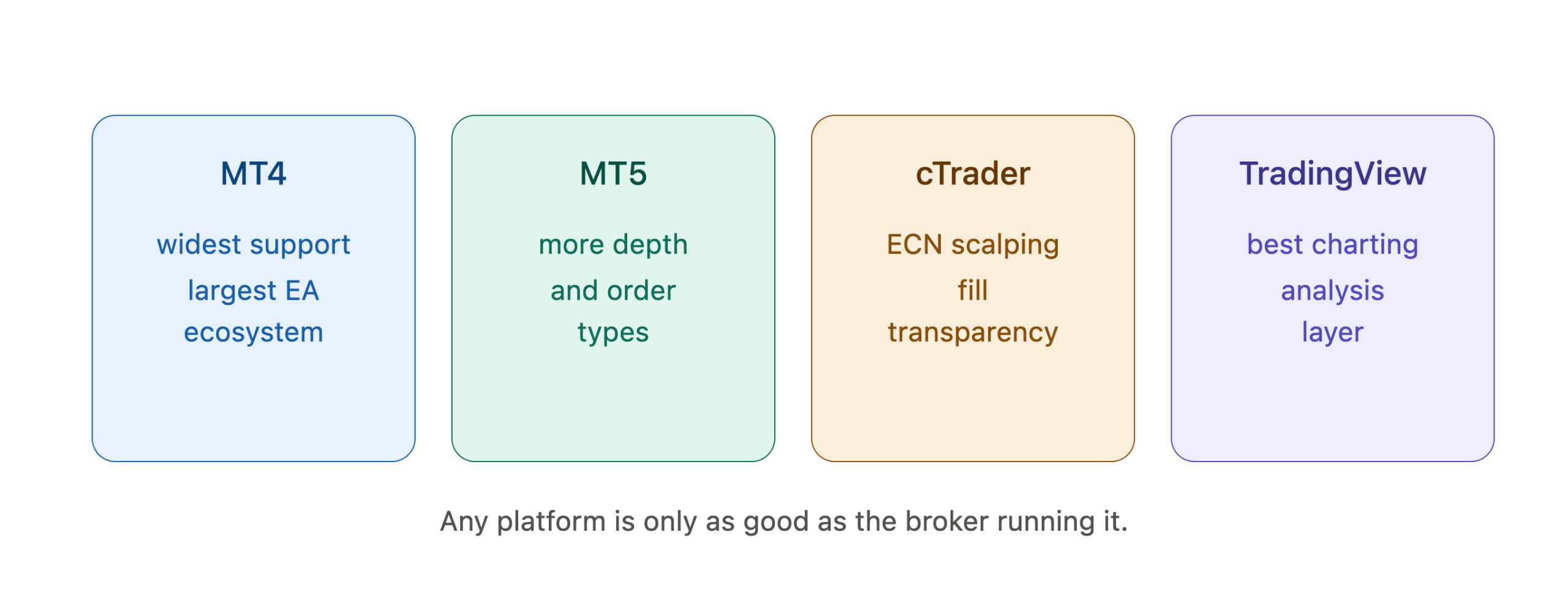
Here is a direct comparison of the four platforms most commonly used by forex day traders, rated on execution model support, automation capability, charting quality, and broker availability.
| Platform | Best For | Automation | Broker Availability | Charting | Execution Model Support |
|---|---|---|---|---|---|
| MT4 | Scalping, EA trading | Expert Advisors (MQL4) | Very wide | Good | Market maker, ECN, STP |
| MT5 | Intraday, multi-asset | Expert Advisors (MQL5) | Wide | Good | Market maker, ECN, STP |
| cTrader | ECN scalping | cBots (C#) | Moderate | Good | ECN and STP |
| TradingView | Analysis-heavy trading | Limited (Pine Script) | Growing | Excellent | Varies by broker |
MT4
The most widely used forex trading platform in the world. Released in 2005, it has been adopted by hundreds of brokers globally. Its ecosystem of free and paid EAs, custom indicators, and scripts has no equivalent in forex. For day traders, MT4 on an ECN broker with raw spreads remains one of the most capable and accessible setups available. Its interface has not changed significantly since launch, which some traders find limiting, but the core functionality handles most day trading strategies without issue.
MT5
The direct upgrade from MT4. It adds 21 timeframes, 6 pending order types, a depth of market window showing queued buy and sell orders at specific price levels, and faster backtesting. Traders who use multiple confluences before entering a trade or who want to see order book depth will find MT5 more analytically capable than MT4. MT5 EAs are written in MQL5 and are not compatible with MT4 systems, so traders with existing automated strategies need to account for migration costs before switching.
cTrader
Built from the ground up for ECN trading. It displays detailed Level 2 pricing and shows full fill information on every trade, including the exact fill price, volume, and whether partial fills occurred. Scalpers who need to understand precisely how their orders were handled will find cTrader more transparent than either MT platform. Fewer brokers support cTrader compared to MT4 or MT5, but the brokers that do tend to be ECN-focused, which is a meaningful filter in its own right.
TradingView
The best charting of any platform available to retail traders. For analysis and trade planning, it is genuinely ahead of the MT platforms. Its use as a direct execution platform depends on the broker integration, which varies widely. It works best as an analysis layer used alongside MT4 or MT5 for order execution. It is less suited to automated strategies or high-frequency scalping where execution consistency is critical.
MT4 vs MT5 for Forex Day Trading
Three practical factors determine whether a trader should be on MT4 or MT5.
- Broker support is the first check. Many brokers still lead with MT4 as their primary platform and offer MT5 as a second option. Some have moved to MT5 exclusively. Before committing to either, confirm which one the target broker supports and whether the account type needed is available on both.
- Existing tools are the second factor. MT4 and MT5 use different programming languages, MQL4 and MQL5 respectively. Indicators and EAs written for MT4 do not run on MT5 without modification. Traders who rely on specific third-party tools should check which platform those tools were written for before making a switch.
- Features needed is the third filter. MT4 handles everything most forex day traders need on major currency pairs. MT5 adds genuinely useful features for traders who want depth of market visibility, more pending order types, or more analytical timeframes. For traders starting fresh today, MT5 is the better long-term foundation because MetaQuotes continues to develop it actively while MT4 receives only maintenance updates.
Asia Forex Mentor covers both platforms in its free forex training and walks traders through platform setup as part of the full trading foundation. Understanding the environment you are executing in matters as much as the strategy you are running inside it.
Matching Your Platform to Your Trading Style
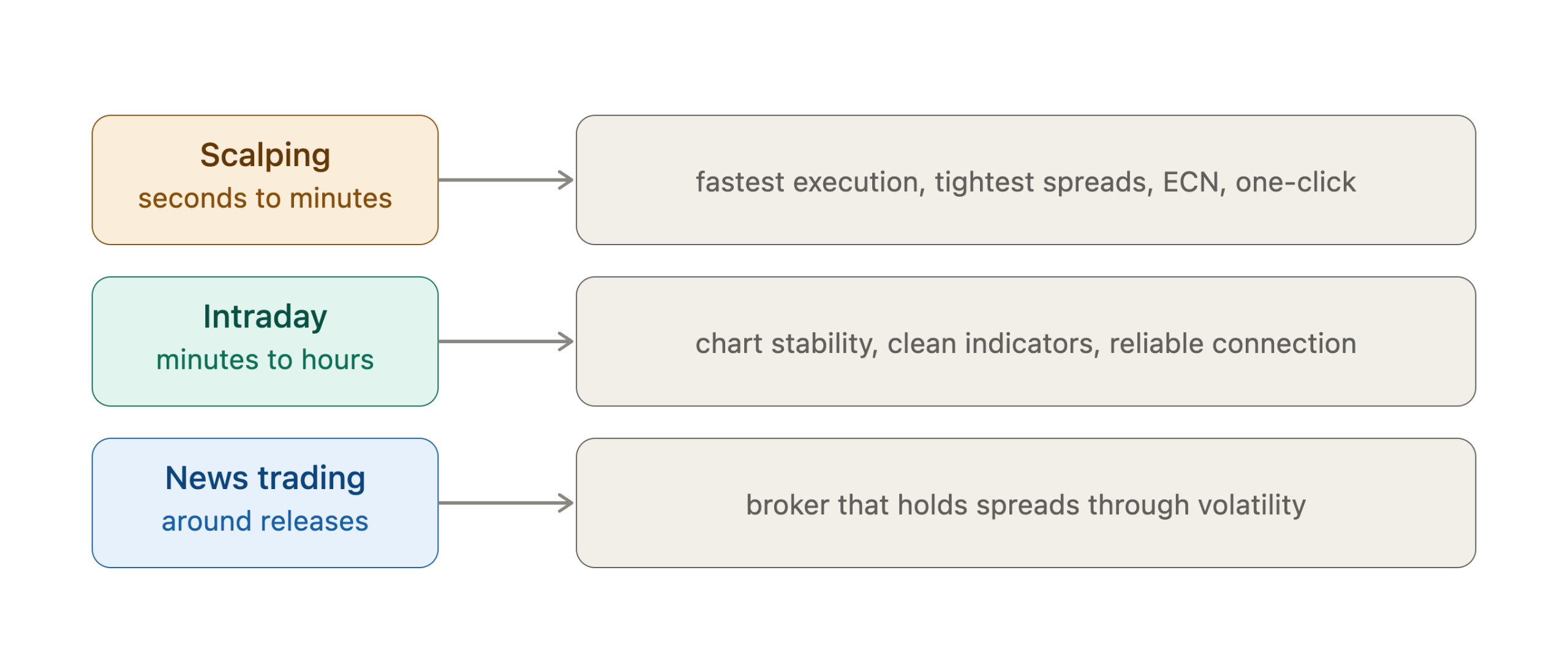
Different day trading styles place different demands on both the platform and the broker. Here is what each style requires.
The key platform requirements by trading style:
- Scalping needs the fastest execution available, tightest spreads, ECN access, and reliable one-click order placement
- Intraday trading needs chart stability, clean indicator performance, and a reliable connection more than millisecond-level execution speed
- News trading needs broker infrastructure that handles volatility without excessive spread widening, since platform choice is secondary to broker execution policy during events
Scalping
The most demanding style for execution quality. Scalpers hold trades for seconds to minutes and target 5 to 20 pips per trade. Every pip of slippage and every delay in execution directly affects results. cTrader on an ECN broker is the most common setup among experienced scalpers because of its fill transparency and low-latency order routing. MT4 on a raw-spread ECN account is also widely used. For scalpers, the broker choice is at least as important as the platform choice, since execution quality comes from the broker’s infrastructure.
Intraday Trading
This means holding positions for minutes to several hours. Execution speed matters but is less critical than for pure scalping. MT4 and MT5 are both fully capable. The factors that matter more for intraday traders are chart reliability, stable data feeds, and clean indicator performance. Traders who use multiple technical confluences before entering may find MT5’s additional analytical depth useful.
News Trading
This style means entering trades during or just around high-impact data releases. Spreads widen sharply at these moments and execution is under peak stress. No platform solves this problem on its own. Brokers with poor liquidity arrangements become nearly impossible to trade during major events. News traders must specifically evaluate broker execution policies during event windows and test live behavior under real news conditions before committing capital to the approach.
How to Choose a Broker for Forex Day Trading
The platform is only half the equation. Two traders can run the same MT4 installation and have completely different trading experiences based solely on the broker behind it. Here is the broker selection process in order.
Step 1: Verify regulation. Check that the broker is regulated by a recognized authority. The main ones for forex are the FCA in the UK, ASIC in Australia, CySEC in Cyprus, and CFTC/NFA in the US. Regulated brokers hold client funds in segregated accounts and operate under formal dispute resolution procedures. Offshore brokers may offer fewer restrictions, but the counterparty risk is substantially higher.
Step 2: Check the execution model. Market makers take the other side of client trades and profit when clients lose. ECN and STP brokers pass orders to external liquidity providers and earn from commission or a small markup. For day traders and scalpers, ECN or STP execution removes the structural conflict of interest that market makers have built into their model.
Step 3: Run a demo first, then go live small. Demo accounts rarely replicate live execution conditions accurately. Slippage, spread widening, and requotes appear during live volatility in ways that demo accounts do not show. Run at least two weeks on demo, then open a small live account to verify that live fills match what the demo showed before scaling up.
Step 4: Check swap rates if you hold overnight. Day traders who close all positions before the daily rollover at 5pm New York time do not pay swap. Traders who sometimes hold overnight should check the swap rates on the pairs they trade most, as these costs accumulate on higher-volume positions.
Step 5: Evaluate deposit and withdrawal conditions. A broker that takes 10 business days to process a withdrawal is a real operational problem for an active trader. Check processing times, any applicable fees, and whether the broker supports payment methods that work for your region before depositing.
Common Mistakes When Choosing a Platform
Here is where most day traders go wrong when selecting a forex trading platform:
- Picking based on appearance or online reviews without testing a demo account first
- Treating platform and broker as the same decision when they are two separate choices
- Ignoring spread widening during news events and only checking spreads in quiet conditions
- Underestimating the real cost of switching platforms after building out a full indicator and EA setup
- Not accounting for leverage and position sizing discipline before going live
- Picking a platform based on how it looks in a video review without running a demo is the single most common mistake. A platform that looks polished on camera may have a slow data feed, unstable connection, or a broker behind it with poor execution. Two weeks on a demo account before depositing is a minimum standard. Testing on a small live account before scaling up is strongly recommended, since demo accounts do not replicate live execution under real market stress.
- Separating platform from broker is a mental model that new traders often skip. MT4 is free software that any broker can license and host. Two brokers can run the same MT4 installation and deliver completely different spreads and execution quality. Choosing MT4 or MT5 is necessary but not sufficient on its own. The broker behind the platform determines the actual trading experience.
- Spread widening during news events catches a lot of day traders by surprise. Platforms display the current spread, which may be 0.1 pip on EUR/USD in normal conditions. During a major data release, that spread can jump to 5 to 20 pips or more depending on the broker. Traders who build strategies around tight spread conditions need to either avoid trading during news windows or specifically find brokers with explicit policies to maintain spreads during events.
- Underestimating switching costs keeps traders on the wrong setup far longer than they should be. Moving from MT4 to cTrader, or from MT4 to MT5, means rebuilding chart templates, custom indicators, and automated systems from scratch. That switching cost is real, but staying on a suboptimal setup for years is more expensive. The right time to switch is when the evidence for a better setup is clear, not when it is convenient.
Also Read: What Is a Pip in Forex and Why It Matters
Conclusion
The best forex day trading platform is not a single answer. It is the combination of the right software and a broker that can actually deliver on the execution quality that software promises.
MT4 is the most widely available platform with the largest ecosystem and the broadest broker support. MT5 is the smarter long-term choice for traders starting fresh, offering more timeframes, more order types, and active development from MetaQuotes. cTrader is the top pick for scalpers who need fast ECN fills and full execution transparency. TradingView is the best charting tool available, but works best as an analysis layer rather than a primary execution platform.
Spreads, execution quality, and total transaction cost are broker decisions, not platform ones. Getting both right at the same time is the job. Start on a demo, run it through real volatility conditions, open a small live account to verify fills, and scale up only after confirming that the setup performs the way you need it to.
Frequently Asked Questions
What is the best day trading platform for forex?
Most forex day traders choose MT4 and MT5, thanks to their broad broker support, established indicator and EA ecosystem, and automation capability. Scalpers who need fast ECN execution and fill transparency tend to pick cTrader. TradingView is best for analysis and charting but less suited to automated or high-frequency execution. The right choice depends on trading style and which brokers are available in the trader’s region.
Is MT4 or MT5 better for forex day trading?
MT5 is the more capable platform. It offers more timeframes, more pending order types, depth of market display, and faster backtesting than MT4. MT4 still has a larger library of existing indicators and EAs, and remains fully functional for day trading on major pairs. Traders starting fresh are generally better served by MT5. Traders with existing MT4 systems should weigh the tool migration cost against the MT5 features before switching.
What spreads should a forex day trader aim for?
On major pairs like EUR/USD, GBP/USD, and USD/JPY, competitive ECN brokers typically offer raw spreads between 0.0 and 0.3 pips with a per-lot commission. Zero-commission accounts bundle costs into a wider spread, usually between 0.6 and 1.2 pips on EUR/USD. Day traders at high trade frequency should calculate total cost per trade across both spread and commission rather than comparing headline spread numbers alone.
What execution model is best for forex day trading?
ECN and STP brokers pass orders directly to liquidity providers and do not take the other side of client trades. Market makers take the opposite position and profit when clients lose. For day traders and scalpers, ECN or STP execution removes the structural conflict of interest and typically produces faster fills and fewer requotes. Verifying whether a broker uses an ECN, STP, or market maker model is an important step before depositing.
What is execution speed and why does it matter for day trading?
Execution speed is the time between placing an order and receiving a confirmed fill. For scalpers targeting 5 to 20 pips per trade, even 200 milliseconds of extra latency can produce 2 to 5 pips of slippage, which flips a profitable trade into a losing one. ECN brokers with trading servers co-located near major liquidity centers in London or New York typically provide faster execution than market makers or brokers running on general-purpose cloud infrastructure.