English
 简体中文
简体中文 繁體中文
繁體中文 日本語
日本語 한국어
한국어 Bahasa Melayu
 Bahasa Indonesia
 Filipino
 ไทย
ไทย Tiếng Việt
 हिन्दी
 العربية
 Italiano
 Português
 Русский
 Español
 Français
 Singapore
 Cambodia
 Myanmar
 Brunei
 Australia
  New Zealand
 Switzerland
 UAE
UAE United States
 Mexico
 Argentina
 South Africa
 IC Markets
 Pepperstone
 AvaTrade
 XM
XM Plus500
 RoboForex
 TMGM
TMGM Exness
 JustMarkets
 Orbex
Orbex Interactive Brokers
 Saxo
Saxo Tiger Brokers
 Binance
 Coinbase
 Gemini Exchange
 Kraken
 iFunds
 IC Funded
 The 5%ers
 TopStep
 IQ Option
 Pocket Option
 RaceOption
 IQCent
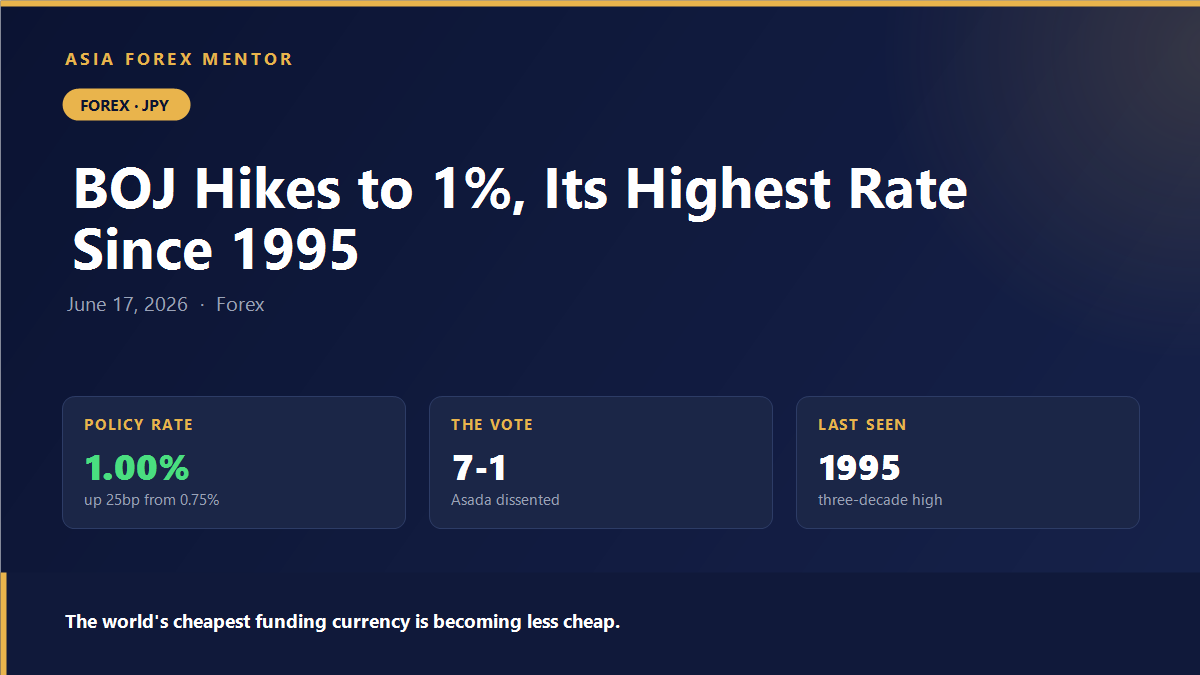
The Bank of Japan has raised its policy rate to 1% — the highest level since 1995 — and the reason it gave should interest every trader running a carry position.
The BOJ lifted the uncollateralised overnight call rate by 25 basis points from 0.75% on 16 June, in a 7–1 vote with board member Toichiro Asada dissenting in favour of a hold. It is the bank’s first hike since December, when it moved to 0.75%, and the first time in three decades that Japanese policy rates have reached 1%.
The cited justification was a weak yen and rising prices — and behind both sits the war in Iran.
Japan Is the Wrong Economy for an Oil Shock
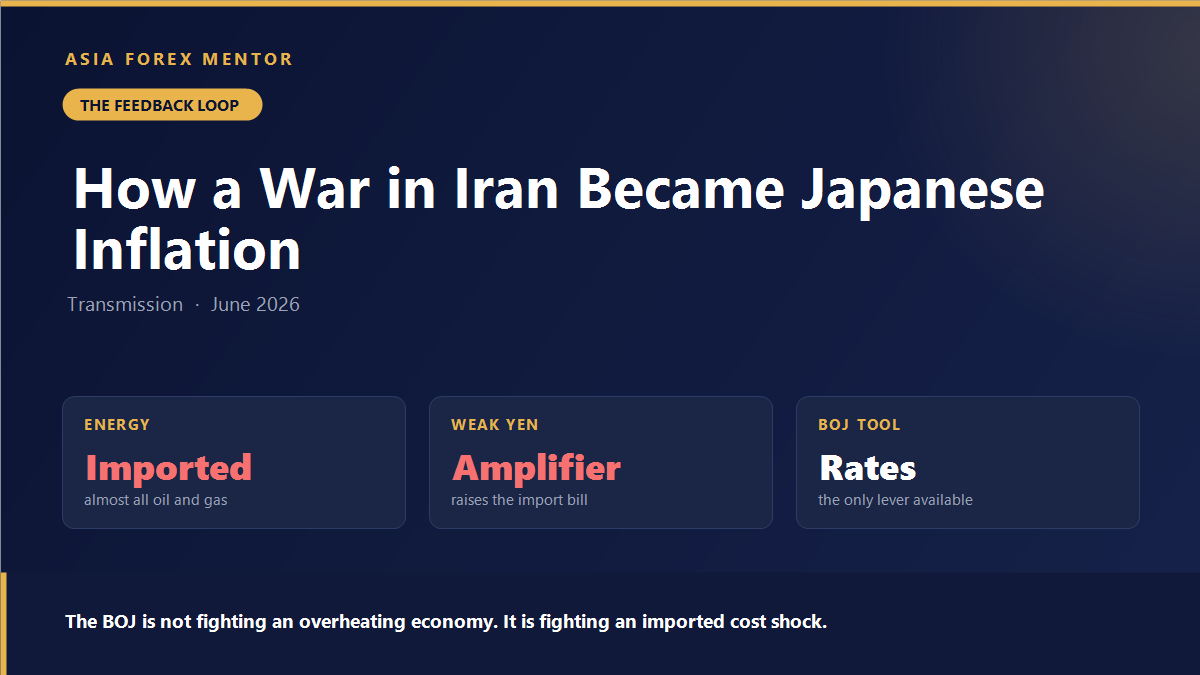
Japan imports almost all of its oil and gas. When Brent trades above $120 and the Strait of Hormuz is contested, Japan does not experience a commodity story — it experiences an import bill.
That transmits into inflation with unusual directness, and it does so through a currency that has been persistently weak. A weak yen makes dollar-denominated energy more expensive in local terms, which pushes inflation higher, which pressures the BOJ to tighten, which is the only tool it has to support the currency. Each part of that loop reinforces the next.
This is why the BOJ moved despite a domestic demand picture that would not, on its own, justify tightening. The bank is not fighting an overheating economy. It is fighting an imported cost shock amplified by its own currency.
Thirty Years of Context
It is difficult to overstate how unusual a 1% Japanese policy rate is. Rates have not been at this level since 1995. An entire generation of market participants has operated under the assumption that Japanese funding is effectively free and will remain so.
That assumption built one of the largest and most persistent trades in global finance: the yen carry trade. Borrow yen at near zero, convert to a higher-yielding currency, collect the differential. It has funded positions in everything from US Treasuries to emerging market debt to, at the margin, risk assets generally.
A 1% funding rate does not end that trade. But it changes its arithmetic, and it establishes a direction of travel. The BOJ has now hiked twice in roughly six months after years of immobility.
Why the Move Was Muted
The yen’s reaction was smaller than the headline suggests, and the reason is positioning.
Speculators had built long yen exposure well ahead of the announcement. When a hike is widely anticipated, the buying happens before the event, and the decision itself produces little follow-through — the classic pattern of a market that bought the rumour and had nothing left to do on the news.
Traders should be careful not to read that muted response as evidence the hike does not matter. Positioning explains the day. The funding cost change persists long after the positioning clears.
The Divergence That Defines the Second Half
Two central banks are now moving in the same hawkish direction for different reasons, and the interaction is what matters.
The Federal Reserve, under newly installed chair Kevin Warsh, has seen rate-cut expectations for 2026 and 2027 collapse, with traders pricing better than a 70% chance of at least one hike by year-end. The target range sits at 3.50%–3.75%.
The BOJ is at 1% and appears to have further to go.
If both tighten, the rate differential — the single largest driver of USD/JPY in recent years — may barely move. What changes instead is volatility, because two active central banks produce twice as many repricing events as one.
For carry traders, this is the difficult configuration: the funding leg is getting more expensive while the currency you are short is getting stronger, and the differential that justified the trade is not necessarily widening to compensate.
Practical Notes for Traders
Carry unwinds are not orderly. They are position liquidations, and liquidations are violent by nature. Historical yen carry unwinds have produced multi-figure moves in days.
Watch intervention risk alongside rate risk. A finance ministry concerned about currency weakness has tools beyond monetary policy, and their use is not scheduled or announced.
A muted reaction to a hike is a positioning signal. It tells you the market was already long. That is useful information about the next move, not evidence the hike was irrelevant.
Japanese market holidays matter. Liquidity in yen crosses thins substantially during them, and thin liquidity magnifies whatever move arrives.
For traders working yen crosses through this period, our forex trading guides cover managing exposure around central bank events.
The Bottom Line
A 1% Japanese policy rate is the highest in three decades, driven by an energy shock the country is structurally exposed to. The immediate currency reaction was muted by positioning. The durable consequence is that the world’s cheapest funding currency is becoming less cheap — and that reprices a great deal more than USD/JPY.
Figures cited are as of 17 June 2026. Market data moves quickly; verify current levels before trading. This article is general information, not personal financial advice.