English
 简体中文
简体中文 繁體中文
繁體中文 日本語
日本語 한국어
한국어 Bahasa Melayu
 Bahasa Indonesia
 Filipino
 ไทย
ไทย Tiếng Việt
 हिन्दी
 العربية
 Italiano
 Português
 Русский
 Español
 Français
 Singapore
 Cambodia
 Myanmar
 Brunei
 Australia
  New Zealand
 Switzerland
 UAE
UAE United States
 Mexico
 Argentina
 South Africa
 IC Markets
 Pepperstone
 AvaTrade
 XM
XM Plus500
 RoboForex
 TMGM
TMGM Exness
 JustMarkets
 Orbex
Orbex Interactive Brokers
 Saxo
Saxo Tiger Brokers
 Binance
 Coinbase
 Gemini Exchange
 Kraken
 iFunds
 IC Funded
 The 5%ers
 TopStep
 IQ Option
 Pocket Option
 RaceOption
 IQCent
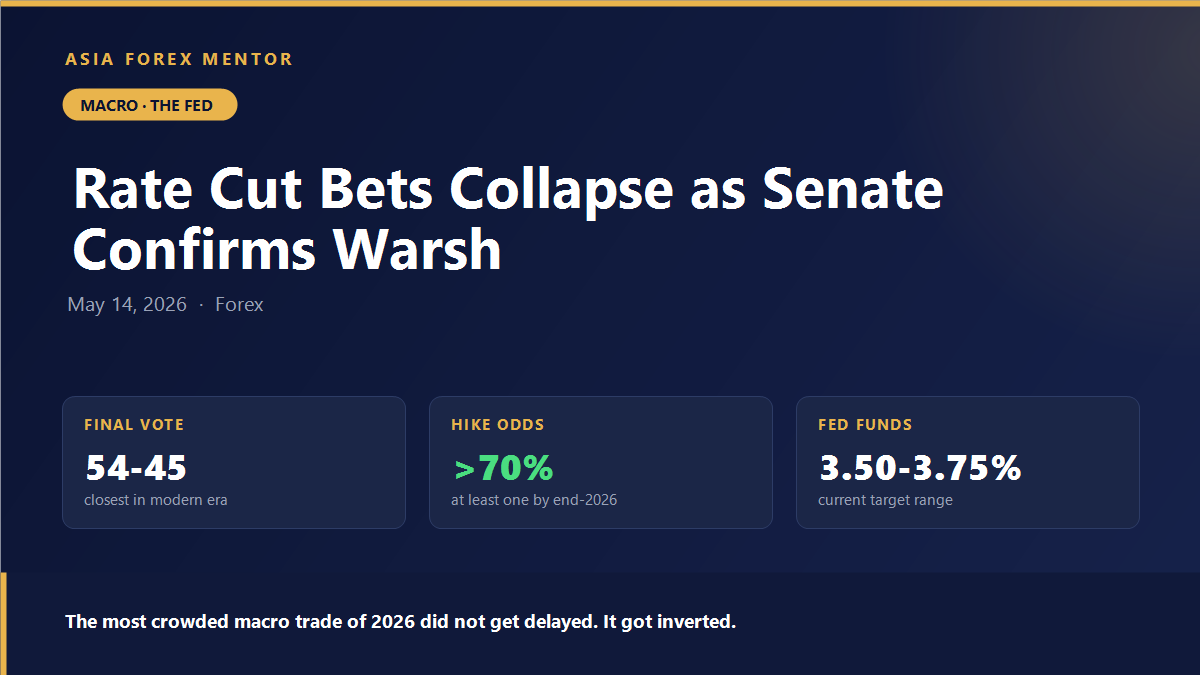
The Senate has confirmed Kevin Warsh as the next Chair of the Federal Reserve, and the rates market has already told you what it thinks that means.
Warsh was confirmed as a member of the Board of Governors on 12 May and as Chairman on 13 May, following a cloture vote of 49–44. The final confirmation vote of 54–45 was the closest for a Fed chair in the modern era. He was nominated by President Trump on 4 March, and will take the oath of office later this month, succeeding Jerome Powell.
The market reaction was immediate and one-directional: odds of a Fed rate cut in 2026 and 2027 collapsed, and rate traders moved to price a greater than 70% chance of at least one rate hike by the end of 2026. The target range currently stands at 3.50%–3.75%.
Why Markets Read Warsh as Hawkish
Warsh’s record is well known to anyone who followed the Fed after the financial crisis. He served as a governor from 2006 to 2011 and was consistently among the most sceptical voices on the committee regarding extended asset purchases and prolonged accommodation. He has spent much of the period since arguing that the Fed’s balance sheet grew too large and that the institution has been too willing to support asset prices.
That history matters more than usual right now because of what he inherits. The Iran conflict has pushed Brent crude to crisis highs above $126, and the resulting energy shock is working its way through global supply chains into core inflation. A chair with a documented preference for defending price stability, arriving precisely as an inflation impulse builds, is a straightforwardly hawkish combination.
Markets did not need guidance to work this out. The rate curve repriced on the appointment alone.
The Trade That Just Broke
The single most crowded macro position of early 2026 was the assumption that the Fed’s next move was a cut. That assumption underpinned a great deal of positioning across bonds, currencies and equities.
It is now gone. Not delayed — inverted. Going from pricing cuts to pricing a 70% chance of hikes inside a few months is one of the larger repricings a rates market delivers.
For traders, the important consequence is not the direction but the dispersion. When the market had a consensus view, volatility was low and carry strategies worked. With policy genuinely two-sided and a new chair whose reaction function nobody has observed in office, the range of plausible outcomes has widened considerably. Wider outcome ranges mean higher volatility, and higher volatility means smaller positions for the same risk.
What Nobody Knows Yet
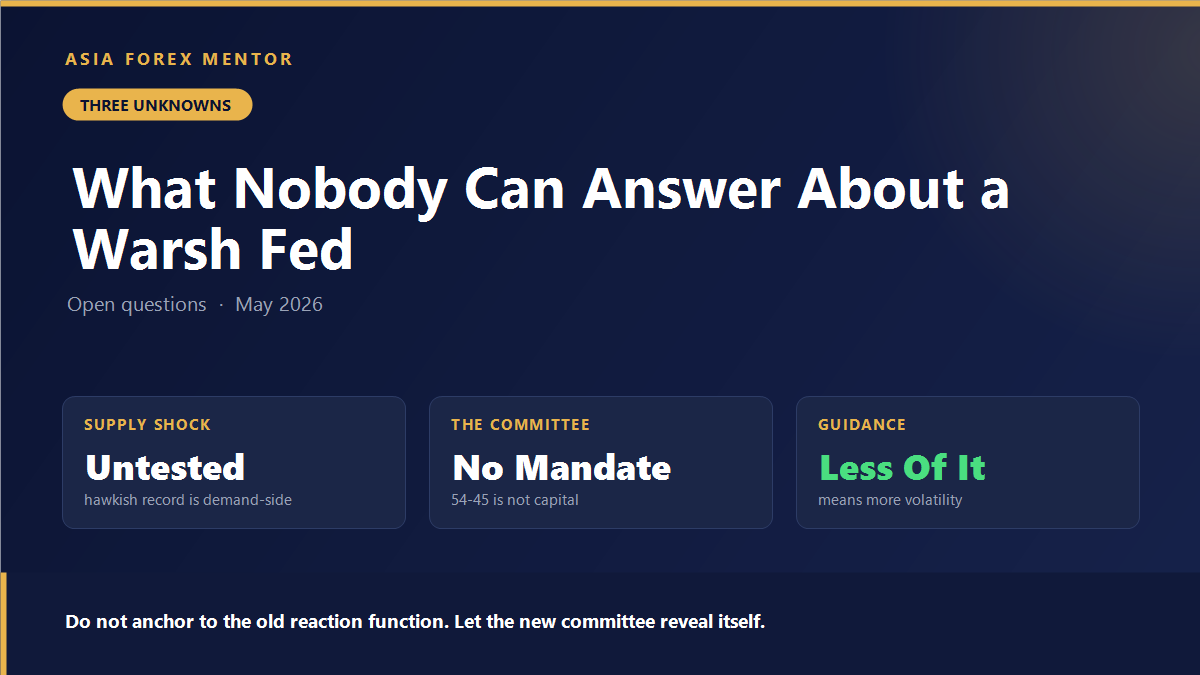
Three things remain genuinely unknown, and traders should resist pretending otherwise.
How Warsh handles a supply shock. His hawkishness is documented in the context of demand-driven inflation and asset bubbles. An energy shock is a different problem, where tightening does nothing to restore oil supply and simply tightens conditions onto a weakening economy. Whether he treats this as a case for looking through inflation or for defending credibility is the central open question.
How he manages the committee. A 54–45 confirmation is not a mandate. The FOMC votes, and a chair arriving with the narrowest confirmation margin in modern history has limited political capital for dissent-heavy decisions.
How he communicates. Warsh has been critical of the volume of Fed forward guidance. If he reduces it, markets lose a source of information they have relied on for over a decade — and less guidance mechanically produces more volatility around each meeting.
Trading a Regime Change
Do not anchor to the old reaction function. Models built on how Powell’s Fed responded to a given data print may not describe how this one does. Let the new committee reveal itself before assuming you know its rules.
The first meeting matters disproportionately. A new chair’s first FOMC is where the reaction function starts becoming observable. Expect elevated volatility around it regardless of the decision.
Rate differentials are moving. A Fed pricing hikes while other central banks sit still widens differentials in the dollar’s favour. The DXY has spent roughly ten months consolidating between 97 and 100 — that range is the level to watch.
Reduce carry exposure. Carry trades are short volatility by construction. A genuinely uncertain policy path is the environment where they are most likely to be hurt.
For traders reworking their approach to central bank events, our forex trading guides cover building a process that survives a policy regime change.
The Bottom Line
The confirmation of Kevin Warsh removes the assumption that underpinned most macro positioning this year. Markets have gone from expecting cuts to pricing a 70% chance of hikes, and they did it on the appointment rather than on data. The harder question — how a hawkish chair handles inflation caused by a war rather than by demand — will not be answered until he actually faces it.
Figures cited are as of 14 May 2026. Market data moves quickly; verify current levels before trading. This article is general information, not personal financial advice.