English
 简体中文
简体中文 繁體中文
繁體中文 日本語
日本語 한국어
한국어 Bahasa Melayu
 Bahasa Indonesia
 Filipino
 ไทย
ไทย Tiếng Việt
 हिन्दी
 العربية
 Italiano
 Português
 Русский
 Español
 Français
 Singapore
 Cambodia
 Myanmar
 Brunei
 Australia
  New Zealand
 Switzerland
 UAE
UAE United States
 Mexico
 Argentina
 South Africa
 IC Markets
 Pepperstone
 AvaTrade
 XM
XM Plus500
 RoboForex
 TMGM
TMGM Exness
 JustMarkets
 Orbex
Orbex Interactive Brokers
 Saxo
Saxo Tiger Brokers
 Binance
 Coinbase
 Gemini Exchange
 Kraken
 iFunds
 IC Funded
 The 5%ers
 TopStep
 IQ Option
 Pocket Option
 RaceOption
 IQCent
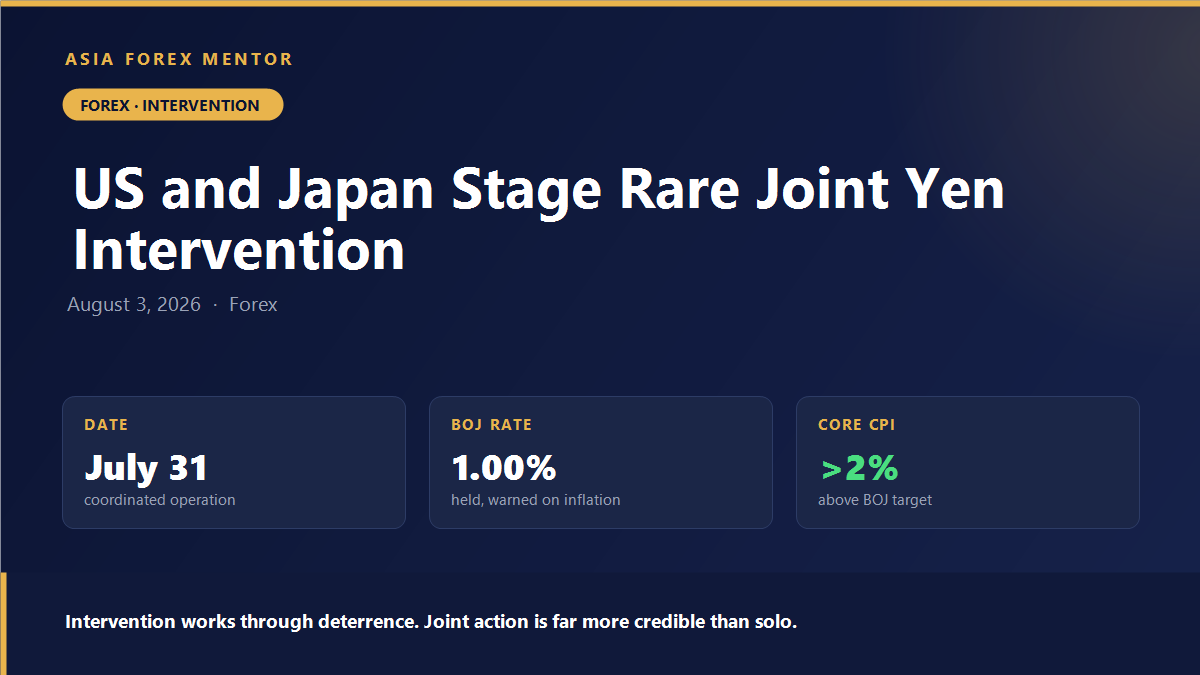
Japan intervened to support the yen on 31 July. The remarkable part is not that it happened — it is who helped.
The United States and Japan staged a joint intervention to support the Japanese currency on 31 July, the same day the Bank of Japan held its policy rate at 1% while warning that core inflation was running above its 2% target.
Coordinated currency intervention between Washington and Tokyo is rare. Understanding why it happened, and why it works differently from unilateral action, matters for anyone trading yen crosses for the rest of this year.
Why Joint Intervention Is Different
Japan has intervened alone many times, and the pattern is familiar: the Ministry of Finance sells dollars, the yen jumps several figures, and within weeks the currency drifts back to where it started. Markets treat unilateral intervention as a speed bump rather than a floor, because the fundamental driver — the interest rate differential — is untouched.
The United States has historically been reluctant to participate, and often quietly critical of it. A Treasury that has spent years pressing trading partners not to manage their currencies does not lightly join an operation to do exactly that.
Joint action changes the calculation in two ways. It signals that both governments regard the currency’s level as a shared problem, which removes the risk that Washington objects to further Japanese action. And it doubles the balance sheet a speculator is betting against.
Intervention works far more through deterrence than through flows. The credibility of the next operation is what constrains positioning, and a joint operation is considerably more credible than a solo one.
The Oil Connection
The reason this became urgent traces back to the Gulf.
Japan imports almost all of its oil and gas. With Brent crude at crisis highs above $126 and the Strait of Hormuz contested, Japan’s import bill has risen sharply. A weak yen makes those dollar-denominated imports more expensive still, which feeds domestic inflation, which is why the BOJ raised rates to 1% in June — its highest since 1995 — and why it is warning about core inflation now.
So the currency is not a standalone problem. It is the transmission channel through which a foreign war becomes Japanese inflation. That is why both monetary policy and the finance ministry are working the same objective, and why the US has an interest in the outcome: a disorderly yen would add another source of instability to an already stressed global system.
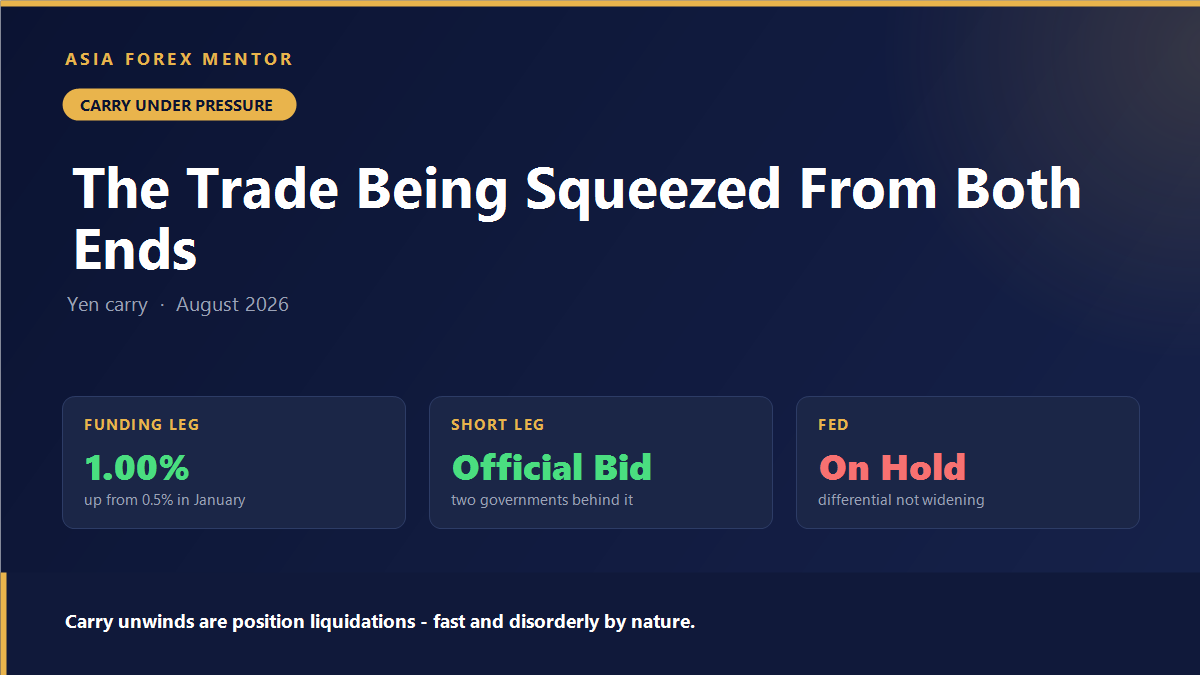
The Carry Trade Under Pressure From Both Ends
For years the yen has been the world’s funding currency. Borrow at effectively zero in Japan, buy something yielding more elsewhere, collect the difference. It is one of the largest persistent trades in global finance.
That trade is now being squeezed from both directions simultaneously. The funding cost has risen — the BOJ has hiked twice in roughly six months, reaching 1% from 0.5% at the start of the year. And the currency being shorted has an explicit, jointly-backed official bid beneath it.
Meanwhile the other leg has weakened. The Federal Reserve has held rates twice under Kevin Warsh, at 3.50%–3.75%, while a divided committee argues about whether to hike at all. A differential that was reliably widening in the dollar’s favour is now, at best, static.
This is the configuration in which carry trades unwind — and unwinds are position liquidations, which means they are fast and disorderly rather than gradual.
What to Watch
The differential, not the level. USD/JPY follows the rate gap. Both central banks are now active, which means the gap can move on either side’s news.
Liquidity windows. Intervention is most effective in thin markets, and authorities know it. Japanese public holidays and low-liquidity sessions are when the risk of a surprise operation is highest.
Official language. Japanese officials escalate through a well-worn vocabulary — “watching closely”, then “excessive moves”, then “will take decisive action”. The progression is a reasonably reliable warning sequence.
BOJ meeting dates. With the bank at 1% and warning on core inflation, each meeting is a live event rather than a formality.
Practical Notes for Traders
Intervention is a gap risk, not a stop-loss risk. Historical operations have moved USD/JPY multiple figures within minutes. A stop guarantees an order, not a price. Size on the assumption your fill is materially worse than your level.
Do not short a currency with an official bid under it, at size. The position can be right on fundamentals and still be unsurvivable through a single operation.
Check your broker’s behaviour in gap conditions. Slippage handling, margin treatment and spread widening vary considerably — our forex broker reviews cover execution conditions in detail.
Reduce carry exposure when volatility rises. Carry is short volatility by construction. Two active central banks and a live intervention threat is the wrong environment for it.
The Bottom Line
A joint US-Japan intervention is a materially stronger signal than Japan acting alone, and it arrives with the BOJ at a three-decade-high policy rate and warning on inflation. The yen carry trade is being squeezed on the funding leg, on the currency leg, and now by an official bid with two governments behind it. Positioning accordingly matters more than having a view on the level.
Figures cited are as of 3 August 2026. Market data moves quickly; verify current levels before trading. This article is general information, not personal financial advice.