Singapore
 Malaysia
 Indonesia
 Philippines
 Thailand
 Vietnam
 Cambodia
 Myanmar
 Brunei
 China
China Japan
Japan South Korea
 Taiwan
 India
India Australia
  New Zealand
 United Kingdom
 Switzerland
 Italy
Italy Spain
Spain UAE
UAE United States
 Mexico
 Argentina
 South Africa
 IC Markets
 Pepperstone
 AvaTrade
 XM
XM Plus500
 RoboForex
 TMGM
TMGM Exness
 JustMarkets
 Orbex
Orbex Interactive Brokers
 Saxo
Saxo Tiger Brokers
 Binance
 Coinbase
 Gemini Exchange
 Kraken
 iFunds
 IC Funded
 The 5%ers
 TopStep
 IQ Option
 Pocket Option
 RaceOption
 IQCent
Forex journaling rarely works because traders record trades instead of decisions. That one habit gap explains why most never find a repeatable edge.
Recording that EUR/USD moved 50 pips in your favor says nothing about whether the decision behind that trade was sound. A trade can lose money on a flawless execution. A trade can win money on a reckless one. Without a journal that captures the quality of the decision itself, the habit cannot teach anything that sticks.
|
ABOUT THIS GUIDE |
This guide covers what forex journaling actually involves beyond logging profit and loss. It walks through the 10-minute post-trade review process, the fields worth tracking, how to read patterns across dozens of trades, and why the habit compounds into a measurable edge over time. |
|
QUICK ANSWER |
Forex journaling is the practice of reviewing the decision behind each trade, not just the result. A complete entry captures the setup conditions, the trading plan, emotional state at entry, and whether the trade was executed correctly. Reviewed consistently across 30 to 50 trades, the habit reveals repeatable mistakes and high-probability patterns invisible trade by trade. |
What Forex Journaling Actually Is
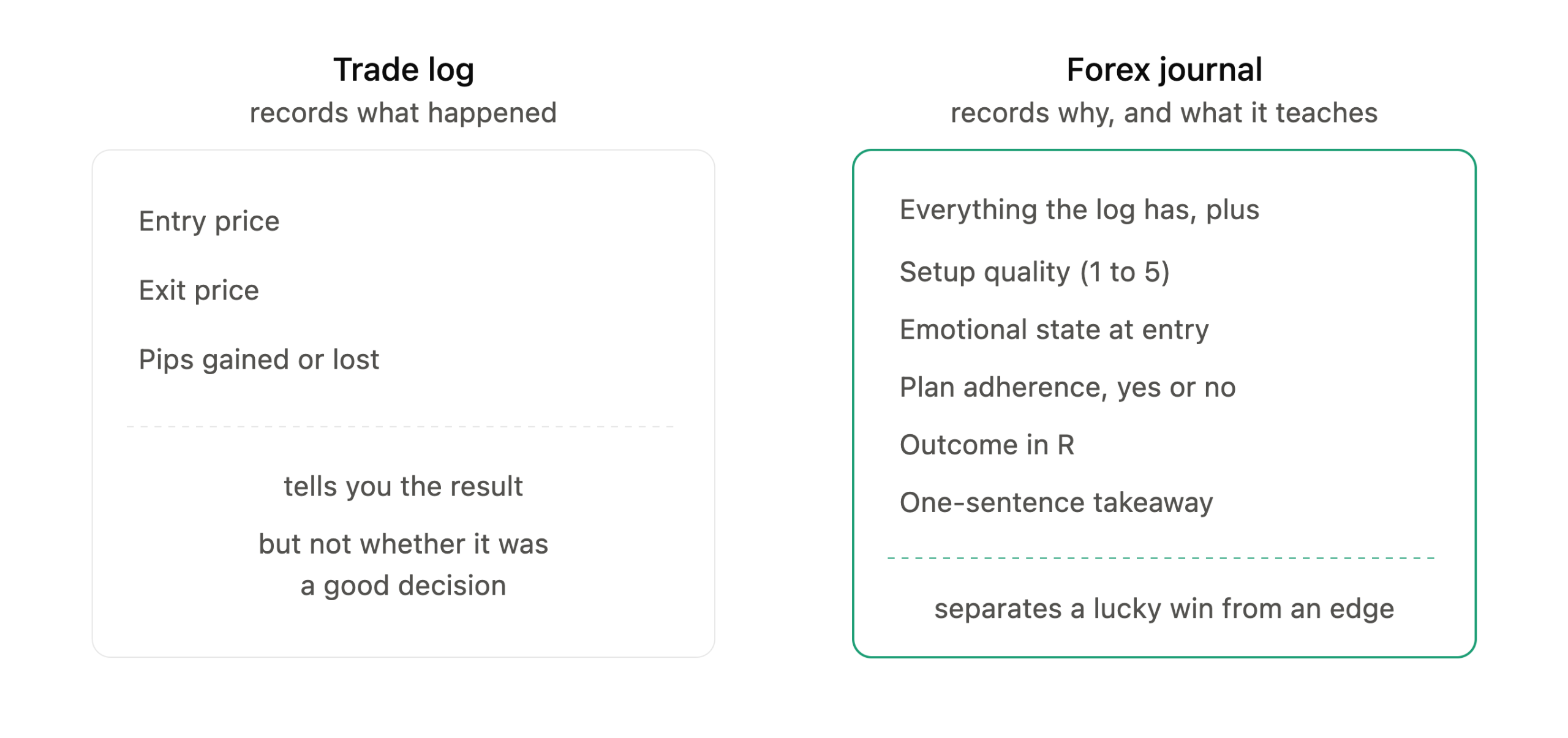
A trade log and a forex journal are not the same thing. A trade log records what happened. A forex journal records why a decision was made, whether it was the right decision given what was known at the time, and what can be learned from it.
Most traders picture a spreadsheet with columns for entry price, exit price, and pips gained or lost. That is a useful starting point, but it is not a journal. A complete forex journal captures the conditions, the reasoning, and the emotional state behind each position, not just the financial output.
The key distinction matters more than traders expect. After all, a profitable trade from a poor decision is still a poor decision, and it will lose money the next time the same conditions appear. A losing trade executed exactly to plan, on the other hand, is evidence the plan is sound. Without a journal that separates decision quality from outcome, traders simply cannot tell the difference between a lucky win and an edge-based one.
Forex journaling creates a feedback loop. Every trade contains information about how a trader reads setups, manages risk, and responds to pressure. The journal extracts that information so it can be reviewed and acted on.
Why Most Journals Fail Before They Pay Off
Most traders who start a forex trading journal quit within the first month. The habit rarely fails because journaling is a bad idea. It fails because of three specific and avoidable mistakes.
Reviewing results instead of decisions is the first mistake. A journal entry that starts with “I made 40 pips today” teaches nothing. The entry should start with whether the setup was valid and whether the plan was followed. Then check whether execution matched the original intention.
Delayed review kills the habit before it can compound. The emotional state at entry, the reasoning behind the stop placement, and the exact moment of hesitation are gone within hours. They cannot be reconstructed after the fact. The review must happen within ten minutes of closing the trade, while everything is still fresh.
Waiting for a losing streak to start journaling is the third mistake. By that point, the habit is associated with pain rather than learning. The habit pays off precisely because it is built during normal conditions and applied consistently, not triggered by emergencies.
The 10-Minute Post-Trade Review
Ten minutes is enough time to capture everything a journal needs. The review should happen immediately after closing a position, before looking at new setups or checking other pairs.
Follow these steps after every trade:
- Take a screenshot of the chart at close. Capture the chart at the timeframe used for the entry decision, with entry and exit points marked. Add a short annotation describing what the setup looked like before entry, not after.
- Write the setup in one sentence. Start by describing what the trade was based on. For example, “Price broke above the 1.0850 resistance level after a clean retest on H1, with H4 trend structure bullish.” One sentence forces clarity, so vague descriptions are a warning sign worth noting.
- Rate the setup quality from 1 to 5. Next, score the quality of the setup at the moment of entry, not based on how the trade turned out. A 5 is a textbook high-probability signal, while a 2 is a marginal trade taken out of impatience.
- Record the emotional state. One or two words describing the mental state at entry. “Calm,” “impatient,” “recovering from a stop-out,” or “revenge trade” are all valid entries. This column becomes the most predictive field in the entire journal.
- Check plan adherence. Did the entry, stop loss, and profit target match the pre-trade plan exactly? Record yes or no. If no, write what changed and why.
- Record the outcome in R. Express the result as a multiple of the amount risked. R is a standardized unit that allows direct comparison across trades of different sizes. A trade that risked 30 pips and gained 60 pips is a 2R win. A trade that risked 30 pips and lost 30 pips is a 1R loss. R removes position size and dollar amounts from the equation, so every trade becomes comparable.
- Write one takeaway in one sentence. What does this trade teach? “Entered 20 pips early because the setup looked close enough and patience was running low.” One sentence, actionable, not self-critical.
That is the complete review. Seven steps, ten minutes, done before anything else.
What a Forex Trading Journal Should Track
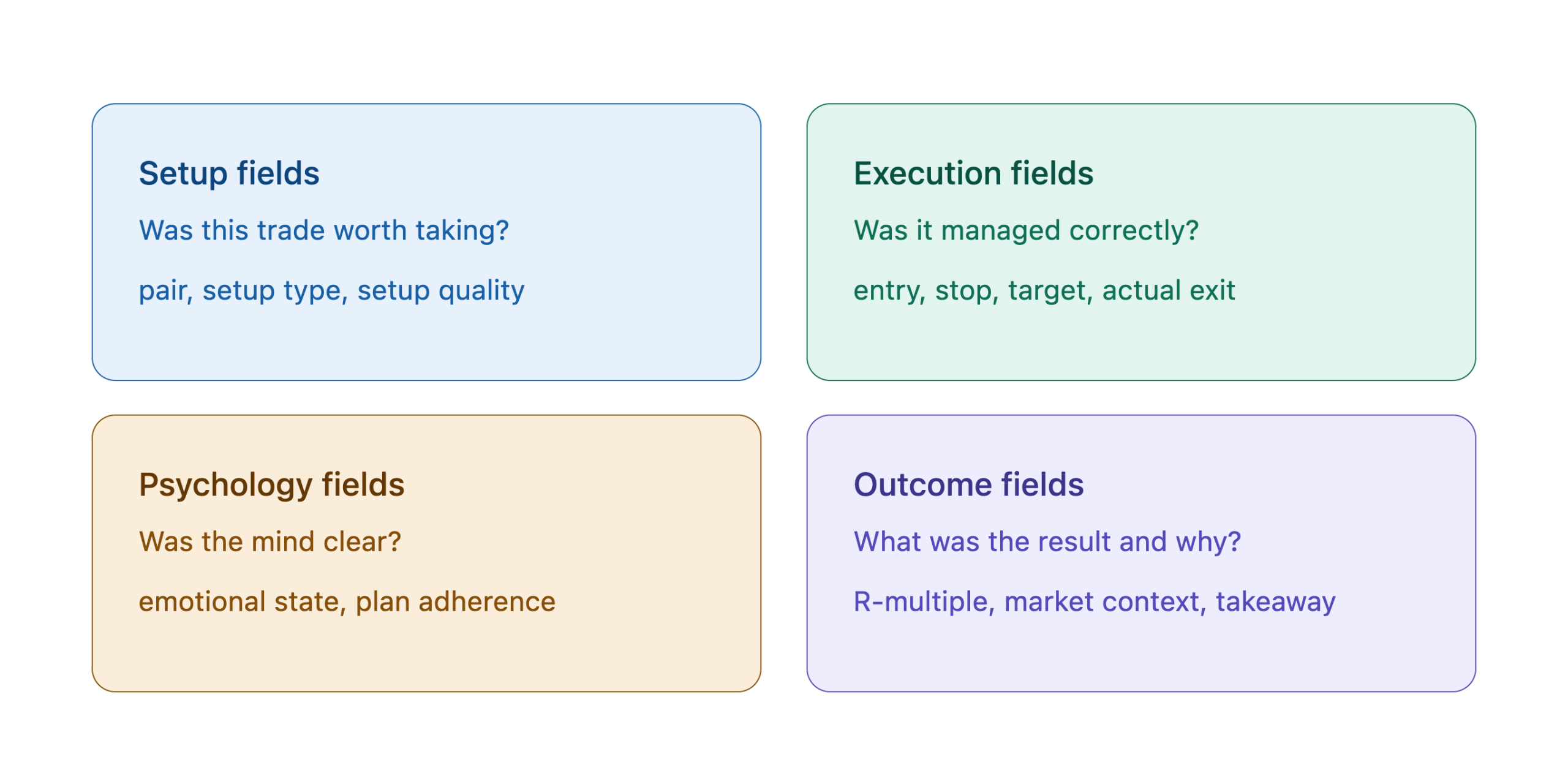
The fields in a forex trading journal fall into four categories. Each category answers a different question.
Here is how to think about each category before reviewing the specific fields to track:
- Setup fields answer whether the trade was worth taking.
- Execution fields answer whether the trade was managed correctly from entry to exit.
- Psychology fields answer whether the decision was made with a clear head.
- Outcome fields answer what the result was and what drove it.
The table below covers every field worth tracking, what to record in each one, and why it matters:
| Field | What to Record | Why It Matters |
|---|---|---|
| Date and session | Date, time, and trading session | Shows which sessions produce the best results |
| Pair | Currency pair traded | Reveals which pairs suit the trader’s edge |
| Setup type | Pattern, level, or signal used | Tracks win rate and R-multiple by setup type |
| Setup quality | Rating from 1 to 5 | Separates high-probability setups from marginal ones |
| Entry price | Exact entry level | Audits whether entries are disciplined or chased |
| Stop loss | Level and distance in pips from entry | Reveals whether stops are placed with logic or randomly |
| Profit target | Take profit level and R ratio | Confirms risk-reward was positive before entry |
| Actual exit | Price and reason for exit | Surfaces premature exits and overstaying |
| R-multiple | Gain or loss as multiple of risk | Standardized comparison across all trades |
| Emotional state | One or two words | Most predictive column for performance patterns |
| Plan adherence | Yes or no | Single most important column in the journal |
| Market context | News, trend direction, session | Explains outlier results |
| Takeaway | One sentence | Forces active learning from every trade |
For traders just starting out, the minimum viable journal captures five fields: pair, setup quality, R-multiple, emotional state, and plan adherence. A journal with these five fields, completed consistently, is worth more than a 20-column spreadsheet that never gets filled in.
Poor stop loss placement is one of the most common patterns that surfaces across journal entries. If it appears repeatedly, the issue is usually behavioral rather than technical.
The Forex Trading Journal Template
A working forex trading journal template does not need to be complex. A simple spreadsheet with the fields above is enough to start. The format matters far less than the consistency of use.
Here is a sample entry using the template structure:
- Date: 10 August 2026
- Pair: EUR/USD
- Session: London open
- Setup: Break and retest of 1.0920 resistance on H1, H4 trend bullish
- Setup quality: 4 out of 5
- Entry: 1.0924
- Stop loss: 1.0892 (32 pips)
- Profit target: 1.0988 (2R)
- Actual exit: 1.0974 (closed before NFP, 1.6R)
- R-multiple: Positive 1.6R
- Emotional state: Calm
- Plan adherence: Partial (early exit planned due to news risk)
- Takeaway: Early exit was justified by scheduled news, not fear. Correct decision.
A chart screenshot goes alongside this entry. Over time, the visual record becomes as valuable as the numbers. Patterns in setup structure become visible when dozens of screenshots are reviewed side by side.
Digital tools like Tradezella and TraderSync can automate some data fields by pulling trade records directly from broker accounts. The automated data handles the numbers. The setup rating, the emotional state entry, and the written takeaway cannot be automated. Those fields require active reflection after every trade, regardless of the platform.
How the Habit Compounds Over Time
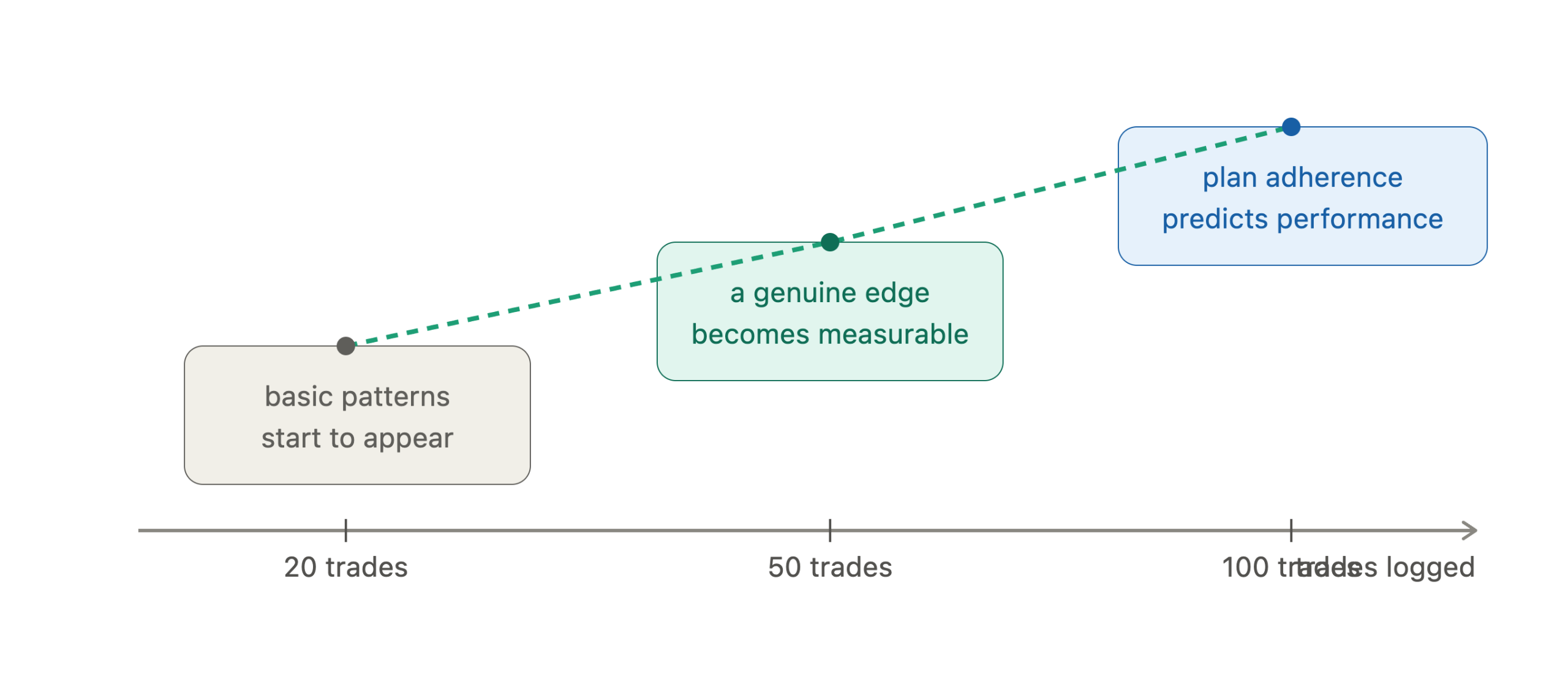
One journal entry teaches very little. Twenty entries begin to reveal patterns. Fifty entries reveal a genuine edge.
After 20 trades, a trader can begin to answer basic questions. Which setups produce the best R-multiples? Which sessions are most profitable? What does the emotional state column look like on the best trading days compared to the worst?
After 50 trades, the picture sharpens into something actionable. A trader who rates setup quality consistently will see a measurable gap between 4 and 5 rated trades and the 2 and 3 rated trades. If the higher-rated setups produce a positive R average while lower-rated trades drag results down, that finding is not random. It becomes a rule: take only A-grade setups and pass on the rest.
After 100 trades, the plan adherence data starts to predict financial performance in a way that changes behavior permanently. In fact, the worst trading periods almost always contain the highest rate of “partial” or “no” entries in the plan adherence column. In other words, behavioral data forecasts financial data, which is why the journal is the most powerful tool a trader can build over time.
Common Forex Journaling Mistakes
The mistakes that derail a forex journaling habit are rarely about the journal itself. They are about the expectations and behaviors traders bring to the process.
Here are the most common mistakes to avoid:
- Recording only profitable trades. A selective journal produces a distorted picture of actual performance. The losing trades, especially the avoidable ones, are where most of the learning lives.
- Reviewing outcomes instead of decisions. Starting each review with the financial result frames the session as a win or a loss rather than a learning event. Start with setup quality and plan adherence, then move to the result.
- Skipping the emotional state field. This column feels unrelated to technical analysis, but it is the most predictive field in the journal. Entries marked “revenge trade” or “forced entry” consistently cluster around the worst R-multiples. Recognizing patterns in FOMO trading behavior is essential context for reading this column accurately.
- Reviewing once a week instead of per session. Weekly reviews are useful for spotting longer-term patterns, but they do not replace the per-trade review. The emotional state and specific reasoning behind a decision disappear within hours of closing the trade.
- Using the journal to judge rather than describe. A takeaway that reads “I was an idiot again” is noise. A takeaway that reads “Entered without waiting for the candle close because I was afraid of missing the move” is actionable information. Description improves. Judgment does not.
- Quitting before the patterns appear. The compound effect of journaling does not show up in the first 20 trades. It surfaces in the patterns visible across 50 to 100 trades. Quitting at 30 entries means leaving before the habit has had a chance to teach anything of value.
A trader’s trading mindset determines how they interpret what the journal reveals. Traders who approach it as a criticism tool find reasons to stop. Traders who approach it as a data source find reasons to keep going.
How to Build a Review Habit That Sticks
Consistency matters far more than completeness. A brief five-field review done after every session is worth more than a comprehensive 20-field review done occasionally.
Four practical steps make the habit stick:
Step 1: Set a fixed review trigger. Run the post-trade review within ten minutes of closing the position. Attach it to the physical action of clicking the close button, not to a calendar reminder or end-of-day alarm.
Step 2: Start with five fields only. Begin with pair, setup quality, R-multiple, emotional state, and plan adherence. Add more detail only after the habit is consistent.
Step 3: Define a minimum, not a maximum. On slow trading days, one trade with a one-sentence takeaway is a complete entry. Raising the bar creates friction. Friction kills habits.
Step 4: Add a weekly pattern scan. Spend 15 minutes on Sunday reviewing the week’s entries. Look for repeated emotional states, repeated setup patterns, and repeated plan deviations. This weekly scan is where the compounding becomes visible.
Trading discipline separates traders who plateau from traders who keep improving. A forex trading journal is one of the clearest expressions of that discipline. It creates an honest record of decision quality that no amount of rationalizing can change.
Also Read: How to Recover From a Trading Losing Streak
Conclusion
Forex journaling is not about recording every detail of every trade. Instead, it is about building a ten-minute habit that turns raw trading experience into usable data. Over time, a journal that tracks setup quality, plan adherence, emotional state, and R-multiples across 50 or more trades reveals patterns that no amount of screen time alone can teach.
In the end, the traders who improve consistently are not the ones with the best strategies. Rather, they are the ones who review their decisions honestly enough to know which parts of their process work and which parts do not.
Frequently Asked Questions
What Is Forex Journaling?
Forex journaling is the practice of reviewing the decision-making process behind each trade, not just the financial result. At a minimum, a complete entry records the setup conditions, emotional state at entry, plan adherence, and outcome expressed as a multiple of risk. Done consistently across 30 to 50 trades, the habit then builds a feedback loop that reveals repeatable mistakes and genuine high-probability patterns.
What Should a Forex Trading Journal Template Include?
A minimum viable forex trading journal template should include the pair traded, the setup quality rating from 1 to 5, the R-multiple outcome, the emotional state at entry in one or two words, and whether the trade followed the plan. A chart screenshot and a one-sentence takeaway complete the entry. Additional fields like session, stop loss distance, and market context can be added once the basic five-field habit is consistent.
How Often Should a Forex Trading Journal Be Updated?
The journal should be updated after every trade, within ten minutes of closing the position. Same-session reviews capture the emotional state and reasoning behind each decision while they are still accurate. Weekly reviews are a useful supplement for spotting longer-term patterns, but they do not replace the per-trade habit. Anything delayed beyond the same session loses most of its value.
What Is the Most Important Thing to Track in a Trading Journal?
Plan adherence is the single most predictive column in a forex trading journal. Traders who track whether they followed their pre-trade plan consistently find that their worst periods cluster around the highest rate of deviations. This holds regardless of the raw number of losing trades. Decision quality forecasts financial results more reliably than any other metric in the journal.
How Long Before Forex Journaling Starts to Improve Results?
Most traders see meaningful patterns between 30 and 50 journal entries. Before 30 trades, the sample size is too small to draw reliable conclusions. Between 50 and 100 entries, patterns in setup type, emotional state, and session performance become clear enough to build new trading rules around. The habit requires patience, but the compounding effect is consistent across traders who stick with it.