Singapore
 Malaysia
 Indonesia
 Philippines
 Thailand
 Vietnam
 Cambodia
 Myanmar
 Brunei
 China
China Japan
Japan South Korea
 Taiwan
 India
India Australia
  New Zealand
 United Kingdom
 Switzerland
 Italy
Italy Spain
Spain UAE
UAE United States
 Mexico
 Argentina
 South Africa
 IC Markets
 Pepperstone
 AvaTrade
 XM
XM Plus500
 RoboForex
 TMGM
TMGM Exness
 JustMarkets
 Orbex
Orbex Interactive Brokers
 Saxo
Saxo Tiger Brokers
 Binance
 Coinbase
 Gemini Exchange
 Kraken
 iFunds
 IC Funded
 The 5%ers
 TopStep
 IQ Option
 Pocket Option
 RaceOption
 IQCent
Most traders lose with good forex trading techniques, not bad ones. They apply the right method at the wrong time, in the wrong market, against the wrong trend. The technique gets blamed, but the real failure is in the timing and the context. This guide covers the part that actually decides the outcome.
|
ABOUT THIS GUIDE |
This guide covers the core techniques professional traders use, then spends the bulk of its focus on the conditions that make a setup worth taking. If you want another list of techniques to memorize, there are hundreds of those available. This one focuses on how to apply them in live markets where context is everything. |
|
QUICK ANSWER |
The most effective forex trading techniques include trend following, support and resistance, candlestick signals, and breakout trading. None of them work reliably in isolation. A technique becomes a high-probability setup only when trend direction, key price levels, and current market conditions all align together. Context is what separates a professional entry from a low-probability guess. |
The Core Forex Trading Techniques Every Trader Should Know
Every professional trader works from a small set of core techniques. The list is not long. What separates an experienced trader from a beginner is not how many techniques they know but how precisely they apply each one.
The table below outlines the foundational forex trading techniques used across professional desks and retail accounts:
| Technique | What It Identifies | Best Market Phase |
|---|---|---|
| Trend Following | Dominant price direction | Trending markets |
| Support and Resistance | Key levels where price reacts | All conditions |
| Candlestick Patterns | Short-term sentiment and signals | Confirmation at key levels |
| Breakout Trading | Price moving past a significant level | Range breaks and news events |
| Fibonacci Retracement | Pullback zones within a trend | Trending markets |
| Moving Average Crossovers | Trend direction and momentum shifts | Medium to long timeframes |
| Price Action Patterns | Pin bars, inside bars, engulfing candles | Key levels in trending markets |
| Divergence Trading | Disagreement between price and momentum | Reversal identification |
Each technique has a defined job. Trend following identifies direction. Support and resistance identifies location. Candlestick patterns and divergence provide the confirming signal. A complete trade setup uses all three layers, not just one.
Understanding how to use Fibonacci retracement as a standalone skill is a starting point. Applying it at a major support level during a confirmed uptrend is where it becomes a high-probability setup. That distinction is what the rest of this guide focuses on.
Why Context Decides Whether a Technique Works
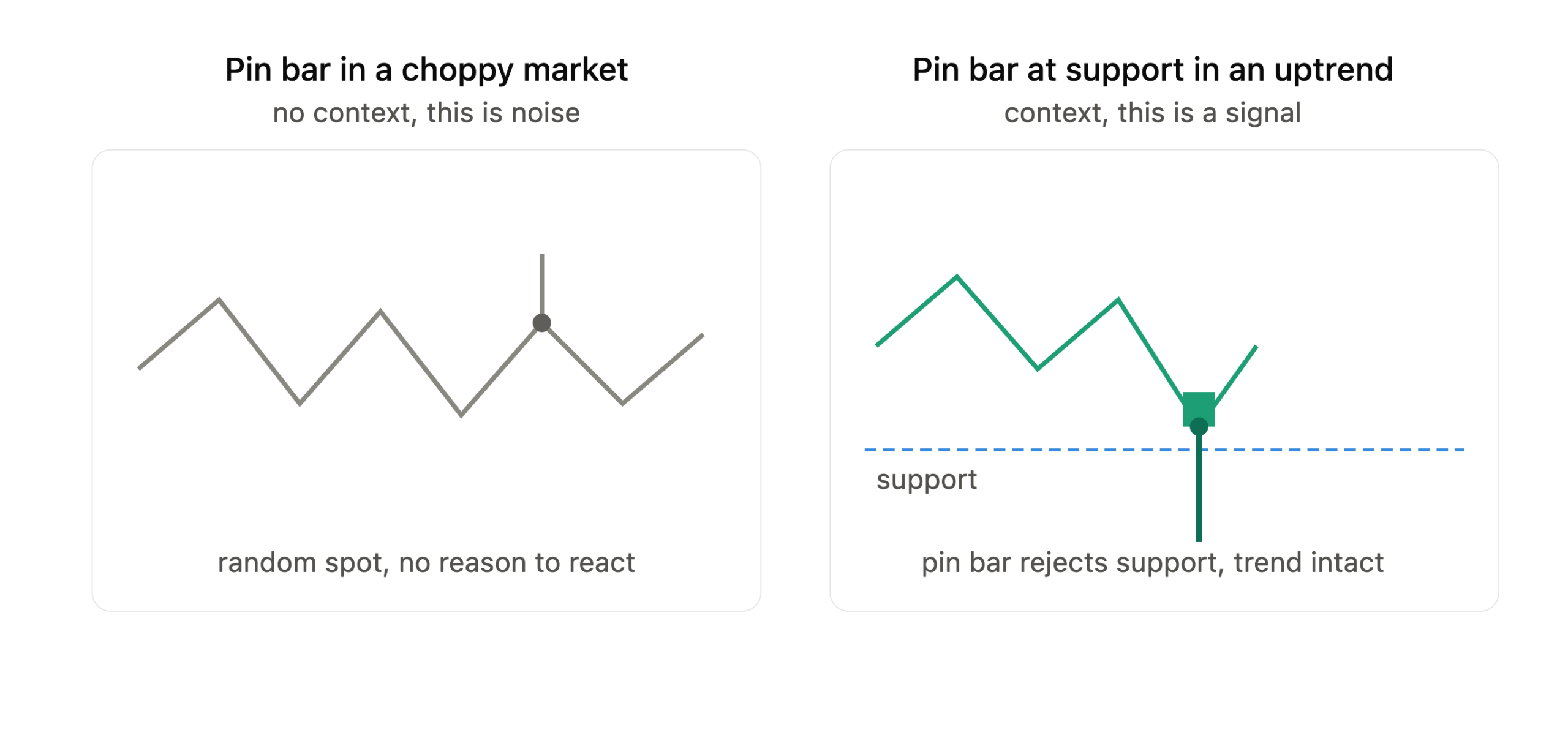
A pin bar at a random point in a choppy, sideways market is noise. The same pin bar at a major support level during a confirmed uptrend, with price pausing after a 70-pip pullback, is worth examining closely. The technique is identical. The context is completely different.
This gap separates traders who perform consistently from those who struggle. Most forex trading content explains what techniques look like. Very little explains the conditions that must exist before a technique is worth acting on.
Professional traders do not apply techniques mechanically. They ask a set of filter questions first. Where is the trend? What level is price sitting at? Is the market trending or consolidating? Is this an active session or a thin one? Only when those answers line up does a technique receive serious attention.
Asia Forex Mentor’s trading framework, developed across more than 20 years of institutional experience, centers on this filtering step. Traders who skip it treat every signal as equal. Traders who master it take fewer trades and connect with a far higher percentage of them.
Setup Conditions That Separate High-Probability Entries
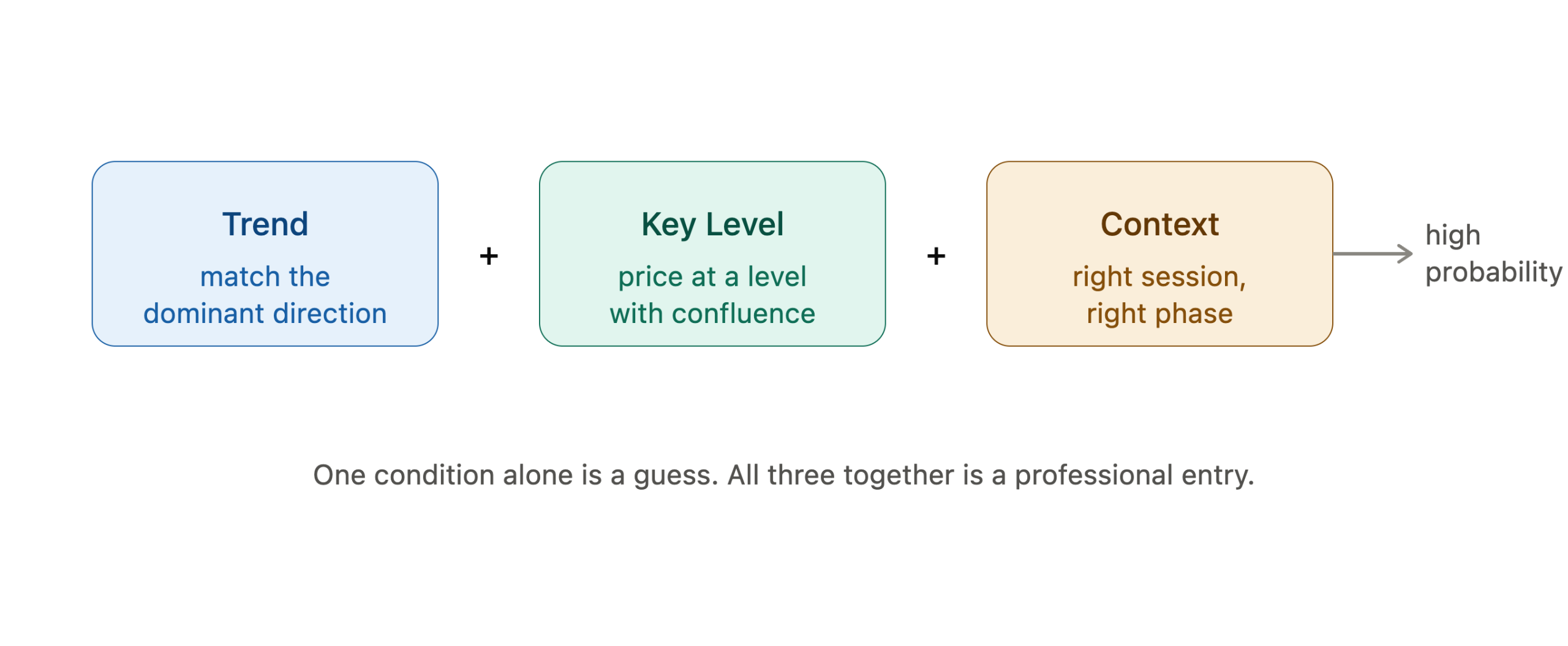
The conditions below form the professional filter. When multiple conditions align behind a technique, the probability of a valid setup increases meaningfully. When they are absent or conflicting, the same technique carries a low probability of success regardless of how clean the pattern looks.
Trend Direction and Alignment
The first check is always trend direction. A professional does not consider a short trade in a clear uptrend unless the context is exceptional. Trading with the dominant trend is not a preference. It is a probability filter that removes a large category of losing trades before they happen.
Trend direction should be confirmed on at least two time frames. The higher time frame (daily or weekly) sets the directional bias. The lower time frame (4-hour or 1-hour) identifies the specific entry zone. This process, known as multiple timeframe analysis , is one of the most reliable filters available to retail traders.
When the daily chart shows a strong uptrend and the 4-hour chart has pulled back to a level of interest, the conditions are aligning well. When the daily chart is trending up but the 4-hour chart shows a choppy reversal with no clear structure, the conditions are not aligned. The same technique produces entirely different results in each scenario.
Traders who take setups on a single time frame without checking the higher-level bias are working without directional context. That alone explains a large portion of losing trades taken on technically valid patterns.
Key Price Levels and Confluence
The second check is whether price is sitting at a meaningful level. Not every price point carries equal weight. The market reacts more reliably at levels where significant buying or selling has occurred before, and where multiple reference points overlap.
Here are the level types that carry the most weight in professional analysis:
- Major swing highs and lows that price has respected two or more times across multiple sessions
- Round numbers such as 1.1000 or 1.2500 in EUR/USD, which naturally attract institutional order flow
- Fibonacci levels drawn from a clear impulse move, particularly the 38.2%, 50%, and 61.8% retracement zones
- Previous week and month open or close prices, which serve as reference points for participants managing longer positions
- Daily and weekly support and resistance zones formed across multiple sessions with strong rejection candles
Confluence is where the real value appears. When a 61.8% Fibonacci level sits at the same price as a prior week’s low and a round number, that cluster is far more significant than any single level alone. A confirmed bearish candlestick signal at that cluster, inside a downtrend, is the type of condition professional traders look for in live markets.
Confluence does not guarantee a win. It increases the probability that the level will hold and that the signal reflects genuine market intention rather than random noise.
Market Context and Volatility
The third check is the current market environment. Not every trading day produces clean, tradeable conditions. Some sessions generate strong directional moves. Others produce compressed, choppy price action filled with false signals and erratic behavior.
Professional traders assess the following before committing to any technique:
- Session timing — the London and New York sessions generate the most reliable volume and directional flow. Setups during the Asian session or during holiday-thin markets carry meaningfully higher noise risk.
- Recent price structure — if price has been ranging between two levels across several sessions, breakout techniques may become relevant, but trend-following techniques almost certainly are not. The technique must match the current market phase.
- Spread and news risk — during major economic releases, spreads widen and price movement becomes erratic. Most experienced traders avoid entries in the 15 to 30 minutes surrounding scheduled high-impact events.
- Momentum or consolidation — a market moving with consistent, directional candles is in a trending phase. A market printing small, overlapping candles is consolidating. Momentum-based techniques belong in the first environment, not the second.
Ignoring market context is one of the most consistent reasons a valid technique produces a losing trade. The technique may be applied correctly. The environment simply makes success unlikely, regardless of how clean the chart setup looks.
How Professionals Filter Techniques in Live Markets
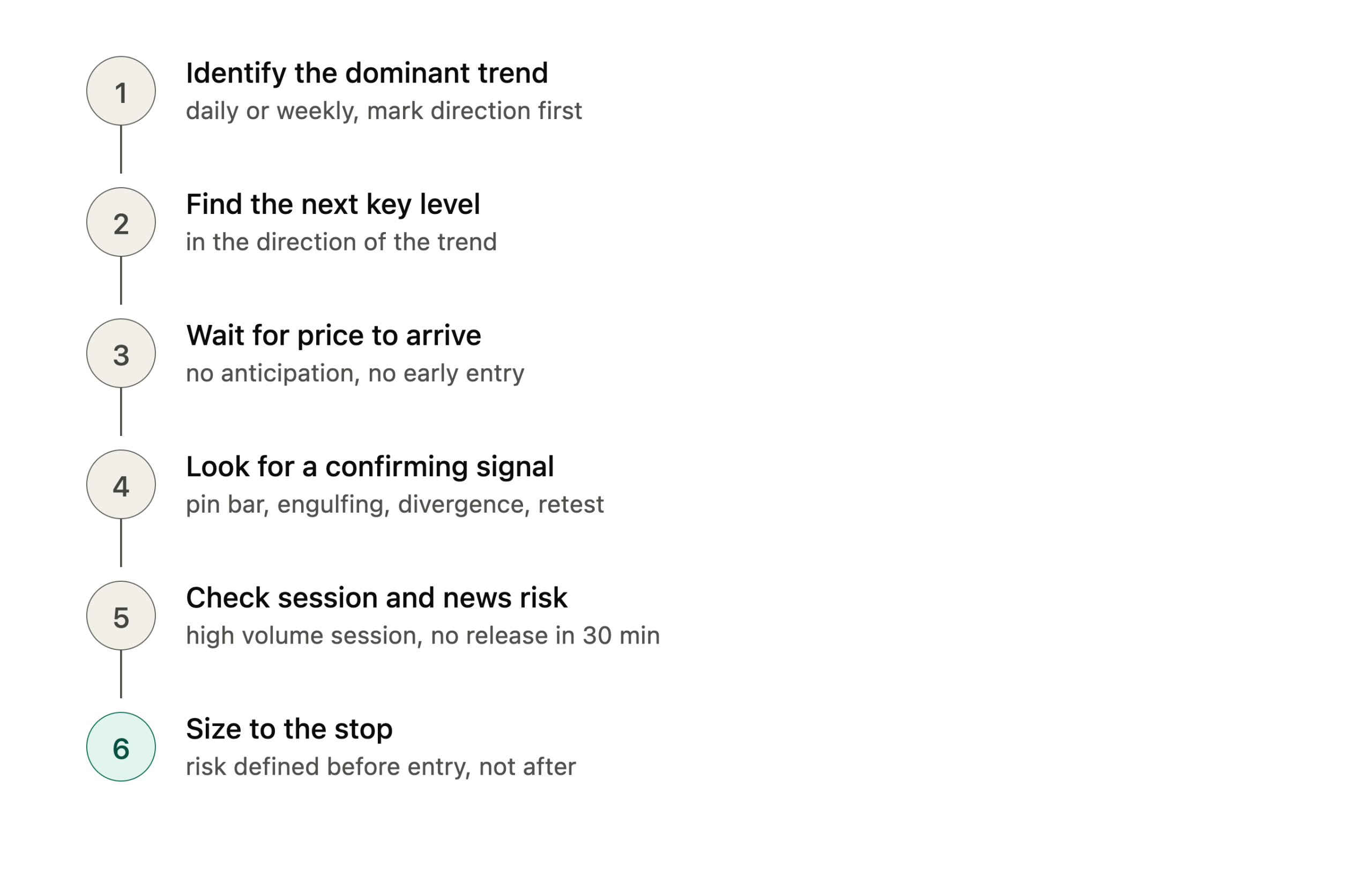
The professional approach is not to scan for a setup and then trade it. It is to define the required conditions first, then wait for price to arrive at those conditions on its own terms.
That is the core shift that separates consistent traders from the majority. The market is not short of signals. It is short of high-probability setups where all the required conditions are genuinely aligned at the same time.
Here is how the filtering process works in practice:
- Identify the dominant trend on the daily or weekly time frame. Mark the direction clearly before looking at any lower time frame.
- Identify the next key level in the direction of that trend. This is the zone where price is most likely to produce a meaningful reaction.
- Wait for price to reach that level. No anticipation. No early entry. Let price come to the setup, not the other way around.
- Look for a confirming technique signal at the level. A pin bar, an engulfing candle, a divergence signal, or a breakout retest, depending on which fits the current context.
- Check session and news risk. Is this a high-volume session? Is a major release scheduled in the next 30 minutes? Is the spread at its normal level?
- Size the position relative to the stop, not relative to a fixed lot number. The risk amount is defined before entry, not after.
This process eliminates most poor trades before they happen. The goal is not to find more setups. The goal is to take only the setups that meet every condition on the list, and to stand aside from everything else.
Traders who learn to read the market like a story, to understand the logic behind why price is at a particular level before entering, develop the judgment that this kind of filtering requires. That judgment cannot be reduced to a checklist alone. It comes from learning to see price behavior in context rather than as isolated patterns.
Confirmation and Timing
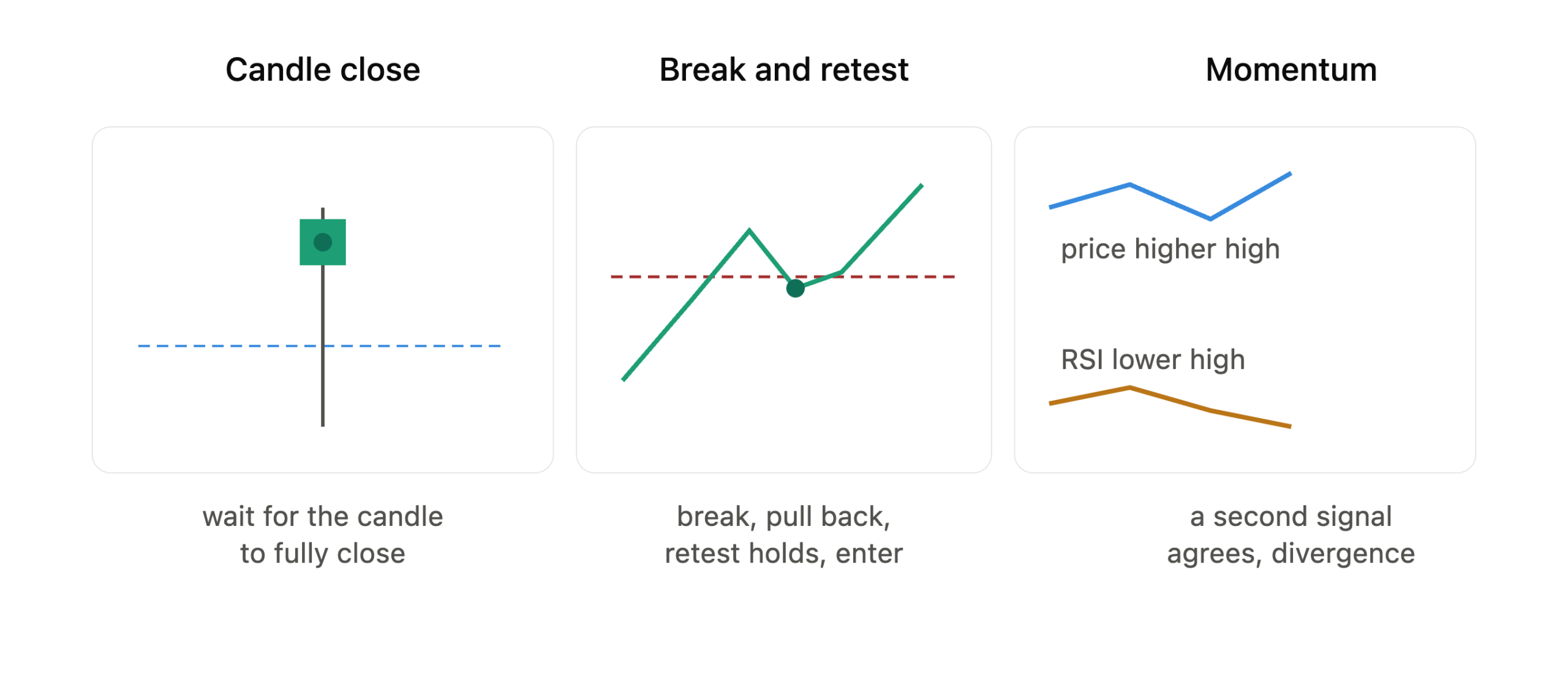
Identifying a potential setup and entering a trade are two different things. A number of traders get the setup right but enter too early, before the market has confirmed that the level is holding or the signal is real.
Confirmation means waiting for price to demonstrate its intention before capital is committed.
Candle close confirmation is the most common professional standard. Rather than entering the moment price touches a key level, the approach is to wait for the current candle to close. A pin bar that closes with a long lower wick and a small real body is a confirmed signal. A candle that is still forming with price mid-wick is a possibility, not a signal.
Break and retest confirmation applies to breakout setups. When price breaks above a resistance level, many traders enter immediately on the break. The more reliable entry is to wait for price to pull back and retest the broken level as new support, then enter once that retest candle closes bullishly. This approach removes a large portion of false breakout entries.
Momentum confirmation uses a secondary read to verify the signal. A bearish engulfing candle at resistance carries more weight when accompanied by a divergence signal on RSI or MACD, showing that momentum is already fading before price has visibly turned. Two independent signals pointing in the same direction are more reliable than one alone.
Waiting for confirmation costs a few pips on the entry price. It prevents considerably more losses on setups that looked right but would have reversed before the move completed. This connects directly to risk-reward ratio planning: tighter confirmation enables a tighter stop, which improves the ratio on every trade taken.
Timing also means knowing when not to act. If price reaches a key level five minutes before a major economic release, the correct decision is almost always to wait. The release may invalidate the setup entirely. Acting before it introduces a level of uncertainty that no technique or confirmation signal can account for.
Common Mistakes When Applying Forex Techniques
Most technique-related losses trace back to a small number of repeatable errors. Identifying them is the first step toward correcting them.
Here are the most common mistakes traders make when applying forex trading techniques:
- Trading against the dominant trend. Counter-trend setups require far more skill and much more specific conditions than most traders carry. A bearish setup in a confirmed uptrend needs multiple converging signals and a clear structural reason for reversal. Without those, it is a low-probability trade regardless of pattern quality.
- Forcing setups where none exist. Not every session produces a tradeable setup. When price is mid-range with no clear bias and no meaningful level in play, there is nothing worth taking. Entering because a pattern appears on the chart is a discipline failure, not a technique failure.
- Ignoring higher time frame context. A setup on the 15-minute chart that conflicts with the daily trend is low-probability no matter how clean the pattern. The higher time frame always sets the directional bias. Lower time frame setups only carry real weight when they align with the larger direction.
- Entering on signal alone without confirmation. A candlestick pattern is a reason to watch. The entry comes after the candle closes and the level holds. Entering mid-candle, before the signal is complete, is one of the most reliable ways to lose on a setup that was otherwise correct.
- Moving the stop loss before it is hit. Widening a stop on a trade moving against entry eliminates the math that made the setup worth taking. The stop is defined at entry and left there. The risk calculation is only valid when the stop stays where it was placed.
- Applying trending techniques in ranging markets. Trend-following setups fail consistently in sideways, choppy conditions. Before applying any momentum-based technique, the market structure must show consistent directional movement. Applying the wrong technique to the wrong market phase is a structural mismatch that timing adjustments cannot fix.
Most of these errors share the same cause: acting on impatience rather than conditions. The market does not reward activity. It rewards precise, well-timed execution on high-probability setups. Traders who apply a strict filter consistently outperform those who trade frequently without one, regardless of which specific techniques they use.
Also Read: Forex Trading Strategies: How to Build a Complete System
Conclusion
The forex trading techniques covered in this guide are not secrets. They appear in textbooks, free courses, and across every major financial education platform. What is not widely taught is the professional judgment to know when those techniques are worth acting on.
Learning to read the market like a story, to understand the context behind why price is where it is before committing to a direction, is what makes the difference. The techniques are tools. The filter is the skill.
Frequently Asked Questions
How Do I Know If a Forex Setup Is High Probability?
A high-probability forex setup has multiple conditions aligning at the same time. The trade direction matches the dominant trend. Price is sitting at a significant key level with confluence from multiple reference points. A confirmed candlestick or price action signal has appeared at that level. The session timing supports directional movement. When all of these are present together, the probability is substantially higher than when only one or two conditions are met.
Can Forex Trading Techniques Work in All Market Conditions?
No technique works equally well in all conditions. Trend-following techniques perform poorly in ranging or choppy markets. Mean-reversion and range-based techniques fail in strongly trending environments. Professional traders identify the current market phase first, then select the technique that matches that phase. Applying a trending technique in a sideways market is one of the most consistent ways to produce losing trades even from technically valid patterns.
What Is the Difference Between a Forex Trading Technique and a Forex Trading Strategy?
A technique is a specific method for identifying an entry or exit, such as a pin bar at a key level or a moving average crossover. A strategy is the complete framework that governs how to select markets, manage risk, size positions, and apply multiple techniques within a defined set of rules. Most traders need both, techniques to identify the setup and a strategy to manage the overall process consistently over time.
What Are the Most Effective Forex Trading Techniques for Beginners
The most effective techniques for beginners are support and resistance, trend following, and basic candlestick patterns such as the pin bar and engulfing candle. These build the foundation for reading price action without relying on complex indicators. Beginners should focus on applying one or two techniques consistently in the right conditions rather than collecting as many patterns as possible. Context matters more than the sophistication of the technique itself.
Why Do Most Traders Fail When Applying Forex Entry Techniques?
Most traders fail because they apply techniques without filtering for context. They see a pattern and enter, without checking trend direction, level significance, session timing, or waiting for candle close confirmation. This creates a low success rate regardless of how technically correct the pattern appears. The pattern is only as reliable as the conditions surrounding it, and ignoring those conditions turns any technique into a coin flip.